Podcasts Audiobooks GCSE Biology: Do They Help?
Podcasts audiobooks GCSE biology revision can reinforce knowledge, but active recall and exam questions matter. Learn to use audio effectively as a supplement.
Revision can look productive without producing much learning. A podcast plays for half an hour, the chapter sounds familiar, and you finish feeling as though something useful must have happened. But familiarity is not the same as being able to answer an exam question.
So, do podcasts audiobooks GCSE biology resources genuinely help? Yes, particularly for reviewing vocabulary, revisiting processes and making use of otherwise empty time. However, listening works best as a supplement. It should not replace active recall, specification-matched notes, practical knowledge or exam questions.
That distinction matters for students balancing Biology with GCSE maths. Audio can create extra revision time while walking or travelling, but your focused desk time should still include the tasks that require writing, calculation, interpretation and feedback.
The quick verdict
Use podcasts and audiobooks for GCSE Biology when you want to:
- preview a topic before learning it properly;
- revisit a process you have already studied;
- hear scientific vocabulary used in context;
- turn a journey or walk into light revision;
- identify gaps to investigate later;
- reduce screen time without abandoning revision.
Do not rely on audio alone when you need to:
- recall precise facts without prompts;
- interpret graphs, tables or biological diagrams;
- learn required practical methods;
- practise calculations and units;
- apply knowledge to unfamiliar situations;
- write answers using the language expected by mark schemes.
The strongest approach is simple: listen, pause, retrieve, check and apply.
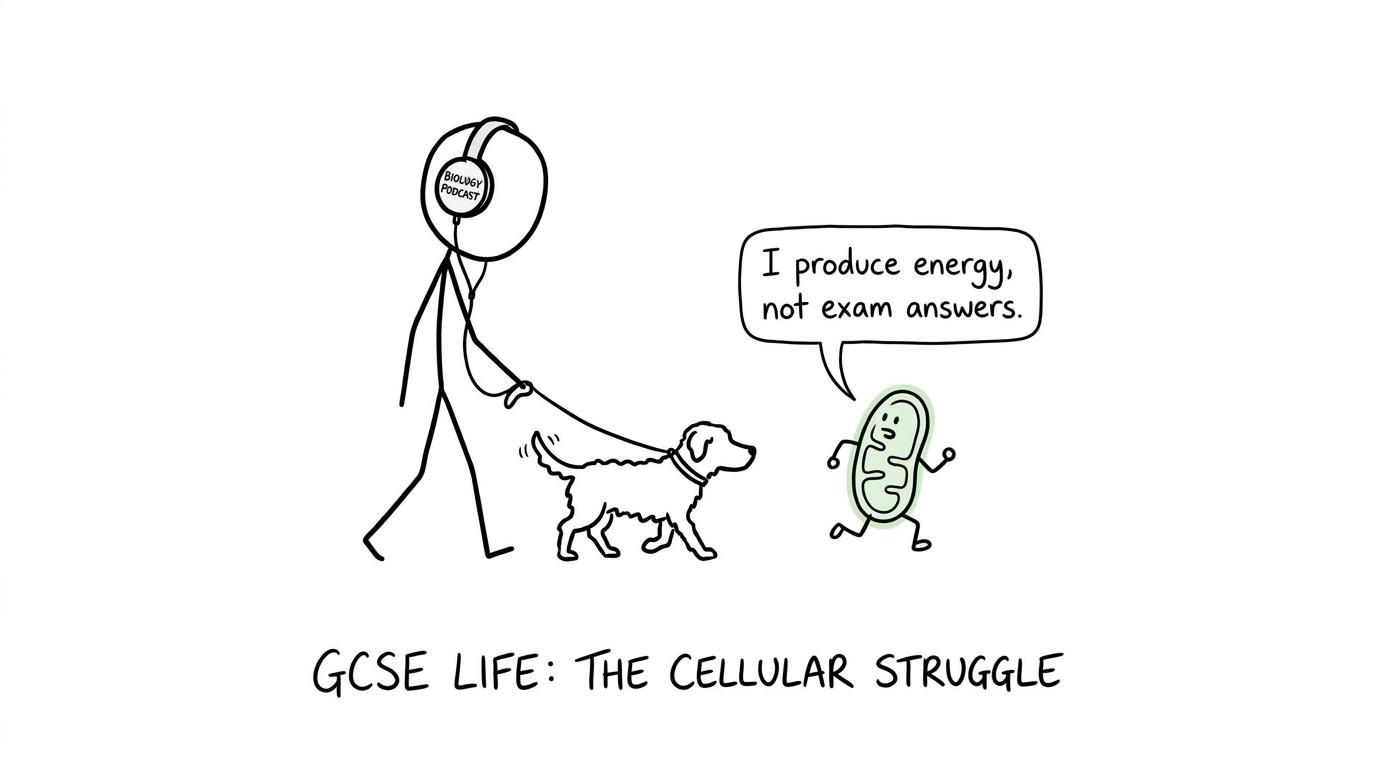 A student walking a dog while a mitochondrion questions the power of a biology podcast
What the evidence says about listening and learning
Research comparing listening with reading does not produce one universal winner. Studies have sometimes found similar comprehension across the two formats, while other research has found an advantage for self-paced reading, especially when material is technical or when listeners multitask.
That mixed picture is useful. It suggests that the format is only part of the story. The difficulty of the material, your level of attention and what you do afterwards all matter.
A clear explanation of respiration may be understandable as audio. A question asking you to interpret experimental data about respiration requires something more. You must select relevant knowledge, read the evidence, make connections and express a justified answer.
There is stronger and more consistent support for retrieval practice: actively trying to remember information rather than merely encountering it again. Classroom research indicates that retrieval can improve retention, particularly when it is repeated after a delay and followed by feedback. That is why replaying an episode is not automatically the best next step. Closing the app and recalling its main ideas may be more valuable.
This does not make listening pointless. It changes its job. Audio is often good for exposure and reinforcement; retrieval and exam practice are needed to turn that exposure into usable knowledge.
Why audio can help with GCSE Biology
It gives complicated processes a narrative
Biology contains sequences: substances move, conditions change and systems respond. A clear spoken explanation can make those relationships easier to follow than an isolated list of facts.
This is especially helpful when revisiting processes such as cell division, homeostasis, natural selection or the movement of substances. The voice provides pacing and emphasis, helping you notice which event causes the next.
However, the explanation should agree with your specification. A fascinating scientific podcast may go far beyond what Edexcel, AQA, OCR or Eduqas expects, while omitting the exact detail your course requires. Check episode content against your school’s specification or topic checklist.
It makes low-energy time useful
Not every minute has the same revision value. A quiet desk is suitable for difficult questions. A bus journey may not be.
Audio can occupy the second kind of time without stealing the first. Listening while travelling, tidying or taking a familiar walk can reinforce material you have already learnt. This is valuable because it creates additional contact with a topic rather than replacing focused practice.
The task alongside the audio should still be simple. If you are reading messages, playing a game or having a conversation, the podcast may become background noise.
It can expose weak understanding
Sometimes a topic feels secure because your notes are in front of you. Listening removes some of those visual prompts. If an explanation mentions osmosis and you cannot predict what comes next, you have found a useful gap.
Write down the topic rather than repeatedly rewinding. Return later with your notes, specification and questions. Revision improves when uncertainty becomes a next action.
Why listening cannot be your whole Biology strategy
GCSE Biology examinations do not assess recognition alone. Across exam boards, assessment includes demonstrating knowledge, applying it and analysing or evaluating information. Questions can draw together mathematical skills, practical methods and biological ideas.
Required or specified practical work is particularly important. For example, current GCSE Biology specifications assess practical understanding through written examinations, and at least 15%15\%15% of marks are allocated to practical skills. You may need to identify variables, interpret results, evaluate a method or suggest an improvement. Hearing someone describe a practical is helpful, but it does not fully rehearse those decisions.
Biology also includes visual and numerical information. You may encounter microscopy images, genetic diagrams, food webs, graphs, sampling data and rates. Audio cannot show you where a line changes gradient or whether a scale has been read correctly.
This resembles maths revision. Watching or hearing a method can begin the learning, but marks come from carrying it out independently. MathsGenie’s GCSE maths revision hub is organised around that movement from explanation to practice, rather than explanation alone.
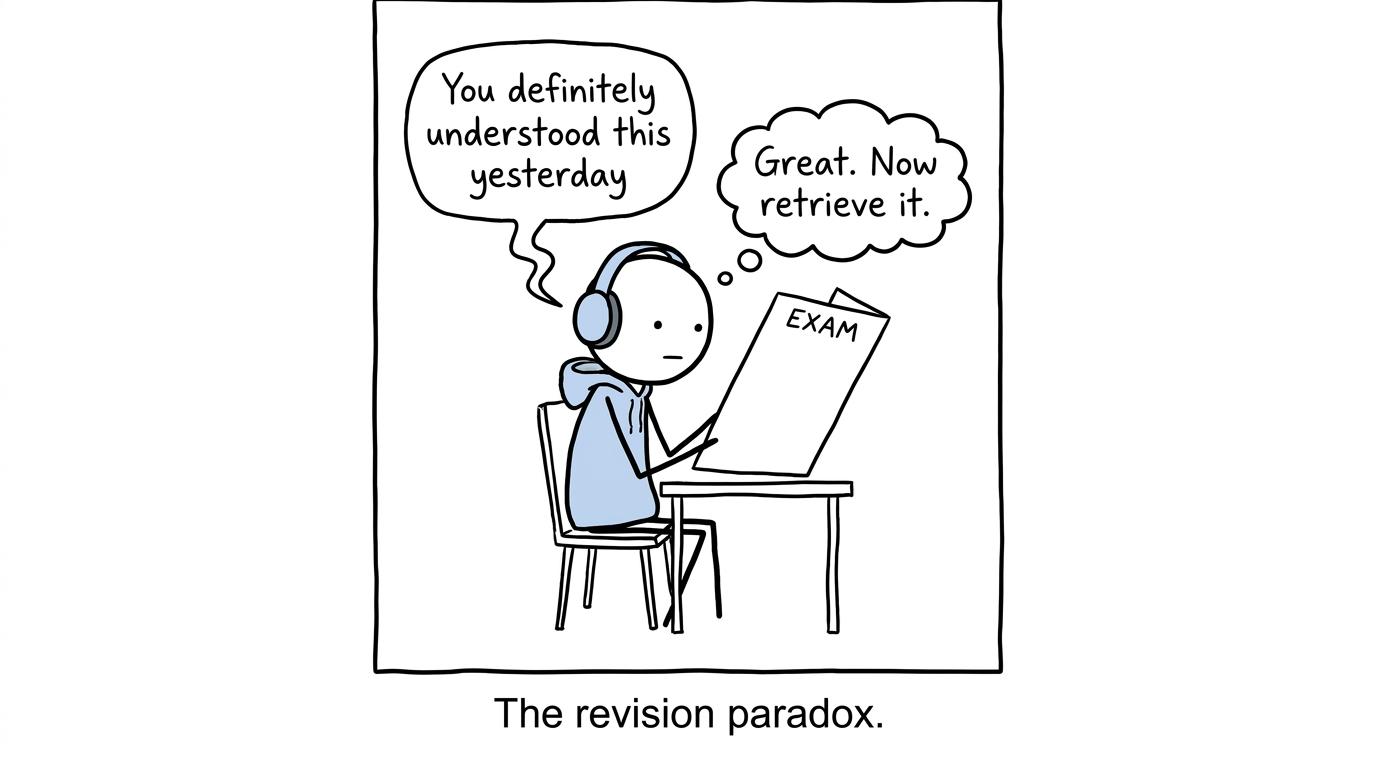 Headphones claim the student understood yesterday while an exam paper asks for retrieval
How to turn a Biology podcast into active revision
Choose one precise purpose
Do not begin with the vague aim of “revising Biology”. Decide what the audio should achieve. You might want to review the stages of mitosis, distinguish communicable from non-communicable disease, or clarify how hormones coordinate a response.
A precise purpose makes it easier to notice whether the resource actually answers your question.
Listen in short sections
Pause after one idea or a short cluster of ideas. Before continuing, say or write:
- the central idea;
- the key scientific terms;
- one cause-and-effect relationship;
- one point you could not explain confidently.
Do this from memory. Looking at a transcript immediately turns retrieval back into reading.
Check against an authoritative source
Podcasts may be old, simplified or designed for a different qualification. Compare your recall with your exam board specification, school textbook or teacher-approved material. Correct errors immediately so that an attractive explanation does not become a durable misconception.
Apply the knowledge
Finish with questions. Begin with short recall prompts, then attempt questions that require application or interpretation. Mark your responses and record what was missing.
The same structure is useful across your revision timetable. For maths, a GCSE one-month revision plan can help you place listening around focused topic sessions rather than letting one subject consume the whole evening.
Return after a delay
Test the topic again later without replaying the episode first. If you can explain it accurately after a gap, the knowledge is becoming retrievable. If you cannot, revisit the specific weakness rather than restarting the entire recording.
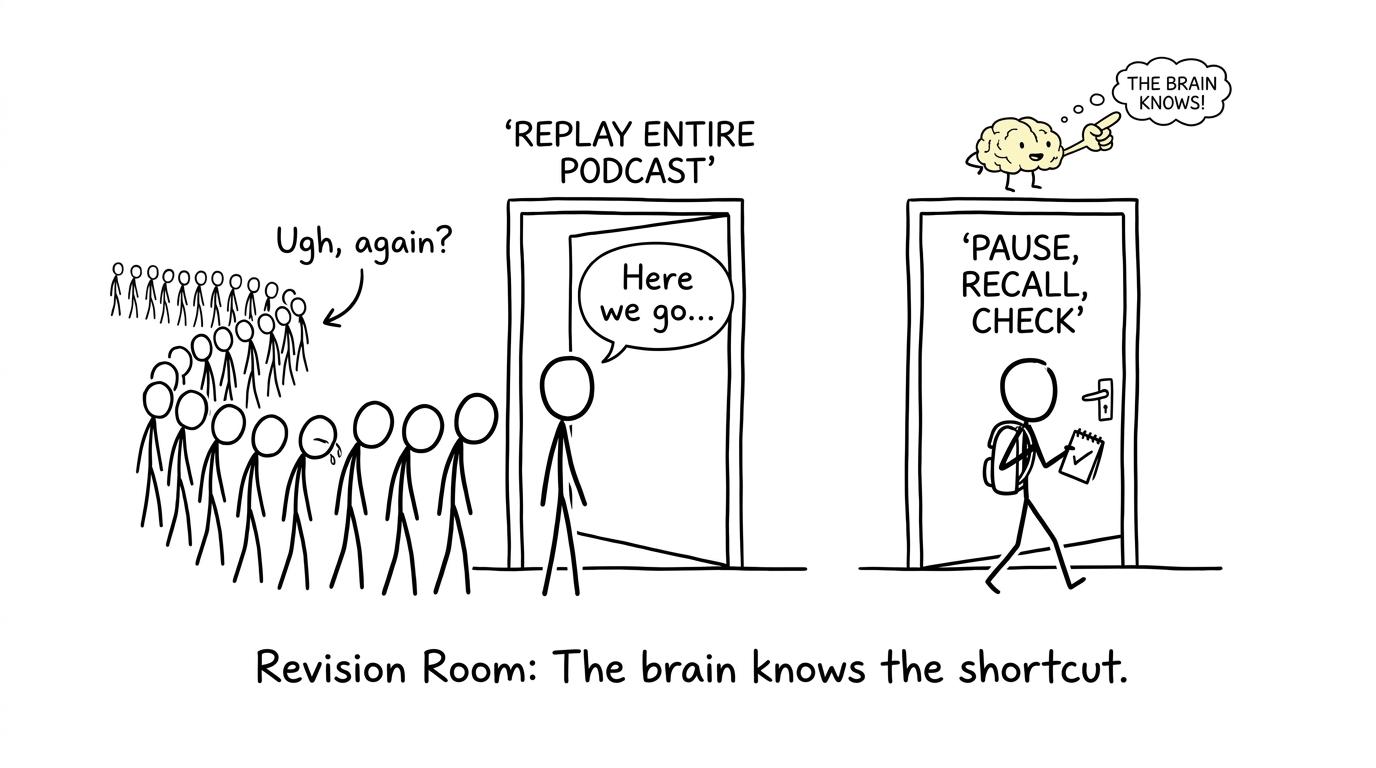 A brain directs a student away from replaying everything and towards pausing, recalling and checking
A balanced routine for students revising Biology and maths
A good revision week gives different tools different jobs. Audio belongs in flexible, lower-intensity periods. Written practice deserves your sharper attention.
Try this pattern:
- Before school or while travelling: listen to a short Biology section.
- After listening: record three recalled ideas and one uncertainty.
- Focused Biology session: check those ideas and answer specification-matched questions.
- Focused maths session: use a MathsGenie revision lesson, then complete questions without prompts.
- End of the week: use a short test or paper to reveal what remains weak.
If organising several subjects feels harder than the content itself, use the structure in this GCSE maths revision timetable as a model. The exact subjects can change; the principle does not. Protect time for recall, practice and correction.
For maths feedback, Edexcel GCSE Maths past papers and AQA GCSE Maths past papers provide realistic written practice with mark schemes. Shorter GCSE Target Tests are useful when a full paper would be too much. These resources cannot test Biology, but they model the active process that audio revision must eventually lead towards.
Students already thinking beyond GCSE can follow the same principle through the A Level maths revision hub: explanations build understanding, while independent questions reveal whether that understanding can be used.
Common mistakes with podcasts and audiobooks
Counting listening time instead of learning
Completing an hour-long episode is not evidence that you can retrieve its content. Measure what you can explain or answer afterwards, not how long your headphones were on.
Multitasking too heavily
Walking a familiar route may leave enough attention for review. Scrolling social media usually does not. Audio is portable, but attention is still limited.
Choosing interesting content instead of relevant content
General science programmes can inspire curiosity, but they may not match your specification. Use them for enrichment, not as your only source of examinable detail.
Replaying instead of retrieving
Replaying feels smooth because the ideas become familiar. Pause first and try to reconstruct the explanation. Then replay only the part needed to check or correct it.
Ignoring practical, visual and mathematical skills
No podcast can replace drawing conclusions from data, interpreting a graph or planning an investigation. Keep written exam questions at the centre of your preparation.
Using audio to avoid difficult practice
The easiest revision method is often the most tempting on a tired evening. If listening repeatedly postpones the questions you find uncomfortable, it has become avoidance rather than support. Maths students can use this guide to starting past papers to build written practice gradually instead of waiting until revision feels complete.
Make audio a bridge, not the destination
Podcasts and audiobooks can help with GCSE Biology. They can make explanations memorable, fill otherwise unused time and reveal gaps in your understanding. But listening alone is unlikely to prepare you fully for questions that demand precise recall, application, data interpretation and practical evaluation.
Use audio as a bridge: listen, retrieve the ideas, verify them against your specification and finish with questions. That final step is where comfortable familiarity begins turning into marks.
For the maths side of your revision, make MathsGenie your free practice base. Start with revision lessons, build independence through practice questions, check your work with mark schemes and video solutions, then test yourself with mini tests, past papers and predicted papers. Listen when listening is useful, and practise when practice is what the exam will demand.