Perfectionism GCSE Physical Education Revision Trap
Perfectionism GCSE physical education revision advice: spot hidden avoidance, use feedback well and build a calmer, more effective GCSE routine.
The strangest thing about perfectionism GCSE physical education revision is that it can look exactly like hard work. You rewrite notes, redesign a timetable and spend an evening making flawless flashcards. Yet you have not attempted a question, tested your recall or discovered what you actually know.
The answer is not to care less. It is to replace perfect preparation with useful action: attempt something, check it, correct it and return to it later. That approach works for GCSE PE theory and transfers directly to maths revision, where marks come from solving problems rather than creating beautiful notes about them.
A quick checklist: is perfectionism controlling your revision?
Perfectionism may be getting in the way if you regularly:
- delay starting until you have the ideal plan, desk or resource;
- rewrite complete pages because one section looks untidy;
- revise favourite topics repeatedly because mistakes feel less likely;
- avoid timed questions until you feel fully prepared;
- treat a low practice mark as a verdict rather than information;
- spend longer choosing a task than completing one;
- restart timetables after one missed session;
- check an answer repeatedly without improving it.
One behaviour means little on its own. The more useful question is whether your standards help you learn or prevent you from meeting uncertainty.
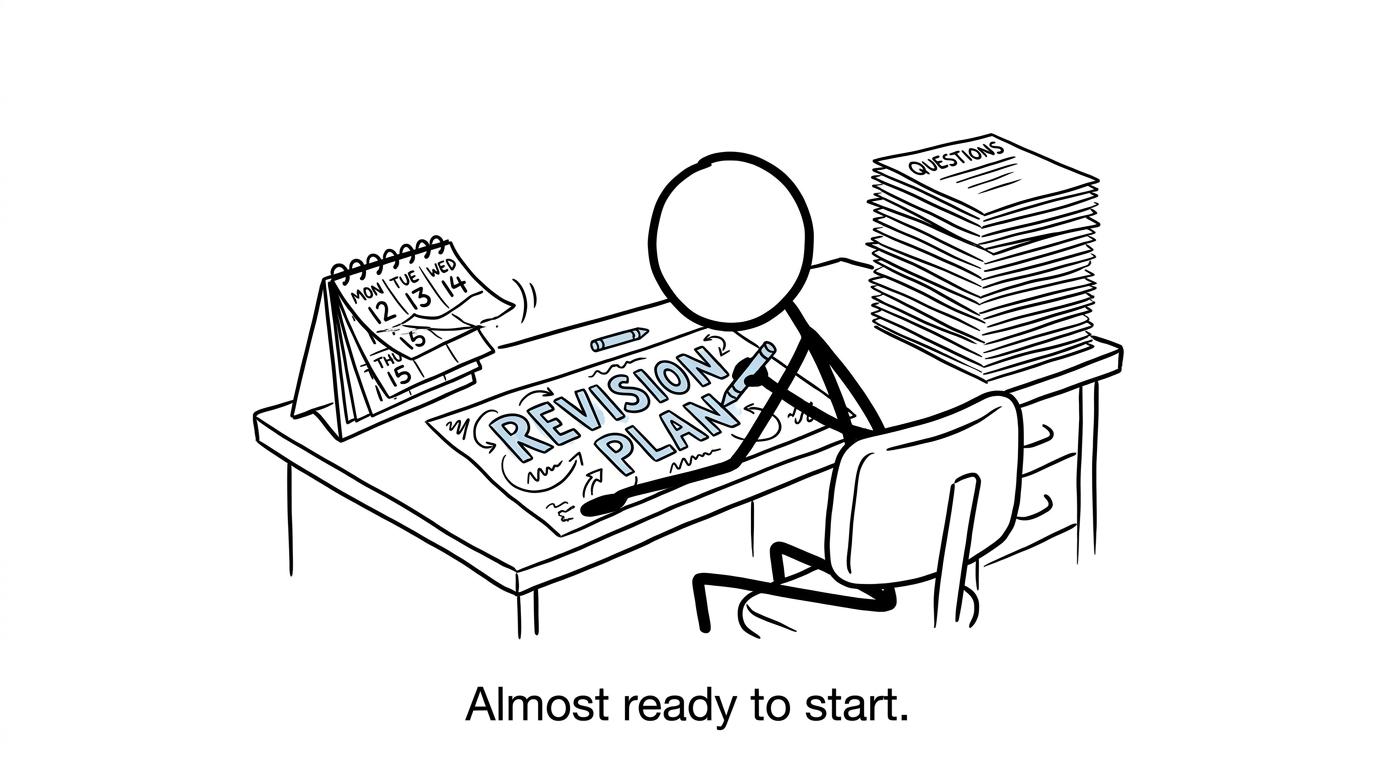 A student perfecting a revision-plan title while the questions wait
How perfectionism hides inside GCSE PE revision
GCSE Physical Education contains different kinds of challenge. Across AQA, Edexcel, OCR and Eduqas, the qualification combines written assessment with non-exam assessment, although paper structures and individual component weightings vary. Current specifications broadly allocate 60%60\%60% to written assessment and 40%40\%40% to practical performance and analysis.
That mixture gives perfectionism several places to hide.
Making notes instead of retrieving knowledge
Applied anatomy, physical training, sports psychology, socio-cultural influences, health and wellbeing all contain knowledge that must be recalled and applied. Copying a definition neatly can feel productive because the result is visible. Unfortunately, seeing information is not the same as retrieving it.
A better test is to close the book and answer a prompt from memory. Then compare your response with trusted notes or a mark scheme. Education Endowment Foundation guidance on retrieval emphasises the active attempt to remember, appropriate challenge and corrective feedback. It also warns that retrieval should not be restricted to simple facts when pupils need to explain, apply, analyse and evaluate.
For GCSE PE, that means moving beyond isolated definitions. Practise linking knowledge to sporting situations and explaining consequences. A rough answer that reveals a missing link has more revision value than a flawless copied paragraph.
Waiting to feel ready for exam questions
Perfectionism often says, “Learn everything first, then test yourself.” The problem is that testing is part of learning. Until you attempt a question, you cannot tell whether the difficulty is recall, application, command words, extended writing or time management.
This matters in PE because written papers can include objective questions, short responses and extended answers. Your exact format depends on your board, so use the current specification and materials supplied by your teacher. Whatever the structure, reading model answers indefinitely will not build the same skill as producing your own response under realistic conditions.
The same principle applies when preparing for maths. The MathsGenie GCSE maths revision hub brings lessons, practice questions, papers and revision tools together so that explanation can lead directly to an attempt.
Confusing one imperfect result with your ability
A disappointing practice mark is data collected before the final assessment. It may identify a weak topic, a misunderstood command word or a rushed conclusion. Perfectionism turns that local problem into a global judgement: “I am bad at this subject.”
That leap makes avoidance more likely. Research has often associated maladaptive perfectionism, particularly fear of failure and excessive concern about mistakes, with procrastination and distress. However, findings are not identical in every study, and much of the evidence involves university students rather than GCSE pupils. Anxiety and other factors can also contribute. The sensible conclusion is not that every high standard is harmful, but that rigid standards become costly when they cause delay, repeated checking or avoidance.
Why perfectionism can do more harm than ordinary procrastination
Ordinary procrastination is usually visible. You know you watched videos instead of revising. Perfectionistic procrastination is harder to notice because it wears the uniform of productivity.
You may spend an hour organising resources and honestly believe you worked for an hour. The hidden cost is opportunity. Time used polishing one page cannot also be used answering questions, reviewing feedback or revisiting a weak topic.
Perfectionism can also distort topic choice. If you revise only what feels safe, your confidence rises while your coverage remains narrow. A better revision plan follows evidence. The process in MathsGenie’s guide to finding weak GCSE topics is designed for maths, but its central lesson transfers well: use assessed work, log where marks were lost and prioritise the gaps that matter.
Finally, perfectionism makes small disruptions feel fatal. Missing Tuesday’s session becomes proof that the whole timetable has failed. The student then spends Wednesday constructing a new timetable rather than resuming the next useful task.
A plan should be a route, not a contract with your ideal self.
Replace perfect revision with a feedback loop
The goal is not careless work. It is high-quality practice delivered through manageable attempts.
Define a minimum useful session
Make the starting requirement small enough to complete on an ordinary day. For example:
- retrieve one subtopic without notes;
- answer a short set of questions;
- mark the response;
- record one correction;
- choose when to revisit it.
If beginning feels difficult, commit to five minutes. Oxford Health NHS guidance presents this as a way to reduce the mental barrier to starting. Continuing is optional. Starting is the success condition.
Maths students can use the same idea with a short topic set or mini test. The GCSE one-month revision plan shows how short retrieval, focused practice and mark-scheme review can fit into a repeatable routine.
Separate drafting from judging
Trying to create and evaluate an answer simultaneously encourages hesitation. Instead, give yourself permission to produce a first attempt without constant checking. Review it only after the attempt is complete.
For an extended PE response, this means committing to an argument before comparing it with the level descriptors or marking guidance. For maths, it means completing a method before opening a solution. MathsGenie’s guide to using Edexcel past papers properly follows this rhythm: attempt, mark, diagnose, fix and reattempt.
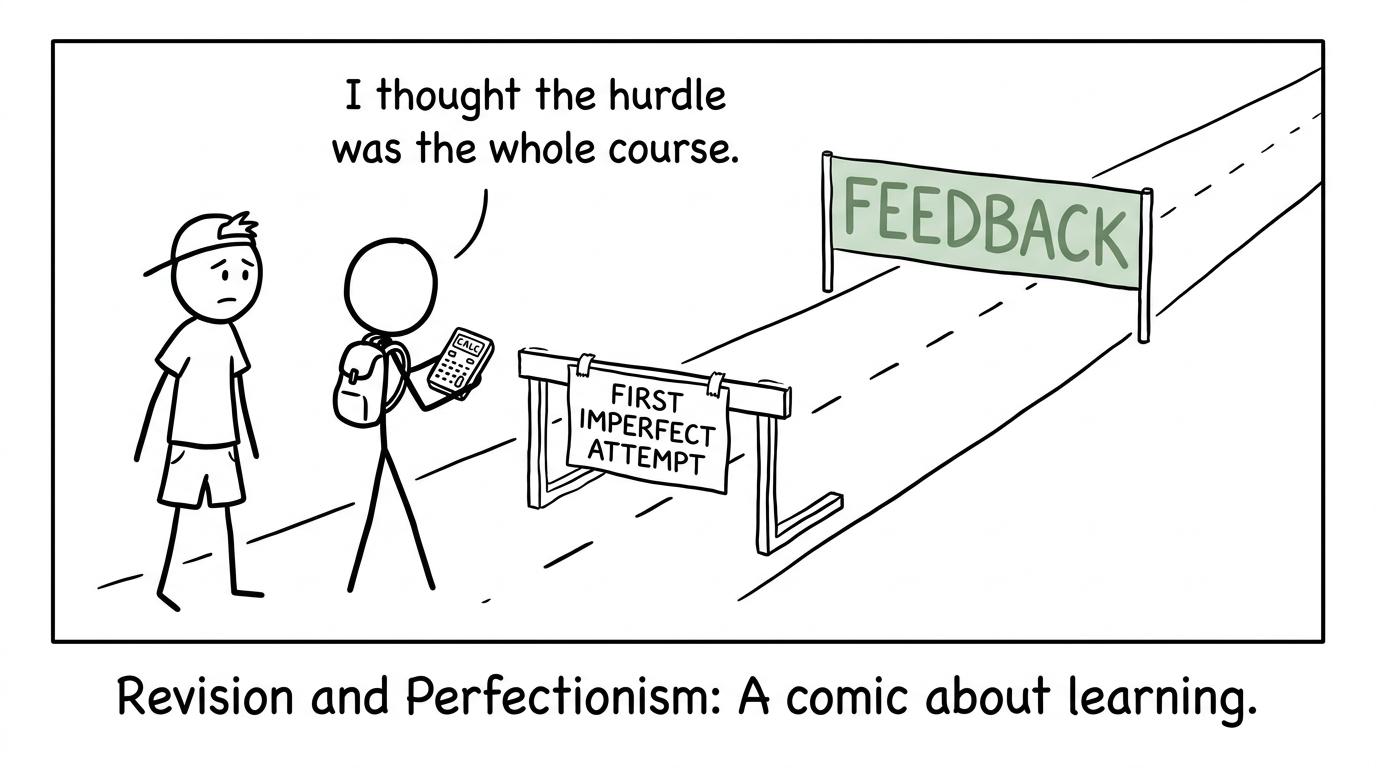 Two students discover that the first imperfect attempt is only a small hurdle
Use three standards instead of one
Not every task deserves maximum effort. Give each session one of three purposes:
- Learn: understand an unfamiliar concept using a lesson or explanation.
- Practise: attempt questions with mistakes expected.
- Perform: work under timed, exam-style conditions.
A learning session may include notes. A practice session should expose gaps. A performance session should test independence. Problems arise when perfectionism expects performance-level accuracy while you are still learning.
If you need a broader weekly structure, the MathsGenie GCSE revision timetable separates foundation work, targeted practice and timed exam sessions.
Keep an error log that leads to action
Do not copy every incorrect answer into an elaborate notebook. Record only what helps the next attempt:
- the topic;
- why the mark was lost;
- the correction;
- the next practice action.
A useful correction is specific: “I described the training method but did not apply it to the performer.” A vague comment such as “revise more” provides no direction.
In maths, your note might identify a content gap, misread instruction or arithmetic slip. Past papers are valuable because their mark schemes make these patterns visible. MathsGenie explains when to begin GCSE past papers, with shorter tests and topic questions useful before full timed papers become the main focus.
Build a routine that tolerates real life
A robust plan expects imperfect days. Include a normal task and a reduced version. If the full session is unavailable, complete the minimum rather than declaring the day lost.
Use weekly targets based on outputs, not appearances. “Complete and review two question sets” is clearer than “revise PE for three hours”. The first produces evidence. The second can be filled with rereading and redesigning.
Schedule revisits too. After correcting a topic, return to it later without notes. Repeated retrieval after a delay is more informative than immediately repeating an answer you can still remember from the mark scheme.
As exams approach, increase realism gradually. Begin with individual questions, move to timed sections and then complete full papers where appropriate. For maths, Edexcel GCSE maths past papers include official mark schemes and worked solutions where available. Students who feel pressure late in the process can also use the GCSE maths night-before plan to prioritise limited, well-chosen practice rather than an impossible final sweep.
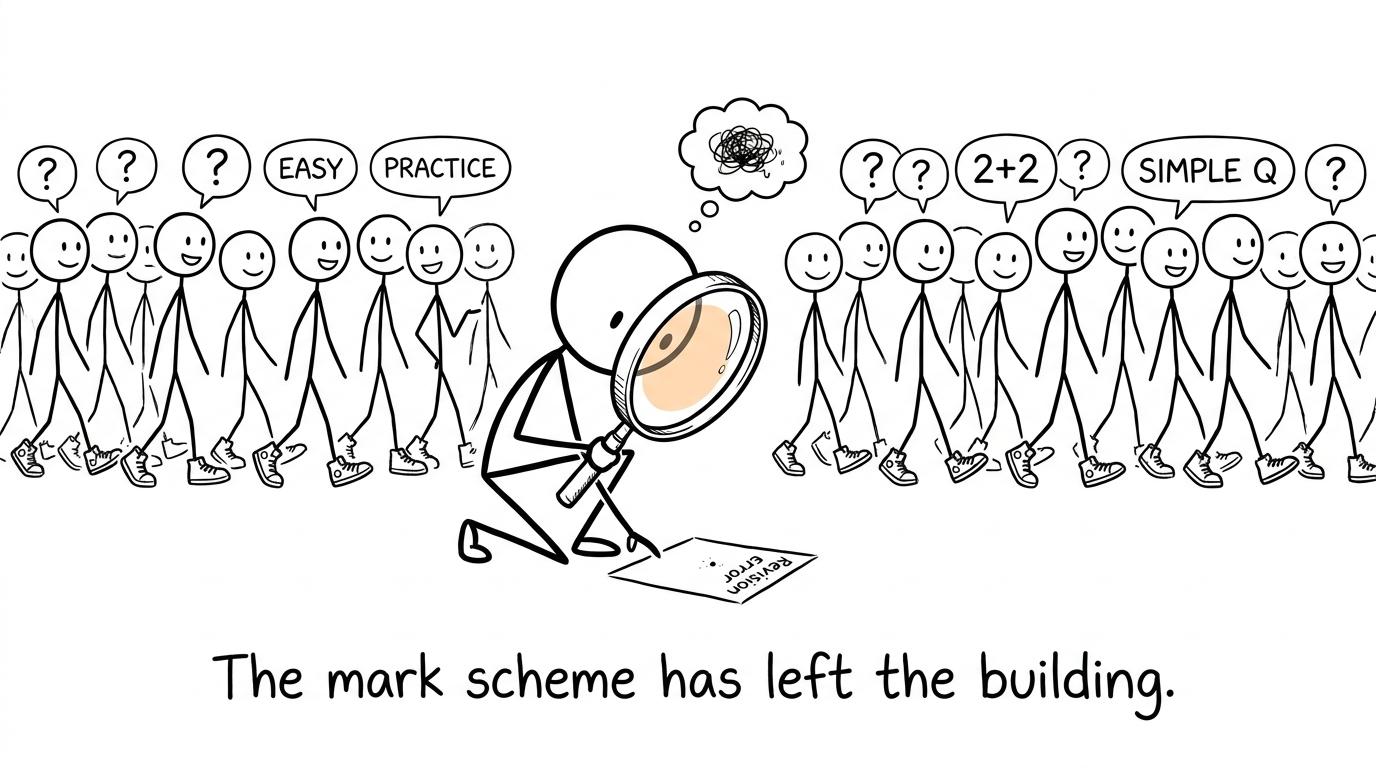 A perfectionist inspects one tiny error while the practice questions escape
Common mistakes when trying to overcome perfectionism
Replacing one perfect system with another
Do not turn “be less perfectionistic” into a new performance target. You will still overthink some sessions. Notice it, choose the smallest useful action and continue.
Lowering standards instead of changing the process
The aim is not poor work. Keep ambitious goals, but judge revision by whether it improves recall, application and exam performance. High standards can be constructive when they remain flexible.
Marking without correcting
A score alone does not improve the next attempt. Read the mark scheme, identify the missing element and practise it again. Feedback must change what you subsequently do.
Revising only comfortable content
Confidence is not the same as coverage. Use mocks, class assessments and practice questions to decide what comes next, even when the evidence points towards a topic you would rather avoid.
Ignoring persistent distress
Revision advice cannot solve every difficulty. If perfectionism is disrupting sleep, school attendance, eating, relationships or everyday wellbeing, speak to a parent, carer, teacher, school pastoral lead or health professional. Asking for support is an appropriate action, not a failure of discipline.
Progress begins with evidence
The quiet danger of perfectionism is not caring too much. It is spending so much effort protecting yourself from an imperfect result that you lose the feedback needed to improve.
Start before you feel completely ready. Produce the rough answer. Mark it honestly. Correct one weakness and return to it later. That loop is useful in GCSE Physical Education, maths and every subject where performance must eventually replace preparation.
For your maths exams, make MathsGenie’s free GCSE revision resources your next practical step. Choose a revision lesson, attempt the practice questions, use the mark scheme or video solution, and then build towards mini tests, past papers and predicted papers. Do not wait for a perfect session. Complete one useful attempt today.