

Perfectionism: GCSE Drama Revision Without the Trap
Perfectionism GCSE Drama revision can look productive while blocking practice. Learn to start sooner, use feedback well and revise with less pressure for exams.
Revision can look impressively organised while achieving almost nothing. The notes are colour-coded. The timetable has been redesigned twice. A paragraph about a set text has taken an hour because every sentence must sound polished. Yet the difficult task: recalling ideas, writing under time pressure or accepting feedback remains untouched.
That is the quiet risk behind perfectionism in GCSE Drama revision. It does not always look like avoidance. It can look like exceptional care. But when high standards make it difficult to begin, finish or expose your work to feedback, perfectionism becomes a polished form of procrastination.
The answer is not to stop caring. It is to replace the goal of flawless revision with a better one: producing useful evidence of what you can currently do, then improving it.
A quick perfectionism checklist
Perfectionism may be controlling your revision if you regularly:
- delay starting until you have the ideal amount of time;
- rewrite notes rather than test what you remember;
- avoid timed answers because the result might disappoint you;
- spend too long perfecting one section while neglecting others;
- treat teacher feedback as a verdict rather than guidance;
- compare unfinished work with somebody else's finished performance;
- abandon a session once it no longer follows the plan perfectly.
One sign on its own proves very little. The useful question is whether the behaviour helps you prepare for assessment or merely helps you feel temporarily protected from making mistakes.
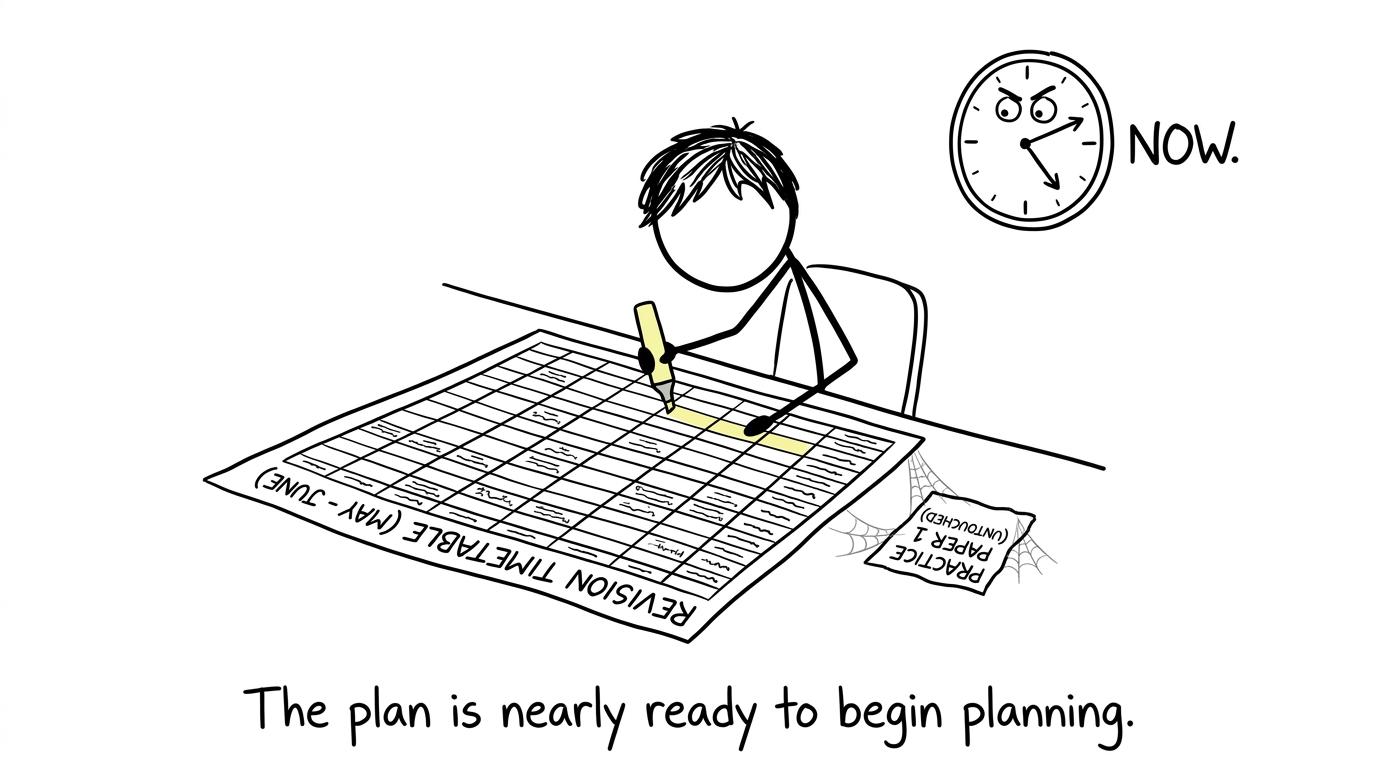 A student perfecting a revision plan while the practice paper waits
How perfectionism appears in GCSE Drama revision
GCSE Drama asks students to work in several different ways. Although component structures and weightings vary between AQA, Edexcel, OCR and Eduqas, the subject commonly involves creating and developing ideas, applying performance or design skills, demonstrating knowledge and understanding, and analysing or evaluating work.
That variety gives perfectionism several places to hide.
Waiting for an original idea
During devising, a student may reject every early suggestion because it feels predictable. The group cannot develop an idea that is never allowed to exist.
Creative work rarely arrives fully formed. An initial idea is material for rehearsal, not a final judgement on your imagination. Trying, observing and refining is part of the assessed process.
Rehearsing only what already feels safe
A perfectionist may repeatedly practise a familiar scene, line or design explanation because success feels reassuring. More vulnerable areas remain untested.
This creates fluency in a narrow area without improving the whole performance. Productive rehearsal should sometimes feel awkward because it is revealing what still needs attention.
Writing notes instead of responses
Beautiful character profiles and theatre-vocabulary cards can be useful. They become avoidance when they replace retrieval, planning and timed writing.
The written examination does not ask whether your folder looked complete. It asks whether you can select relevant knowledge, connect theatrical choices to meaning and explain their effect clearly under the conditions of your paper.
Over-editing evaluation work
Analysis and evaluation require precision, but endless editing can flatten a response. A student may spend so long searching for an impressive phrase that the central point becomes less clear.
Examiners reward relevant evidence and developed explanation. Sophisticated vocabulary cannot rescue an answer that never identifies what happened, why the choice was effective and how the audience responded.
Treating performance errors as disasters
Live performance feels personal because your work is visible. Perfectionism can turn a missed cue or uncertain rehearsal into evidence that you are simply “bad at Drama”. That conclusion is much larger than the event.
A rehearsal mistake is information. It may show that a transition needs a clearer cue, a line needs retrieval practice or an intention needs to be more specific. Information can be acted upon. A global judgement cannot.
Why perfectionism can be more disruptive than ordinary procrastination
Ordinary procrastination is often visible. You know you have avoided the task. Perfectionism is harder to challenge because it can wear the costume of productivity.
You may work for an entire evening and still avoid the activity most likely to improve your result. The problem is not simply lost time. It is distorted feedback. Neat notes create the feeling of progress without showing whether you can recall, apply, analyse or perform.
Research on students has found associations between maladaptive perfectionism, procrastination and psychological distress. However, the evidence is nuanced. Different forms of perfectionism do not behave identically, much of the research involves university students rather than GCSE Drama candidates, and some studies suggest anxiety may be a stronger predictor of procrastination. It would therefore be wrong to claim that every ambitious student will procrastinate.
The practical distinction is simpler:
- Helpful high standards encourage preparation, persistence and revision after feedback.
- Unhelpful perfectionism makes mistakes feel threatening, so starting, finishing and receiving feedback become harder.
You do not need lower ambitions. You need standards that lead to action.
Replace perfect outcomes with repeatable actions
The most useful revision target is one you can complete and inspect. “Understand the whole play” is vague. “Plan one response about the use of space without notes” produces evidence.
Use the five-minute start
An NHS performance-mindset resource recommends committing to a task for just five minutes to reduce the barrier to starting. The purpose is not to complete all your revision in five minutes. It is to make beginning smaller than the fear surrounding it.
Choose one action: retrieve five key moments, annotate one short extract, practise one transition or plan one paragraph. After five minutes, you can stop or continue. Either choice is better than waiting for ideal motivation.
Separate drafting from judging
Creating and evaluating are different mental jobs. Trying to perform both at once can make every sentence or idea feel stuck.
During a first draft, aim to place relevant ideas on the page. During the next pass, check accuracy, specificity and structure. A rough answer gives you something to improve; a blank page gives you nothing.
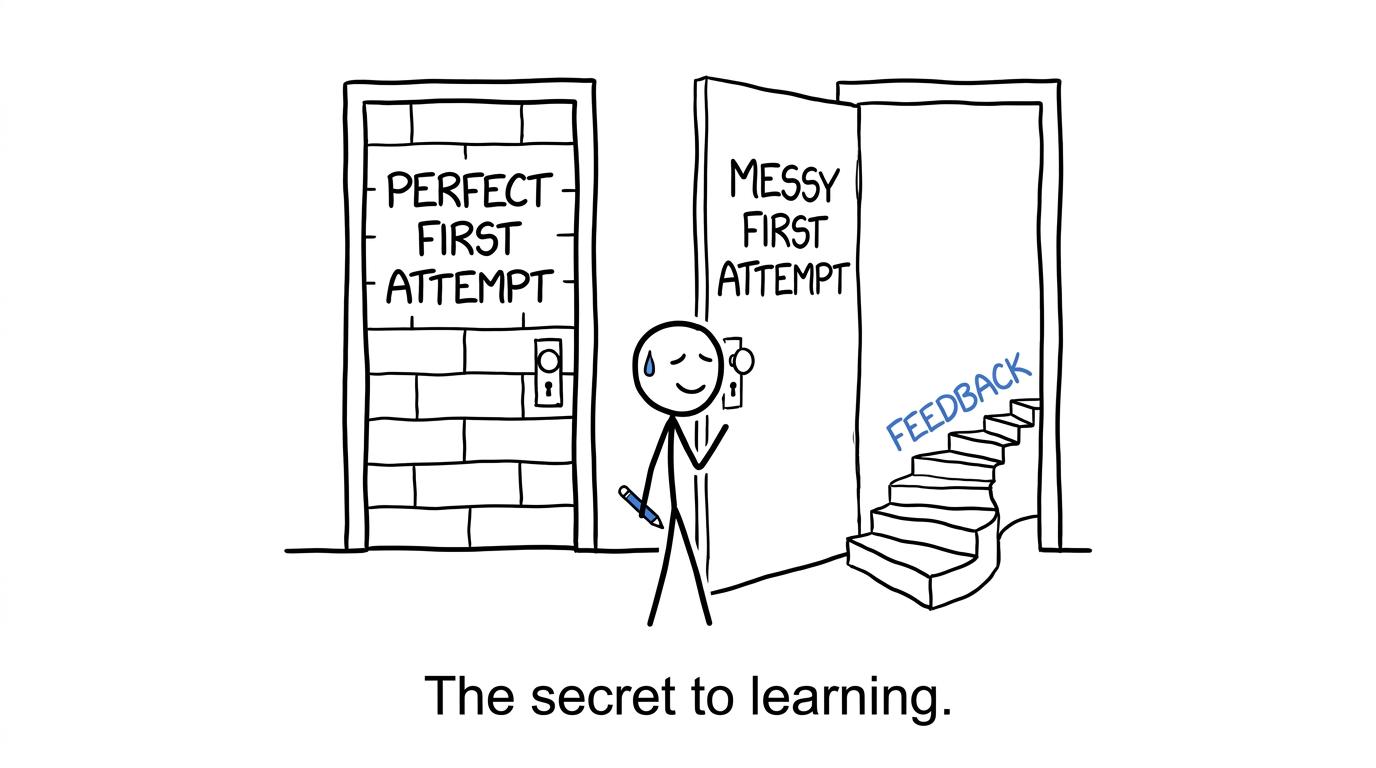 The imperfect first attempt opens a route to feedback
Set a definition of done
Before a session, decide what completion means. For example:
- one timed plan completed without notes;
- one scene rehearsed twice with a different focus each time;
- one page of retrieval questions answered and checked;
- one evaluation paragraph edited once, not indefinitely.
A stopping rule prevents one task from consuming the time needed for the rest of the specification.
Practise being seen before you feel ready
Ask a teacher, classmate or rehearsal group for feedback on unfinished work. Make the request specific: clarity of intention, use of terminology, strength of evidence or effectiveness of a transition.
Feedback is most valuable while there is still time to respond to it. Hiding work until it feels perfect removes that opportunity.
A revision cycle that makes mistakes useful
Use this compact cycle for Drama and other GCSE subjects:
- Choose: identify one precise skill or assessment objective.
- Attempt: work without notes where appropriate.
- Check: use teacher guidance, the task criteria or an official mark scheme.
- Record: write one specific improvement, not a general criticism.
- Repeat: return to the skill in a later session.
The same principle is especially powerful for GCSE maths. A student who avoids questions until they feel confident never discovers what needs fixing. If maths is part of your exam preparation, the MathsGenie GCSE maths revision hub lets you move from revision lessons to practice questions and then check your understanding.
For a shorter routine, follow the 20-minute GCSE maths revision structure. It limits planning time and makes active practice unavoidable.
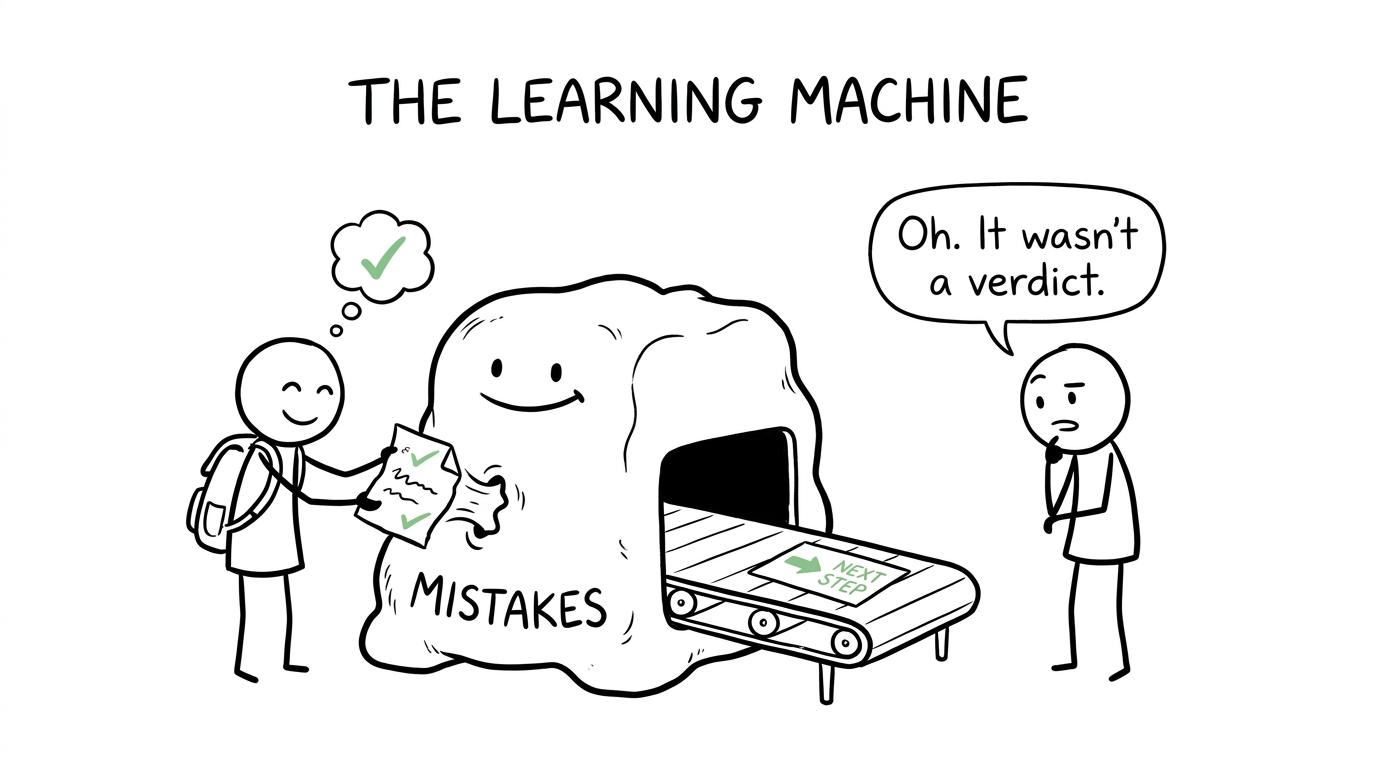 A marked paper turns mistakes into a useful next step
Why this matters to GCSE maths students too
Perfectionism changes costumes between subjects. In Drama, it may appear as endless script annotation or reluctance to perform an unfinished idea. In maths, it often appears as watching another explanation instead of attempting questions, refusing to mark an incomplete paper or spending too long on one difficult problem.
The cure is the same: obtain honest evidence sooner.
Use the guide to finding your weakest GCSE topics to turn errors into a manageable priority list. Then use MathsGenie revision resources for mini tests, practice materials and predicted papers rather than waiting until you feel ready for assessment-style work.
If a full paper feels intimidating, begin with a section. When you are ready for authentic exam practice, choose material for your board and tier. For example, the AQA GCSE maths past papers include official mark schemes and worked solutions where available.
A realistic plan also needs room for imperfect days. The GCSE maths revision timetable guide helps you combine topic work, feedback and timed practice without expecting every session to run flawlessly. If exams are close, use the more focused one-month GCSE maths revision plan.
Common mistakes when trying to overcome perfectionism
Replacing one perfect system with another
You do not need an elaborate anti-perfectionism tracker. A short task, a timer and one written correction are enough. The system should make work easier to begin, not become another project.
Calling careless work “good enough”
Letting go of perfection does not mean ignoring accuracy. It means matching effort to purpose. A rough first draft can be incomplete; a final exam response should still be checked carefully.
Marking work when emotions are high
If a disappointing attempt immediately triggers harsh self-criticism, take a short pause before reviewing it. Then classify errors specifically: missing knowledge, weak evidence, unclear explanation, timing or execution. Specific labels create next steps.
Revising only comfortable material
Confidence can be misleading when it comes from repetition rather than testing. Give some revision time to tasks you might get wrong. That is where feedback has the greatest value.
Trying to change everything at once
Choose one behaviour first. Submit one unfinished paragraph for feedback. Attempt one timed plan. Mark one maths mini test honestly. Small acts of completion weaken perfectionism more effectively than another ambitious promise.
Progress begins before confidence
Perfectionism promises protection: if you prepare for long enough, perhaps you can avoid the discomfort of an imperfect attempt. But revision works in the opposite direction. Confidence usually follows attempts, feedback and correction. It rarely arrives beforehand.
For GCSE Drama, let early ideas be tested, allow rehearsals to reveal weaknesses and write answers before every phrase feels polished. For maths, follow the same rhythm: learn, practise, mark, fix and retest.
Make MathsGenie your free maths revision base. Start with a revision lesson, complete the practice questions, use mini tests to check recall and build towards past papers and predicted papers with mark schemes and video solutions. You do not need a perfect session today. You need one honest attempt, and a clear next step.










