Peaking Too Early in GCSE Further Maths Revision
Peaking too early GCSE Further Maths revision is common. Learn why confidence fades and use a practical plan to keep every topic fresh until exam day.
There is a peculiar kind of revision anxiety that appears when things are going well. You understand the algebra. Differentiation feels manageable. A practice paper comes back with a strong mark. Then one thought arrives: what if this confidence disappears before the exam?
The phrase “peaking too early GCSE Further Maths revision” describes a real concern, but the short answer is reassuring: yes, it is normal to feel most confident months before the exam. It does not mean your ability has reached a permanent peak. More often, recent learning feels fluent because it is familiar. The solution is not to keep revising at maximum intensity until May. It is to revisit the material through spaced, active practice so that confidence becomes durable knowledge.
The quick checklist
If Further Maths feels strong earlier than expected:
- Test your knowledge without notes rather than relying on familiarity.
- Revisit older topics at planned intervals.
- Mix topics instead of completing endless blocks of one skill.
- Keep an error log based on lost marks.
- Use short maintenance sessions during busy GCSE weeks.
- Save some unseen papers for the final run-in.
- Increase timed practice gradually as the exam approaches.
- Continue until your actual examination date, not an arbitrary point in May.
The aim is not to hold one perfect level of confidence for several months. It is to build a revision system that can recover knowledge whenever it starts to fade.
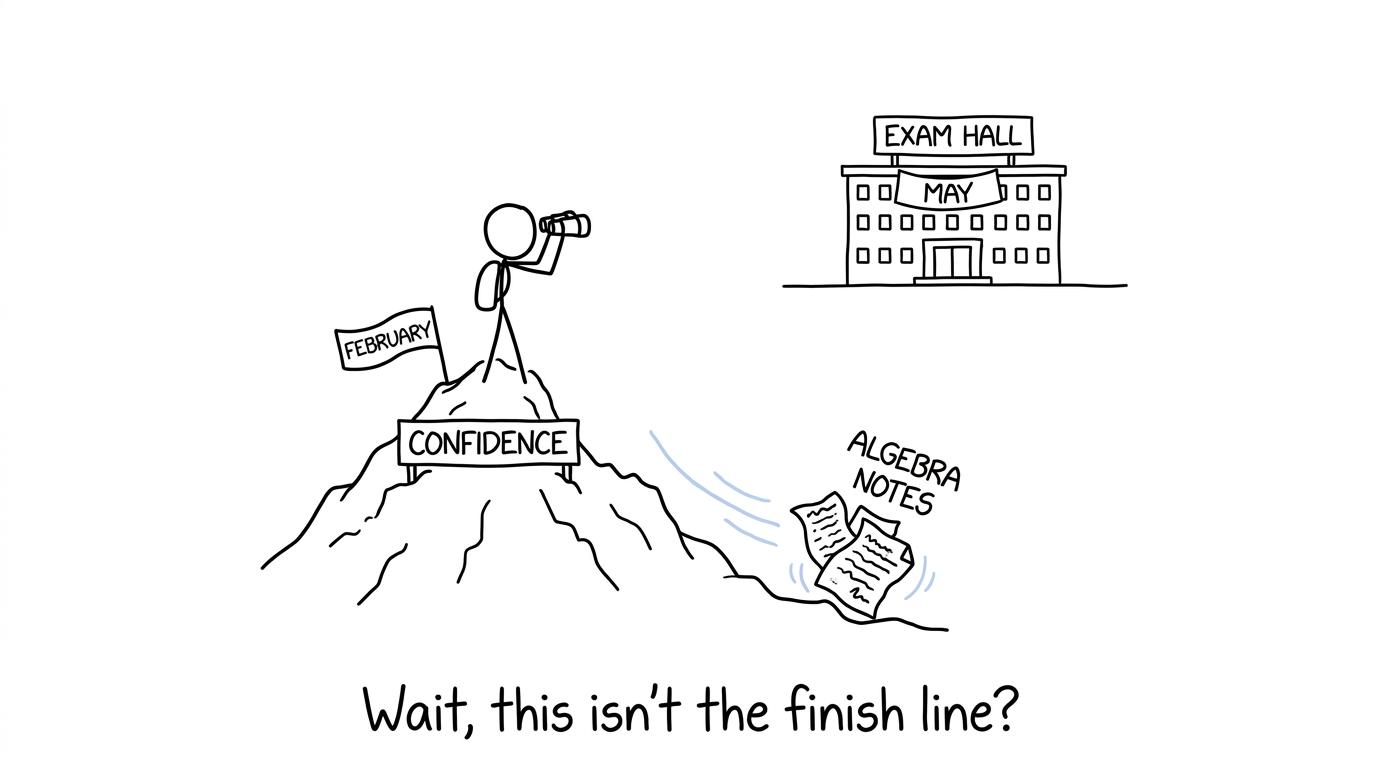 A student discovers that the confidence summit is not the revision finish line
Why confidence can arrive before exam readiness
Further Maths is often taught to students who are already comfortable with higher-tier GCSE Maths. New ideas can therefore click quickly. AQA's Level 2 Certificate in Further Mathematics, for example, builds on Key Stage 4 knowledge and extends areas such as algebra, coordinate geometry, calculus, matrices and geometry. It is an additional, untiered qualification intended to stretch students working around grades 7-9 in GCSE Maths.
That background creates momentum. If you have recently completed a unit on matrices, the notation is still visible in your mind. If your class has just revised differentiation, the method may feel automatic. Yet recognition is not the same as independent recall.
You can recognise a method while reading a solution but still struggle to produce it from a blank page several weeks later. This is why confidence immediately after finishing a topic is an unreliable measure of how secure it will be in May or June.
Use the AQA GCSE Further Maths revision hub to test that difference. Attempt questions before opening notes or solutions. If you can select the method, complete it accurately and explain your reasoning without prompts, the topic is genuinely becoming secure.
You probably have not peaked: you have finished the first stage
A peak suggests that everything afterwards must decline. Revision rarely works like that. It is closer to a series of smaller climbs:
- understanding a method for the first time;
- recalling it after a gap;
- choosing it within a mixed set;
- applying it to an unfamiliar problem;
- producing it accurately under timed conditions.
Early confidence may mean you have completed the first climb. That is useful progress, not a warning sign.
It also helps to separate three things students often group together as confidence:
Topic confidence
You can complete questions when you know the topic in advance. This is the confidence developed through focused worksheets and revision lessons.
Selection confidence
You can look at a mixed question and decide which idea is required. Interleaved practice develops this because the method is no longer announced by the page heading.
Exam confidence
You can select and execute methods accurately while managing time, unfamiliar wording and pressure. Past papers reveal this more honestly than feelings do.
A student may have excellent topic confidence in February but still need to build selection and exam confidence. That is not decline. It is the next part of preparation.
How to keep Further Maths fresh until May
Research on learning supports three particularly relevant ideas: retrieval practice, spacing and interleaving. Retrieval means bringing knowledge to mind rather than merely rereading it. Spacing means returning to material after a gap. Interleaving means mixing related problem types so that you must identify the appropriate method.
These approaches may feel harder than reading familiar notes. That difficulty is often useful because it exposes what can actually be recalled.
Use a maintenance cycle
A sustainable weekly cycle could contain:
- one short retrieval session on an older topic;
- one focused session repairing a weakness;
- one mixed set covering several areas;
- one timed section followed by careful marking.
This is a framework, not a compulsory timetable. Adapt it around your GCSE workload, school assessments and teacher guidance. The MathsGenie revision planner can help you distribute sessions without allowing Further Maths to consume every evening.
Short sessions are particularly valuable during weeks dominated by English, science or other subjects. The 20-minute GCSE maths revision routine provides a useful structure for active recall, exam questions and immediate feedback.
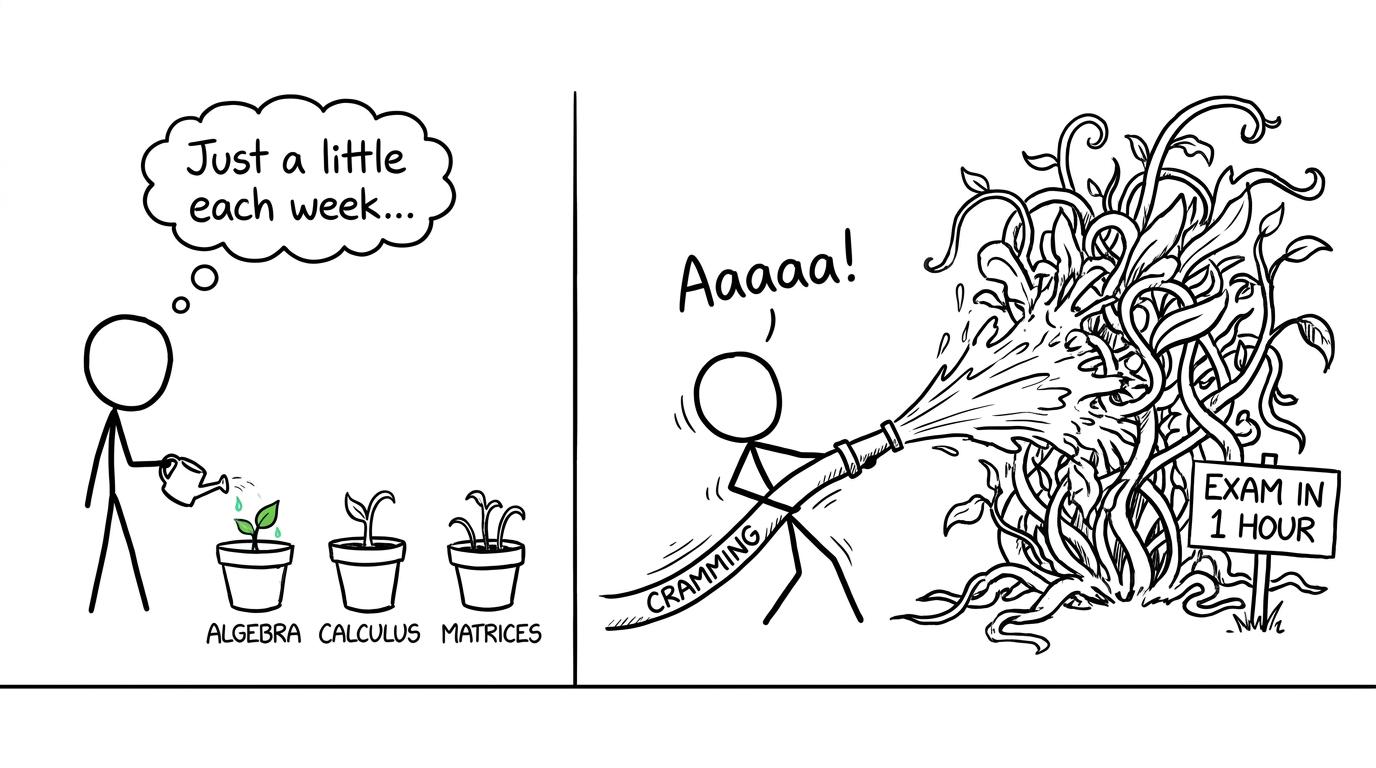 Three maths topics receive regular care while cramming arrives with a fire hose
Rotate the full specification
Students tend to maintain favourite topics and quietly avoid awkward ones. Build a rotation that includes the full content for your qualification. For AQA Level 2 Further Mathematics, that means checking your coverage of:
- number;
- algebra;
- coordinate geometry;
- calculus;
- matrix transformations;
- geometry.
Your school may offer a different qualification, such as OCR's Free Standing Mathematics Qualification, so always follow the specification and examination guidance for your own entry. “Further Maths” is not one identical paper across every board.
Keep higher-tier GCSE foundations active too. Manipulating expressions, solving equations, using exact values and reasoning with graphs support much of the extended content. The GCSE Maths revision hub lets you return to those foundations through lessons, questions and revision guides.
Let performance decide what comes next
Do not revise a topic simply because it feels rusty, and do not abandon one because it feels easy. Gather evidence.
After a mixed set, classify each lost mark as:
- a knowledge gap;
- incorrect method selection;
- an algebraic or arithmetic slip;
- incomplete reasoning;
- poor time management.
This turns a vague fear of decline into a specific next action. A knowledge gap needs a revision lesson. A selection error needs mixed questions. A careless slip needs slower checking. A timing problem needs controlled timed practice.
For ordinary GCSE Maths maintenance alongside Further Maths, grades 7-9 mini tests can provide quick evidence without requiring a complete paper.
Build towards papers instead of exhausting them early
Past papers are finite. Completing every available paper months before the exam can leave you with little genuinely unseen material when you most need realistic rehearsal.
Start with topic questions and selected paper sections. Later, move towards complete papers in timed conditions. MathsGenie's guide to when to start GCSE past papers explains how to move from diagnosis to regular timed work and then final exam preparation.
For AQA Level 2 Further Mathematics, the current assessment structure contains two papers. Each lasts one hour and 45 minutes and carries half of the qualification. Paper 1 is non-calculator and Paper 2 allows a calculator; content from across the specification may appear on either paper. Check the latest timetable and instructions through your school because dates and administrative arrangements can change between series.
A paper is not finished when you write the final answer. It is finished when you have:
- marked it using the correct mark scheme;
- identified why each mark was lost;
- repaired the weakest skills;
- reattempted difficult questions after a gap.
The principles in using GCSE Maths past papers properly transfer well to Further Maths: attempt, mark, diagnose, repair and retest.
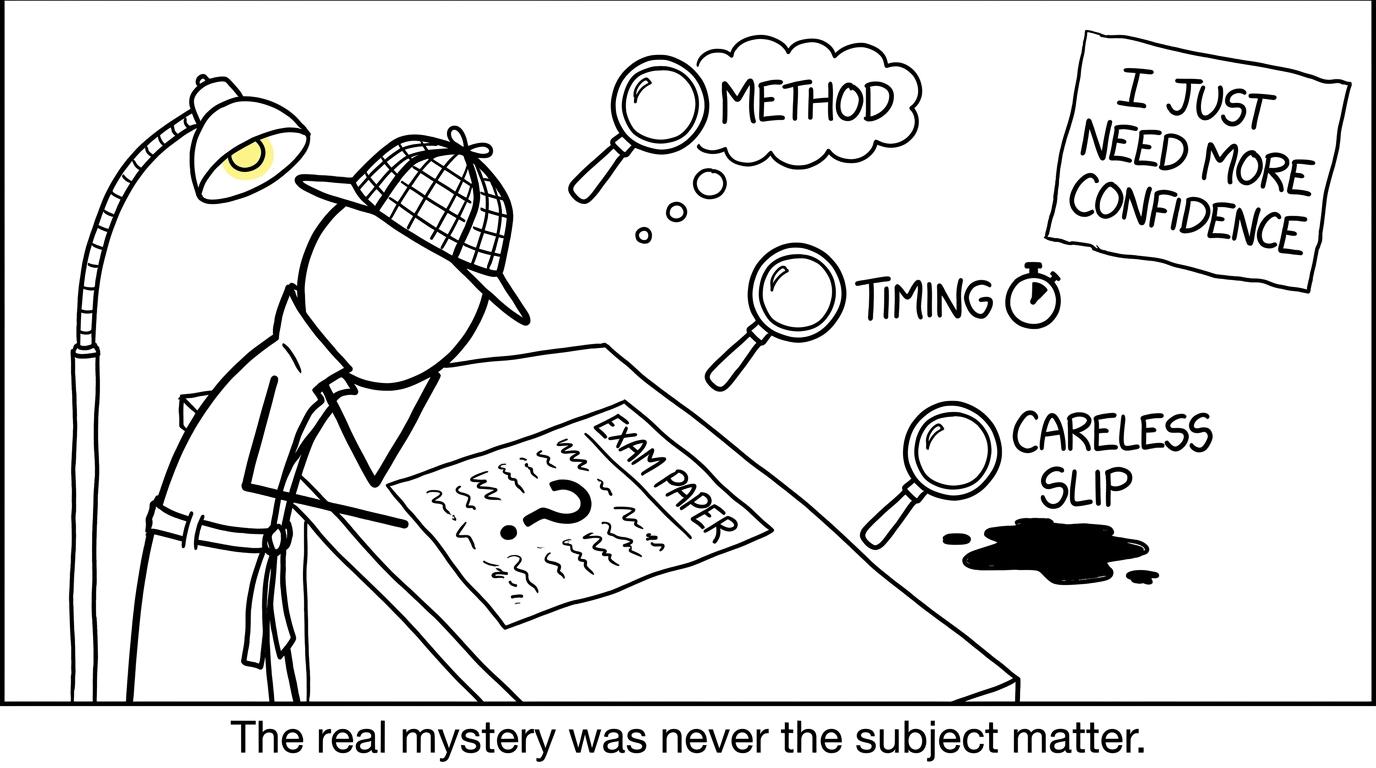 A student detective investigates method, timing and careless slips
What to do when your marks dip
A lower score after several strong weeks can feel like proof that you peaked early. It may mean something much less dramatic.
The paper might contain more of your weaker topics. It may be the first genuinely mixed test you have attempted. You might be completing it under stricter timing. In each case, the lower mark gives more useful information than another comfortable worksheet.
Look at a trend across several comparable assessments rather than treating one score as a verdict. More importantly, inspect the errors. If lost marks are concentrated in one area, the solution is targeted. If methods are correct but unfinished, timing may be the issue. If you cannot recognise what questions require, increase mixed practice.
Nearer the examination, unseen GCSE predicted papers can support broader Maths preparation. They should complement, not replace, official past papers and topic practice. For Further Maths, prioritise resources that match your exact qualification.
Common mistakes when trying to stay at your peak
Revising intensely for months without recovery
Maximum effort is difficult to sustain and can crowd out other GCSE subjects. Use a repeatable weekly minimum, then increase paper practice gradually.
Rereading because it feels reassuring
Notes and videos are useful for rebuilding understanding, but they do not prove recall. Close the resource and answer questions independently.
Repeating only impressive topics
Calculus and matrices may feel distinctively “Further Maths”, but marks can also depend on precise algebra, geometry and coordinate reasoning. Rotate the whole specification.
Treating every dip as failure
Harder mixed practice will often feel less fluent than blocked practice. Judge whether errors are being identified and corrected, not whether every session feels easy.
Aiming to peak in May regardless of the timetable
May is a useful checkpoint because the main GCSE examination period is under way, but your Further Maths paper may take place later. Maintain short retrieval sessions until the examination you are actually sitting.
Turn early confidence into lasting confidence
Feeling strong months before GCSE Further Maths is not a problem to solve. It is time you can use well. Instead of forcing yourself to remain at one emotional high point, keep returning to the material in small, demanding and measurable ways.
Start with the free AQA Further Maths revision resources. Use revision lessons when understanding has faded, practice questions to rebuild fluency, mark schemes and video solutions to diagnose errors, and past papers to test whether your methods survive exam conditions. Keep ordinary higher-tier GCSE Maths moving with mini tests and predicted papers, and organise the whole process with the revision planner.
The goal is not to feel perfect every week. It is to arrive at the exam able to retrieve, choose and apply the right mathematics when it matters.