

Peaking Too Early in GCSE D&T Revision?
Peaking too early GCSE Design and Technology revision? Learn why confidence fades and use a spaced plan to keep D&T knowledge fresh for the exam.
Revision has a strange way of making confidence feel temporary. You understand materials, processes and sustainability in February, then worry that none of it will survive until the summer exam. If peaking too early GCSE Design and Technology revision is on your mind, the short answer is reassuring: feeling confident early is normal, and it is not a problem. The risk comes only if you stop retrieving and applying what you know.
You do not need to remain at maximum intensity for months. You need to keep the knowledge active through short, spaced returns while protecting enough time and energy for maths and your other GCSE subjects.
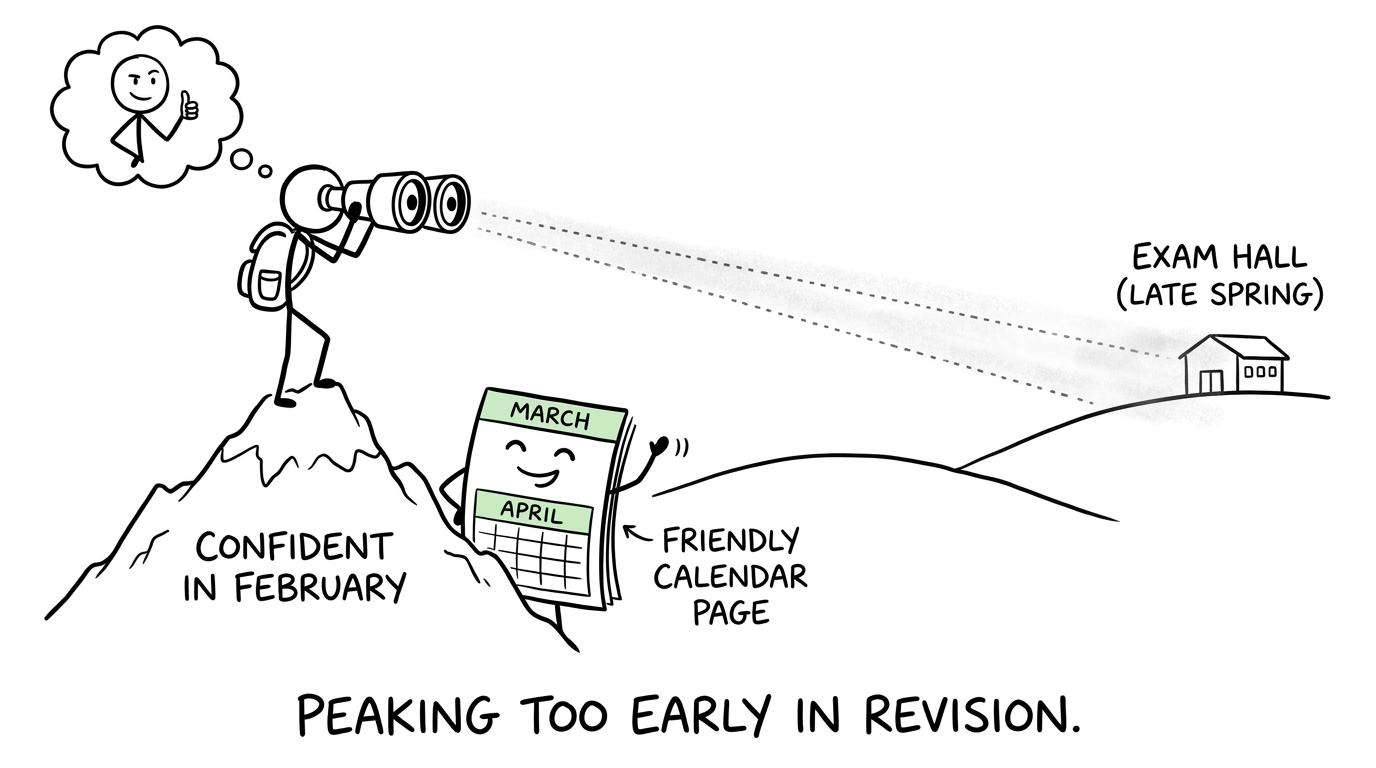 A student reaches the revision summit long before the exam hall
The quick answer: have you really peaked too early?
Use this checklist before changing your revision plan:
- Can you recall key D&T facts without opening your notes?
- Can you apply those facts to an unfamiliar product or design context?
- Can you explain why a material, process or design choice is suitable?
- Can you complete calculations accurately and include appropriate units?
- Can you interpret command words and construct longer evaluative answers?
- Can you repeat that performance after a gap of at least several days?
If most answers are yes, you have probably built a strong foundation rather than peaked. Move into maintenance mode.
If confidence disappears as soon as the notes close, your early fluency may be familiarity rather than secure learning. That is useful information, not failure. Retrieval practice can reveal exactly what needs strengthening.
Why D&T confidence can arrive months before the exam
Design and Technology has an unusual rhythm. Students often spend a large part of the course immersed in their non-exam assessment, researching a need, developing ideas, making a prototype and evaluating decisions. That sustained contact can create a genuine period of confidence.
The major GCSE D&T specifications from AQA, Edexcel, OCR and Eduqas divide assessment between a written examination and non-exam assessment. Each contributes 50%50\%50% of the qualification, although paper lengths, sections and terminology vary by board. Completing or nearing the end of the practical project can therefore feel like reaching a summit.
But the written paper asks for more than memories of one project. Depending on the specification, it can assess core and specialist technical principles, designing and making principles, materials, manufacturing processes, sustainability, analysis, evaluation and mathematical application.
That explains the uneasy feeling. Your project knowledge may be strongest now, while the breadth required for the written paper still needs regular attention.
Confidence is not the same as long-term retention
Reading familiar notes produces a comfortable signal: I recognise this. An examination asks a harder question: Can I retrieve, select and use this without help?
Research on learning consistently supports spacing practice across separate sessions rather than placing the same revision into one long block. Retrieval practice can also expose forgotten content and misconceptions, although its effectiveness depends on suitable difficulty and useful feedback.
This is why an early peak can be deceptive. A long revision session may create impressive short-term fluency. What matters is whether the knowledge remains available weeks later.
Replace one peak with a long plateau
The best mental model is not a mountain with one perfect summit. It is a plateau: a sustainable level of readiness maintained until the written paper.
You reach that plateau by reducing volume without removing contact. Once a topic is secure, stop rewriting all your notes. Revisit it through brief, effortful checks.
A practical maintenance pattern is:
- first return after roughly 222 or 333 days;
- another return around 111 week later;
- another after roughly 222 weeks;
- continued short checks until the examination.
These intervals are not a universal formula. If retrieval is effortless, widen the gap. If you cannot explain an idea accurately, shorten it and relearn the missing detail.
The same principle is valuable in maths. MathsGenie’s guide to stopping GCSE content from fading uses spaced practice, mixed questions and feedback rather than repeated passive reading.
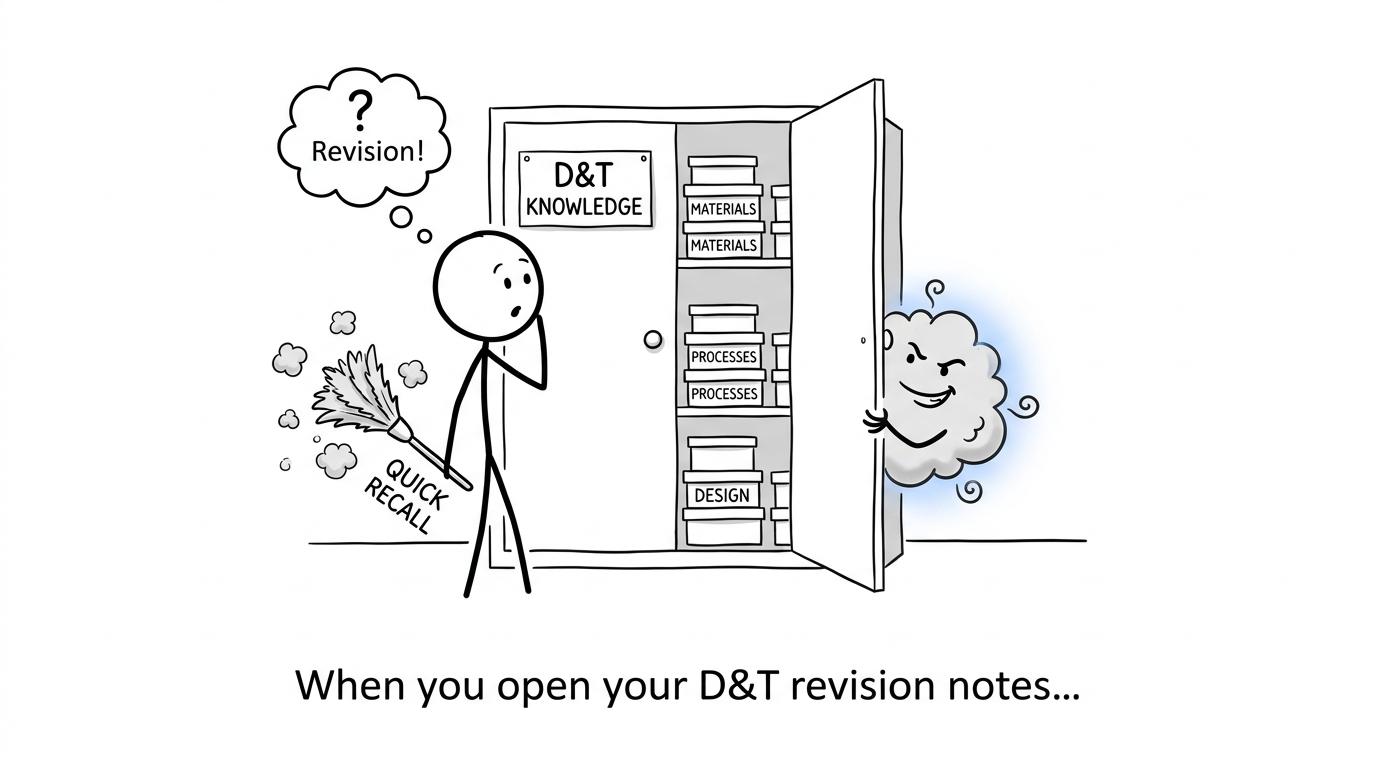 A small recall routine keeps dust away from stored knowledge
A maintenance plan from early confidence to exam season
Keep one short D&T recall session each week
Begin with a blank page or closed-book quiz. Retrieve definitions, material properties, processes, environmental considerations and design principles before checking your resources.
Do not measure the session by pages covered. Measure it by gaps discovered. A forgotten fact that reappears during practice is much cheaper than one that reappears in the examination.
Rotate content instead of repeating your favourite area
A student specialising in timbers may enjoy returning to timbers because success feels reassuring. The written assessment still requires the breadth specified by the relevant exam board.
Rotate between areas such as:
- core technical principles;
- specialist material knowledge;
- manufacturing and production processes;
- designing and making principles;
- sustainability and social considerations;
- graphical communication;
- calculations and interpretation;
- extended analysis and evaluation.
Check the current specification supplied by your school. D&T is not divided into foundation and higher tiers in the way GCSE maths is, and the exact paper structure differs across AQA, Edexcel, OCR and Eduqas.
Move from recall to application
Facts are the starting material, not the finished product. After retrieving a property or process, practise deciding where it would be appropriate, what trade-offs it creates and how it affects a product's user or environment.
Mark schemes matter here. They show whether a response needs a named feature, an explanation, contextual application or a justified judgement. Avoid memorising a generic paragraph and forcing it into every context.
Use exam questions as a temperature check
Occasional timed questions tell you whether knowledge remains usable under pressure. Mark the response promptly and classify each lost mark:
- knowledge gap;
- weak application to the context;
- incomplete explanation;
- calculation or unit error;
- misread command word;
- poor time management.
This is the same diagnostic idea used in MathsGenie’s guide to finding your weakest GCSE topics. The subject may change, but the useful question remains the same: why was the mark lost?
Do not neglect the maths inside D&T
D&T specifications include mathematical skills within design contexts. AQA and OCR, for example, state that at least 15%15\%15% of the written paper assesses maths. Edexcel also includes calculation questions, while students should always check their own specification for the precise requirements.
Relevant skills may include percentages, ratios, scale, area, volume, unit conversion, tolerances, quantities and interpretation of data. These should not be left until the final week merely because they also appear in GCSE maths.
Use the GCSE maths revision hub to keep the underlying skills secure. Ratio revision supports scale and proportional reasoning, while similar shapes, area and volume can strengthen spatial calculations relevant to design contexts.
The mathematical method does not change because the question contains a product. What changes is the context. Read carefully, select the necessary information, show working and include units.
Balance D&T maintenance with GCSE maths revision
When one subject feels secure, there is a temptation either to abandon it or to keep revising it because success feels good. Neither is efficient.
Give secure D&T content a small maintenance allocation and direct most of your effort towards genuine weaknesses across your timetable. A manageable routine might include one short D&T recall session, one application session and a periodic timed question set, rather than several complete evenings.
For maths, short diagnostic tasks can perform the same role. GCSE mini tests reveal whether a method is still available without consuming the time required by a full paper. If daily revision feels crowded, the 20-minute GCSE maths revision routine offers a simple learn, practise and mark structure.
As the exams approach, increase realistic practice gradually. Use the correct board, paper type and maths tier. Maths students following Edexcel can use Edexcel GCSE maths past papers, while AQA students can work from the AQA GCSE maths revision area.
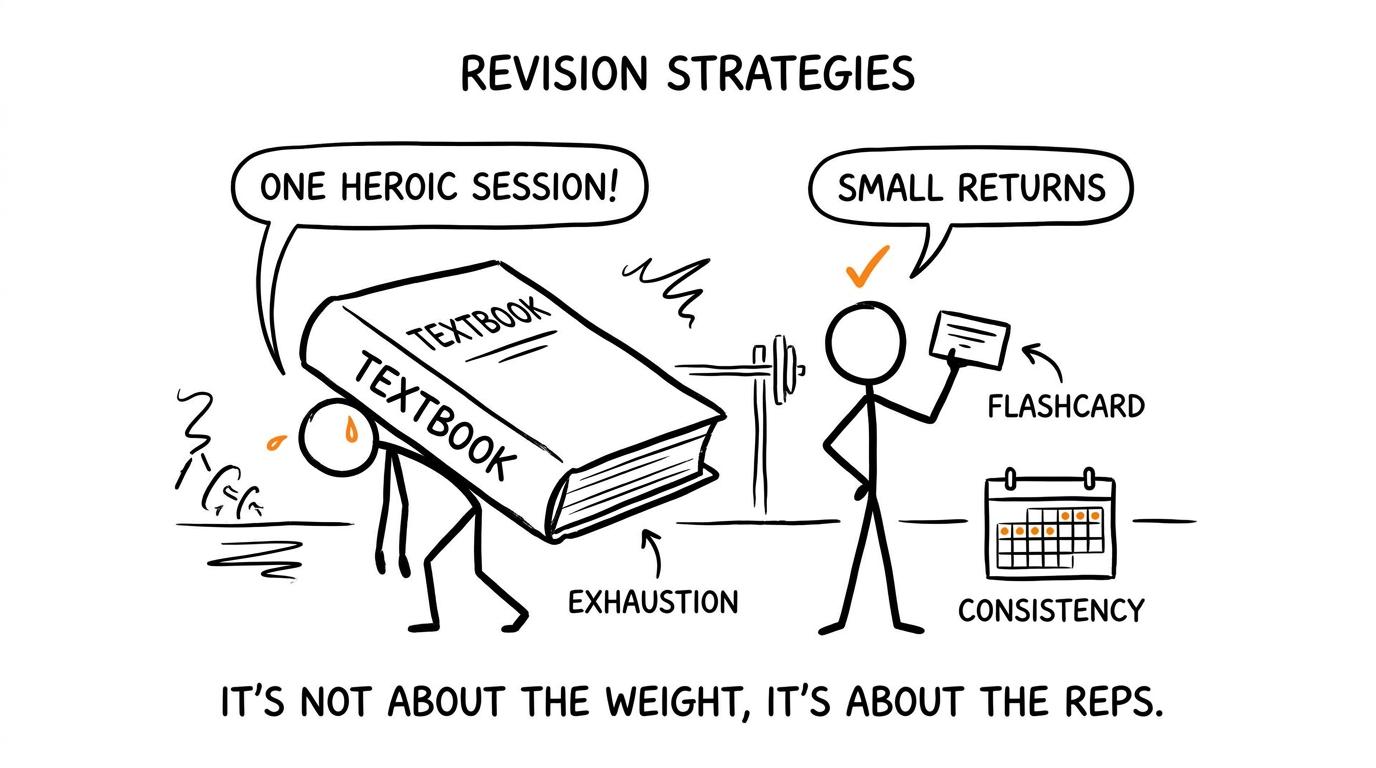 One huge revision session competes with calm repeated practice
Common mistakes when trying to stay exam-ready
Stopping completely because a mock went well
One strong result is evidence of progress, not permanent storage. Keep a light retrieval schedule so the knowledge remains accessible.
Revising only by rereading the NEA portfolio
Your project can help you remember authentic decisions, but it does not cover every written-paper requirement. Use the specification and past questions to check breadth.
Repeating comfortable topics
Confidence can become avoidance in disguise. If materials questions always go well but calculations or extended evaluation do not, spend more time where marks are actually leaking.
Testing too often without correcting errors
A question only becomes useful revision when you inspect the response. Check the mark scheme, identify the missing element and attempt a different question after a gap.
Treating every subject as equally urgent every day
A revision timetable should respond to evidence. Secure knowledge needs maintenance; weak knowledge needs repair. The allocation should change as new test and paper results arrive.
Burning out before May and June
Hours completed are a poor measure if attention has collapsed. Protect sleep, take genuine breaks and finish sessions with a clear next action. Consistency is more sustainable than repeated emergency revision.
Your confidence has not arrived too soon
Feeling ready early is an advantage. It gives you time to discover whether confidence survives closed-book recall, unfamiliar contexts and timed questions. If it does, maintain it gently. If it does not, you still have time to rebuild it.
The aim is not to feel at your absolute best every day until the examination. It is to arrive with knowledge that has been retrieved repeatedly, corrected carefully and applied under realistic conditions.
Use that same calm system for maths. Start with MathsGenie’s free revision lessons, move into practice questions and mini tests, then use past papers and predicted papers under timed conditions. Mark them with the available mark schemes and video solutions, add the errors to your revision planner, and return to the topics that genuinely need attention.
Do not chase one dramatic peak. Build readiness that lasts.










