

Is an Online GCSE English Course Worth It?
Online GCSE English Language revision course guide: decide if paid tuition is worth it, what to check, and when free resources may be enough for success.
Revision has a strange way of turning choice into pressure. One tab promises expert tuition. Another offers free videos. Your English mock needs attention, but the maths exam is approaching too. Suddenly, choosing a resource feels like another subject to revise.
So, is an online GCSE English Language revision course worth paying for? Sometimes. A good course can provide structure, personalised feedback and accountability. But if it mainly repackages generic videos and worksheets, free resources may serve you just as well. The deciding question is not whether paid courses are automatically better. It is whether a particular course solves a problem that free independent revision has not solved for you.
The short answer: when is a paid course worth it?
A paid English Language course is most likely to be worthwhile if you:
- need detailed feedback on your own writing;
- struggle to organise revision without deadlines;
- repeatedly lose marks on the same assessment objective;
- want live access to a knowledgeable teacher or tutor;
- need help adapting techniques to your exam board;
- will attend consistently and complete the work between sessions.
Free resources may be enough if you can already plan your time, identify weaknesses and practise independently. They are particularly effective when your school provides useful feedback and you mainly need more model answers, question practice and exam familiarity.
Before paying, ask one blunt question: what will this course give me that I cannot obtain free from school, official exam materials and independent revision? A clear answer is a good sign. A vague promise to “boost your grade” is not.
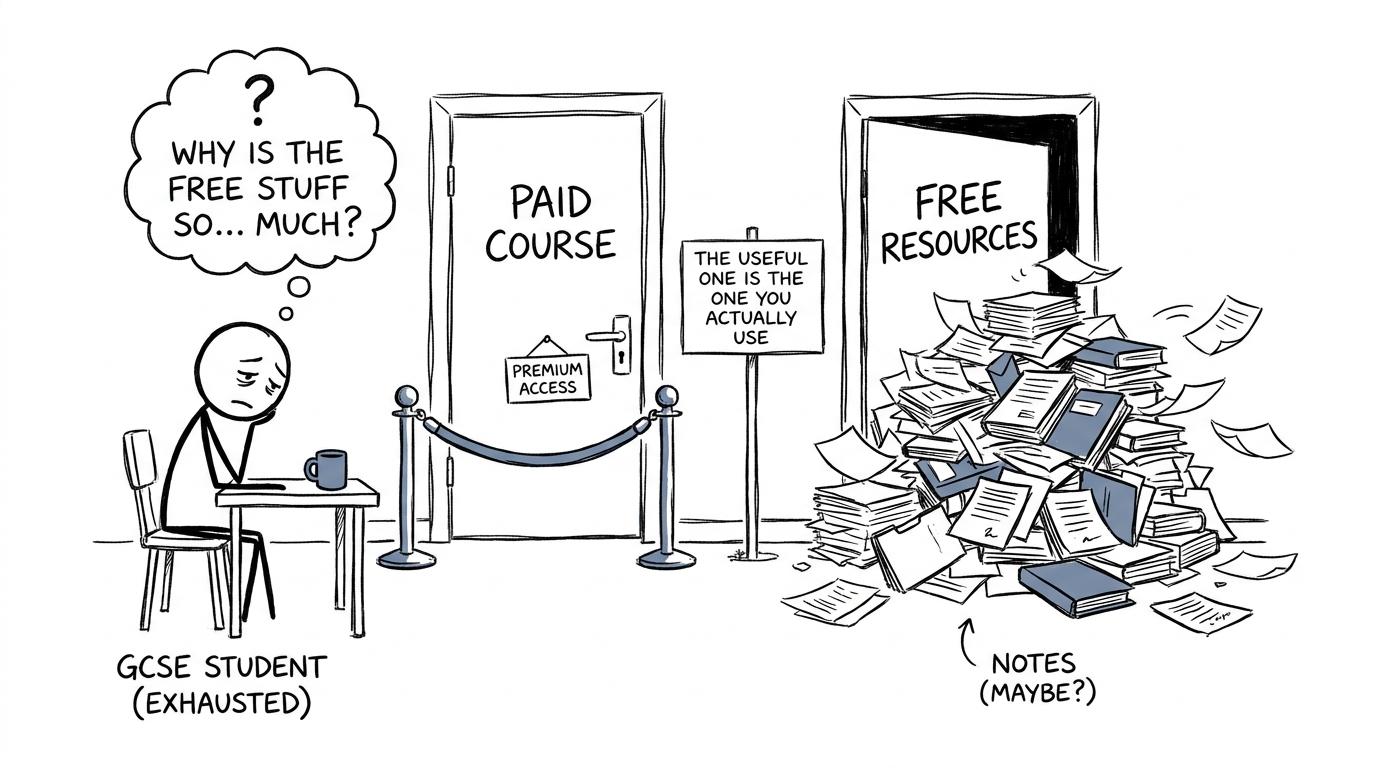 A student choosing between a paid course and free revision resources
What GCSE English Language actually assesses
You cannot judge a course until you know what it should teach.
GCSE English Language assessment objectives are set nationally and shared across exam boards in England. Broadly, the examined qualification gives equal weighting to reading and writing: reading accounts for 50%50\%50% and writing accounts for 50%50\%50%. Students need to interpret information, analyse language and structure, compare perspectives, evaluate texts and communicate effectively for different audiences and purposes.
Technical accuracy matters substantially. The assessment objective covering vocabulary, sentence structures, spelling and punctuation represents 20%20\%20% of the qualification as a whole. Spoken Language is compulsory and reported separately as an endorsement, but it does not contribute to the final numerical grade.
The precise papers, timings, source combinations and question sequences differ between AQA, Pearson Edexcel, OCR and Eduqas. For example, AQA’s current specification uses two externally assessed papers, each contributing 50%50\%50%, while OCR also uses two externally assessed components. A useful course must therefore match your board and specification, rather than teaching a supposedly universal answer formula.
English Language has no foundation or higher tier. That distinction matters when you return to maths revision, where your tier affects the content and papers you should use.
What are you really paying for?
Recorded explanations are inexpensive to distribute and widely available. Worksheets are easy to reproduce. The most valuable parts of a paid course are usually the parts that require a skilled person’s attention.
Personalised feedback
English answers are not improved simply by seeing that they differ from a model. You need to understand why an explanation lacks precision, where evidence has been underused, or how a paragraph could better address purpose and audience.
Strong feedback should be:
- connected to the relevant assessment objective;
- specific to words and sentences you wrote;
- clear about the next action;
- followed by an opportunity to redraft or retry;
- consistent with current exam-board expectations.
A course offering regular, individual marking may justify its cost. One offering only automated quizzes and general comments is providing something much closer to a free resource library.
Structure and accountability
Some students do not lack information. They lack a reliable sequence.
A well-designed course decides what to practise this week, sets a deadline and returns feedback before the next task. That can prevent the familiar cycle of watching advice videos without producing any writing. You are paying partly to remove decisions.
However, structure works only if you follow it. A course left unopened has no advantage over a free worksheet left untouched.
Access to a teacher
Live lessons can be valuable when they allow genuine questions, explanation and correction. Check whether sessions are taught by the named teacher, how large the group is and whether recordings are available when you miss a lesson.
“Live” is not automatically personal. A crowded webinar with limited interaction may offer less value than careful feedback delivered asynchronously.
Paid online courses compared with free resources
The comparison is not simply paid versus free. It is supported revision versus unsupported revision.
| Feature | Paid course | Free resources |
|---|---|---|
| Teaching sequence | Usually planned for you | You normally build your own plan |
| Individual feedback | Possible, but must be confirmed | Usually limited outside school |
| Live questions | Often available | Uncommon |
| Flexibility | Depends on lesson times | Usually very flexible |
| Exam-board match | Should be explicit | Requires careful selection |
| Cost | Varies considerably | No course fee |
| Success depends on practice | Yes | Yes |
Free revision is not automatically less rigorous. Official specifications, past papers, mark schemes and examiner guidance can show precisely what is assessed. The challenge is turning those materials into a routine of writing, marking, reflection and redrafting.
That principle is familiar in maths. Watching someone solve a problem can create recognition, but independent practice creates recall. MathsGenie’s guide to using GCSE mark schemes as a revision coach explains how marking becomes part of learning rather than a final judgement. The same attitude helps in English, even though extended responses require more interpretation.
How to evaluate an online GCSE English Language revision course
Do not buy because the sales page feels reassuring. Look for evidence that the teaching matches your needs.
Check the specification match
The provider should clearly name the exam board and explain which papers, sections and assessment objectives are covered. Be cautious if one rigid answer structure is presented as suitable for every question and board.
Inspect the feedback promise
Find out:
- how often your work will be marked;
- whether feedback is individual or generic;
- who marks it;
- how quickly it is returned;
- whether you can submit a redraft;
- whether feedback covers both reading and writing.
If marking is the main reason you are paying, these details should not be hidden.
Examine the workload
A demanding course is not necessarily a good course. You still have maths, science and other GCSE subjects to prepare for. Ask how many lessons and assignments are expected each week, and whether the schedule fits your actual timetable.
Maths revision should not disappear while English becomes urgent. MathsGenie’s GCSE English Language exam-week checklist includes a simple approach for keeping maths active alongside English. Short, contained sessions can preserve fluency without competing with your main priority.
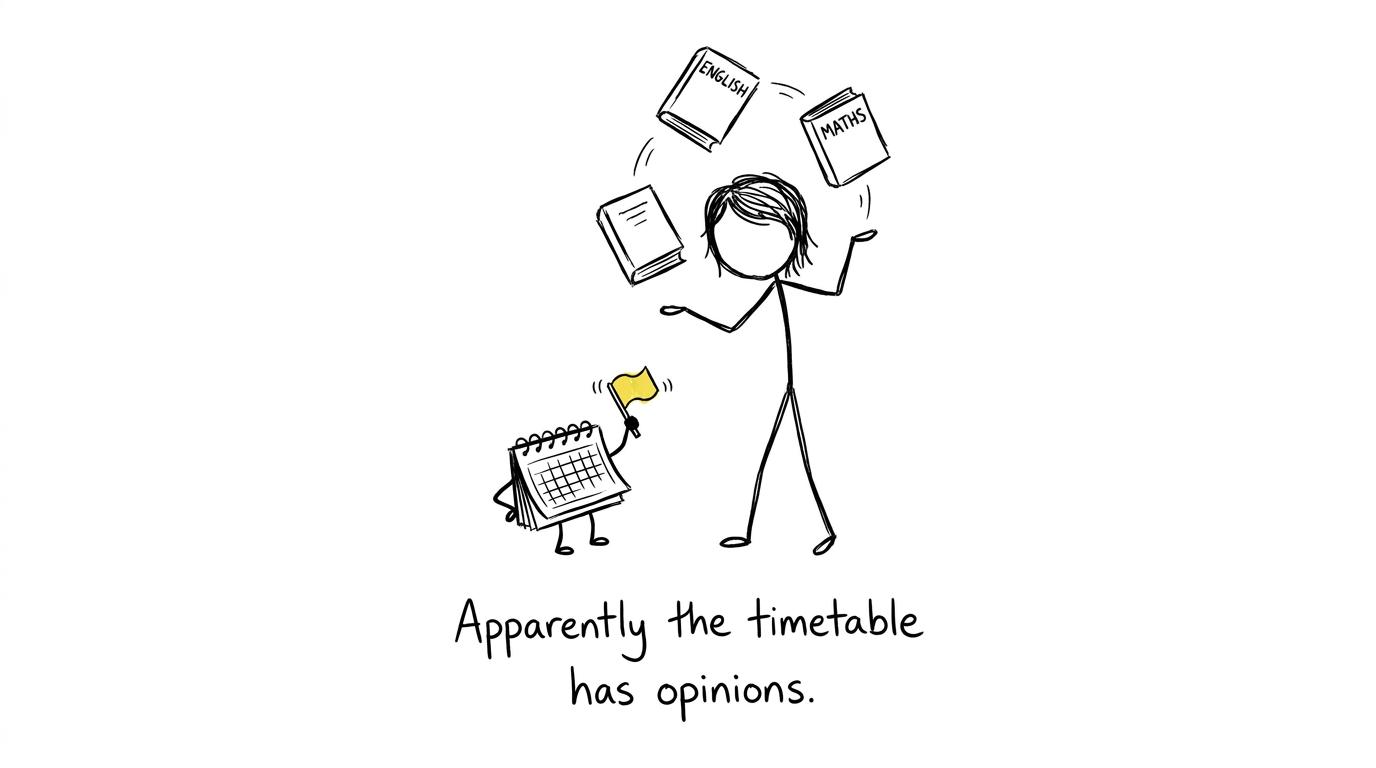 A student juggling English and maths revision
Read the practical terms
Before paying, check the total cost, payment schedule, cancellation terms, trial or refund conditions, access period and whether recordings expire. These details can change, so rely on the provider’s current written terms rather than old reviews or social-media posts.
Be sceptical of guaranteed grades
No responsible course can guarantee a particular GCSE grade. Results depend on your starting point, attendance, independent practice, exam performance and many other factors. Look for precise teaching commitments, not confident predictions about outcomes.
When free resources are probably enough
You may not need a paid course if your difficulty is mainly a lack of practice.
Try a short free-resource test first:
- confirm your exam board and specification;
- choose one reading or writing skill;
- complete a timed question;
- use the mark scheme and school feedback to identify one weakness;
- improve or redraft the response;
- repeat with a fresh question later.
If you can maintain that cycle, paying for more content may add little. If you repeatedly avoid the work, cannot interpret feedback or do not know what to improve, structured support becomes more valuable.
The same diagnostic approach protects your maths progress. Use Edexcel GCSE Maths mini tests for short checks, then move to Edexcel GCSE Maths past papers when you need full exam practice. Students on another board can begin from MathsGenie’s free GCSE and A Level maths revision hub or use the dedicated Eduqas GCSE Maths revision area.
How to balance an English course with maths revision
A course should make your week clearer, not consume every available hour.
Create separate jobs for each subject. English Language needs regular reading analysis and sustained writing. Maths needs repeated retrieval, written working and exam-style questions. Do not revise either subject entirely through passive video watching.
On busy school days, MathsGenie’s 20-minute maths revision routine gives you a manageable maintenance session. During a longer preparation window, the one-month GCSE maths revision plan can help you distribute topic practice, mini tests and papers.
Near the exams, use GCSE predicted maths papers to rehearse unfamiliar combinations of topics. Predicted papers are practice tools, not promises of what will appear, so they should complement rather than replace past papers and specification coverage.
Common mistakes when choosing a revision course
Paying for motivation alone
A purchase can feel like progress before any work has happened. Choose a course for a specific service: feedback, teaching, planning or accountability, rather than the temporary relief of having bought something.
Confusing more content with better revision
A library containing hundreds of videos may still leave you unsure what to do next. Sequence and feedback matter more than volume.
Ignoring the exam board
General reading and writing skills transfer, but paper structures do not always match. Confirm that question guidance applies to AQA, Edexcel, OCR or Eduqas as appropriate.
Never writing under timed conditions
English Language is a performance subject. Advice becomes useful only when you produce complete responses under realistic time pressure.
Letting English replace maths completely
A weak English mock may deserve extra attention, but abandoning maths for several weeks creates another problem. Keep a small maths routine running through revision lessons and free practice resources, then increase paper practice when your timetable allows.
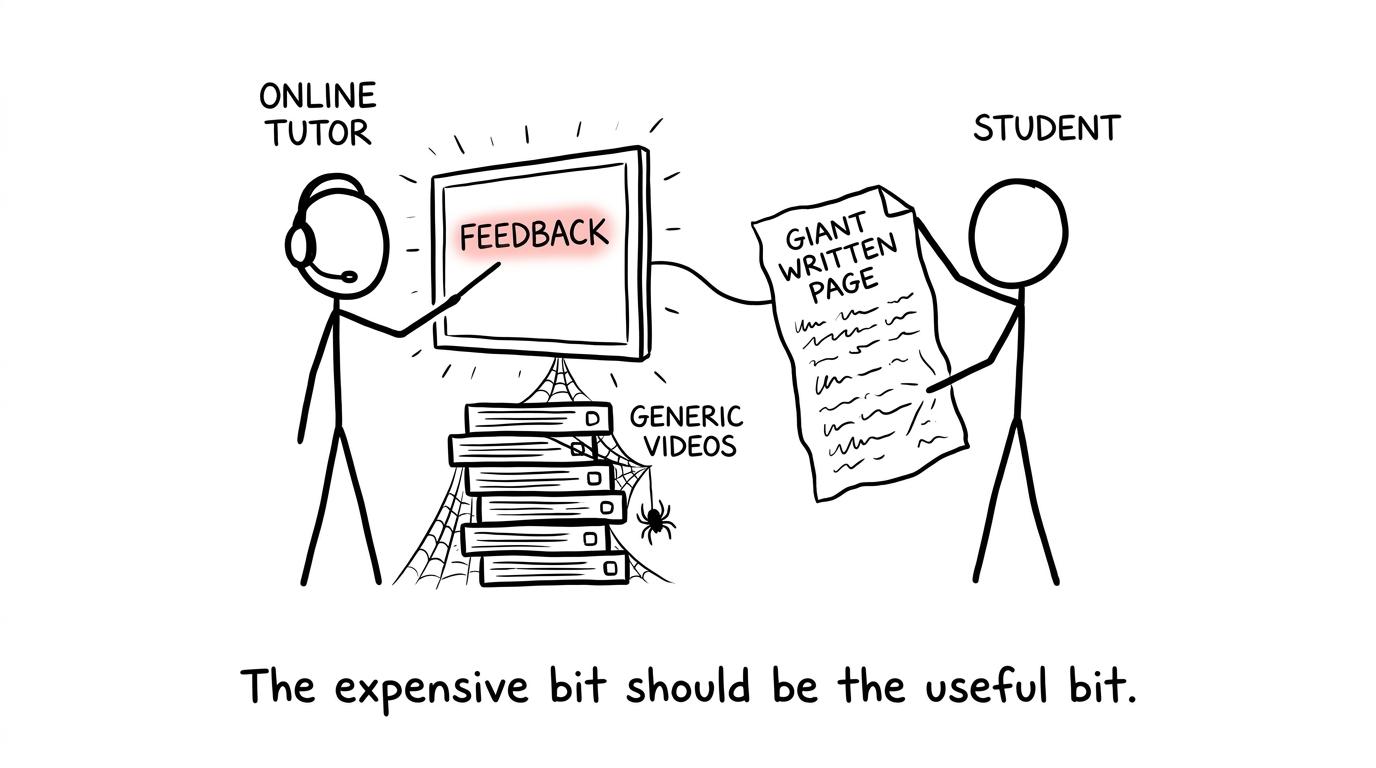 A tutor explaining why useful feedback matters more than generic videos
Make the decision based on the bottleneck
A paid online GCSE English Language revision course is worth it when it removes a real obstacle: weak feedback, unclear structure, unanswered questions or poor accountability. It is unlikely to be worth it when it merely places familiar free content behind a payment screen.
Try to name your bottleneck in one sentence. If you need somebody to diagnose and respond to your writing, look for strong individual marking. If you already receive that support at school, organise free materials into a consistent practice cycle before spending money.
And protect the rest of your revision. Use MathsGenie as your free maths base: learn through revision lessons, practise with topic questions and mini tests, check mark schemes and video solutions, then build confidence with past papers and predicted papers. The best revision resource is not the one with the loudest promise. It is the one that helps you complete the next useful piece of work.










