Is an Online GCSE Bengali Revision Course Worth It?
Online GCSE Bengali revision course: see when paid tuition is worthwhile, when free resources are enough, and how to protect your GCSE maths revision time.
There is a particular kind of revision worry that appears when you are preparing for more than one demanding GCSE. Bengali needs vocabulary, grammar, listening and speaking practice. Maths needs regular problem-solving, careful marking and time under exam conditions. Both can expand to fill every free evening you have.
So, is an online GCSE Bengali revision course worth paying for? The short answer is: it can be, but only when it provides targeted teaching, individual feedback and a clear structure that free resources cannot give you. If it is mainly a collection of recorded videos and worksheets, free materials may be enough.
The decision is not really paid versus free. It is guided feedback versus independent revision and whether that guidance solves a problem you genuinely have.
The quick decision checklist
Before joining a course, ask:
- Does it match your exact qualification and exam board?
- Will a knowledgeable tutor mark your speaking and writing?
- Are live classes small enough for you to participate?
- Does the course include listening, speaking, reading and writing?
- Will you receive useful feedback rather than just a score?
- Can you attend consistently without sacrificing maths revision?
- Is there a trial lesson, sample material or clear cancellation policy?
- Could your school, family or free exam-board resources already provide what you need?
A course that passes these tests may be worthwhile. A course that cannot answer them clearly probably is not.
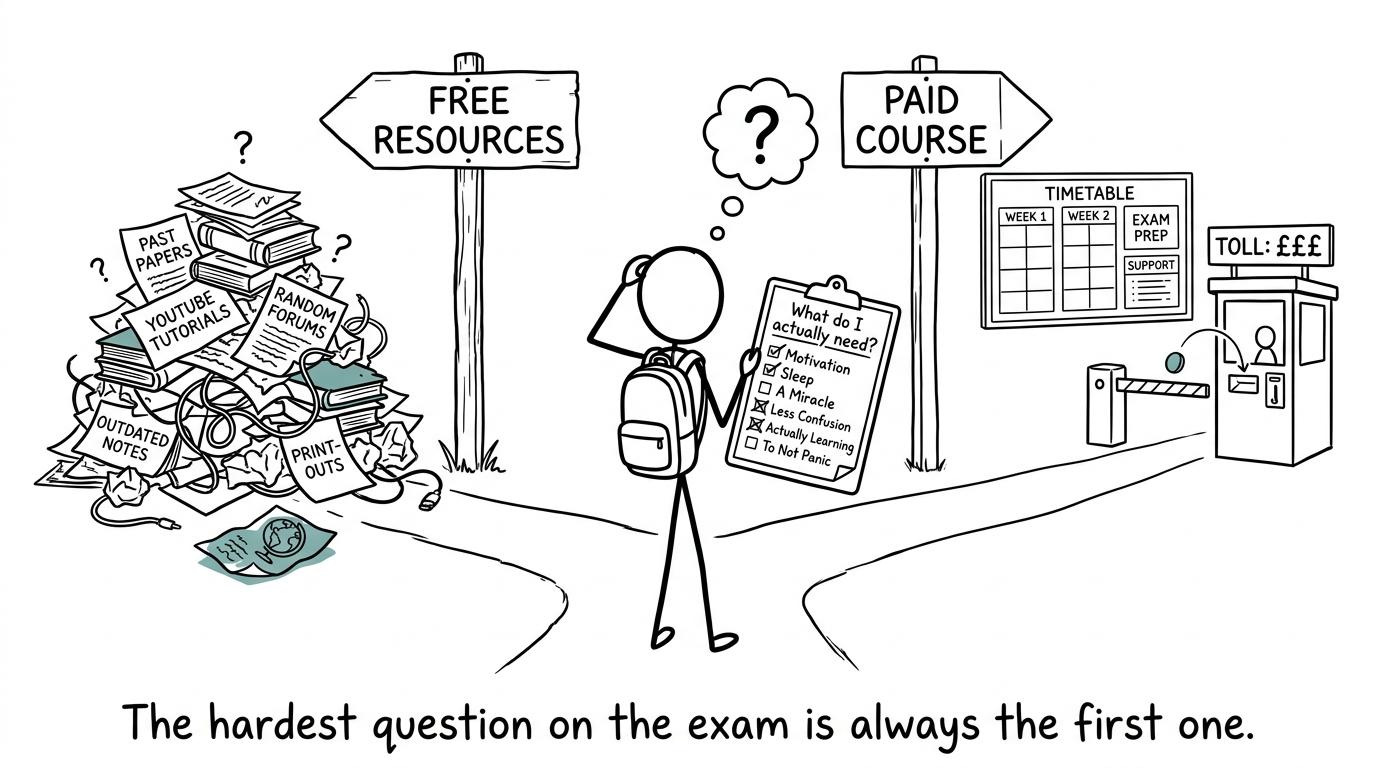 A GCSE student choosing between free resources and a paid course
Start by checking which Bengali qualification you take
This sounds obvious, yet it is one of the easiest details to miss. GCSE Bengali and International GCSE Bangla are not interchangeable names for an identical assessment.
AQA currently offers GCSE Bengali. Its specification assesses listening, speaking, reading and writing, with each skill contributing 25%25\%25% of the qualification. Students enter all components at the same tier: Foundation targets grades 111-555, while Higher targets grades 444-999.
Pearson Edexcel offers an International GCSE in Bangla. Its structure and assessment arrangements differ from AQA GCSE Bengali. Course providers sometimes use phrases such as “GCSE Bengali” broadly, so do not rely on the course title alone.
Check the qualification name, specification code, tier and examination series with your teacher or exams officer. Then ask the provider to confirm in writing that its lessons cover that exact specification. A polished course aimed at the wrong assessment is still the wrong course.
This principle matters in maths too. Edexcel, AQA, OCR and Eduqas cover common national GCSE maths content, but paper styles and specification organisation vary. The GCSE maths topics by exam board and tier guide can help you make the equivalent check for maths.
What are you actually paying for?
Information itself is rarely the scarce resource. Students can often find vocabulary lists, specification documents, past papers and grammar explanations without paying. What is scarce is reliable diagnosis.
A strong tutor notices that your answer communicates the right idea but uses a narrow range of language. They hear hesitation in a speaking task. They identify a recurring spelling or grammatical error across several pieces of writing. Then they choose the next task around that evidence.
That is the main potential value of a paid course:
- diagnosis, identifying the precise reason marks are being lost;
- feedback, explaining what to change and how;
- accountability, creating a regular reason to complete work;
- interaction, especially for spontaneous speaking and listening;
- sequencing, teaching content in a sensible order;
- exam alignment, connecting practice to the correct specification and mark scheme.
Current educational evidence supports targeted one-to-one and small-group tuition, but averages are not guarantees. Tuition tends to work best when it addresses diagnosed needs, stays connected to the curriculum and gives pupils frequent opportunities to respond to feedback. Paying a fee does not automatically create those conditions.
Why speaking and writing can justify paid support
Reading and vocabulary can often be practised independently because you can compare many answers with a mark scheme or model response. Speaking is different. You need another person to listen, ask follow-up questions and respond to what you actually say.
Writing also benefits from expert marking. A model answer can show quality, but it cannot tell you which patterns in your own work are limiting accuracy or variety.
If these are your main weaknesses and suitable support is unavailable through school or family, live tuition may offer genuine value. If your problem is simply that you have not learnt the required vocabulary or attempted available papers, buying a course may add structure without fixing the underlying habit.
When free GCSE Bengali resources may be enough
Free revision can be entirely sensible when you already have access to a Bengali teacher, receive useful marking at school and are capable of following a timetable independently.
You may not need a paid course if you can:
- obtain the correct specification and topic list;
- use official sample or past assessment material;
- practise listening regularly;
- find a fluent speaker for conversation practice;
- submit writing to a teacher for feedback;
- mark work honestly and revisit mistakes;
- maintain a consistent weekly routine.
Free does not mean unstructured. You still need a cycle: attempt, check, diagnose, correct and retest. Simply watching explanations or rereading vocabulary can feel productive while avoiding the harder work of recalling language unaided.
The same distinction appears in maths. MathsGenie provides free GCSE maths revision lessons and practice resources, but improvement comes from answering questions, checking solutions and repairing mistakes. Access is not the same thing as action.
When an online GCSE Bengali revision course is worth it
Paid tuition becomes more reasonable when there is a clear gap between what you need and what you can obtain freely.
You need regular personalised feedback
A tutor should be able to explain your recurring weaknesses and set specific next steps. Feedback such as “revise grammar” is too vague. You should leave knowing what to practise before the next lesson.
You lack speaking opportunities
A live course can create regular, structured conversation and help you become comfortable responding without a prepared script. Ask how much individual speaking time each student receives. A large webinar may technically be live while offering almost no interaction.
You struggle to organise independent revision
Some students know what to do but repeatedly postpone it. A fixed class, deadline and marked assignment can reduce the number of decisions required each week. In that case, part of the fee buys accountability.
You have a specific gap to close
Targeted support is usually more valuable than a broad course covering everything again. Perhaps listening is secure but extended writing is not. Ask whether the provider adapts tasks to your needs or follows the same programme for every student.
A useful parallel is MathsGenie’s guide to finding your weakest GCSE topics. Diagnose first. Spend time and money second.
When paying is probably not worthwhile
Be cautious if the course:
- does not name the qualification or specification it teaches;
- offers recorded content without marking or tutor contact;
- promises a particular grade or guaranteed improvement;
- places many students in a class with little individual participation;
- cannot explain the tutor’s Bengali language and teaching experience;
- provides no sample lesson, syllabus or feedback policy;
- duplicates support you already receive at school;
- creates a timetable you are unlikely to sustain.
Recorded lessons are not inherently poor. They may be convenient and well taught. But if videos are the main product, compare them carefully with free materials before paying. The strongest reason to purchase tuition is usually responsive teaching, not another login page.
How to compare a paid course with free resources
Use evidence rather than the provider’s headline claims.
| Question | What a strong answer looks like |
|---|---|
| Which qualification is covered? | The exact board, specification and tier are stated clearly. |
| How are students assessed? | An initial diagnostic identifies strengths and gaps. |
| Is teaching live? | Students can answer, ask questions and receive corrections. |
| How is writing marked? | Feedback refers to accuracy, communication and exam criteria. |
| How is speaking practised? | Every student receives regular individual speaking time. |
| What happens after mistakes? | Students complete targeted practice and are retested. |
| What resources are included? | Materials match the current specification and course plan. |
| Can progress be reviewed? | The tutor can show completed work and explain next priorities. |
If the provider avoids these questions, the course may be selling reassurance more than teaching.
Protecting your GCSE maths revision time
A Bengali course can be useful and still be the wrong choice if it crowds out another priority. Revision has an opportunity cost: every scheduled hour belongs to something else first.
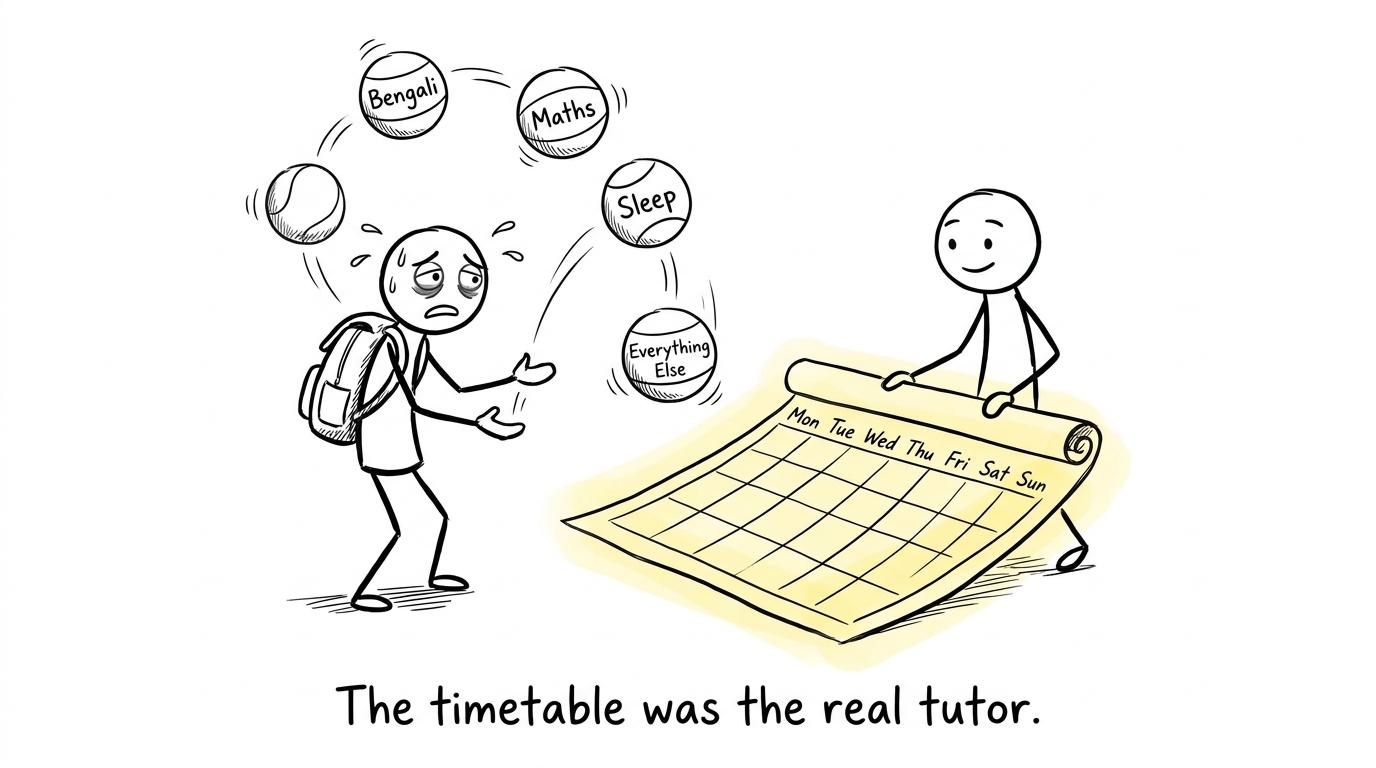 A student juggling Bengali, maths, sleep and everything else
Build one combined timetable rather than separate plans for each subject. Include lessons, homework, travel, sleep and genuine rest before adding optional tuition. The GCSE maths revision timetable provides a practical framework, while the one-month GCSE maths revision plan can help when exams are approaching.
On busy school days, consistency matters more than designing an impressive schedule you abandon after a week. A short session using the GCSE twenty-minute maths revision routine can preserve maths momentum around Bengali classes.
Keep some maths sessions short and diagnostic. GCSE mini tests can reveal gaps without consuming an entire evening. As exams approach, add timed papers and follow the complete, mark, diagnose and retest method described in the guide to using GCSE maths past papers properly.
Common mistakes when choosing a Bengali course
Buying before diagnosing the problem
“Bengali feels difficult” is not a useful diagnosis. Identify whether the difficulty is vocabulary recall, listening comprehension, speaking fluency, reading, translation, grammar, spelling, timing or extended writing.
Confusing fluency with exam readiness
Speaking Bengali at home can be a major strength, but an examination also rewards performance against defined assessment criteria. Everyday fluency does not automatically provide formal vocabulary, accurate writing or familiarity with task formats.
The reverse is also true: a student who lacks confidence in conversation may still have strong reading and writing skills. Start from evidence, not assumptions.
Choosing by price alone
The cheapest course may offer little interaction. The most expensive may provide features you do not need. Compare the amount and quality of individual feedback, not just the total number of teaching hours.
Ignoring group size
Small-group tuition can allow interaction and targeted support. As a class grows, individual speaking time and feedback can shrink. Ask for the normal group size rather than accepting the word “small”.
Treating attendance as revision
Joining a lesson is only the beginning. You still need to retrieve vocabulary, complete tasks, apply feedback and revisit errors. A course cannot practise on your behalf.
Make the decision your results need
An online GCSE Bengali revision course is worth considering when it matches your exact qualification, provides meaningful speaking and writing feedback, targets diagnosed weaknesses and fits alongside your other subjects. Free resources are likely to be enough when you already receive expert feedback, have someone with whom to practise speaking and can manage a disciplined revision cycle independently.
Do not buy a course simply to feel that something has been done. Buy it only when you can name the problem it will solve.
Then protect the rest of your revision. Use MathsGenie as your free maths base: begin with revision lessons and practice questions, check your work with solutions and mark schemes, build accuracy through mini tests, and progress to past papers and predicted papers. Good revision is rarely about collecting more resources. It is about choosing the right next task and completing it carefully.