Can You Use an Old Textbook for GCSE English?
Old textbook GCSE English Literature advice: check set texts, poetry, exam board and assessment rules before using a hand-me-down revision guide.
A hand-me-down textbook can feel like a small victory. The notes are already there, the important quotations are highlighted, and it costs nothing. Then doubt arrives: what if the course has changed?
The short answer is that an old textbook for GCSE English Literature can still be useful, but only after you check it against your current exam board specification, set texts, poetry anthology and assessment format. Literary analysis ages slowly. Exam instructions can change much faster.
A well-annotated guide to Macbeth may remain valuable for years. A revision guide covering a withdrawn modern text, an old poetry cluster or outdated question structure may send your revision in the wrong direction. The safest approach is to keep the useful literary insight while checking every exam-specific detail with your teacher and the current specification.
The quick textbook checklist
Before relying on an older book, check these details:
- Exam board: AQA, Pearson Edexcel, OCR or Eduqas
- Specification code: not merely the subject name
- Your exact set texts: including the correct play, novel and modern text
- Poetry anthology or cluster: poem lists can be updated
- Exam format: papers, sections, timings and question styles
- Assessment objectives: what the examiner rewards
- Publication date: useful evidence, although not a guarantee of accuracy
- Teacher approval: your school knows which options your class has entered
If all eight match, the book is probably safe as a supporting resource. If the literary text matches but the exam guidance does not, use it for ideas about character, theme and language, not as your map of the examination.
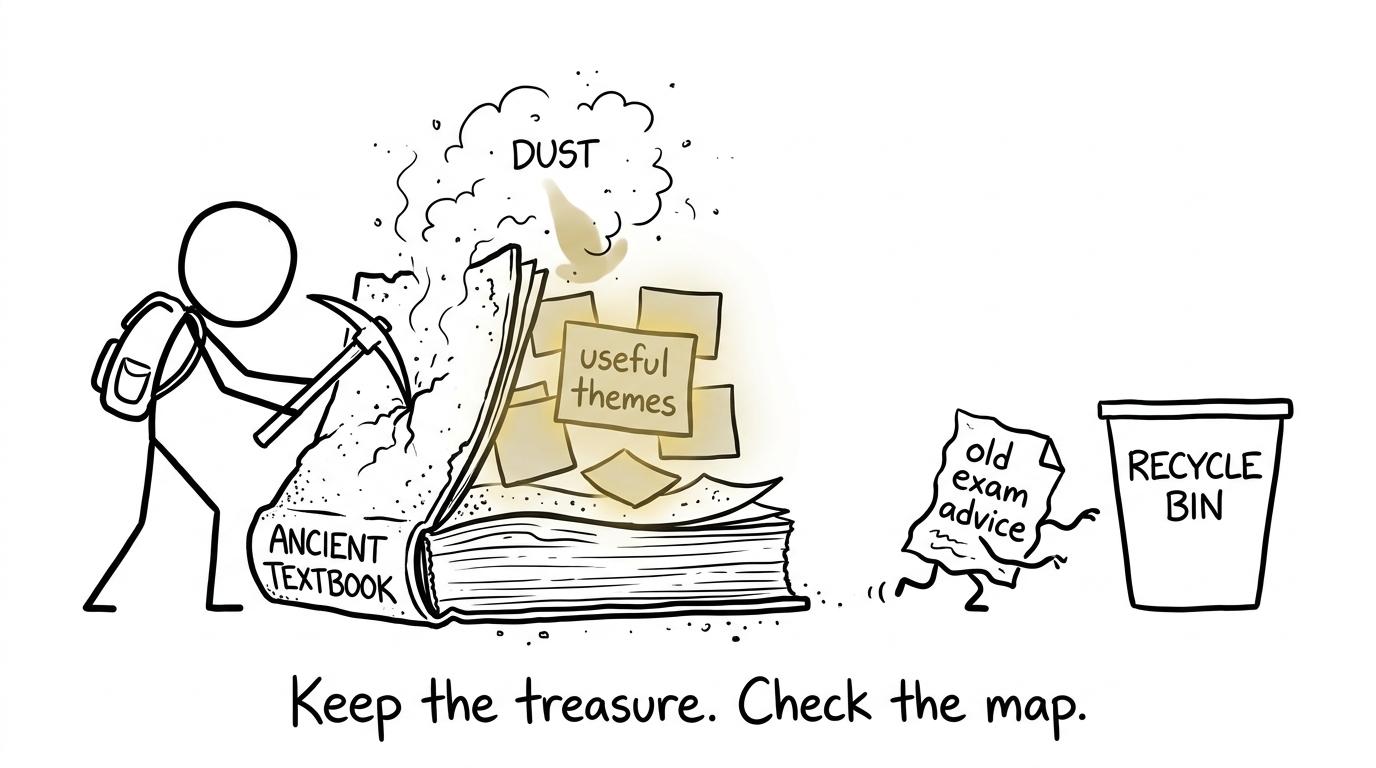 A student discovers useful ideas and outdated exam advice inside an ancient textbook
How much has GCSE English Literature changed recently?
The broad shape of GCSE English Literature in England has been relatively stable since the reformed qualifications were introduced for first teaching in 2015. The national subject requirements still include Shakespeare, a nineteenth-century novel, poetry from 1789 onwards and British fiction or drama from 1914 onwards. Students must also respond to unseen material.
That stability is good news for anyone using an older textbook. Core skills such as interpreting a text, selecting evidence, analysing language and structure, considering context and developing a personal response have not suddenly become obsolete.
However, stability at subject level does not mean every revision book remains current. Exam boards choose their own set-text menus, anthologies and paper structures. Those details can change while the wider qualification remains recognisable.
Recent AQA changes
AQA introduced three modern texts for first teaching in 2023 and first examination in 2025: Princess & The Hustler, Leave Taking and My Name is Leon. Three previous options, The History Boys, Never Let Me Go and the play version of The Curious Incident of the Dog in the Night-Time, had their final AQA examination in 2024.
AQA also added the Worlds and Lives poetry cluster, first examined in 2025. Its established Power and Conflict and Love and Relationships clusters remain options, but an older guide cannot be assumed to cover whichever cluster your school selected.
This is a perfect example of why the date on the cover is not enough. An old Macbeth guide might be entirely relevant, while a more recent general guide could contain a modern-text option that is no longer examined.
Recent Eduqas changes
Eduqas made set-text changes for assessment from 2025, including replacing some previous options. More importantly for current students, its poetry anthology changes for assessment from 2027. The anthology examined for the final time in summer 2026 is replaced by a new collection containing a different selection of poems.
If you are taking Eduqas in 2027 or later, a hand-me-down anthology from an older sibling is therefore not a reliable poetry list. Some individual poems and general comparison techniques may still help, but you need the anthology specified for your examination year.
Pearson Edexcel and OCR
Pearson reported no change to the delivery of its GCSE English Literature specification for the 2025-2026 academic year. That makes many recent Edexcel guides potentially serviceable, provided they cover your school’s chosen texts and the correct specification.
OCR’s current qualification continues to assess a modern prose or drama text, a nineteenth-century novel, a poetry cluster and Shakespeare. OCR has also refreshed parts of its poetry provision over the life of the qualification, so an older printed anthology or guide should be checked poem by poem against the current list.
The practical lesson is simple: exam boards do not all update the same material at the same time. Never decide that a book is current merely because another student used it recently.
What parts of an old textbook still hold up?
Some knowledge has a long shelf life. A strong explanation of dramatic irony in An Inspector Calls does not stop being thoughtful because the page was printed several years ago. Neither does a careful discussion of responsibility, social class or Priestley’s construction of the Inspector.
An older guide can remain valuable for:
- plot and character summaries
- explanations of themes and motifs
- analysis of language, form and structure
- relevant historical or literary context
- short, accurate quotations
- vocabulary for discussing writers’ methods
- prompts for developing alternative interpretations
The original literary text itself is usually the most durable resource. Shakespeare’s language does not change when an exam board updates a specification. Older editions of public-domain novels may also contain the same core text, although introductions, notes, pagination and editorial choices can differ.
Check quotations against the edition used by your class. A typing error, modernised spelling or shortened quotation copied from a guide can become surprisingly difficult to unlearn.
Which parts become outdated first?
The most fragile pages are usually those closest to the examination.
Treat the following with caution:
- lists of prescribed texts and poems
- paper names and question numbers
- timings, marks and weightings
- advice about which material is printed in the paper
- model answers written for an earlier mark scheme
- predictions about likely characters or themes
- references to temporary examination arrangements
GCSE English Literature is untiered, unlike GCSE maths, where students may sit foundation or higher tier. Current GCSE Literature qualifications are linear and externally assessed. AQA, Edexcel and Eduqas GCSE Literature examinations are closed book, with required stimulus material supplied in the assessment where applicable. Do not interpret ownership of a textbook as permission to take it into the examination.
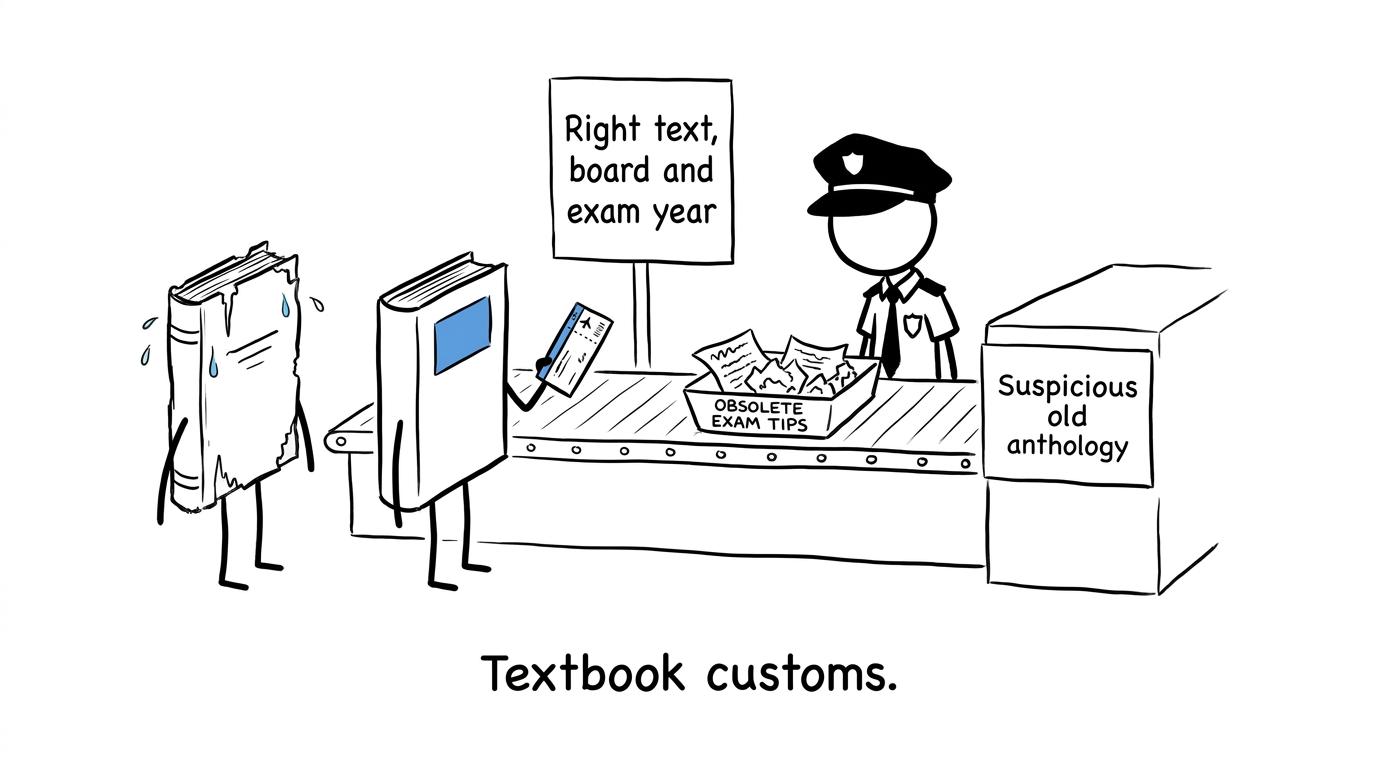 Revision books pass through a checkpoint for the correct text, board and examination year
A traffic-light test for a hand-me-down textbook
Green: use it confidently
Use the resource normally when the specification, exam board, examination year, text list and anthology all match. Even then, compare its examination advice with current information from your teacher.
Amber: use selected chapters
An amber book covers your literary text but not your current specification. Its thematic analysis and context may be helpful, but ignore paper layouts, timings and mark allocations until independently checked.
This category includes many general guides to widely studied texts such as Macbeth, A Christmas Carol and An Inspector Calls.
Red: replace it
Do not make the book a central revision resource if it teaches a withdrawn set text, the wrong poetry anthology or a substantially different qualification. The same applies if you cannot identify its exam board or publication context.
A free hand-me-down is not free if it costs hours of revision on material you will not be examined on.
How to use an older guide without inheriting its mistakes
Start by writing your board, specification code, set texts, poetry cluster and examination year on the inside cover. This turns a vague worry into a concrete comparison.
Next, label questionable pages. You might mark literary analysis as “content” and paper advice as “check”. Do not copy every annotation left by the previous owner. Their interpretation may be interesting, but it is not automatically accurate or suited to your question.
Finally, test what you learn through retrieval and timed writing. Reading familiar-looking notes can create confidence without recall. Close the book, plan a response from memory, select evidence and then check what you missed.
That principle transfers directly to maths revision. Reading a method is only the beginning; attempting questions reveals whether you can use it. The GCSE Maths revision hub organises free lessons, worksheets and exam practice by board, while the guide to finding your weakest GCSE topics shows how evidence from questions can shape your next revision session.
Balance old resources with current evidence
A textbook explains content. A specification defines what may be assessed. A mark scheme shows how marks are awarded. These resources do different jobs, so one cannot safely replace all the others.
For English Literature, ask your teacher for the latest board information and use current assessment materials where available. For maths, the same discipline means choosing papers for your board and tier rather than treating every old paper as interchangeable.
MathsGenie’s guide to using GCSE past papers properly explains the paper, mark, fix and retest cycle. Students can find board-specific resources through the GCSE Maths revision area, or use Edexcel GCSE Maths past papers with mark schemes and worked solutions where available.
Shorter checks can be more revealing than another hour of rereading. The Edexcel GCSE Maths mini tests provide focused timed practice, while Edexcel predicted papers can add fresh practice near the examination. Predicted papers should supplement current specification knowledge and official past papers, not replace them.
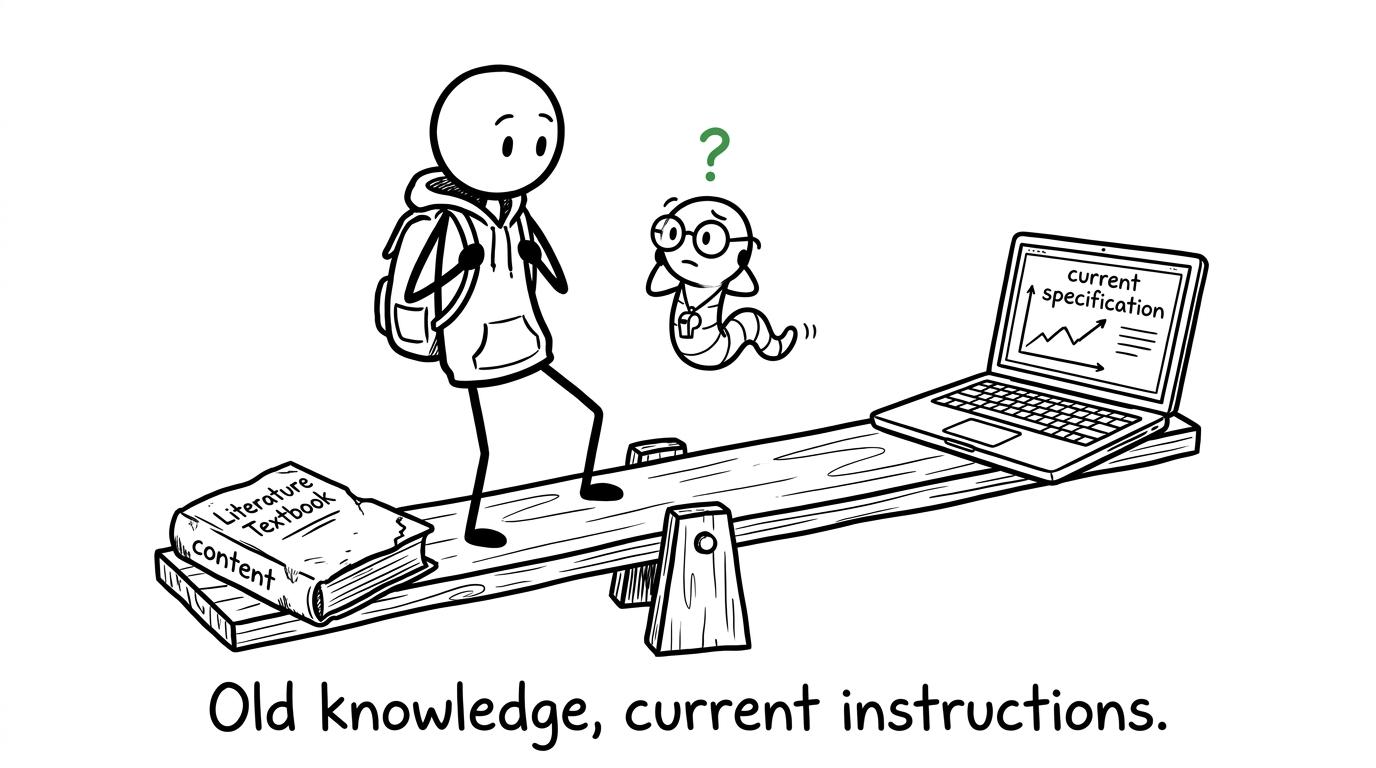 An old textbook and current specification balance on a revision seesaw
Common mistakes when using an old GCSE textbook
Assuming the title proves it matches
“GCSE English Literature” is too broad. Two books with that title may cover different boards, set texts, anthologies or examination years.
Checking the novel but forgetting poetry
Students often notice that their Shakespeare play matches and stop checking. Poetry collections are particularly vulnerable to change, as recent AQA and Eduqas updates demonstrate.
Learning outdated question structures
Useful analysis can be wrapped inside obsolete examination advice. Verify timings, marks, sections and assessment objectives before practising a rigid essay formula.
Trusting every handwritten annotation
Previous notes may be insightful, mistaken or copied from an unrelated lesson. Treat them as possible interpretations, then confirm quotations and context.
Rereading instead of retrieving
A highlighted page feels productive because it is familiar. Real preparation requires recalling quotations, planning arguments and responding to unfamiliar questions without leaning on the guide.
Using old practice without current practice
Older materials can expand your question bank, but current materials should calibrate your preparation. The same rule applies in maths: use older questions for additional skill practice, then return to present-format papers. MathsGenie’s GCSE one-month revision plan offers a structured way to combine topic repair, timed work and mark-scheme review.
The sensible verdict
Yes, an older textbook can still hold up for GCSE English Literature. The lasting parts are usually its explanations of the literary work: character, theme, language, structure and context. The risky parts are its text lists, anthology coverage, paper format and examination advice.
Do not throw away a useful book merely because it has an old cover. Equally, do not trust it merely because someone else passed it down. Keep the insight. Verify the instructions.
Then apply that same careful habit to your maths preparation. Start at the MathsGenie GCSE Maths revision hub, choose the correct board and tier, and build a reliable cycle using free revision lessons, practice questions, mini tests, past papers, predicted papers, mark schemes and video solutions. Good resources matter, but checking that they match the examination in front of you matters even more.