

Old Textbook GCSE Biblical Hebrew: Is It Useful?
Old textbook GCSE Biblical Hebrew advice: learn what remains useful, what has changed, and how to cover the current Pearson specification and set texts.
An old textbook can feel reassuring. Its pages are already annotated, difficult passages have been translated in the margins, and somebody else has trusted it before you. But if you are considering an old textbook for GCSE Biblical Hebrew, the short answer is: yes, it may still be useful for grammar, vocabulary and translation practice, but it should not be your only revision resource.
The current Pearson Edexcel GCSE was introduced for teaching from 2018, and its prescribed literature changes periodically. For examinations from 2026 to 2028, students study different set texts from those used in earlier examination cycles. A hand-me-down book can therefore remain strong on the language while being outdated on the literature and assessment details.
That distinction matters. Knowledge can age slowly; specifications can change overnight.
The quick textbook checklist
Before relying on an older book, check these five things:
- Is it written for Pearson Edexcel GCSE Biblical Hebrew specification 1BH0?
- Was it published for the reformed GCSE introduced from 2018?
- Does it cover the set texts prescribed for your examination year?
- Do its questions resemble the current language and literature papers?
- Are you checking your answers against current mark schemes and examiner guidance?
If the answer to the first two questions is no, treat the book as a supporting language reference rather than a complete course. If the set texts are wrong, you will need current literature materials even when the grammar chapters remain helpful.
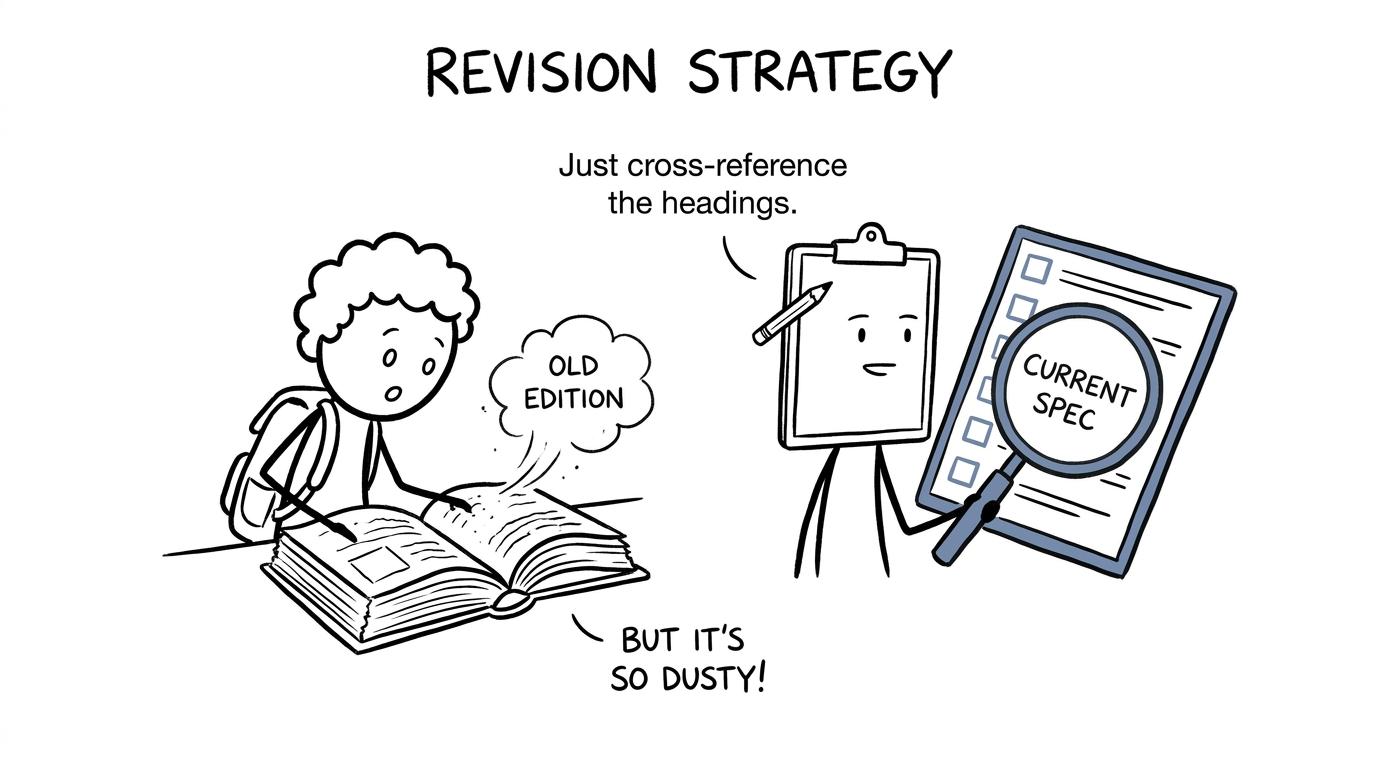 A student checks a dusty old textbook against the current specification
How much has GCSE Biblical Hebrew changed?
There are two different kinds of change to consider: the major reform introduced from 2018 and the smaller updates made since then.
The important divide is pre-2018 and post-2018
The present Pearson Edexcel GCSE Biblical Hebrew qualification has specification code 1BH0. It was developed following the reform of GCSE ancient-language qualifications and was taught from September 2018.
A textbook written specifically for this reformed course is likely to match much of the current qualification's broad structure. A much older book designed around the legacy GCSE may still explain Biblical Hebrew accurately, but its assessment assumptions, terminology, question styles and prescribed passages may no longer align with the examination you will sit.
That does not make the older book worthless. Verb forms do not become incorrect because an examination board publishes a new document. But a good explanation of language is not the same thing as complete preparation for an examination.
Recent specification changes have been limited
Pearson reported in 2025 that the Department for Education had updated the ancient-languages subject content and described the resulting changes as minor, without a significant effect on teaching and learning. The current Pearson specification is Issue 2.
This means a reasonably recent 1BH0 textbook has not suddenly become unusable. Students should nevertheless use the latest specification because it is the authoritative checklist for content, assessment objectives and prescribed literature.
The safest conclusion is balanced: the underlying course has not recently been rebuilt from the ground up, but not every page of every older resource will match your examination year.
The biggest issue is the set texts
For examinations from 2026 to 2028, the Pearson specification prescribes:
- Genesis, chapters 41, 42 and 43, concerning Joseph's rise to power
- Kings, chapters 4, 5, 6 and 7, concerning the miracles of Elisha
Set texts rotate. Consequently, a textbook prepared for an earlier examination cycle may contain detailed notes, questions and commentary on passages that are no longer prescribed.
Those chapters can still offer reading practice, but revising them as though they were your examinable literature would use valuable time badly. Literature preparation needs to focus on the precise chapters named for your examination year, including their language, context, literary features and themes.
Always compare the contents page of a hand-me-down textbook with the latest Pearson specification and information supplied by your school or teacher. Do not rely only on the publication date: a recently printed copy can still reproduce material created for a previous set-text cycle.
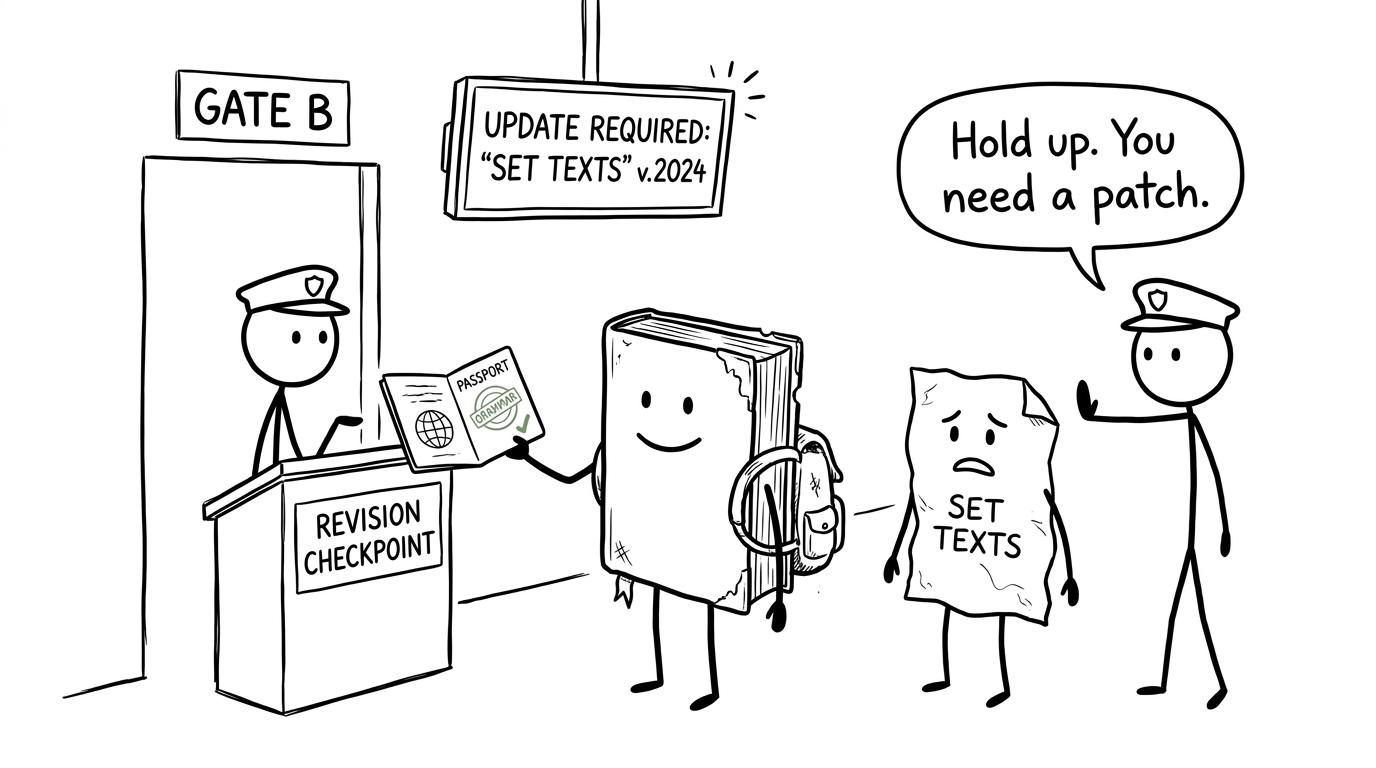 An old grammar book passes while outdated set texts stop for an update
What an older textbook can still teach well
A strong older textbook may remain valuable in several areas.
Grammar and syntax
Clear chapters on nouns, pronouns, particles, sentence structure and verb morphology can continue to support the current course. The important question is whether the explanation is accurate and sufficiently detailed, not whether the cover looks new.
Older books can be especially useful when they present the same grammatical idea differently from your class notes. Sometimes a second explanation makes a difficult pattern visible. However, terminology can vary between resources, so match unfamiliar labels with those used by your teacher and the current specification.
Core vocabulary and recognition
Much of the high-frequency vocabulary needed for unseen reading remains relevant. A hand-me-down book may provide useful word lists and short recognition exercises.
Check whether its vocabulary coverage is complete enough for the present specification. Treat additional words as helpful enrichment, but do not assume that an old list defines exactly what can be assessed now.
Unseen translation practice
Unfamiliar passages can build careful reading habits. They encourage you to identify forms, notice connections between clauses and avoid guessing from one familiar word.
The limitation is marking. A translation may communicate the broad meaning while missing details required for full credit. Current mark schemes and teacher feedback show how the examination rewards accuracy, so old exercises work best when paired with modern assessment guidance.
Consolidation rather than prediction
An old textbook is good at helping you understand what Biblical Hebrew does. It is less reliable at telling you exactly what your next examination will do.
This principle applies to maths revision as well. A long-established algebra method remains valid, but students still need current papers to understand how that knowledge is assessed. MathsGenie's guide to using Edexcel GCSE Maths past papers properly explains the useful cycle: attempt, mark, diagnose and revisit. The same cycle can be adapted to a language paper.
What an old textbook cannot safely replace
Even an excellent book should not replace the following current materials:
- the latest Pearson Edexcel specification for 1BH0
- the set-text list for your examination year
- current sample assessment materials and past papers
- current mark schemes and examiner guidance
- instructions from your school or subject teacher
The qualification is assessed through a language paper and a literature paper, each worth 50%50\%50% of the GCSE. Revision therefore has to cover both sides. A book full of grammar drills cannot compensate for missing prescribed literature, while memorising set-text notes cannot replace accurate unseen translation skills.
Be careful not to confuse Biblical Hebrew with Modern Hebrew. They are separate qualifications with different specifications and assessments. A Modern Hebrew GCSE textbook is not a substitute for a Biblical Hebrew course book simply because the two share part of a name.
How to use a hand-me-down textbook effectively
The best approach is not to decide whether the whole book is "good" or "bad". Audit it chapter by chapter.
Create three categories:
- Current and useful: grammar explanations, relevant vocabulary and suitable unseen passages
- Useful with checking: exercises whose question format or terminology may be dated
- Not current: old set-text preparation, legacy assessment advice or superseded paper information
Write the relevant specification section beside each useful chapter. This turns the book from a general pile of information into a targeted revision tool.
Next, combine content practice with assessment practice. Complete a passage, check the language carefully, consult an appropriate mark scheme where one exists, and record the reason for each error. A useful error log distinguishes between vocabulary gaps, form-recognition errors, misunderstood syntax and incomplete English expression.
Maths students can use the same diagnosis when revising another GCSE. Rather than writing "wrong" beside a question, identify what failed. MathsGenie's Edexcel GCSE Maths past papers include official mark schemes and solutions, while its explanation of Edexcel and AQA GCSE Maths differences shows why board-specific preparation matters. Biblical Hebrew deserves the same precision: revise the qualification you are actually taking.
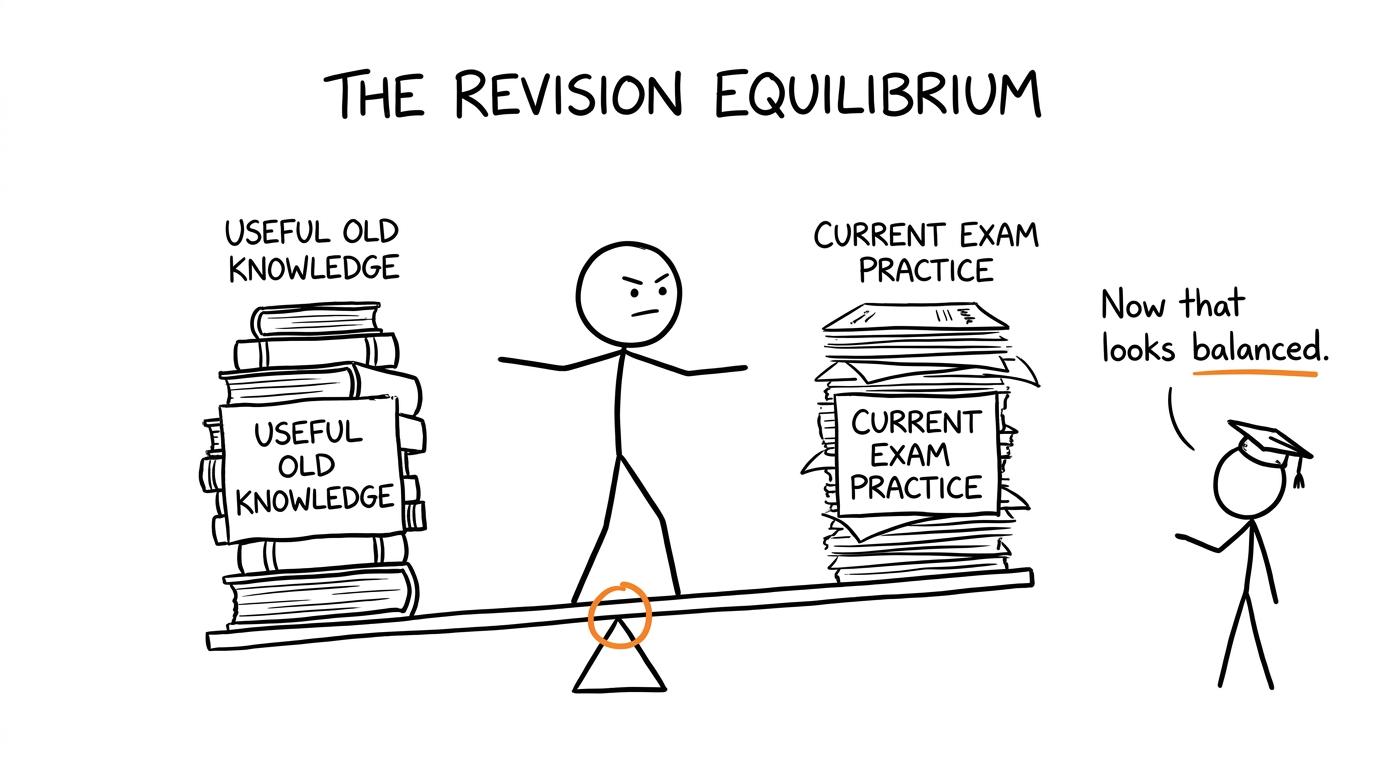 A student balances old knowledge with current examination practice
Build a revision plan around gaps, not chapters
Reading an old textbook from the first page to the last can feel productive because progress is easy to measure. Yet examinations do not award marks for reaching the final chapter.
Start with the current specification and mark each area as secure, developing or not yet covered. Then select textbook sections that address genuine gaps. Give separate time to unseen language, prescribed literature, vocabulary recall and timed examination practice.
This is the logic behind effective maths revision too. MathsGenie's article on how to revise Edexcel GCSE Maths without wasting time recommends using marked work to locate the topics losing marks. Its comparison of Edexcel and OCR grade boundaries also reinforces an important lesson: marks, boundaries and assessment materials must be interpreted in the correct board and examination context.
For Biblical Hebrew, the equivalent is simple. Let current assessment evidence decide what you revise next, not the order chosen by an old book's author.
Common mistakes when using an older textbook
Assuming old means inaccurate
Language explanations may remain sound for many years. Rejecting a useful resource solely because of its age can mean losing clear explanations and valuable practice.
Assuming accurate means specification-matched
A passage can be translated correctly and still be irrelevant to the current prescribed literature. Accuracy and current examination relevance are different tests.
Revising obsolete set texts
This is the largest practical risk. Confirm that your literature chapters match the set texts for your examination year before investing time in detailed annotation or essay preparation.
Using old questions without current marking guidance
Older exercises can develop knowledge, but they may not reflect current command words, allocation of marks or expected response style. Pair them with current papers and mark schemes.
Confusing Biblical and Modern Hebrew
Check the exact qualification title and specification code. GCSE Biblical Hebrew under Pearson Edexcel is not the same course as GCSE Modern Hebrew.
Letting one subject consume the whole timetable
Students taking Biblical Hebrew still need a balanced GCSE revision plan. Use the free MathsGenie GCSE and A Level maths revision resources to keep maths moving through revision lessons, practice questions, mini tests, past papers, predicted papers, mark schemes and video solutions.
The verdict on an old textbook for GCSE Biblical Hebrew
A hand-me-down textbook still holds up when it teaches accurate grammar, useful vocabulary and careful translation. It becomes risky when it is treated as the final authority on prescribed literature, paper structure or assessment expectations.
If it was produced before the reformed course began in 2018, use it selectively. If it was written for specification 1BH0 but covers an earlier set-text cycle, keep its language sections and replace its literature preparation. In every case, check the latest Pearson specification for your examination year.
The wisest revision rarely depends on one perfect resource. It combines lasting knowledge with current evidence. Use the old book for what has endured, current materials for what has changed, and regular marked practice to discover the difference.
Then bring the same discipline to maths. Start at MathsGenie, choose your board and tier, work through free revision lessons and practice questions, and test your progress with past papers, predicted papers, mini tests, mark schemes and video solutions. A resource becomes valuable not because it is old or new, but because you use it for the right job.










