Old Textbook GCSE Arabic: Is It Still Useful?
Old textbook GCSE Arabic guide: check if a hand-me-down matches Edexcel 1AA0, what changed after 2017, and how to fill revision gaps safely.
A hand-me-down textbook can feel like either a bargain or a risk. The pages contain useful vocabulary, grammar and reading practice, but the cover may mention an unfamiliar specification. You begin to wonder whether revising from it will prepare you for the exam you are actually sitting.
The short answer is that an old textbook GCSE Arabic resource can still be useful, especially if it was written for the Pearson Edexcel GCSE Arabic specification introduced for teaching in 2017. However, no older book should be trusted as your only guide. Check its specification code, themes, tier and assessment format against the current information supplied by your school and exam board.
The age of a book matters less than its alignment. Knowledge often lasts. Exam structures sometimes do not.
The quick textbook checklist
Before building revision around a hand-me-down book, check:
- Qualification: Is it UK GCSE Arabic rather than International GCSE Arabic?
- Exam board: Does the cover name Pearson Edexcel?
- Specification code: Does it show 1AA0?
- Publication basis: Was it written for first teaching from 2017?
- Skills: Does it cover listening, speaking, reading and writing?
- Themes: Does it match the five current Edexcel themes?
- Tier: Does it distinguish between foundation and higher tier where necessary?
- Assessment: Does its exam advice match current papers and mark schemes?
- Condition: Are audio files, online materials and answers still accessible?
- Confirmation: Has your teacher approved it for your examination year?
If most answers are yes, the book can probably remain part of your revision. If several are no, keep it for supplementary language practice rather than treating it as a complete course.
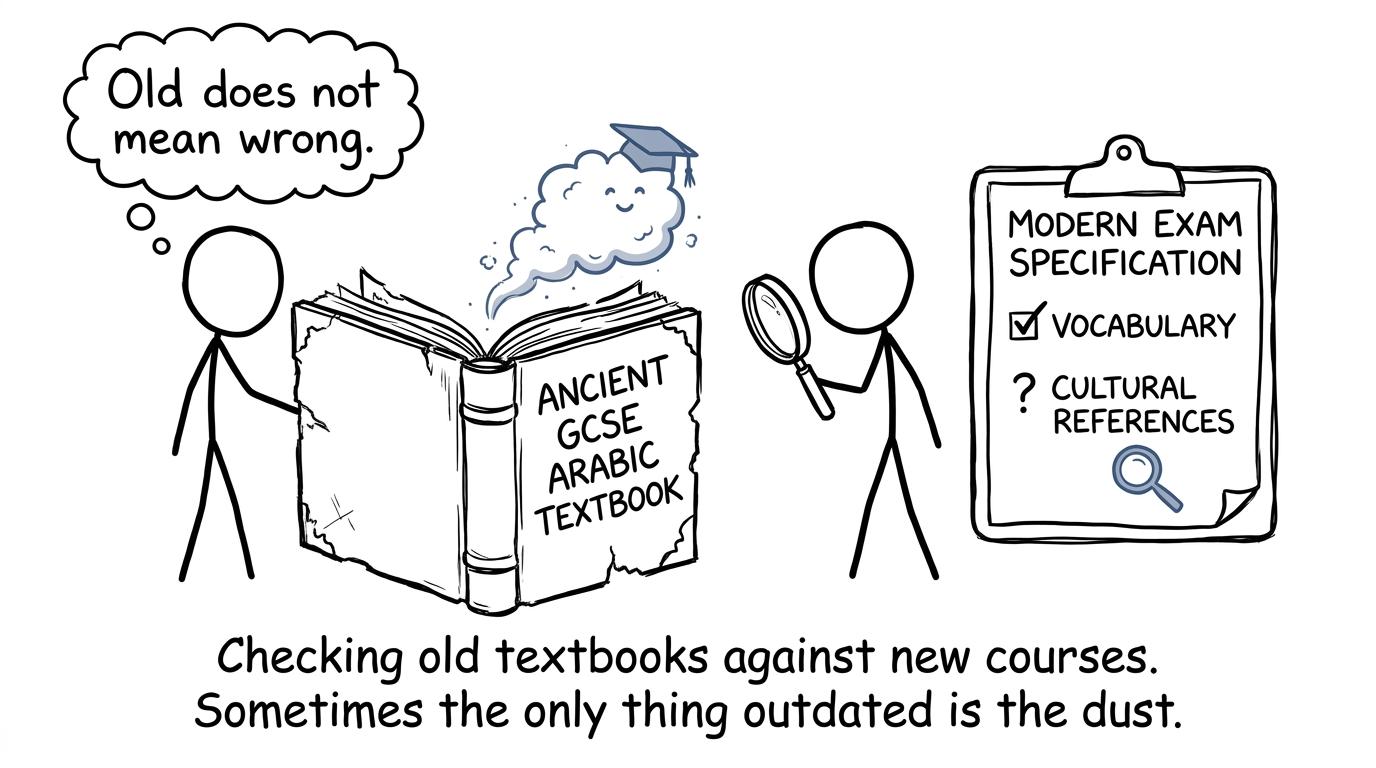 An old textbook and a modern specification checklist deciding whether age means outdated
How much has GCSE Arabic changed recently?
For regulated GCSE Arabic in England, the central qualification is Pearson Edexcel GCSE Arabic, specification 1AA0. Among Edexcel, AQA, OCR and Eduqas, Pearson was the board accredited to offer the reformed GCSE Arabic introduced for first teaching in September 2017. Its first examinations took place in 2019.
The current Pearson specification available in 2026 is Issue 5, dated October 2022. It retains the same overall course introduced in 2017: four language skills, five broad themes, foundation and higher tiers, and four externally assessed papers.
This means GCSE Arabic has not recently undergone the same wholesale specification replacement affecting French, German and Spanish for first examinations in 2026. Government reforms introducing revised content for those three languages do not automatically replace the current Arabic course. The earlier modern foreign languages subject content continues to apply to other languages, including Arabic.
That distinction matters. A French textbook labelled for a pre-2024 course may face a clear specification break. A GCSE Arabic book written accurately for Edexcel 1AA0 may still align reasonably well in 2026.
There is still an important dividing line, though: 2017. Books designed for the older Edexcel GCSE Arabic course, before specification 1AA0, may contain valuable language but outdated topics, task structures and assessment advice.
What the current Edexcel GCSE Arabic course requires
The current qualification assesses four skills through four papers:
- listening and understanding in Arabic;
- speaking in Arabic;
- reading and understanding in Arabic;
- writing in Arabic.
Each paper contributes 25%25\%25% of the qualification. Students enter either foundation or higher tier and must take the same tier across all four papers. Dictionaries are not permitted in the assessments.
Questions are organised around five themes:
- identity and culture;
- local area, holiday and travel;
- school;
- future aspirations, study and work;
- international and global dimension.
All themes are considered through students' own contexts and those of Arabic-speaking countries and communities. The course therefore requires more than memorising isolated vocabulary. Students need to understand and communicate ideas across different settings, time frames and purposes.
A suitable textbook should support all four skills and all five themes. A book containing only reading passages and grammar exercises may still be helpful, but it cannot prepare you fully for listening or speaking.
When an older textbook still holds up
A textbook written specifically for Edexcel 1AA0 is likely to remain useful for the stable parts of language learning.
Vocabulary and grammar remain valuable
Words do not become incorrect because a cover looks old. Core vocabulary involving family, school, travel, employment and everyday life remains useful when it appears in the current specification. The same is true of grammatical control, sentence construction, opinions, reasons and time frames.
Reading passages can build comprehension. Writing prompts can develop accuracy. Speaking questions can help you practise responding without translating every sentence mentally first.
The strongest revision resources often age well because they teach transferable understanding rather than trying to predict one examination paper.
The 2017 specification has remained recognisable
A book explicitly based on the GCSE grades 9-1 Edexcel Arabic course, specification 1AA0, starts from the correct framework. Later specification issues may clarify wording or administrative details without making every earlier textbook obsolete.
Even so, compare the contents page with the latest theme and assessment information supplied by your school. A matching specification code is evidence, not a guarantee.
Extra practice is still extra practice
An older book can provide fresh reading texts, vocabulary retrieval and writing prompts after you have exhausted your main class materials. This is particularly useful when you treat each activity as practice rather than proof of the current exam format.
The same principle works in maths. Older questions can strengthen an enduring method, while current specification resources show how it is assessed today. Maths students can see this distinction through MathsGenie's GCSE maths revision hub, where lessons, exam questions and board-specific papers serve different purposes.
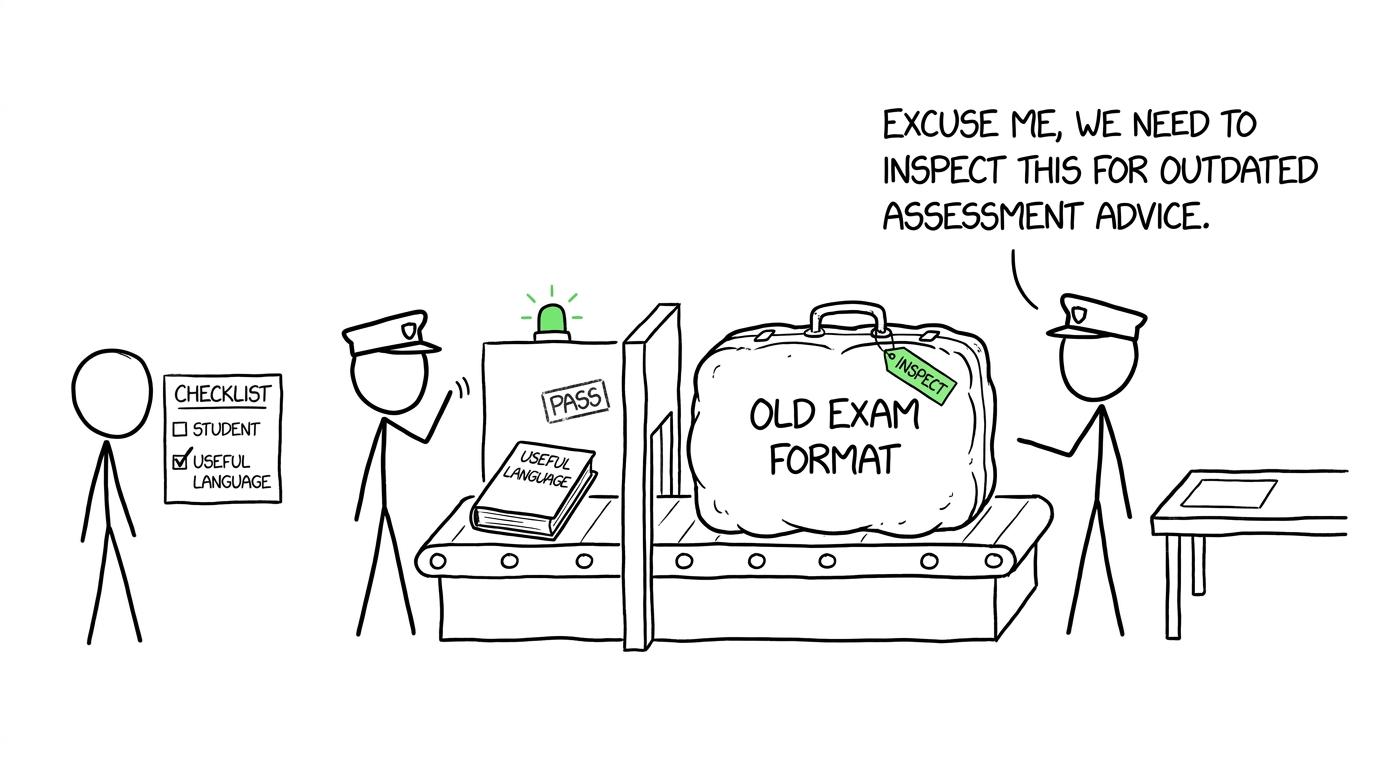 Useful language passes inspection while an old exam format is checked separately
When the book is no longer enough
Some old resources should be treated cautiously, even when their language content is sound.
It belongs to the pre-2017 GCSE
The former Edexcel specification used a different structure and grouped content differently. A pre-2017 book may refer to old units, controlled assessment or task formats that no longer match 1AA0.
You can still use its vocabulary, grammar and suitable comprehension texts. Do not rely on its paper timings, mark allocations, grade language or assessment strategy.
It is for International GCSE Arabic
Pearson Edexcel International GCSE Arabic (First Language), specification 4AA1, is a separate qualification from UK GCSE Arabic 1AA0. Its target learners, papers and assessment structure differ.
The words “GCSE Arabic” and “Arabic First Language” on a cover can look reassuringly similar, but the specification code settles the question. If you are entered for 1AA0, a 4AA1 textbook is supplementary material, not a direct examination guide.
Its digital resources have disappeared
Language textbooks often depend on audio recordings, teacher files or online exercises. A second-hand copy without working audio access leaves a significant gap because listening is a quarter of the current qualification.
Before buying or committing to a book, check whether its recordings and answers are still legitimately available. A cheap book is less useful if a central part of the course is missing.
It does not reflect current mark schemes
A textbook can teach good Arabic while giving dated examination advice. Current past papers, sample assessment materials and mark schemes reveal the actual task wording, expected response length and ways marks are awarded.
This is why paper practice should sit beside content revision. MathsGenie's guide to using GCSE past papers properly explains the broader feedback loop: attempt, mark, diagnose, repair and retest. Apply the same logic to Arabic using the official materials provided by your board and school.
How to use a hand-me-down textbook safely
Do not ask the old book to perform every job. Give it a defined role.
Use three layers of revision
Build your Arabic preparation from:
- the current specification, which defines what can be assessed;
- current papers and mark schemes, which show how the course is examined;
- the textbook, which provides teaching, vocabulary and additional practice.
If these layers disagree, the current specification and assessment materials take priority.
Label outdated pages
Once you have checked the book, mark pages containing an old task format or irrelevant examination advice. This prevents you from rediscovering the same uncertainty weeks later.
You might label material as “current exam practice”, “useful language only” or “not needed”. That small act turns an ambiguous resource into an organised one.
Keep an evidence-based revision routine
After completing a textbook activity, decide what it revealed. Was vocabulary missing? Did verb formation cause difficulty? Was listening speed the problem? Your next task should answer that weakness.
This is also the reasoning behind a structured one-month GCSE maths revision plan: diagnosis is more useful than repeatedly revising comfortable material. Students balancing both subjects can use MathsGenie's advice on when to begin GCSE past papers to organise their maths workload while keeping regular Arabic practice in the week.
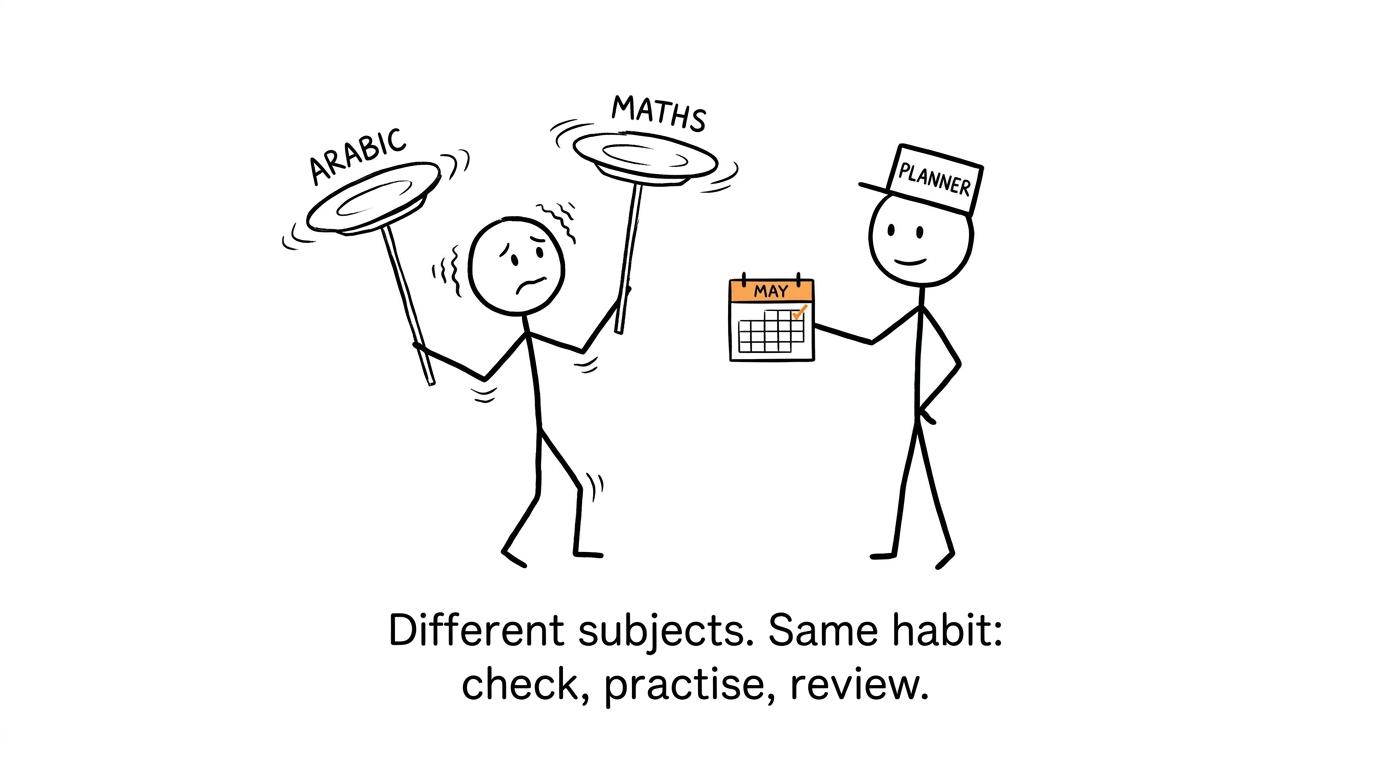 A revision planner helps a student balance Arabic and maths
Common mistakes with older GCSE Arabic books
Assuming newer always means better
A recent generic Arabic workbook may align less closely than an older book written specifically for 1AA0. Check relevance, not just the publication year.
Assuming a matching topic means a matching exam
A chapter about school may still contain the wrong task type. Topic alignment and assessment alignment are separate checks.
Revising only reading and writing
A convenient textbook can pull revision towards silent written tasks. The current qualification also assesses listening and speaking, so these need planned practice.
Confusing foundation and higher tier
The qualification requires one tier across all four papers. Use tasks appropriate to your entry tier and ask your teacher if the book's labels are unclear.
Treating old assessment advice as current
Timings, task formats and mark guidance should always be checked against current board information. This principle applies across GCSEs. MathsGenie's discussion of GCSE predicted topics similarly warns against replacing full specification coverage with guesses.
Letting one resource control the timetable
A textbook is a tool, not a revision plan. Balance learning, retrieval, timed practice and correction. For maths, short foundation and higher mini tests can expose gaps without requiring a full paper, while the GCSE night-before revision plan helps keep final preparation calm and selective.
The sensible verdict
A hand-me-down GCSE Arabic textbook can absolutely still hold up. If it was written for Pearson Edexcel 1AA0 from 2017 onwards, its main themes, language instruction and skill practice may remain closely relevant because GCSE Arabic has not yet received the same recent specification replacement as French, German and Spanish.
A pre-2017 book can still support vocabulary and grammar, but it should not direct your exam preparation. An International GCSE First Language Arabic book is also designed for a different qualification. In every case, verify the code, compare the contents with the current specification and use recent papers to identify gaps.
The wider revision lesson is simple: old resources are valuable when you know exactly what job they are doing.
For your maths preparation, make MathsGenie's free GCSE revision hub your starting point. Use revision lessons to rebuild weak methods, practice questions and mini tests to develop accuracy, then past papers, predicted papers, mark schemes and video solutions to turn knowledge into exam-ready performance.