Moving Sets in GCSE Maths Numeracy: Does It Matter?
Moving sets GCSE maths numeracy explained: learn how class changes, exam tiers and revision can affect your final grade, confidence and next steps.
Being told that you are moving maths sets can feel like receiving an exam result before you have sat the exam. Moving up may sound like proof that you are succeeding. Moving down can feel like a judgement. Yet the honest answer to moving sets GCSE maths numeracy concerns is reassuring: changing class does not directly determine your final grade.
Your result comes from your performance in the assessed units or papers. A set change can affect the pace of teaching, the topics you meet, your confidence and possibly the tier for which your school intends to enter you. Those indirect effects matter, but the number attached to your classroom door does not appear on your certificate.
The distinction that matters most is simple: your set is where you are taught; your tier controls the grades available in the examination.
The short answer: what actually affects your outcome?
If your set changes, work through this checklist:
- Confirm whether your examination tier is changing too.
- Check which WJEC qualification or specification you are following.
- Ask which topics your new class has already covered.
- Compare your recent assessments by topic, not just by total mark.
- Build a short catch-up or consolidation plan.
- Practise questions matching your actual tier and specification.
- Review progress with your teacher before entry decisions are finalised.
Start by finding your board and course in the GCSE Maths revision hub. The right revision material matters more than the name of your set.
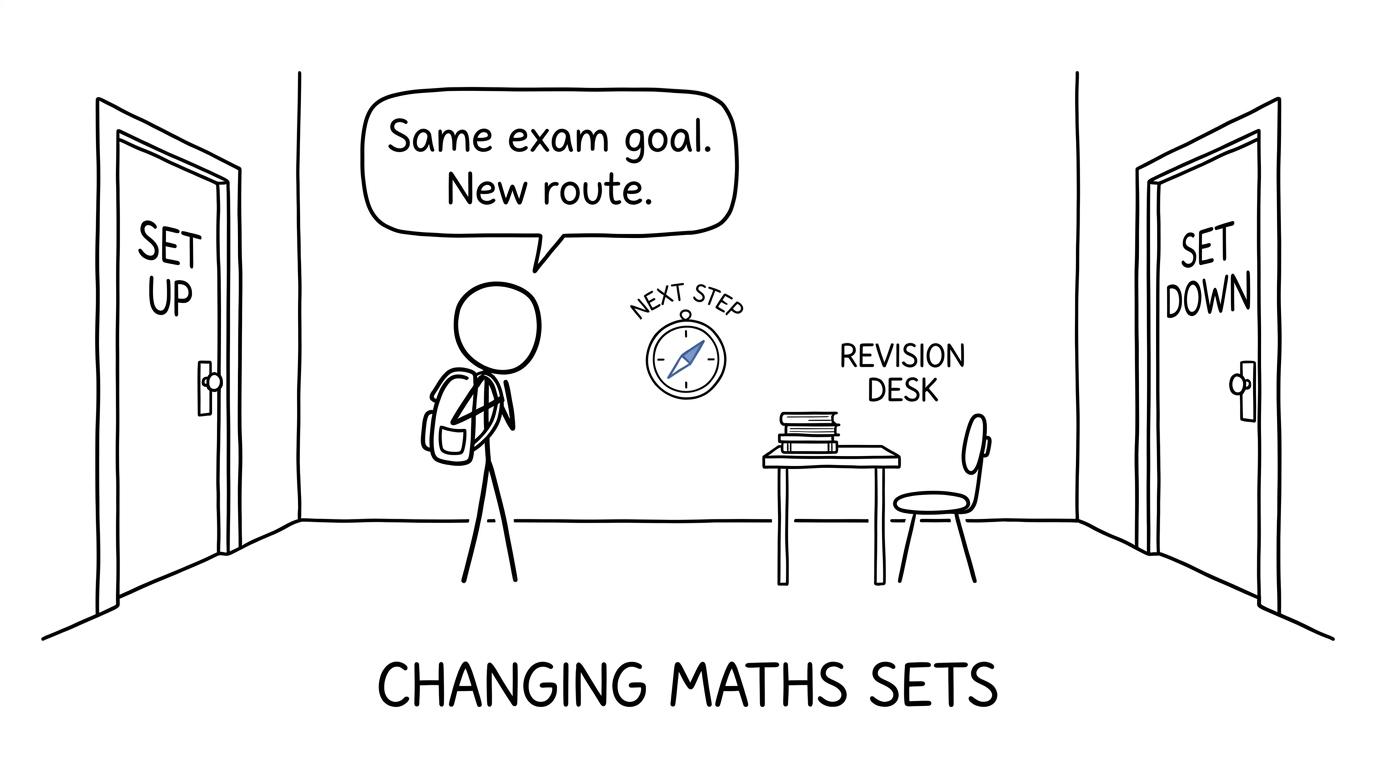 A student choosing a route after changing maths sets
Set and tier are not the same thing
A school set is an internal teaching group. Schools usually use assessment performance, classwork, teacher judgement and sometimes behaviour or confidence when arranging sets. There is no national rule saying that a particular set must take a particular examination tier.
A tier is an official assessment entry. It determines the paper you sit and the range of grades available.
That means a move from Set 222 to Set 333 does not automatically change your examination entry. Equally, remaining in the same set does not guarantee that your tier will remain unchanged. Schools can review entry decisions as your performance develops.
This is why your first question should not be, “Does this mean I am worse at maths?” Ask instead:
“Does this change my intended tier, specification coverage or examination entry?”
That question turns an emotional label into useful information.
GCSE Maths Numeracy in Wales: know your specification
The phrase GCSE Maths Numeracy usually refers to qualifications in Wales. The system is changing, so your year group matters.
The legacy GCSE Mathematics and Numeracy qualification
The legacy WJEC GCSE Mathematics and Numeracy qualification used three tiers:
- Foundation: grades D-G
- Intermediate: grades B-E
- Higher: grades A*-C
Students had to take both units at the same tier within the examination series. Consequently, a set change only altered the possible final grade if it also led to a different tier entry.
Summer 202620262026 was the final full assessment opportunity for this standalone qualification. WJEC has identified limited resit opportunities in January and June 202720272027, subject to demand. If you are resitting, confirm the available series and tier directly with your school or college rather than assuming the arrangements are unchanged.
MathsGenie’s guide to WJEC GCSE Maths revision can help you turn past-paper performance into a focused topic list.
The new Mathematics and Numeracy Double Award
Learners who began Year 101010 in September 202520252025 follow the new WJEC GCSE Mathematics and Numeracy Double Award. It combines mathematics and numeracy in one course leading to two grades.
The qualification has three externally assessed units:
- Unit 111: Financial Mathematics and Other Applications of Numeracy, worth 30%30\%30%
- Unit 222: Non-calculator Mathematics, worth 30%30\%30%
- Unit 333: Calculator Mathematics, worth 40%40\%40%
There are two assessment tiers. Higher allows grades A*-D, while Foundation allows grades C-G. Importantly, WJEC permits mixed-tier entry across units. A learner may therefore be entered at different tiers for different units when the school considers that appropriate.
For students on this course, moving sets still does not create a grade by itself. However, you should ask whether the move changes the planned tier for any individual unit. That is more precise than asking only whether you are a Foundation or Higher student.
What if you are taking GCSE Maths in England?
In England, GCSE Maths from Edexcel, AQA and OCR uses grades 999-111. Eduqas qualifications taken in England follow the relevant Eduqas specification. The standard GCSE Maths structure has Foundation and Higher tiers:
- Foundation offers grades 111-555.
- Higher offers grades 444-999, with a narrow grade 333 safety net for candidates just below grade 444.
A grade 444 or 555 has the same value whether achieved on Foundation or Higher, and the certificate does not show the tier. Foundation does, however, cap the maximum available grade at 555.
So the same principle applies: moving sets is not the decisive event. A change of tier may be. Use the GCSE topics by exam board and tier to check that your revision matches the paper you are likely to sit.
How moving up a set can affect you
Moving up often means a quicker pace, less repetition and earlier exposure to demanding material. It may also make Higher-tier entry more likely, but this is a school decision rather than an automatic rule.
The opportunity is clear: you may encounter more ambitious questions and have access to teaching that supports the top of your available grade range. The risk is quieter. Students sometimes interpret promotion as proof that revision is no longer necessary, or they become reluctant to admit that they have missed a step.
If you move up, identify any content the new set has already completed. Ask for a topic list and use a revision lesson before attempting exam questions. Do not try to repair every possible gap at once. A controlled plan is better than a heroic weekend.
The MathsGenie revision planner can help you schedule those missing topics without abandoning your current classwork.
How moving down a set can affect you
Moving down can feel more final than it is. It may reflect recent assessments, the pace that currently suits you, gaps in prior knowledge or the school’s view of the safest examination entry. It does not establish your maximum mathematical ability.
Research should make us cautious about treating sets as destiny. The Education Endowment Foundation’s updated review reports that setting and streaming produce no average improvement in progress compared with mixed-attainment teaching. It also notes slightly worse outcomes for lower-attaining pupils and slightly better outcomes for higher-attaining pupils, while rating the evidence as very limited.
In other words, a lower set is not guaranteed to help or harm you. What happens inside the group matters: the quality of explanation, the level of challenge, opportunities to move again and what you practise independently.
A move down may even improve your eventual outcome if the new pace lets you secure methods that were previously rushed. But check that you are still being prepared for the tier needed for your target grade. If your goal sits above the maximum grade available on the proposed tier, discuss the evidence you would need to demonstrate before entries are confirmed.
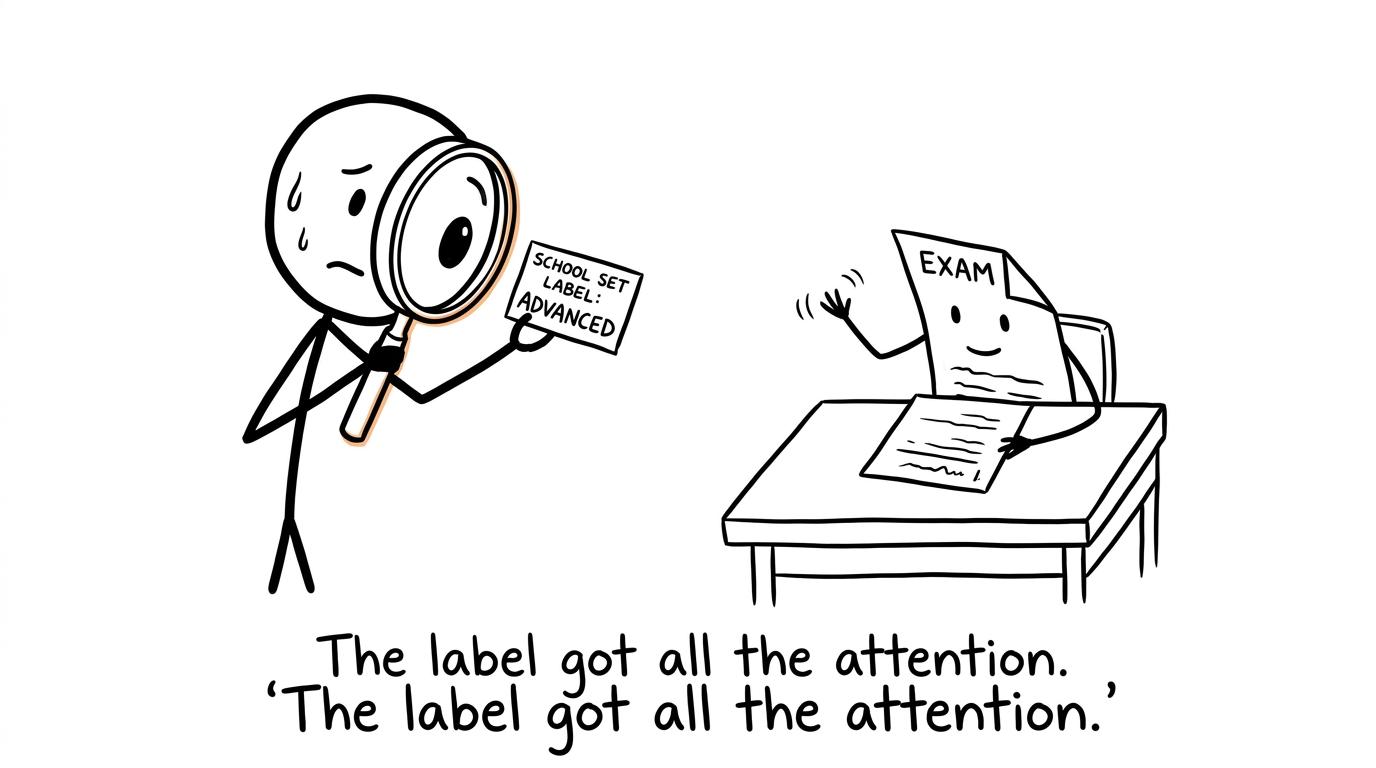 A set label distracting a student from the real exam
How to adapt after changing sets
Get the facts before changing your revision
Ask your teacher four specific questions:
- Which qualification and specification am I taking?
- Is my intended tier changing?
- Which topics has the new class covered that I have not?
- When will my placement or tier next be reviewed?
Record the answers. Anxiety often grows in the space left by missing information.
Diagnose your actual gaps
Complete a short assessment or a paper section at the correct tier. Mark it carefully, then divide lost marks into three categories:
- Knowledge: you did not know the method.
- Process: you knew the method but could not complete it reliably.
- Accuracy: you made an arithmetic, notation or reading error.
This produces a revision plan based on evidence rather than the assumption that every topic is weak. MathsGenie’s GCSE mini tests are useful for short checks, while full papers test whether methods remain secure under time pressure.
Use a repeatable repair cycle
For each weak topic:
- Learn or revisit the method through a revision lesson.
- Complete focused practice questions without notes.
- Mark the work immediately.
- Identify the first incorrect step.
- Redo the skill on another day.
- Test it later in a mixed paper.
Use mark schemes as a revision tool, not merely as a way to calculate a score. They show which steps earn marks and whether your written method communicates enough.
Measure progress consistently
One unusually good or bad test can mislead you. Keep a simple record of topic accuracy, paper marks and recurring errors across several assessments. Compare like with like: the same specification, tier and approximate paper difficulty.
Grade boundaries change between examination series, so a raw mark from one paper is not a guaranteed future grade. Its most useful purpose is to reveal what to revise next.
If you need structure, adapt the one-month GCSE maths revision plan around your new class timetable.
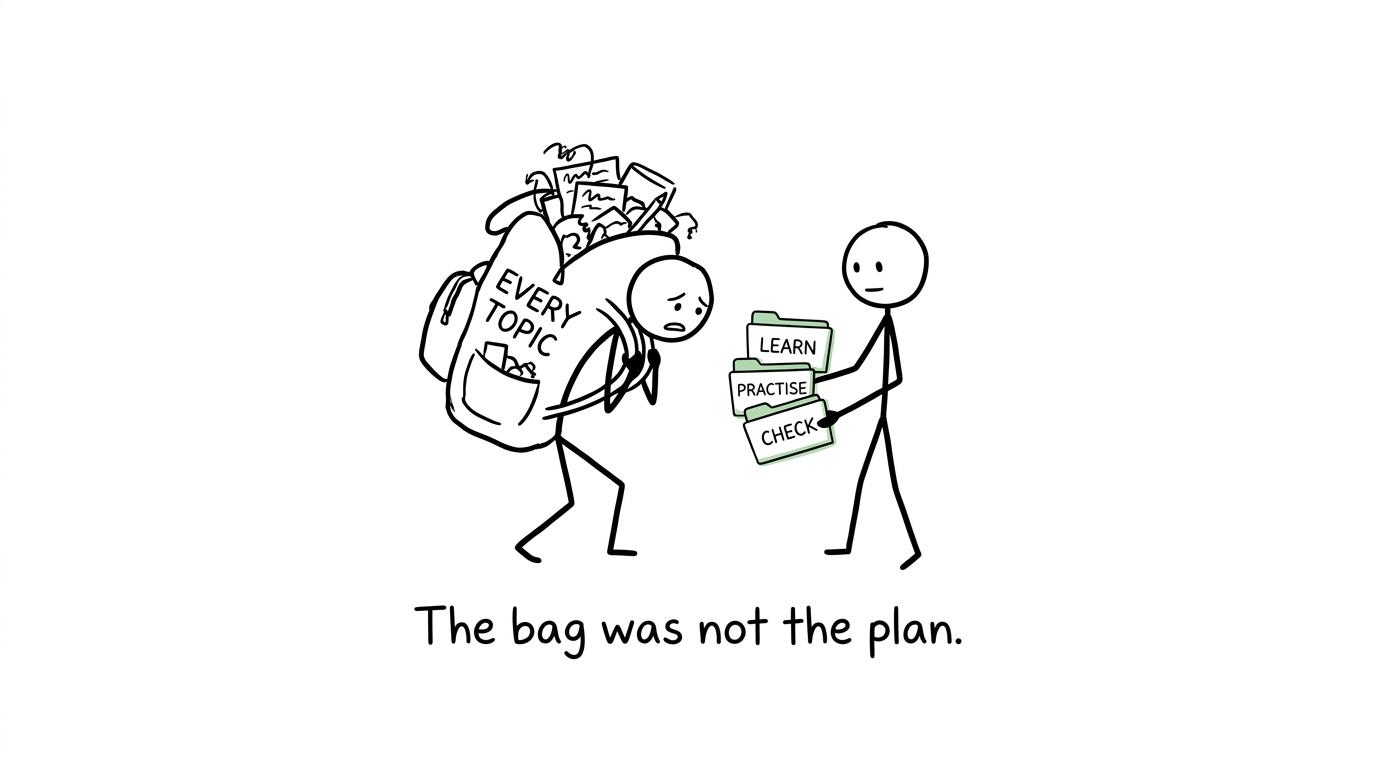 A student replacing an overloaded revision bag with a simple system
Common mistakes after a set change
Treating the set number as a predicted grade
Set labels organise classes; they do not award qualifications. Ask about the tier and use assessed work to judge progress.
Revising material for the wrong paper
Generic maths practice can help, but examination preparation should match your specification and tier. This is especially important during the transition between the legacy Welsh Numeracy qualification and the new Double Award.
Trying to catch up on everything immediately
A long list creates movement without direction. Prioritise the topics already taught by your new class and the skills responsible for repeated lost marks.
Avoiding difficult questions after moving down
A slower teaching pace should not mean removing challenge completely. Once core methods are secure, continue attempting unfamiliar and multi-step questions appropriate to your intended tier.
Using predicted papers as predictions of your grade
Predicted papers are practice resources, not forecasts of exact examination content or personal results. Use GCSE predicted papers to expose gaps, then return to topic practice and video solutions.
Your set can change; your next action is still yours
Moving up or down a set partway through GCSE Maths Numeracy can influence your classroom experience and, sometimes, the tier your school considers appropriate. It does not directly decide your final grade. The decisive questions are what will be assessed, which grades your tier makes available and how effectively you respond to feedback.
Begin by confirming your qualification, unit and tier. Then use MathsGenie as your free revision base: learn through revision lessons, build accuracy with practice questions and mini tests, and test your progress using past papers and predicted papers. Mark every attempt with the mark scheme, use video solutions when a method remains unclear, and let each mistake choose your next revision task.
A set change is information, not a verdict. Open the MathsGenie GCSE Maths revision hub, choose the resources matching your course and take the next measurable step.