

Make Your Own GCSE Further Maths Practice Questions
Make own GCSE Further Maths practice questions with a reliable method. Turn notes into accurate exam-style tasks, mark schemes and effective revision at home.
Revision notes can create a comforting illusion. You recognise the factor theorem, remember what a matrix transformation looks like and understand differentiation while the page is open. Then you meet an unfamiliar exam question and the method suddenly feels less certain.
So, is it worth trying to make own GCSE Further Maths practice questions? Yes, provided question writing supplements rather than replaces professionally written exam practice. Creating a question forces you to decide what knowledge matters, how a method works and which information makes an answer possible. Those decisions reveal gaps that rereading can hide.
The best approach is to spend a small part of your revision time writing and checking questions, then spend most of it answering questions from trusted sources. MathsGenie's free AQA GCSE Further Maths revision hub gives you lessons, questions, past papers and mark schemes against which to test your work.
The short answer and revision checklist
Making your own questions is worthwhile when you:
- start from the specification or a clearly defined topic;
- write one question around one main skill;
- calculate and record the correct answer;
- remove ambiguity from the wording;
- compare the style with genuine exam questions;
- leave the question for a few days before attempting it;
- continue using past papers and established practice resources.
It is less useful when designing questions becomes an elaborate form of avoiding them. A beautifully formatted worksheet is not automatically productive revision. The learning lies in making mathematical decisions, checking them and later retrieving the method without your notes.
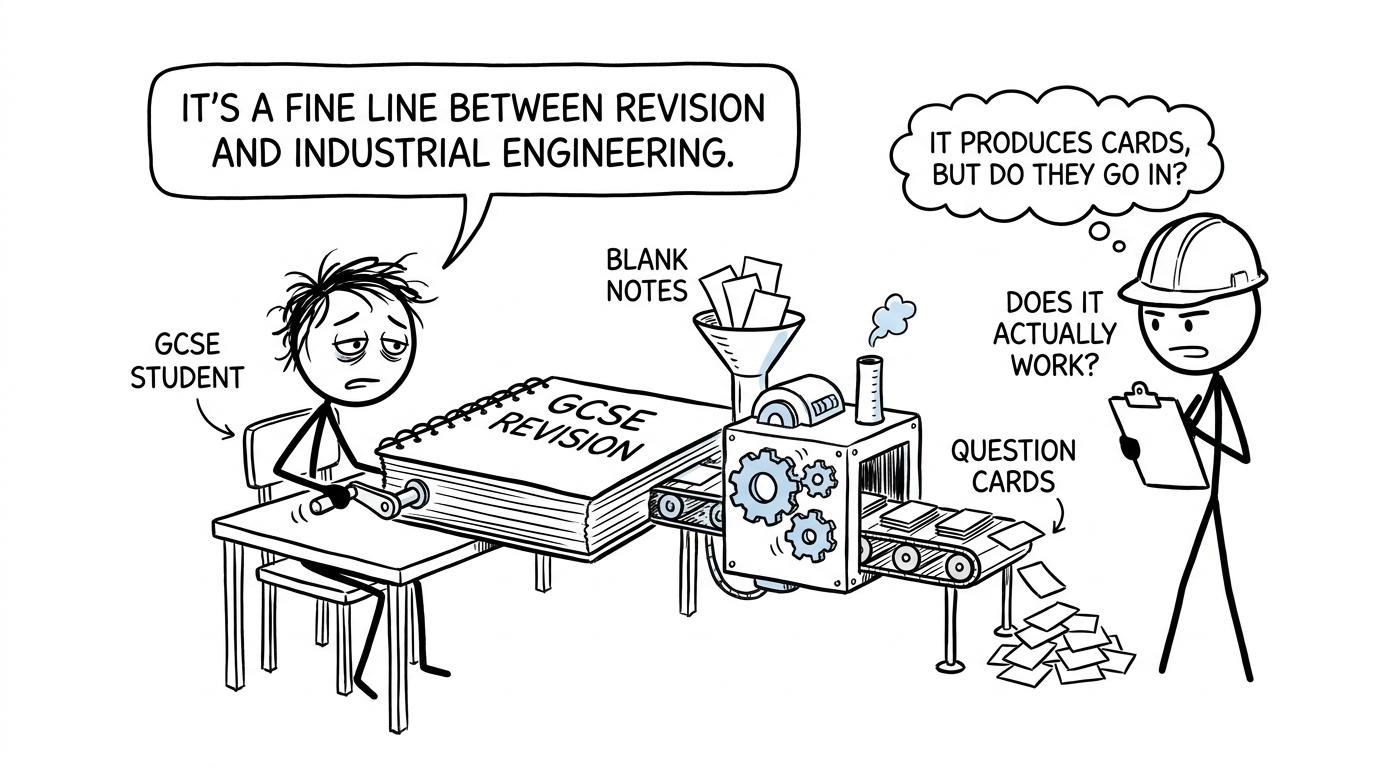 A student turns revision notes into practice questions while an inspector checks whether the machine works
Why writing questions can deepen your understanding
Answering a familiar exercise asks, "Can I use this method here?" Writing an accurate question asks several earlier questions:
- What is the method really testing?
- What information must be supplied?
- Which values create a manageable but non-trivial problem?
- Is there one valid answer, several answers or no answer?
- What working should earn marks?
That is a different kind of attention. You move from following the road to thinking about why the road was built that way.
Research with learners outside the GCSE setting suggests that generating questions can support recall, understanding and awareness of important ideas. However, that evidence should not be treated as a promise about GCSE grades. The practical conclusion is narrower: question generation can be a useful form of active revision, especially when it includes answering, feedback and correction.
Official papers remain essential because they reproduce the language, sequencing and demand of the real assessment more reliably than a student-written question can. Use the GCSE past-paper timing guide to decide when to introduce timed paper practice alongside your own questions.
Check which Further Maths qualification you take
Schools sometimes use "GCSE Further Maths" as a convenient label for different qualifications. Confirm the exact title and specification with your teacher before building a question bank.
For example, AQA's Level 2 Certificate in Further Mathematics, specification 836583658365, covers number, algebra, coordinate geometry, calculus, matrix transformations and geometry. It has two written papers: one non-calculator paper and one calculator paper. Content from any part of the specification may be assessed on either paper.
OCR's FSMQ Additional Mathematics is different. It is a Level 3 qualification with its own content and assessment structure. A question suitable for one course is not automatically suitable for another, even when topics overlap.
This also means that the foundation and higher tier labels from your main GCSE Mathematics course should not simply be copied onto Further Maths materials. Check the structure of your actual qualification. If a GCSE prerequisite needs attention, use the AQA GCSE Maths revision area before extending the idea into Further Maths.
How to turn your notes into practice questions
Extract one precise learning objective
Do not begin with a broad heading such as "algebra" or "calculus". Choose a statement narrow enough to test, such as:
- apply the factor theorem to a polynomial;
- find the gradient function of a curve;
- determine the equation of a tangent;
- use a matrix to describe a transformation;
- prove a coordinate geometry result.
Your first question should focus mainly on that objective. Mixed problems can come later, once you know the individual methods are secure.
Close the notes and retrieve the method
Before writing the question, put the notes out of sight and record the essential method from memory. For differentiation, that might include the general relationship
ddx(axn)=anxn−1.\frac{d}{dx}\left(ax^n\right)=anx^{n-1}.dxd(axn)=anxn−1.For the factor theorem, the key relationship is
f(a)=0⟺(x−a) is a factor of f(x).f(a)=0 \quad \Longleftrightarrow \quad (x-a)\text{ is a factor of }f(x).f(a)=0⟺(x−a) is a factor of f(x).Then reopen your notes and correct what you missed. This stage matters because copying a question directly from notes mainly practises copying. Retrieval makes your current understanding visible.
Design backwards from a valid answer
Question writers often begin with a structure whose answer they already know. This is safer than choosing random values and hoping the resulting problem behaves well.
For a polynomial question, you could privately construct
f(x)=k(x−a)(x−b)(x−c),f(x)=k(x-a)(x-b)(x-c),f(x)=k(x−a)(x−b)(x−c),where kkk, aaa, bbb and ccc are carefully selected integers. Expand it for the question, but retain the factorised form in your answer sheet. You can then build prompts about the factor theorem, algebraic division or solving f(x)=0f(x)=0f(x)=0.
For differentiation, begin with a function such as
y=axn+bxm+c,y=ax^n+bx^m+c,y=axn+bxm+c,and decide whether the intended task concerns the derivative, a tangent, a normal or a stationary point. Choose coefficients that produce sensible arithmetic for the calculator conditions you want.
This is not about making every answer easy. It is about ensuring the question is solvable and that any difficulty comes from the intended mathematics rather than accidental ugly numbers.
Write an exam-style instruction
Use a clear command word: find, show that, prove, solve, hence or determine. Each creates a different expectation.
A "show that" question must give a target that is genuinely true. A proof question must require reasoning rather than numerical confirmation. "Hence" should depend meaningfully on an earlier result. If part (b) can be completed just as easily without part (a), the connection may be artificial.
Keep the wording economical. Extra context should serve the mathematics, not disguise it.
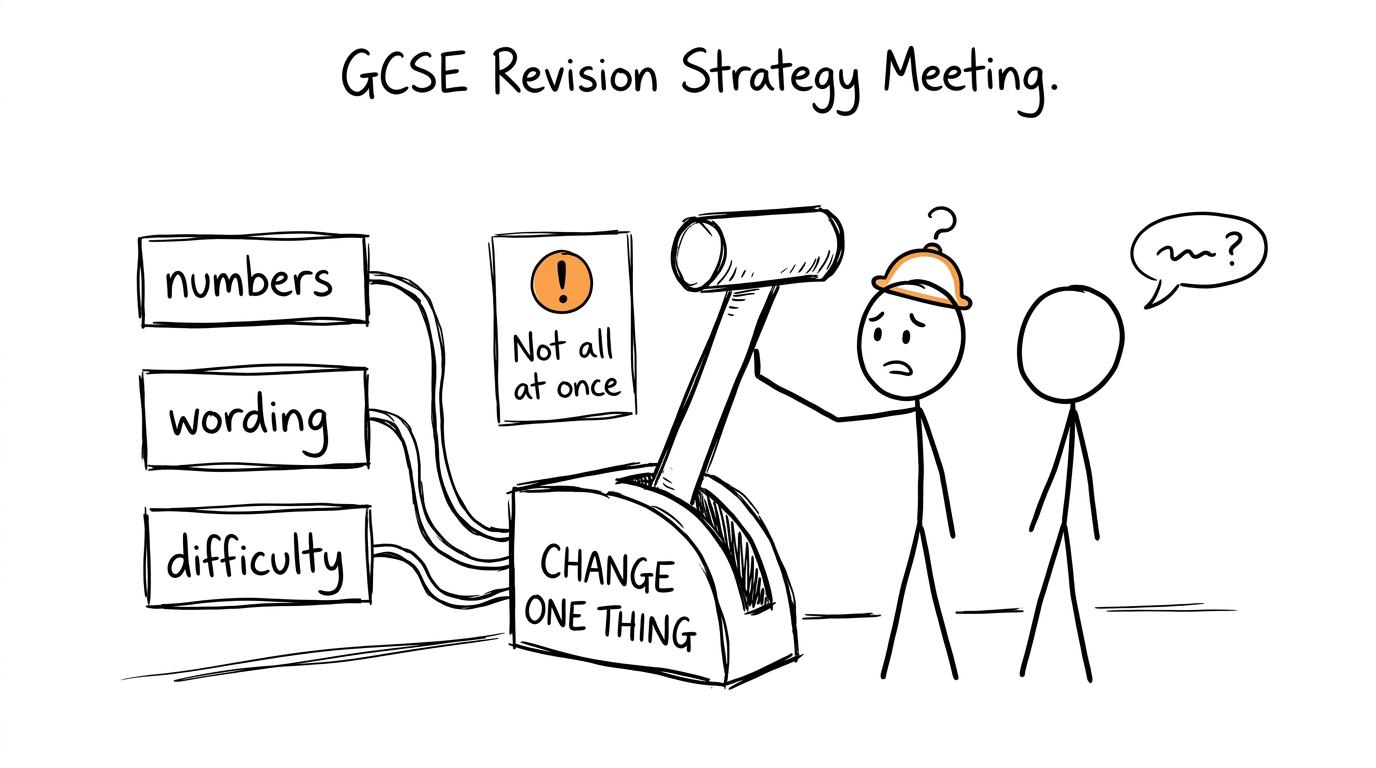 Two students use a change-one-thing lever while avoiding changing numbers, wording and difficulty together
Use the change-one-thing rule
Once you have a sound question, create variations by changing one feature at a time. You might alter:
- a coefficient or coordinate;
- the required form of the answer;
- the direction of a transformation;
- a calculator question into a non-calculator question;
- a direct instruction into a proof or interpretation task;
- one-step demand into a connected two-part problem.
Changing everything at once makes errors harder to detect. Changing one feature lets you observe why the method still works or why it stops working.
You can also vary the representation without changing the underlying skill. A relationship might be presented through an equation, graph, matrix or geometric description. Recognising the same structure in unfamiliar clothing is valuable preparation for higher-demand questions and later A Level Maths revision.
Write an answer and a simple mark scheme
A question is not finished when the wording is finished. Complete it independently and record:
- the final answer;
- the essential method;
- important intermediate results;
- the number of marks you think is reasonable;
- acceptable alternative methods, if you know them.
Do not imitate exam-board mark-scheme codes unless you understand them. A plain checklist is enough for personal revision. For a three-mark item, for instance, you might award one mark for a correct setup, one for a valid transformation and one for the answer.
Then compare your judgement with the mark schemes in the AQA GCSE Further Maths resources. This comparison teaches you how much working a real assessment expects.
If your answer becomes unexpectedly complicated, revise the inputs. If two methods produce different results, the question needs debugging before it belongs in your revision bank.
Test the question like an examiner
Leave your finished question untouched for several days. Then answer it without notes and under a short time limit. The gap helps separate memory of writing the question from genuine retrieval of the method.
Use this quality-control check:
- Is every symbol defined?
- Is enough information provided?
- Are calculator expectations sensible?
- Does the command word match the task?
- Is the answer unique where it should be?
- Have exact values been preserved where appropriate?
- Does the mark allocation match the amount of work?
- Is the content on your specification?
If possible, swap questions with a classmate taking the same qualification. If they interpret your wording differently, that is useful feedback. Rewrite the question rather than explaining verbally what you meant.
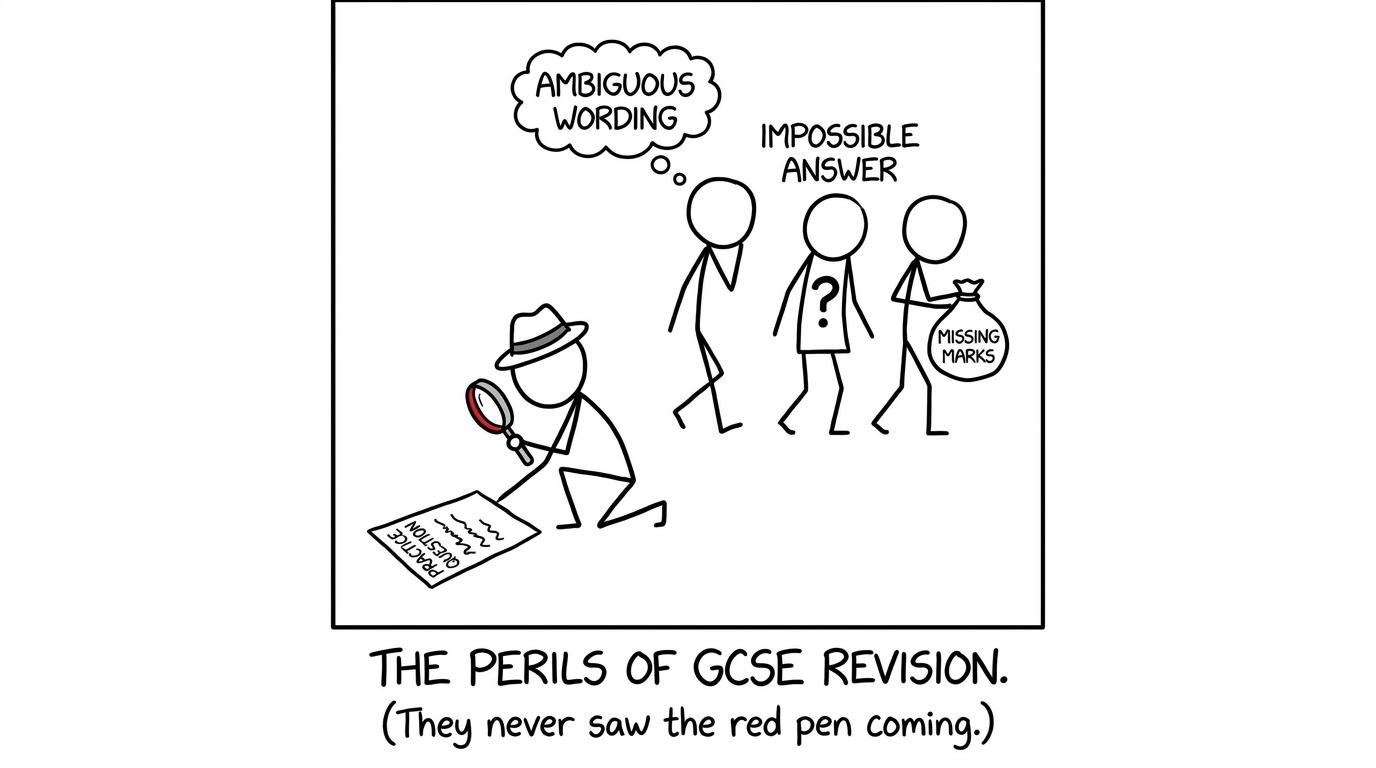 A student detective catches ambiguous wording, an impossible answer and missing marks escaping from a question
Balance question writing with exam practice
Your own questions are strongest for exploring structure and repairing a specific weakness. They are weaker for predicting the overall balance, wording and difficulty of a real paper.
A reliable revision cycle is:
- learn or refresh one method;
- write one or two accurate questions;
- answer them after a delay;
- complete established topic questions;
- mark everything carefully;
- finish with mixed or timed paper practice.
Use the advice on finding your weakest GCSE topics to choose what deserves a student-written question. Near the exams, bring in GCSE predicted papers for fresh mixed practice, but remember that predicted papers are preparation tools rather than guarantees of future content.
Common mistakes when making Further Maths questions
Choosing random numbers without checking them
Random coefficients can create impossible conditions, unwanted repeated roots or arithmetic that overwhelms the intended skill. Build backwards from a known structure and solve the question yourself.
Copying notes almost word for word
Changing one number in a textbook question requires little thought. First identify the mathematical structure, then write a new prompt from memory.
Making every question extremely difficult
Difficulty is not the same as quality. Include short retrieval questions, standard applications and occasional connected problems. A question bank should help you build control, not merely prove that Further Maths can be intimidating.
Writing questions but never answering them
Generation and retrieval serve different purposes. Always schedule your questions for a later attempt, then mark and correct them.
Ignoring official materials
Your wording may be ambiguous and your mark allocation may be unrealistic. Compare your work with authentic papers and mark schemes. For broader exam practice, MathsGenie's Edexcel GCSE Maths past papers also demonstrate how questions develop across a full paper, although you must still match Further Maths content to your own specification.
Make question writing part of a better revision system
Writing your own Further Maths questions is valuable because it changes your role. For a few minutes, you stop asking only, "How do I get the answer?" and start asking, "What makes this method valid?"
Keep the activity small and rigorous. Choose one specification point, retrieve the method, design backwards, write a clear instruction, solve it and check it against established material. Then return to answering questions under exam conditions.
Start with MathsGenie's free AQA GCSE Further Maths revision hub. Use the revision lessons and practice questions to secure each topic, your own questions to expose its structure, and past papers, predicted papers, mark schemes and video solutions to prepare for the real assessment. A good question does more than fill a page; it shows you what you truly understand and what to revise next.










