

Make Your Own GCSE Food and Nutrition Questions
Make own GCSE Food and Nutrition practice questions to improve recall, expose weak spots and strengthen the maths skills used in recipes and data analysis.

A page of neat notes can feel reassuring. Yet close the book and ask yourself to explain gelatinisation, calculate a recipe scale factor or evaluate a food choice, and that reassurance may disappear.
So, is it worth trying to make own GCSE Food and Nutrition practice questions? Yes, provided you check them against your specification, past papers and reliable answers. Writing a question forces you to decide what matters, how knowledge might be applied and what a complete response should contain. That thinking can teach you almost as much as answering the question.
It should not replace official exam practice, however. Research into student-generated questions is mixed: question writing can encourage active processing and retrieval, but poorly targeted questions may miss what an assessment actually tests. The strongest approach combines your questions with genuine exam-board materials and carefully marked practice.
The quick checklist
Your self-written question bank should:
- follow the specification for your exam board;
- cover recall, application, analysis and evaluation;
- include short, extended and data-based questions;
- test calculations as well as food knowledge;
- have an answer or mark scheme written at the same time;
- be attempted without notes after a delay;
- sit alongside official past-paper questions.
For the mathematical parts of Food Preparation and Nutrition, MathsGenie can help you repair the underlying skills. Proportion recipe questions are an especially useful starting point.
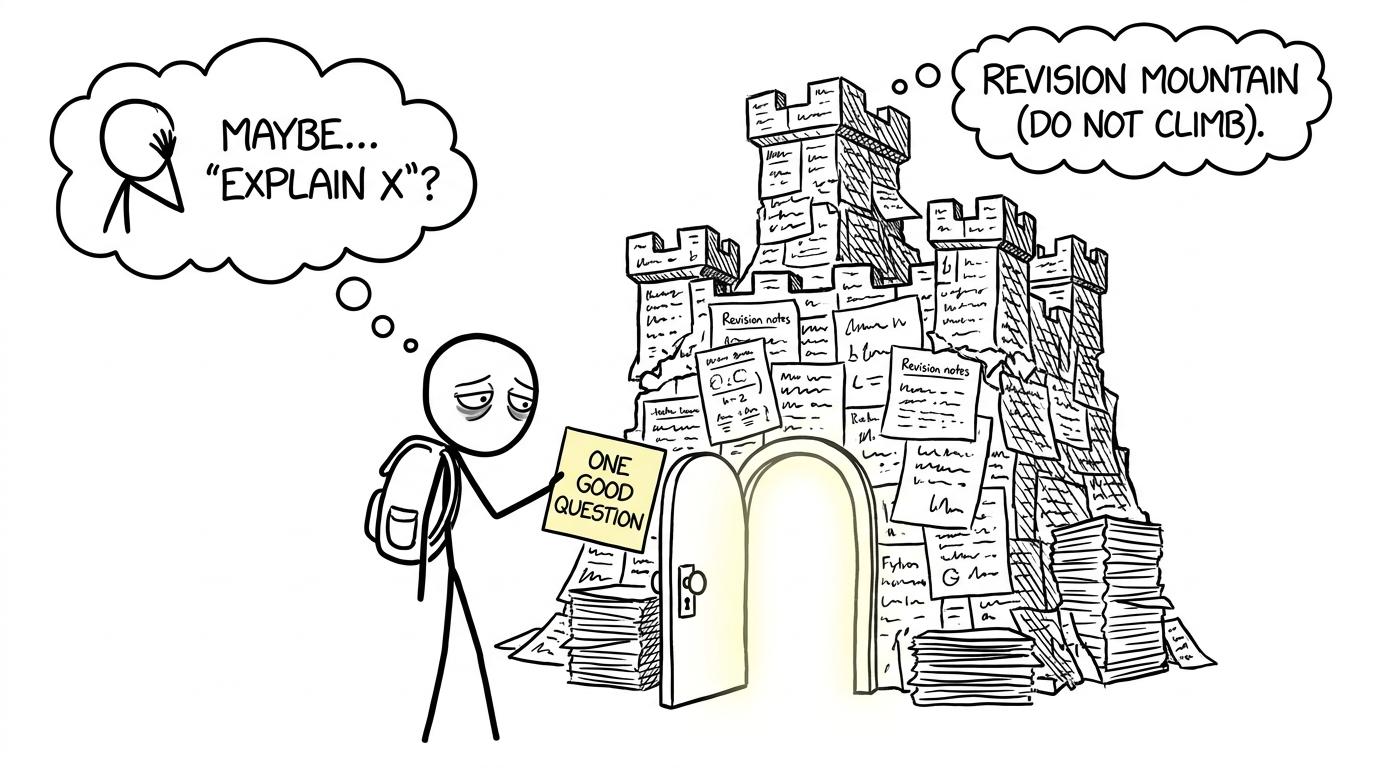 A student finds that one good question opens a door through a castle of revision notes
Why writing questions can improve your revision
Answering a question asks, “What do I know?” Writing one asks a deeper set of questions: “What is important here? How could it be tested? What would distinguish a vague answer from a precise one?”
That change of role matters. You stop treating your notes as a finished object and begin inspecting their structure.
Suppose a page covers food safety. Simply rereading it may make the terminology familiar. To create useful questions, you must separate definitions from explanations, identify situations where the knowledge applies and decide which details belong in a high-quality answer. Even before you attempt the question, you have organised the content.
Question writing also reveals gaps. If you cannot produce a clear answer key without copying a paragraph, you may not yet understand the idea well enough. That is valuable information, not failure.
There is an important limit. A question can be beautifully written and still be poorly aligned with your course. Use your current specification and recent assessment materials as boundaries. AQA organises its content into five broad areas, while OCR and Eduqas structure their content differently. Paper formats also vary. Your own bank must match the board you actually take rather than becoming a general food quiz.
Turn your notes into a balanced question bank
Start with the specification, not a blank page
Divide the examinable content into the headings used by your exam board. Then place each page of notes beneath the relevant heading. This reduces the risk of spending an evening producing twenty questions on a favourite topic while ignoring food provenance, food science or safety.
For every section, aim for a mixture of demands:
- Recall: state, name, identify or define.
- Explanation: explain why or describe how.
- Application: use knowledge in a particular dietary, practical or commercial context.
- Analysis: interpret information, results, labels, tables or graphs.
- Evaluation: weigh evidence and reach a supported judgement.
The shared assessment objectives for GCSE Food Preparation and Nutrition distinguish knowledge and understanding, application, practical performance, and analysis and evaluation. Written examinations principally assess knowledge, application, analysis and evaluation; practical performance is assessed through non-exam assessment. That means a bank made entirely of definition questions is too narrow.
Convert each note into a question stem
Read one small section and identify its central idea. Then hide the note and phrase a question that requires the idea to be retrieved or used.
Useful stem patterns include:
- “State two…”
- “Explain how…”
- “Suggest why…”
- “Compare…”
- “Analyse the information to…”
- “Evaluate whether…”
Match the command word to the response you expect. “State” should not require a long chain of reasoning. “Explain” needs linked reasoning rather than a list. “Evaluate” should invite evidence on more than one side and a justified conclusion.
Avoid lifting a sentence from your notes and removing one word. That usually tests recognition rather than understanding.
Write the answer before moving on
A self-written question without a checked answer is unfinished. Create a short mark scheme containing the exact facts, links or calculations needed. For an extended response, list the acceptable content and describe what a developed judgement would need.
Then check both question and answer against your textbook, teacher materials, specification and official mark schemes. If two reasonable interpretations are possible, rewrite the wording.
Mark allocation should reflect demand. One straightforward fact may deserve one mark; a developed explanation needs room for linked ideas. You do not need to imitate an examiner perfectly. You do need a consistent standard that prevents generous self-marking.
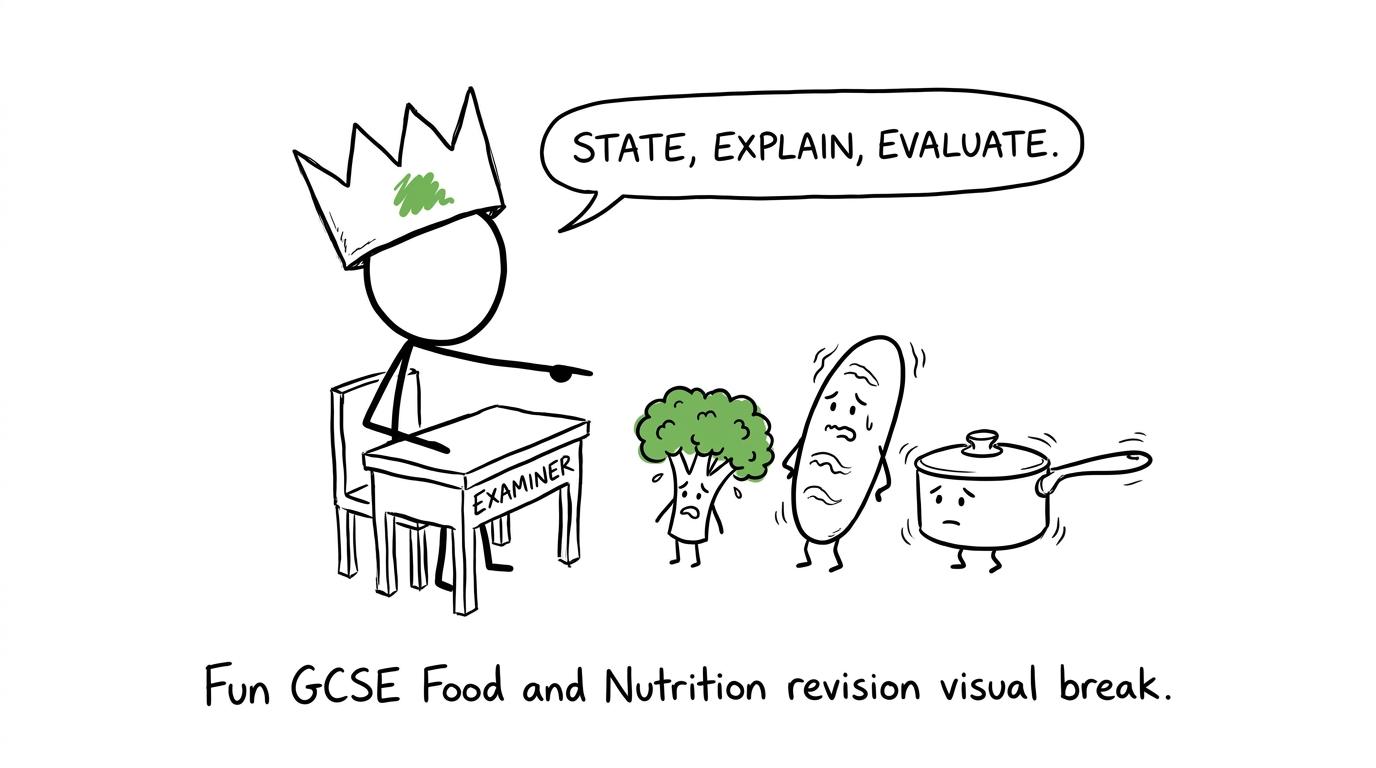 A student examiner questions a broccoli, loaf and saucepan using command words
Include the maths hidden inside Food and Nutrition
Food questions often place familiar mathematics inside an unfamiliar setting. Recipe quantities, nutritional information, costs, sensory testing and investigation results can all involve numerical reasoning. Practising the context without strengthening the mathematics leaves a weak link.
Ratio and recipe scaling
For recipes, the central relationship is direct proportion. A reliable general model is:
scale factor=required number of portionsoriginal number of portions\text{scale factor}=\frac{\text{required number of portions}}{\text{original number of portions}}scale factor=original number of portionsrequired number of portionsand
new quantity=original quantity×scale factor.\text{new quantity}=\text{original quantity}\times\text{scale factor}.new quantity=original quantity×scale factor.When creating questions, vary what is unknown. You might ask for revised ingredient quantities, the number of portions possible from a given supply, or which ingredient limits production. Do not make every question a simple doubling exercise.
Use the GCSE proportion revision area to rebuild the method, then try the proportion ingredients question booklet without looking at its solutions.
Ratio matters when comparing ingredient mixtures or interpreting proportions. The GCSE ratio revision guide explains how equal parts, totals and shares fit together.
Percentages, averages and units
Nutritional tables and investigation data may require calculations such as:
percentage=partwhole×100.\text{percentage}=\frac{\text{part}}{\text{whole}}\times 100.percentage=wholepart×100.Sensory or experimental results may also require a mean:
mean=sum of the valuesnumber of values.\text{mean}=\frac{\text{sum of the values}}{\text{number of values}}.mean=number of valuessum of the values.Your questions should make units explicit and occasionally require conversion between compatible units. A correct numerical value with the wrong unit can communicate the wrong quantity. Use MathsGenie’s conversions and units revision and percentages revision guide when these skills feel less secure than the food content.
Writing calculation questions is useful because it makes you inspect the relationship between the numbers. But always verify your arithmetic and wording before adding a question to your bank.
Use your questions in a revision cycle
Question writing is preparation. Retrieval begins when you attempt the questions later without support.
A practical cycle is:
- create a small set from one topic;
- write and verify its answers;
- leave the questions for a short gap;
- answer them closed-book;
- mark strictly;
- record the reason for each lost mark;
- rewrite weak questions and reattempt them later.
Shuffle topics as the exam approaches. A mixed set is harder because it removes the clue provided by a chapter heading. That difficulty is useful: the examination will not announce which part of your notes to remember.
Keep official questions in the cycle too. Your own questions are strongest for exploring notes and targeting personal gaps; official papers are better evidence of authentic wording, balance and demand. The same principle underpins effective maths revision. MathsGenie’s guide to finding your weakest GCSE topics shows how marking can turn mistakes into a focused revision list.
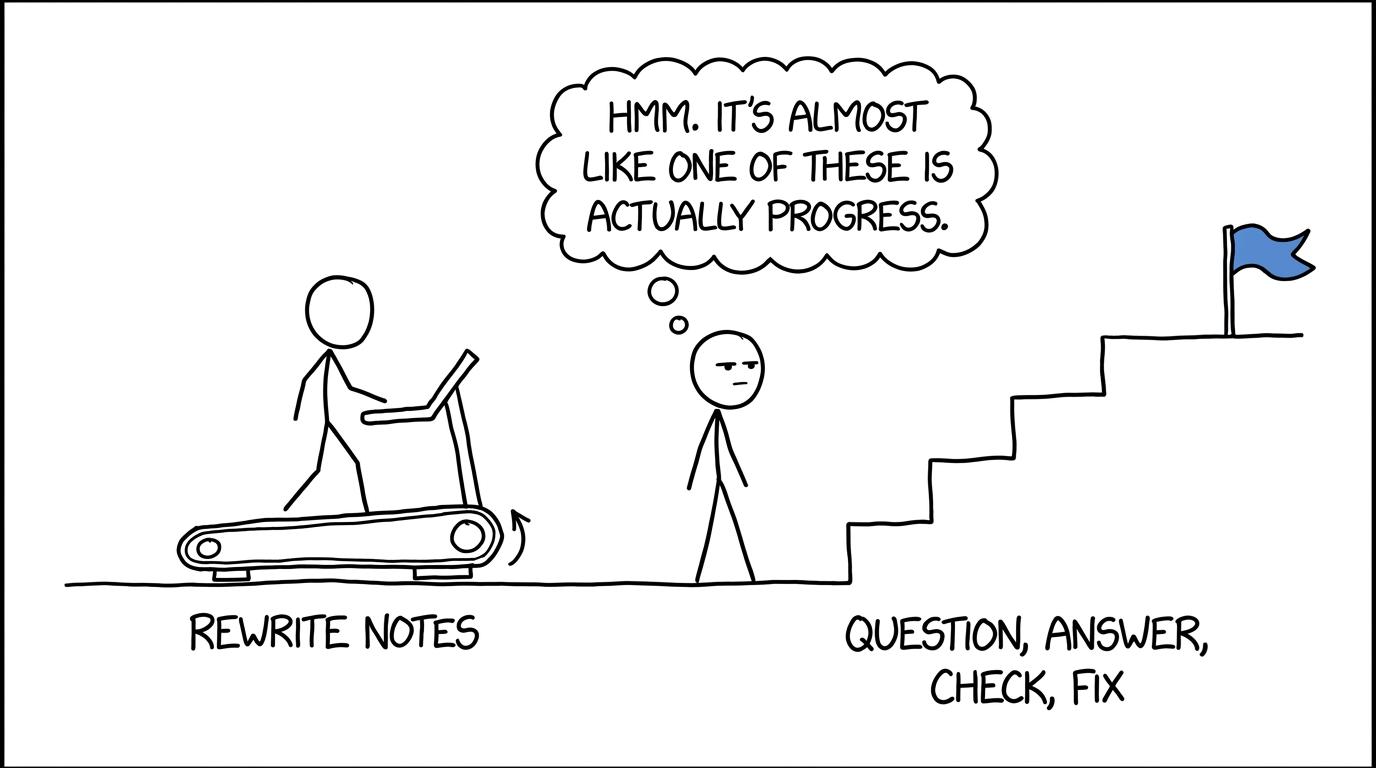 A revision treadmill goes nowhere while a question, answer, check and fix staircase reaches a flag
Common mistakes when making practice questions
Testing only easy facts
Definitions feel productive because they are quick to write and mark. They do not provide enough practice in application or evaluation. Include unfamiliar contexts and evidence-based prompts.
Copying the notes into the question
If the wording supplies most of the answer, little retrieval is required. Keep necessary context, but remove accidental clues.
Writing ambiguous multiple-choice questions
A strong multiple-choice item has one defensible answer and plausible alternatives. Avoid unnecessary negatives and options that overlap. If more than one answer could reasonably be selected, revise the item.
Inventing answers from memory
Confidently remembered information can still be incomplete. Check answers against trusted course materials before using them for self-marking.
Making every calculation identical
Repeatedly changing only the numbers can create fluency with one procedure, but it does not test interpretation. Vary the unknown quantity, data format and decision required.
Replacing exam papers entirely
Self-written questions cannot perfectly reproduce an exam board’s style. Keep them as one layer of revision, not the whole system. For your maths preparation, Edexcel GCSE Maths past papers and mark schemes provide the authentic paper practice your own questions cannot replace.
Is making your own questions worth the time?
It is worth the time when the process is selective. Do not rewrite an entire textbook as a question bank. Choose topics where your recall is weak, where ideas are easily confused or where a calculation repeatedly costs you marks.
A good question creates three benefits: it organises knowledge while you write it, retrieves knowledge when you answer it, and provides feedback when you mark it. A poor question merely gives your pen something to do.
Start with one page of Food and Nutrition notes today. Produce a balanced handful of questions, verify the answers and schedule a closed-book attempt. Then strengthen the calculations behind them with MathsGenie’s free revision lessons and practice questions.
For maths exam preparation, continue the same honest loop: learn the method, answer questions, use mark schemes and video solutions, record mistakes, and test yourself again with mini tests, past papers and predicted papers. MathsGenie gives you the structure; your corrections are what turn that structure into progress.










