Is GCSE Religious Studies EBacc? The Clear Answer
Is GCSE Religious Studies EBacc? No. See which subjects count, what this means for school options, and how to protect time for focused GCSE maths revision.
Choosing GCSE options can feel strangely permanent. A subject may interest you, yet one phrase on an options sheet, “EBacc subjects”, can make you wonder whether choosing it will close doors later.
So, is GCSE Religious Studies EBacc? No. Religious Studies does not currently count as an EBacc subject in England. For the humanities part of the English Baccalaureate, you must take GCSE History or GCSE Geography. Religious Studies can still be a valuable GCSE, but it does not replace either of those subjects within the EBacc combination.
That answer is simple. What it means for your timetable, your future choices and your maths revision deserves a little more care.
The answer at a glance
Here is the essential checklist:
- GCSE Religious Studies does not currently count towards the EBacc.
- The EBacc humanities requirement is met by GCSE History or GCSE Geography.
- Religious Studies remains a recognised GCSE graded on the 999 to 111 scale.
- RE provision and taking a GCSE qualification in Religious Studies are not the same thing.
- You may be able to take Religious Studies alongside the full EBacc, depending on your school's timetable.
- The EBacc is a school performance measure and subject combination, not a separate qualification or certificate.
- Government plans are changing how the EBacc is used in school accountability, but this does not retrospectively turn Religious Studies into an EBacc subject.
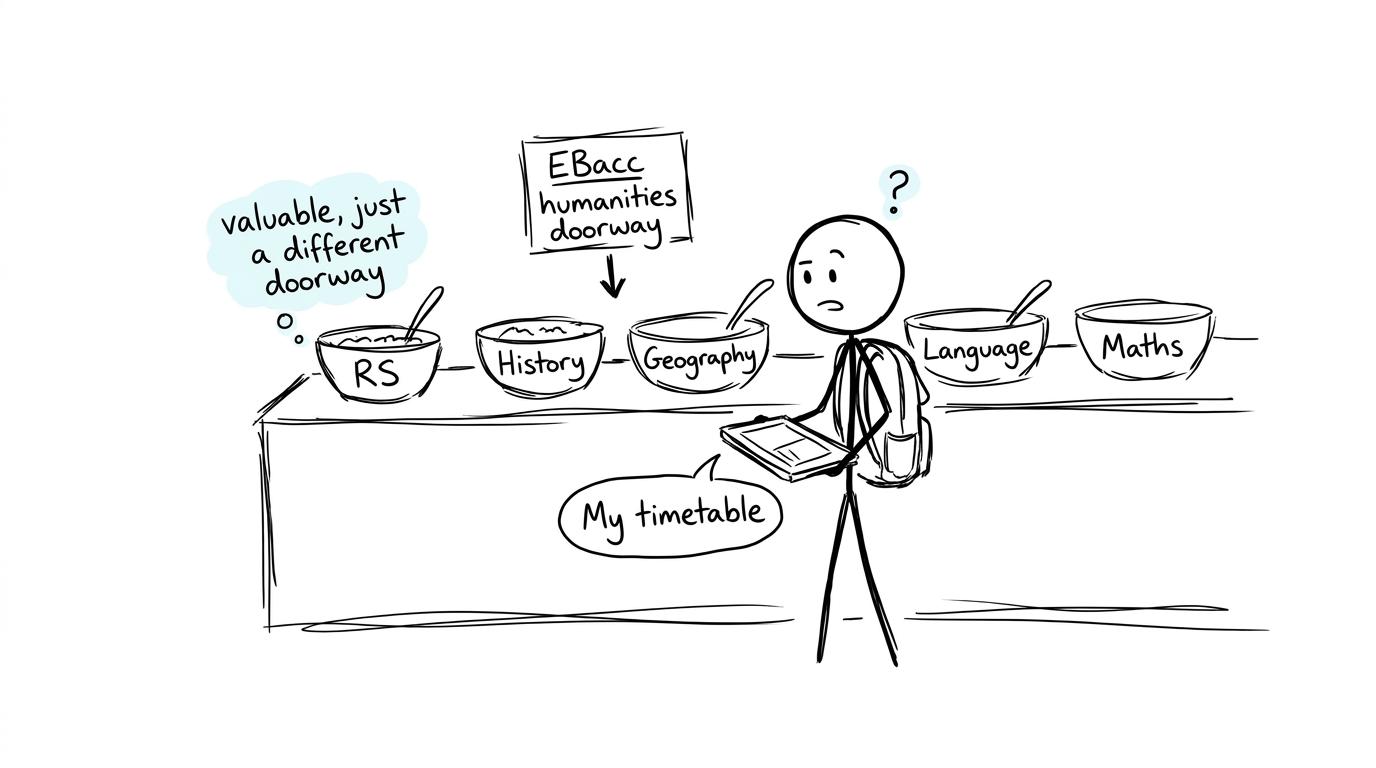 A student choosing between valuable GCSE subjects at an options buffet
Which subjects count towards the EBacc?
The English Baccalaureate, usually shortened to EBacc, was created as a way of measuring entry and attainment across a particular group of academic subjects in England. It is not an additional examination.
The current subject pillars are:
- English language and English literature
- maths
- science
- a modern or ancient language
- History or Geography
Science may be covered through Combined Science or an eligible combination of separate sciences. The exact qualifications that count are set out in the Department for Education's official eligible qualifications list.
Religious Studies is absent from the humanities pillar. That is the key detail. Although Religious Studies is plainly a humanities subject in the wider educational sense, the existing EBacc definition uses History or Geography specifically.
This is why a student taking English, maths, science, French and Religious Studies would not complete the full EBacc combination unless they also took History or Geography.
Why does Religious Studies not count as an EBacc humanity?
The difference is not a judgement that Religious Studies lacks academic value. GCSE Religious Studies requires knowledge, comparison, analysis, evaluation and structured argument. Current GCSE subject content in England includes the study of religions, sources of wisdom and authority, the influence of belief, and religious, philosophical or ethical questions.
Specifications from boards such as AQA, OCR, Pearson Edexcel and Eduqas organise that content differently, so students should always follow the specification selected by their school.
The exclusion exists because the EBacc was designed around a deliberately narrow set of subject pillars. For its humanities component, the policy selected History and Geography rather than every subject that could reasonably sit under the humanities label.
That distinction matters. “Not included in the EBacc” does not mean:
- not academically demanding
- not a full GCSE
- not useful for future revision skills
- not respected as part of a broad set of qualifications
- not worth choosing if it suits your interests and plans
It only means that the subject does not fill one of the existing EBacc slots.
RE lessons and GCSE Religious Studies are different
A common source of confusion is the difference between Religious Education, usually called RE, and the examined GCSE in Religious Studies.
In England, state-funded schools are required to provide RE across the relevant key stages, subject to withdrawal rights. However, this does not mean that every pupil must be entered for a full GCSE Religious Studies qualification. Schools can organise their provision in different ways, and GCSE Religious Studies may be optional, compulsory within a particular school, or delivered through another timetable arrangement.
A full-course GCSE and a short-course qualification are also different. If your school mentions “core RE”, “full-course RS” or “short-course RS”, ask exactly which qualification you would be entered for. Do not assume that attending an RE lesson automatically means you are taking a full GCSE.
Your school can confirm:
- whether Religious Studies is optional or compulsory
- whether the course is full or short course
- which exam board and specification it follows
- how many lessons it receives
- whether it can be combined with History or Geography
What does this mean for your GCSE options?
If you want to follow the full current EBacc combination, you need to choose History or Geography as the humanities subject. You may still be able to choose Religious Studies in another option block.
The real constraint is often not the number of worthwhile subjects. It is the timetable. Two subjects may appear in the same option block, or your school may reserve certain combinations for particular pathways.
Before submitting your choices, ask three practical questions.
Do I want or need the full EBacc combination?
Your school may strongly encourage an EBacc pathway, but individual circumstances differ. Ask your options adviser what the pathway means at your school and how it fits your interests, current attainment and likely post-16 plans.
The EBacc itself is not a separate GCSE. You receive grades for the individual subjects you take. Sixth forms, colleges and training providers publish their own entry requirements, so check the actual requirements for any course you are considering rather than relying on a label alone.
Can I take Religious Studies as well?
Some students can take History or Geography for the EBacc and choose Religious Studies as an additional subject. Others face timetable clashes. Your school's options booklet is more useful here than a general answer online because option blocks are decided locally.
If there is a clash, speak to the school before assuming nothing can change. It may not be possible to alter the blocks, but it is better to ask while choices are still being discussed.
Which subject am I prepared to revise consistently?
Interest does not remove the need for work, but it makes sustained work more realistic. Religious Studies often involves precise knowledge, relevant references, comparison and extended evaluation. History requires secure factual knowledge and evidence-based explanation. Geography combines knowledge, application, data and fieldwork-related understanding.
Choose with the whole course in mind, not just one enjoyable Year 9 lesson.
Why maths still deserves protected revision time
GCSE options naturally draw attention towards the subjects you are choosing. Maths is different: it is compulsory, it forms its own EBacc pillar, and it is often an important entry requirement for post-16 courses.
That makes maths easy to take for granted. It is always on the timetable, so revision can be postponed while option subjects feel newer and more urgent.
A better approach is to give maths a fixed place in the week. Start by checking your exam board and tier through the GCSE Maths revision hub. Edexcel, AQA, OCR and Eduqas assess shared national subject content, but their papers and presentation are not identical. Foundation and higher tier also offer different grade ranges and levels of demand.
If you are unsure what belongs on your revision list, use the GCSE maths topics by exam board and tier as a map. This prevents a familiar problem: revising whatever feels comfortable while repeatedly avoiding the topics that actually cost marks.
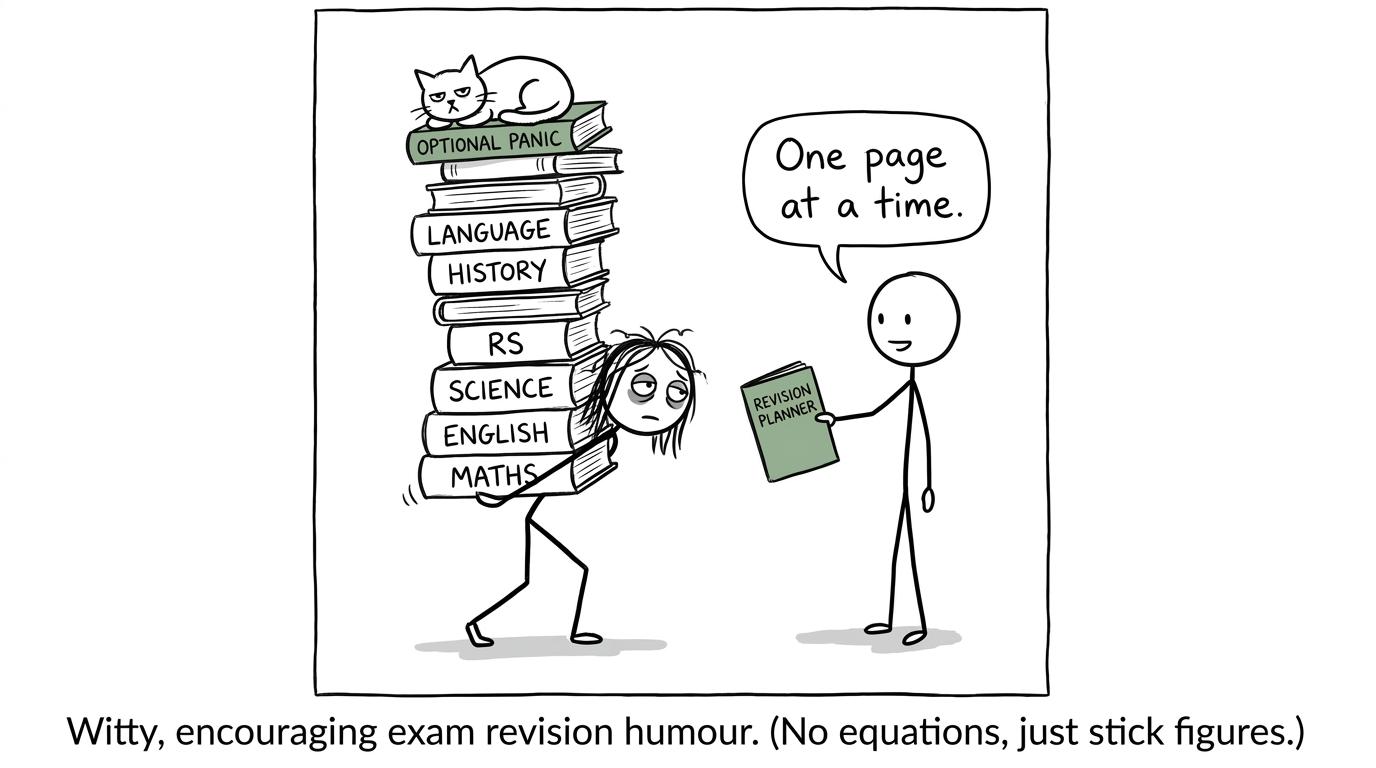 A student balancing an ambitious GCSE workload with a tiny revision planner
A balanced revision plan for maths and option subjects
The best timetable is rarely the most ambitious one. It is the one you can repeat when school is busy.
A sensible weekly rhythm might include:
- short maths retrieval practice on several days
- one focused session on a weak maths topic
- one mini test or timed paper section
- separate blocks for knowledge-heavy subjects such as Religious Studies
- time to mark work and correct errors
The best order for learning GCSE maths topics can help you build skills in a logical sequence. Number fluency supports ratio and proportion; algebraic foundations support graphs and more demanding higher-tier work. Revision becomes less frustrating when prerequisite skills are repaired first.
On crowded school days, the 20-minute GCSE maths revision routine offers a manageable structure. The important habit is not merely completing questions. It is marking them, identifying why marks were lost and returning to the same weakness later.
As exams approach, use Edexcel GCSE Maths past papers if that is your board, or select the appropriate board through the main revision hub. Past papers reveal whether the difficulty is knowledge, accuracy, interpretation or timing. Predicted papers can add fresh practice, but they should support rather than replace official past papers.
For a longer structure, adapt the one-month GCSE maths revision plan around your other subjects. A plan should reduce decisions, not fill every free hour.
Are the EBacc rules changing?
This is an area where current wording matters. The government has announced the removal of EBacc entry and attainment measures from headline school accountability arrangements, with changes connected to the 2025 to 2026 academic year. A proposed replacement approach to performance measures has included a broader humanities category containing Religious Studies alongside subjects such as History and Geography.
However, a proposed future accountability category is not the same as saying Religious Studies currently counts towards the EBacc. Under the established EBacc subject definition, it does not.
Policy changes also affect different year groups at different times. If your school refers to a new accountability framework, ask which cohort it applies to and whether the arrangement is confirmed or still proposed. For your personal options, the school's current timetable and qualification offer remain the immediate facts that matter.
Common mistakes when thinking about RS and the EBacc
Assuming every humanity counts
The everyday category “humanities” is broader than the EBacc humanities pillar. For the current EBacc combination, Religious Studies cannot replace History or Geography.
Believing the EBacc is another certificate
You do not sit an EBacc examination. You sit individual GCSEs, and the combination is used as a measure of entry and attainment.
Confusing compulsory RE with compulsory GCSE RS
Schools must provide RE in England, subject to withdrawal arrangements, but that does not automatically mean every student takes a full-course GCSE Religious Studies examination.
Choosing only for the EBacc label
The label is one consideration, not a complete options strategy. Look at post-16 requirements, your school's guidance, timetable restrictions, your interests and the work each course involves.
Letting options anxiety replace current revision
A future timetable matters, but so do the assessments already in front of you. Keep improving the core subjects while you investigate your choices. If grade terminology is adding to the confusion, read the guide to GCSE grades 999 to 111.
Make the choice clear, then return to the work
GCSE Religious Studies is not currently part of the EBacc. To meet the EBacc humanities requirement, you need History or Geography. Depending on your school's option blocks, you may still be able to take Religious Studies as an additional GCSE.
Once you have checked the facts with your school, the most useful next step is ordinary and powerful: return to consistent revision. Use MathsGenie's free revision lessons to rebuild weak methods, practice questions and mini tests to check them, then past papers and predicted papers to develop timing. Mark schemes and video solutions show where marks are earned and where your method needs to become clearer.
Start with the MathsGenie GCSE Maths revision area, choose your board and tier, and turn one uncertain topic into your next completed task.