GCSE 9-1 Grades Explained: A*-G Equivalence
GCSE 9-1 grades explained with an A*-G comparison table, pass grades, tier limits and practical advice for parents supporting maths revision.
A GCSE results slip can feel like it is written in a new language. Many parents remember aiming for an $ m A,, , m Bororor m C,whilestudentsnowtalkaboutgrades, while students now talk about grades ,whilestudentsnowtalkaboutgrades9,, ,7andandand4.So,hereare∗∗GCSE9−1gradesexplained∗∗simply:grade. So, here are **GCSE 9-1 grades explained** simply: grade .So,hereare∗∗GCSE9−1gradesexplained∗∗simply:grade9isthehighest,gradeis the highest, gradeisthehighest,grade1isthelowest,andgradeis the lowest, and gradeisthelowest,andgrade4$ is a standard pass.
The important detail is that the numeric and letter scales do not match perfectly. They have three official comparison points: the bottom of grade 777 aligns with the bottom of the old grade $ m A,grade, grade ,grade4withgradewith gradewithgrade m C,andgrade, and grade ,andgrade1withgradewith gradewithgrade m G$.
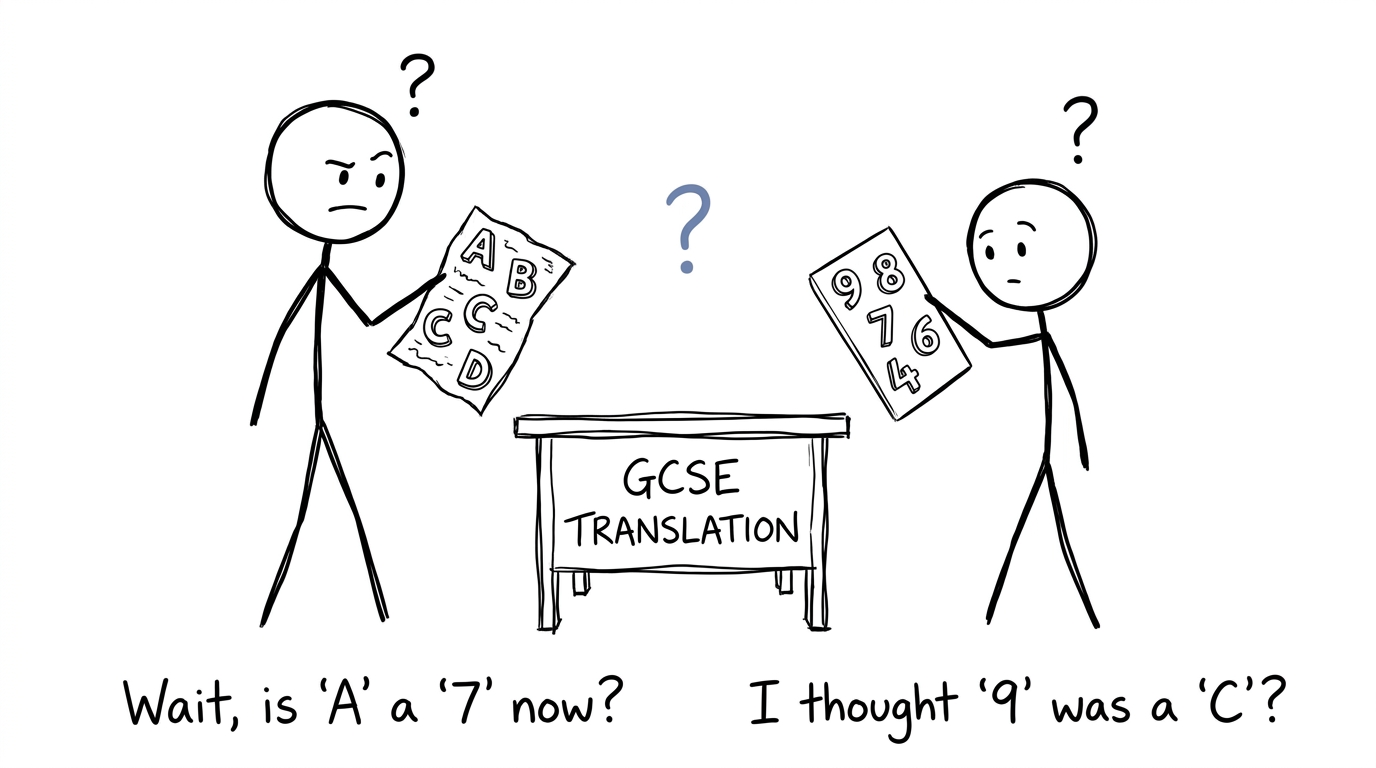 A parent and student trying to translate two GCSE grading languages
GCSE grade equivalence from A* to G
This comparison table is a useful guide, but it should not be treated as an exact conversion chart.
| Current GCSE grade | Approximate old-grade description | Meaning |
|---|---|---|
| 999 | High $ | |
| m A^*$ | The highest level of performance | |
| 888 | Lower $ | |
| m A^*orhighor highorhigh | ||
| m A$ | Between the strongest old grades | |
| 777 | Lower $ | |
| m A$ | Bottom aligned with the old grade $ | |
| m A$ | ||
| 666 | High $ | |
| m B$ | Strong performance above grade $5$ | |
| 555 | Low $ | |
| m Borhighor highorhigh | ||
| m C$ | Government-designated strong pass | |
| 444 | Low $ | |
| m C$ | Standard pass; bottom aligned with the old grade $ | |
| m C$ | ||
| 333 | $ | |
| m Dorhighor highorhigh | ||
| m E$ | Below the standard-pass benchmark | |
| 222 | Low $ | |
| m Eorhighor highorhigh | ||
| m F$ | Performance above grade $1$ | |
| 111 | Low $ | |
| m Fororor | ||
| m G$ | Bottom aligned with the old grade $ | |
| m G$ | ||
| $ | ||
| m U$ | $ | |
| m U$ | Ungraded |
Grades 777, 888 and 999 collectively cover the territory previously occupied by grades $ m Aandandand m A^.Theextragradeatthetopwasintroducedtoprovidegreaterdifferentiationbetweenthehighest−performingstudents.Agrade. The extra grade at the top was introduced to provide greater differentiation between the highest-performing students. A grade .Theextragradeatthetopwasintroducedtoprovidegreaterdifferentiationbetweenthehighest−performingstudents.Agrade9isthereforenotsimplyarenamedis therefore not simply a renamedisthereforenotsimplyarenamed m A^$.
The essential parent checklist
When reading a maths report or results slip, remember:
- 999 is the highest grade and 111 is the lowest.
- Grade 444 is a standard pass.
- Grade 555 is a strong pass.
- Grade 777 begins at the old grade $ m A$ benchmark.
- $ m Umeanstheminimumstandardforgrademeans the minimum standard for grademeanstheminimumstandardforgrade1$ was not reached.
- Entry requirements can be higher than the standard-pass benchmark.
- Grade boundaries change between exam series, so a grade is not tied to a fixed percentage.
The numeric scale applies to reformed GCSEs in England. Wales and Northern Ireland continue to use different grading arrangements for many qualifications, so check which qualification and exam board appear on the certificate.
What grades 4 and 5 mean
Grade 444 is officially described as a standard pass and is broadly comparable with the old grade $ m C.Grade. Grade .Grade5isa∗∗strongpass∗∗,sittingwithintherangepreviouslycoveredbygradesis a **strong pass**, sitting within the range previously covered by gradesisa∗∗strongpass∗∗,sittingwithintherangepreviouslycoveredbygrades m Bandandand m C$.
That does not mean every college, apprenticeship or sixth form uses the same entry requirement. A course might request grade 555, 666 or higher in maths, particularly where the subject will be used extensively. Families should check the exact published requirements rather than assuming that every pass opens the same door.
Foundation and higher tier in GCSE maths
Tier matters because it affects the grades available. In GCSE maths, foundation tier normally offers grades 111 to 555. Higher tier offers grades 444 to 999, with a restricted grade 333 available as a safety net for students who narrowly miss grade 444.
Students can explore exam-board-specific support through the GCSE Maths revision hub. The Edexcel GCSE Maths revision page, for example, brings together revision lessons, questions, mini tests and papers for foundation and higher tier.
Grades are not fixed percentages
A familiar mistake is to assume that a particular percentage always produces the same grade. Grade boundaries are set for each exam series and can move according to the demands of the papers and the evidence available to awarding organisations.
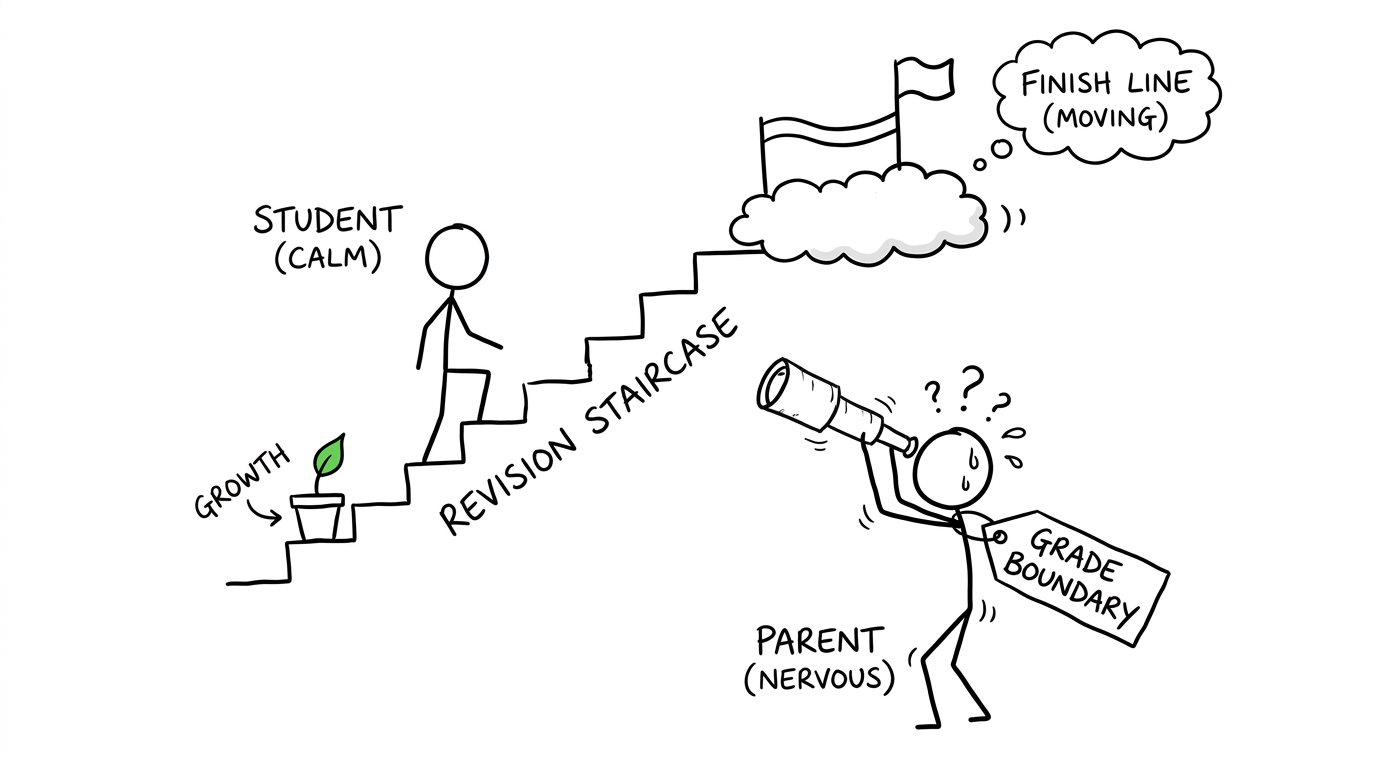 A parent attempting to predict a moving grade boundary while a student revises
For a realistic picture, students should complete GCSE maths past papers, mark them carefully and compare their totals with boundaries from the same series. MathsGenie's GCSE grade boundaries page covers major exam boards including Edexcel, AQA, OCR and Eduqas. Edexcel students can also use the predicted grade calculator as a planning guide.
Common mistakes when comparing GCSE grades
Treating every number as one letter
There are nine numbered grades but only eight old letter grades from $ m A^*tototo m G$. Some grades necessarily overlap old letter ranges.
Calling grade 5 the only pass
Grade 444 is the standard pass. Grade 555 is the strong pass. Individual courses may set higher requirements, but that does not change the official descriptions.
Predicting a grade from an arbitrary percentage
Boundaries vary by exam board, tier and exam series. Use the correct published boundaries rather than a percentage remembered from another paper.
Focusing on the label rather than the next marks
A grade is a summary of performance, not a revision plan. The useful question is where more marks can be gained. Topic worksheets with answers help students target weak areas before moving to GCSE predicted papers.
Turn grade understanding into better revision
The old and new grading systems are best understood as overlapping scales, anchored clearly at grades 777, 444 and 111. Once that translation is clear, attention can return to what actually changes a result: learning methods, practising questions and reviewing errors.
Start with MathsGenie's free revision lessons and practice questions, then use mark schemes, video solutions, mini tests, past papers and predicted papers to measure progress. Finally, check the latest GCSE grade boundaries for the relevant board and exam series rather than guessing what a mark might mean.