

Imposter Syndrome Top Set GCSE Economics: Help
Imposter syndrome top set GCSE Economics feelings can be common. Learn why confidence misleads, how to revise with evidence, and when to seek support early.
A teacher asks a question about inflation. Someone answers immediately. Three other hands rise while you are still deciding what the question means. In a few seconds, one difficult thought appears: perhaps everyone belongs here except me.
If you are searching for imposter syndrome top set GCSE Economics, the short answer is reassuring: feeling out of your depth in a high-attaining class is not unusual, and the feeling is not reliable evidence that you lack ability. Research on the imposter phenomenon links it with self-doubt, difficulty accepting success and perfectionism. However, there is not enough robust research specifically measuring its prevalence among top-set GCSE Economics students to attach an honest percentage to it.
What matters is what you do next. Confidence is a feeling. Your attempts, corrections and progress provide better evidence.
A quick reality check
Keep these points in view:
- A top set is a school grouping, not a separate GCSE Economics qualification.
- A quick answer from another student reveals speed at one moment, not their complete understanding.
- Finding unfamiliar material difficult is part of learning it.
- GCSE Economics assesses knowledge, application, analysis, evaluation and quantitative skills, not effortless classroom performance.
- Specific practice provides better information than comparison.
- Persistent anxiety deserves support from a trusted adult, teacher, school pastoral team or health professional.
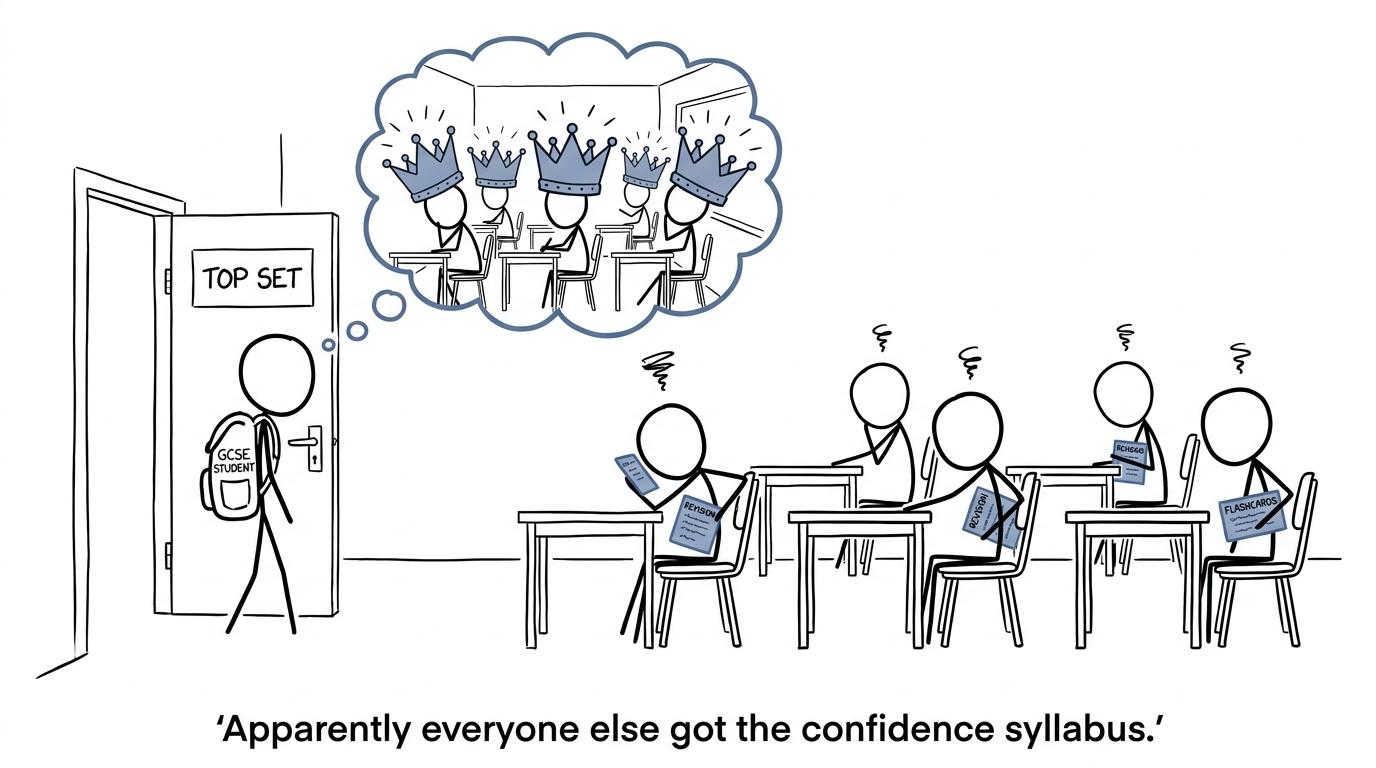 Students discover that confidence was not included in the syllabus
What imposter feelings look like in a top set
The term imposter phenomenon is often used in research for a pattern in which capable people struggle to internalise achievement. They may attribute success to luck, easy questions or help from others, while treating every mistake as proof that they are inadequate.
For a GCSE student, that pattern might sound like this:
- “I only did well because the test was easy.”
- “If I ask about this graph, everyone will realise I should not be here.”
- “One weak essay means I am not a top-set student.”
- “I need to understand everything immediately.”
- “Everyone else revises less and knows more.”
These thoughts can feel convincing without being accurate. Research involving university students has found associations between stronger imposter feelings, lower self-efficacy and maladaptive perfectionism. That evidence cannot simply be converted into a statistic about GCSE pupils, but it helps explain why ambitious learners may doubt themselves even when there is evidence of competence.
The important distinction is this: a knowledge gap identifies something to learn. Imposter thinking turns that gap into a judgement about who you are.
Why top-set Economics can amplify self-doubt
Your comparison group suddenly changes
A student who previously felt quick may enter a class where many people answer quickly. Their ability has not disappeared; the reference group has changed.
This is similar to changing the scale on a graph. The underlying value may be the same, but its appearance changes because the surrounding values are different. Being stretched by a strong class can therefore feel like decline even while your understanding is growing.
Economics mixes several demanding skills
GCSE Economics is not just a collection of definitions. AQA and OCR assessments require students to recall ideas, apply them to contexts, analyse chains of reasoning and make supported judgements. Quantitative work also includes calculations and the interpretation of economic data.
You might understand demand but find evaluation difficult. Another student may write fluent paragraphs but hesitate over percentage change. A single classroom conversation rarely reveals those differences.
The AQA GCSE Economics revision hub helps make the course less mysterious by separating it into lessons, questions and revision tools. Once a broad worry becomes a named skill, it becomes easier to improve.
Top-set students may expect fluency too early
High expectations can quietly become an impossible rule: “If I belong here, this should feel easy.” Yet difficult learning often feels slow and untidy. Secure knowledge is normally built through retrieval, mistakes, feedback and repeated attempts.
Perfectionism can make this process look like failure. It encourages you to hide incomplete work, avoid challenging questions or revise only familiar topics. That protects confidence briefly, but it also removes the feedback needed for progress.
Visible confidence is incomplete information
You can hear a classmate's answer. You cannot see the revision completed the night before, the question they misunderstood last week or the uncertainty they chose not to mention.
Comparing your internal doubts with somebody else's public performance is an unfair comparison. The data sets do not measure the same thing.
What actually helps imposter syndrome in top set GCSE Economics
Replace identity questions with skill questions
“Am I clever enough?” is too broad to produce a useful action. Ask narrower questions instead:
- Can I define the key term accurately?
- Can I apply it to the extract?
- Can I explain the next link in the chain?
- Can I use data to support a judgement?
- Can I complete the calculation and interpret the result?
A vague fear becomes manageable when it is translated into an observable task. MathsGenie's guide to finding your weakest GCSE topics offers a practical model: attempt questions, mark them carefully, classify each lost mark and retest the underlying skill.
Keep an evidence log, not a confidence diary
Confidence can change with sleep, classroom atmosphere or one awkward question. Evidence is steadier.
After a revision session, record:
- the topic attempted;
- what you could do without notes;
- the precise reason marks were lost;
- one correction you made;
- the date you will retry it.
Classify errors as a knowledge gap, application gap, reasoning gap, quantitative error or exam-technique issue. “I am bad at Economics” tells you nothing. “I describe the policy but do not explain its effect on firms” gives you a next step.
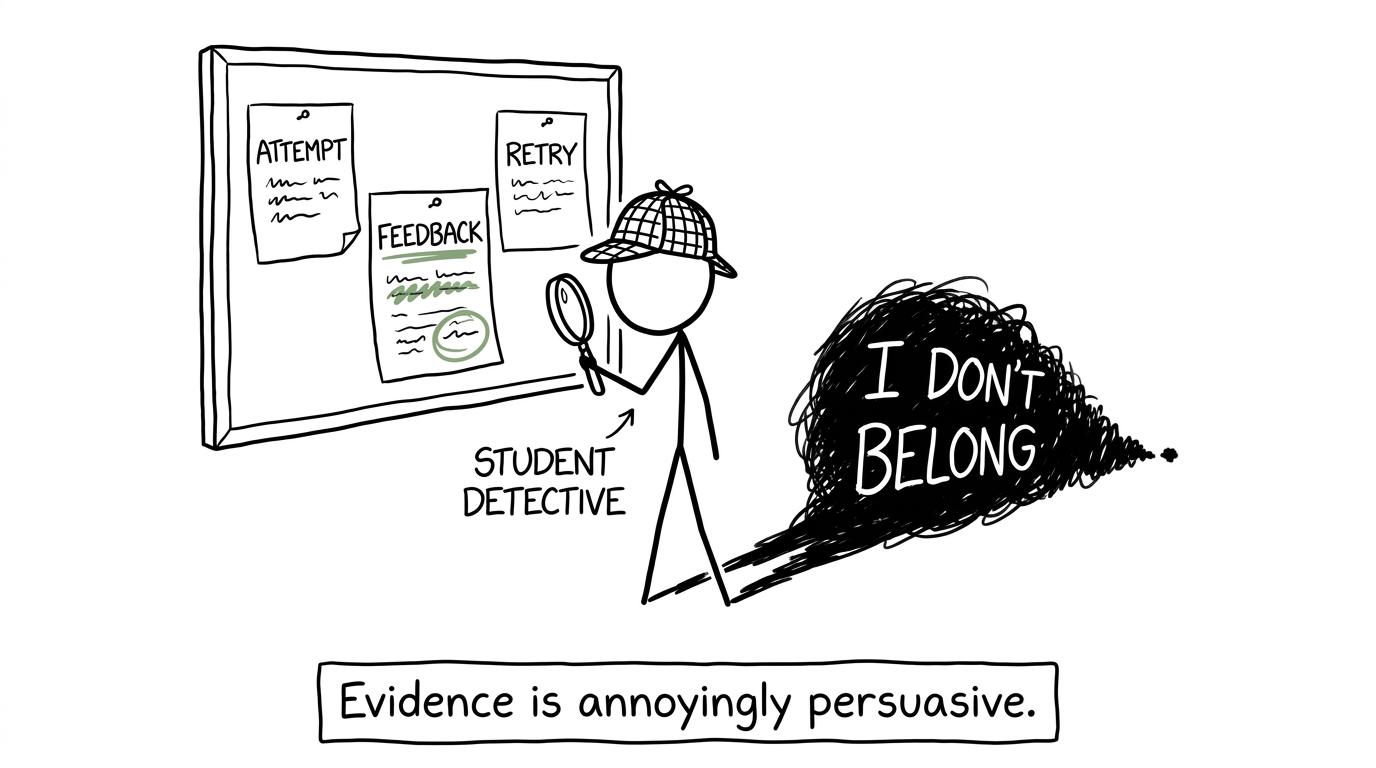 A student detective uses attempts, feedback and retries as evidence
Use a short learn-practise-mark-retry cycle
A calm revision cycle is more useful than waiting to feel ready:
- Learn: review one concept or method.
- Practise: answer a small set without copying notes.
- Mark: use the mark scheme and identify exactly what was missing.
- Retry: return to a fresh question after a gap.
This creates evidence that your brain tends to overlook. The GCSE one-month revision plan applies the same principle to maths: diagnose first, revisit material and use timed practice rather than relying on rereading.
Strengthen the maths inside Economics
Quantitative questions can make Economics feel more intimidating, especially when several skills appear together. Rebuilding them separately reduces cognitive load.
Useful relationships include:
Percentage change=new value−original valueoriginal value×100%\text{Percentage change}=\frac{\text{new value}-\text{original value}}{\text{original value}}\times 100\%Percentage change=original valuenew value−original value×100% Profit=total revenue−total cost\text{Profit}=\text{total revenue}-\text{total cost}Profit=total revenue−total cost Average cost=total costoutput\text{Average cost}=\frac{\text{total cost}}{\text{output}}Average cost=outputtotal costThese formulae are only part of the task. You also need to select the correct values, retain units and explain what the result means in context. MathsGenie's quantitative skills in Economics revision guide brings percentages, averages, costs, revenue, profit and data interpretation together. You can also use the accompanying Economics quantitative skills flashcards for retrieval.
If percentage change itself feels uncertain, return briefly to the GCSE percentage change resources. Repairing a foundation skill is not evidence that you are behind. It is efficient revision.
Practise being seen while learning
Imposter feelings grow when every uncertainty is hidden. Start with a manageable act:
- ask your teacher one specific question after class;
- compare one answer with the mark scheme;
- explain a concept to a partner;
- submit an imperfect practice paragraph for feedback;
- say which step of a calculation you do understand.
The aim is not to perform confidence. It is to learn that uncertainty can be visible without becoming a verdict on your ability.
Speak to your teacher using evidence
Instead of saying only, “I do not think I belong in top set,” bring a marked answer and ask where the next mark would come from. Teachers can help distinguish between a genuine subject gap, harsh self-assessment and an exam-technique issue.
Remember that class placement is an organisational decision made by your school. It is not a permanent label, and it does not define your eventual GCSE grade.
A revision routine that builds earned confidence
Use three short sessions during the week and one mixed check when time allows:
Session one: retrieve
Choose one Economics topic. Write definitions, diagrams or reasoning chains from memory, then check them. Keep the focus narrow.
Session two: apply
Answer questions based on a context or data source. Application means using the information given, not repeating a memorised paragraph.
Session three: repair
Review the week's errors. Revisit the smallest skill responsible for repeated lost marks, including percentages, averages or graph interpretation through the GCSE Maths revision hub.
Mixed check: test under pressure
Complete a timed section, mini test or paper. Mark it on the same day and choose the next two revision priorities. Past papers are most valuable when they change what you practise next.
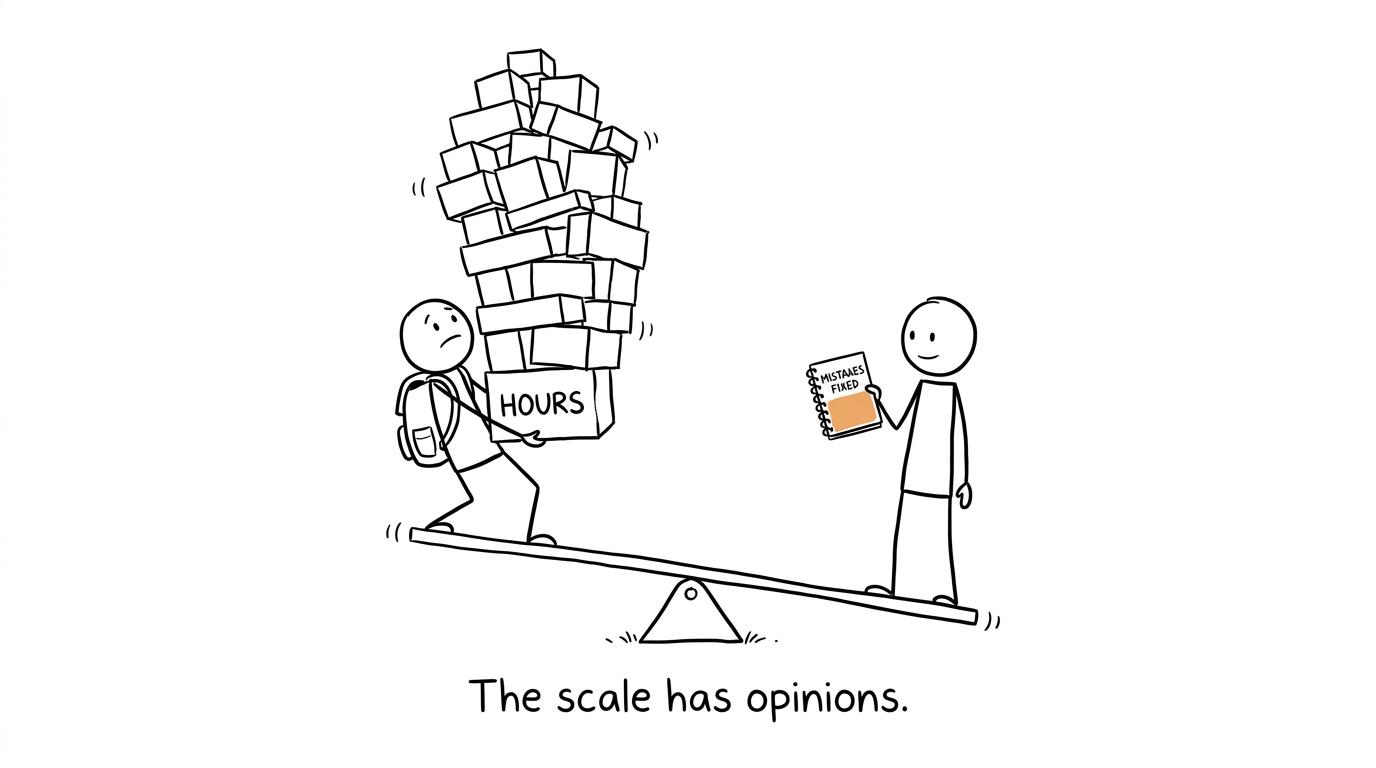 A small notebook of corrected mistakes outweighs a tower of revision hours
Common mistakes when trying to feel more confident
Revising only comfortable topics
Familiar work creates a quick sense of fluency but may leave the largest marks gaps untouched. Use marked work to choose priorities.
Treating every mistake as an identity statement
A missing unit, weak chain of analysis or incorrect denominator is a specific error. Correct it at that level rather than turning it into “I cannot do Economics”.
Measuring revision by hours alone
Time matters, but activity matters more. A shorter session containing retrieval, questions and corrections can produce better evidence than a long period of highlighting.
Comparing marks without context
Students may have revised different topics, received different support or made different types of error. Compare your current work with your previous work before drawing conclusions from somebody else's total.
Expecting one successful test to remove every doubt
Imposter feelings may return before a mock or after a difficult lesson. The goal is not to guarantee permanent confidence. It is to have a reliable response when doubt appears.
Ignoring persistent distress
Revision strategies cannot solve every wellbeing problem. If worry is affecting sleep, concentration, attendance or daily life, tell a parent, carer, teacher, school pastoral lead, school nurse or GP. If you feel unable to cope or keep yourself safe, seek urgent help from a trusted adult and appropriate emergency or NHS support.
Build confidence from proof, not performance
Feeling uncertain in top set does not prove that you entered the wrong room. Often, it means the work matters to you and the comparison group has become more demanding. The useful question is not whether you feel like the strongest person in the class. It is whether your revision process helps you understand more, correct errors and collect marks more consistently.
Start small. Choose one topic, attempt questions without notes, use the mark scheme and record one precise correction. Then retry it.
MathsGenie gives you a free place to run that cycle with revision lessons, practice questions, flashcards, mini tests, past papers, predicted papers, mark schemes and video solutions. Open the Economics or maths revision hub, identify the next skill rather than judging your whole ability, and let repeated evidence do what comparison cannot: show you that progress is happening.










