

How to Use Mixed-Topic Practice for GCSE Maths
How to use mixed-topic practice for GCSE Maths, choose methods confidently, correct mistakes and follow a realistic weekly revision plan before exams begin.
A student can spend an hour rereading algebra notes and finish feeling reassuringly familiar with algebra. Then an exam question appears without a topic label, and the method suddenly feels much harder to find.
That gap explains how to use mixed-topic practice for GCSE Maths effectively. Instead of completing a long block of nearly identical questions, mix several previously learned topics in one session. Answer without looking at the method, mark the work carefully, then revisit the errors. This trains you not only to carry out a method, but to recognise when it is needed.
Imagine a student called Maya. She is hypothetical, but her routine is common. She rereads notes because recognition feels like progress. When she swaps some of that reading for mixed questions, revision becomes less comfortable. It also becomes more revealing. She can no longer rely on the previous question to tell her what to do next.
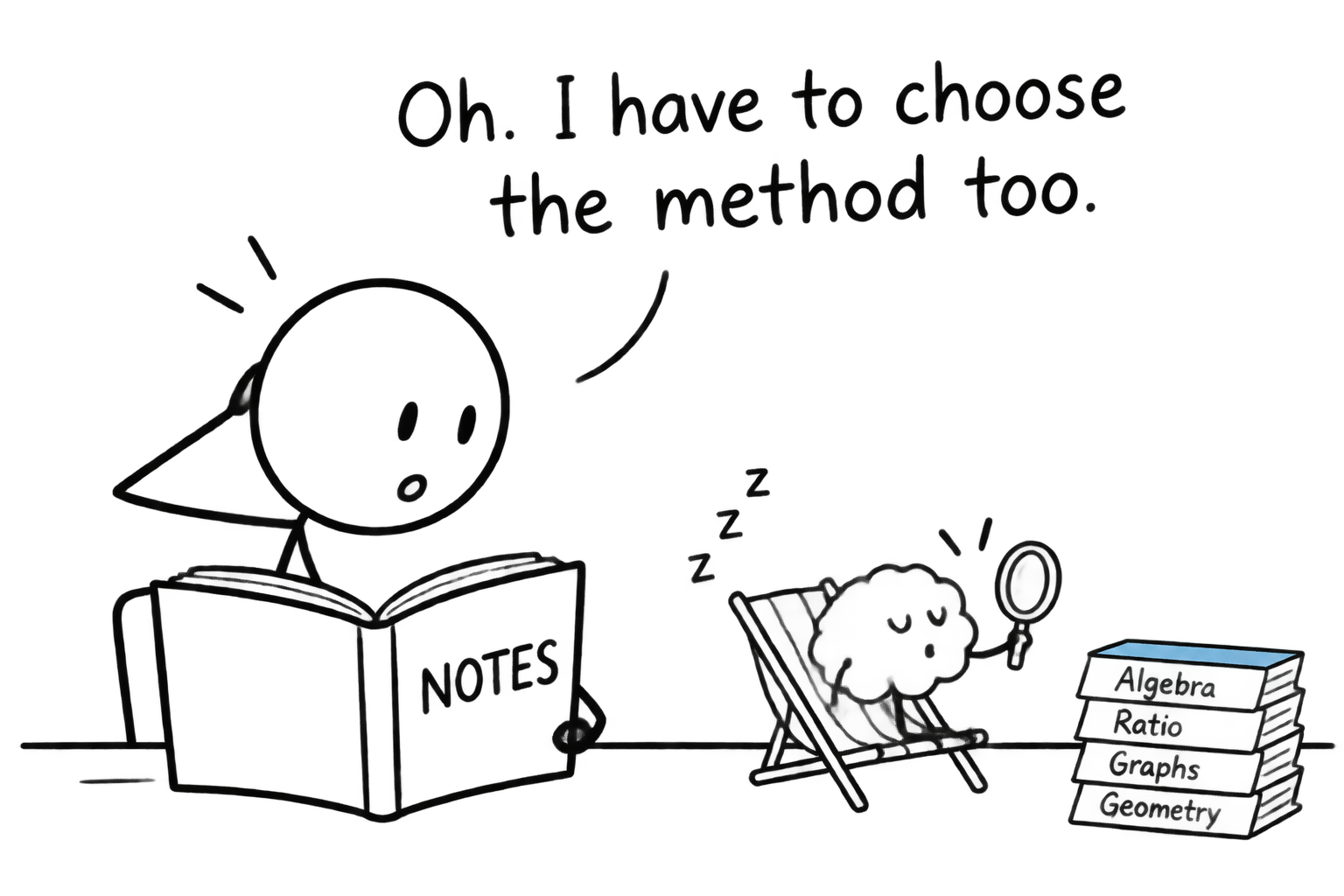 A GCSE student discovers that mixed practice makes the brain choose a method
Your mixed-topic practice checklist
A useful session follows a simple cycle:
- Choose three to five topics that you have already learned.
- Include questions at an appropriate foundation or higher tier level.
- Remove topic headings and worked examples while answering.
- Spend around 25-40 minutes attempting the questions.
- Mark every answer using solutions or a mark scheme.
- Record whether each error came from knowledge, method choice or accuracy.
- Revisit weak methods before attempting another mixed set.
The wider GCSE Maths revision guide explains how this fits alongside topic learning, past papers and a realistic timetable.
What the research says about mixed practice
Researchers often call this approach interleaving. Blocked practice keeps similar questions together. Interleaved practice changes the question type, so the learner repeatedly has to identify an appropriate strategy.
A 2019 randomised controlled trial involved 54 seventh-grade mathematics classes in the United States. Students completed either interleaved or blocked assignments. On an unannounced test around one month later, the interleaved group averaged 61%, compared with 38% for the blocked group.
That is promising evidence, but it is not a guarantee that copying the same routine will produce the same result for every GCSE student. The pupils were younger, the curriculum was different and one study cannot settle every question about revision. Broader reviews from the Education Endowment Foundation also describe cognitive science approaches as promising while noting limitations in how directly some findings transfer into ordinary classrooms.
The sensible conclusion is modest: mixed practice can help, particularly when success depends on distinguishing between methods. It should complement clear teaching, focused topic practice and feedback rather than replace them.
Why rereading can create false confidence
Rereading has a place when you need to refresh a definition, formula or worked method. The problem begins when familiarity is mistaken for recall.
Maya recognises every line of a worked solution. Recognition feels smooth because the page supplies the structure. In an exam, however, she must retrieve the method and decide whether the question involves proportion, simultaneous equations, trigonometry or something else.
Mixed-topic practice revision removes that clue. A ratio problem might be followed by an equation, a probability question and a circle theorem. The change forces a useful pause: “What kind of problem is this?”
That pause can feel like slower progress. In reality, it exposes decisions that blocked worksheets may hide.
How to apply mixed-topic practice to GCSE Maths
Learn a topic before mixing it
Mixed practice is usually better for consolidation than first instruction. If completing the square is completely new, begin with a revision lesson, modelled examples and focused questions. The GCSE Maths revision hub provides topic resources organised for different exam boards and tiers.
Once you can complete several focused questions without heavy support, place the topic into a mixed set. Keep some blocked practice for techniques that are not yet secure.
Mix topics that require different decisions
Do not create a set containing ten questions that only look different. Combine areas such as percentages, linear graphs, area, probability and equations. It is also useful to mix easily confused methods, such as direct and inverse proportion or perimeter and area.
Choose questions from the correct specification for Edexcel, AQA, OCR or Eduqas. Foundation students should practise accessible questions across their tier rather than borrowing higher-only content indiscriminately. Higher students still need fluent access to foundational skills.
Mark for the cause of the error
A score tells you what happened. An error label suggests what to do next.
Use three categories:
- Knowledge: you did not remember a fact, formula or rule.
- Selection: you knew the method but did not recognise that it applied.
- Execution: you chose correctly but made an algebraic, arithmetic or notation error.
If Maya makes a selection error, rereading the final answer is not enough. She should write the clue she missed, review the method briefly, then attempt a similar question later without support. MathsGenie's practice questions, mark schemes and video solutions can make this correction stage more precise.
Increase exam realism gradually
Start with a short untimed set. Then add a time limit, calculator restrictions or longer problem-solving questions. Eventually, use full GCSE past papers and mixed exam resources, where topics arrive in an unpredictable order.
A past paper is not merely a final test. Its mark scheme can reveal where your reasoning stopped earning marks. For guidance on introducing complete papers without wasting them, read when to start GCSE past papers.
A sample week of mixed-topic practice
This example assumes four main sessions and one short review. Adjust the length around schoolwork, other subjects and your exam date.
| Day | Session | Purpose |
|---|---|---|
| Monday | Learn or repair one weak topic, then complete focused questions | Build enough understanding for later mixing |
| Tuesday | Complete a 30-minute set mixing four secure or partly secure topics | Practise selecting methods without headings |
| Wednesday | Rest from formal maths revision or complete a short error review | Create space before retrieving methods again |
| Thursday | Complete another mixed set containing Tuesday's weakest topic | Revisit errors after a delay |
| Saturday | Attempt part of a past paper under timed conditions | Apply mixed practice in an exam-style setting |
| Sunday | Mark carefully and choose next week's topics | Turn evidence into a new plan |
Do not make every session difficult. A workable set might contain some secure questions, several questions that require thought and one or two genuine challenges. If nearly everything is impossible, return to topic teaching. If everything is automatic, increase the variety or difficulty.
If arranging these sessions starts to feel like revision work of its own, build a schedule in the Revision Planner around your exam date, available time, topics and confidence.
For a broader weekly structure, compare this plan with the GCSE Maths revision timetable guide and advice on how long to revise for GCSE Maths.
Common mistakes with mixed-topic practice
Mixing topics before understanding them
Random questions cannot teach every method from scratch. Use revision lessons and focused practice first when your understanding is incomplete.
Checking answers too quickly
Looking at a solution after one uncomfortable minute turns retrieval into recognition. Give the question a reasonable attempt, write down what you know and identify a possible first step before checking support.
Recording scores but ignoring patterns
A mark such as 14 out of 20 matters less than the reason six marks disappeared. Keep a brief error log and use it to select the next set.
Making every session a full paper
Full papers are valuable, but they require time to complete and analyse. Short mixed sets provide more frequent feedback and can target recent weaknesses without exhausting your supply of papers.
Treating difficulty as proof that it is failing
Interleaving often feels harder than repeating one method. That difficulty is useful only when questions remain achievable and feedback follows. Persistent confusion is a signal to step back, not to struggle indefinitely.
Turn the method into a routine
Maya's important change is not a dramatic result. She simply stops letting the chapter heading choose every method for her. Her week now alternates focused repair, mixed retrieval and careful marking, which more closely reflects the decisions demanded by a GCSE paper.
You have seen how the weekly plan works. The remaining challenge is following it consistently before fixed exam dates arrive. Build your mixed-topic schedule in the Revision Planner.















