GCSE Maths Revision: How Long Should You Revise?
GCSE maths revision: learn how long you should revise, by time-to-exam and target grade. Build a realistic plan using Maths Genie papers and topics.
The question every GCSE student asks (usually at 11pm)
If you’re revising for GCSE maths, there’s a moment that arrives like clockwork: you look at the calendar, then at your notes, then back at the calendar, and you wonder whether you’re meant to revise for one hour a day or basically move into a library until June. The honest answer is calmer than you think. Most students don’t need more revision time for GCSE maths; they need the right kind of time, repeated often enough that the methods start to feel automatic.
The goal of GCSE revision isn’t to prove you can work hard. It’s to make sure, when the paper asks for a method under pressure, your brain doesn’t have to negotiate. It just starts.
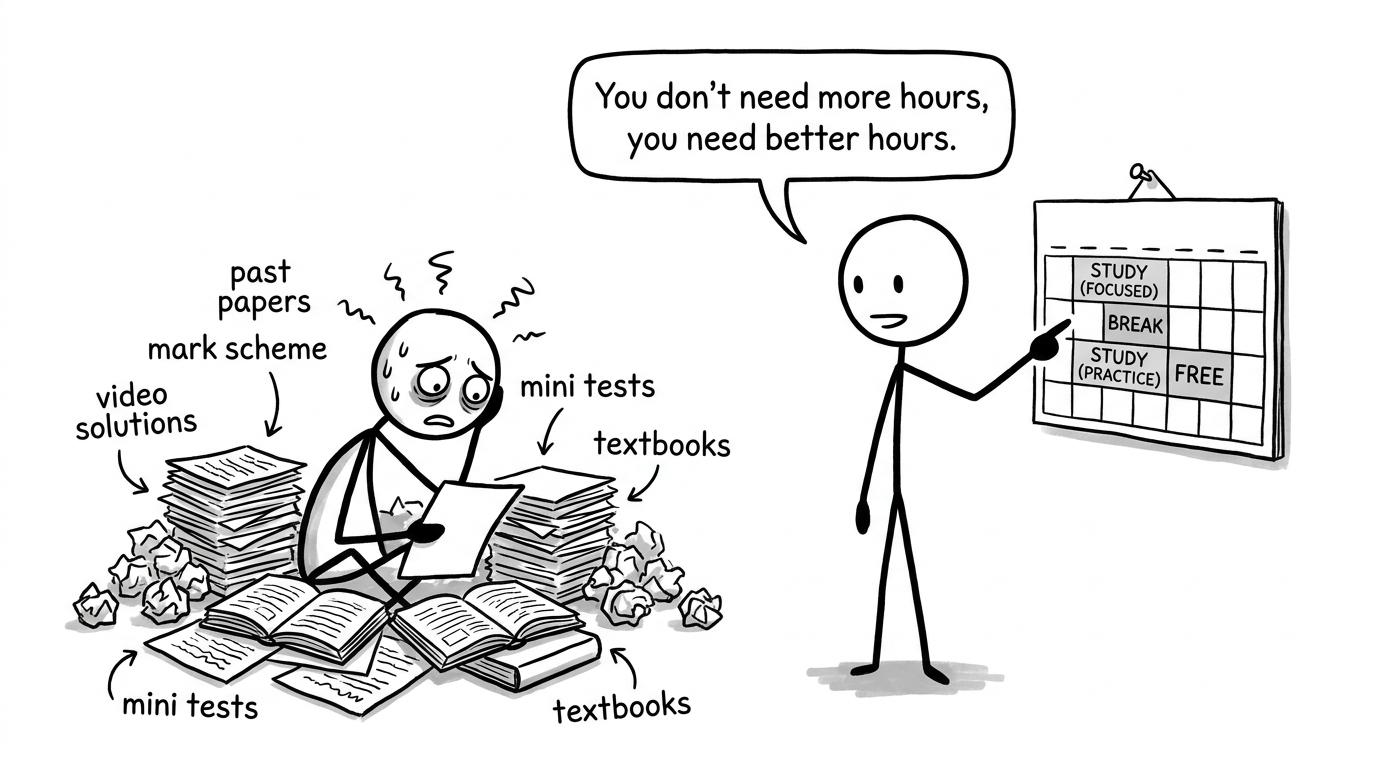 A calm revision calendar beats panic hours
A simple checklist before you decide your GCSE revision hours
Before you set a number of hours, set a direction. Use this quick checklist:
- When are your GCSE maths exams? (Weeks matter more than months.)
- Which tier are you sitting? Foundation or Higher.
- Which exam board? Edexcel, AQA, OCR, Eduqas (and whether you’re using matched practice papers).
- What’s your current working grade and target grade? Grades 999-111.
- What’s your biggest bottleneck? Forgotten skills, slow exam technique, or tricky problem-solving.
Maths Genie helps you answer these quickly because you can move between structured content and exam-style practice:
- Work through topic gaps using the Edexcel GCSE Maths learning journey.
- Build exam stamina with GCSE predicted papers.
- Use wider support materials like GCSE resources and predicted revision papers.
How long should you revise for GCSE maths? (The realistic answer)
Most GCSE students do best with short, consistent sessions that contain real practice questions and honest feedback from mark schemes. Think in terms of weeks to go, not an abstract “hours per day”.
If your GCSE maths exam is 12+ weeks away
Aim for 333 to 555 hours per week.
That might be:
- 4×454 \times 454×45 minutes (topic-based practice)
- plus one short paper section at the weekend
At this stage, your revision is mainly about rebuilding the foundations: number, algebra, ratio, graphs, and geometry methods. Using a structured pathway is helpful because GCSE maths content is wide, and random revision often just repeats what you already like.
A sensible routine is:
- Pick one topic.
- Watch the lesson.
- Do exam questions.
- Mark it.
- Revisit the topic later (spaced practice).
You can do that efficiently through the Maths Genie topic lists (organised by grade content) rather than endlessly hunting for resources.
If your GCSE maths exam is 6-12 weeks away
Aim for 555 to 888 hours per week.
Now the shift is from “learning content” to “using methods under time pressure”. You still revise topics, but you start blending them into mixed practice, because real GCSE papers don’t tell you what topic the next question is.
A good balance is:
- 222 topic sessions (plug gaps)
- 222 mixed sessions (mini tests or paper sections)
- 111 longer session (timed paper practice)
For students who struggle with pace, the old but effective approach is to build stamina with smaller chunks first. Maths Genie has options like split tests on older pages, but the bigger win is simply doing more timed sets and marking them properly.
If your GCSE maths exam is 0-6 weeks away
Aim for 888 to 121212 hours per week (spread out).
This is where the temptation is to do marathon revision days. But GCSE maths rewards freshness and accuracy, not exhaustion. Two focused 606060-minute sessions most days beats one drained 666-hour session on Sunday.
At this stage, your time should be mainly:
- Past or predicted papers
- Mark scheme analysis (why you lost marks)
- Targeted topic repair
Use papers that match your tier. For example, if you’re revising for higher tier, use the GCSE predicted papers to practise unseen-style combinations, then drop back into topic lessons to fix weaknesses.
The GCSE revision formula: minutes that actually count
Many students revise GCSE maths in a way that feels productive but doesn’t change their marks: re-reading notes, copying examples, highlighting.
A better model is:
Progress≈Practice×Feedback×Repeat \text{Progress} \approx \text{Practice} \times \text{Feedback} \times \text{Repeat} Progress≈Practice×Feedback×RepeatEven if you do fewer hours, you get more results when each hour includes:
- exam-style questions
- marking with solutions
- a short “fix list” of errors
- revisiting that fix list later
That’s why Maths Genie’s combination of revision lessons, exam questions, and worked solutions is so effective for GCSE preparation.
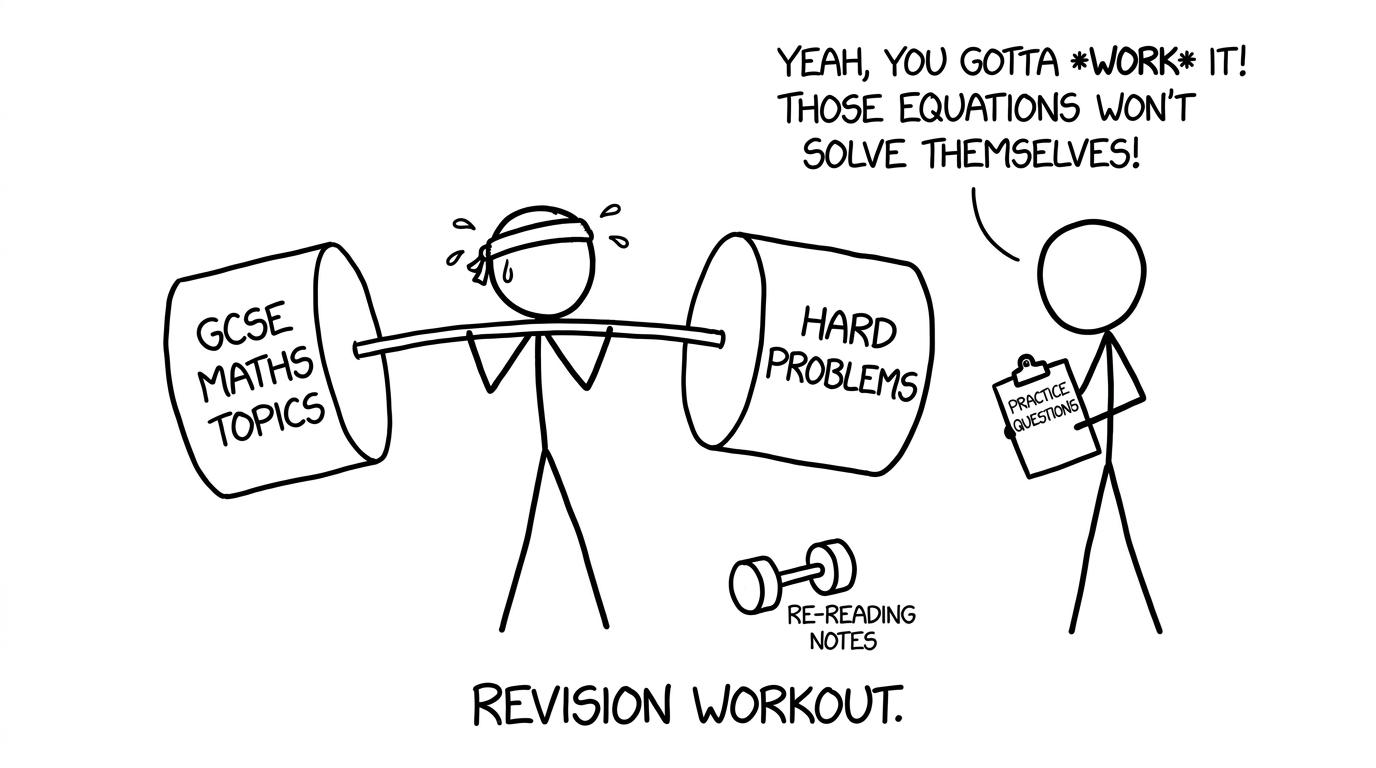 Practising beats re-reading
A worked example: turning a GCSE time budget into a plan
Let’s make this concrete.
Suppose you have 888 weeks until your GCSE maths Paper 1, and you can realistically revise 666 hours per week.
Total available time:
8×6=48 hours 8 \times 6 = 48 \text{ hours} 8×6=48 hoursNow split it into what actually improves GCSE marks:
- 50%50\%50% timed exam practice: 0.5×48=240.5 \times 48 = 240.5×48=24 hours
- 35%35\%35% topic repair: 0.35×48=16.80.35 \times 48 = 16.80.35×48=16.8 hours
- 15%15\%15% retrieval and quick checks: 0.15×48=7.20.15 \times 48 = 7.20.15×48=7.2 hours
Round sensibly:
- 242424 hours papers (about 121212 papers at 222 hours each, or more if you do sections)
- 171717 hours targeted topics
- 777 hours quick review sessions
This is a GCSE revision plan you can actually follow because it respects real life. It also forces you to spend most of your time where GCSE marks are earned: on paper-style questions.
To run this on Maths Genie:
- Use the GCSE revision and resource hub to access papers and extras.
- Use the Edexcel GCSE learning journey (or equivalent pathways) to target weak topics.
What to do in a typical 60-minute GCSE maths revision session
A strong GCSE session has a shape. Here are three formats that work.
Topic-first session (best early on)
- 101010 minutes: recall key facts and methods from memory
- 353535 minutes: exam questions on one topic
- 151515 minutes: mark and write a “next time” note
Example “next time” note: “When solving equations, check for negative sign errors before substituting.”
Paper-first session (best closer to the exam)
- 353535 minutes: timed paper section
- 151515 minutes: mark and categorise mistakes
- 101010 minutes: redo the hardest question without notes
Fix-list session (the quiet superpower)
- 101010 minutes: choose 333 previous mistakes
- 404040 minutes: practise only those question types
- 101010 minutes: write a one-line method for each
This is where GCSE grades often jump because you stop making the same mistakes.
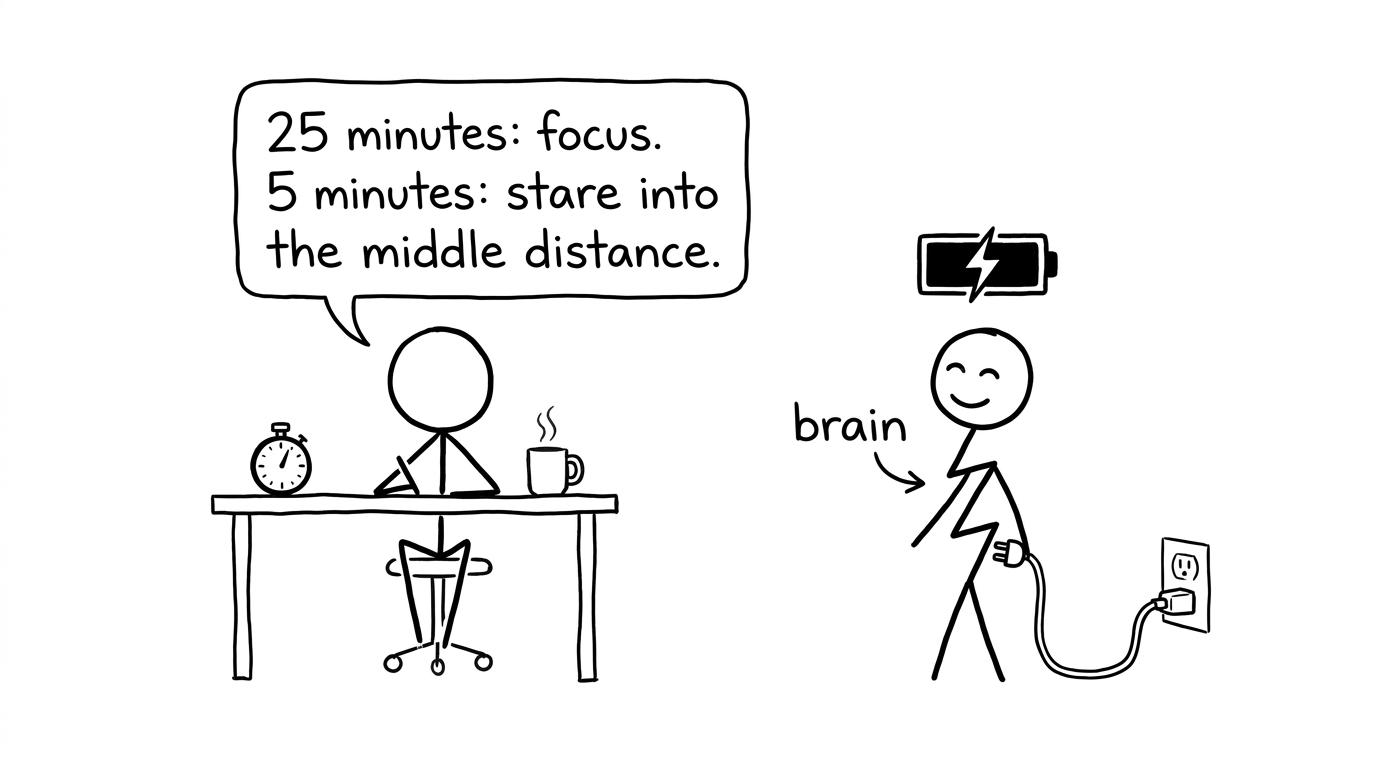 Focus, then tea, then existential staring
A worked example: the kind of GCSE method you need under pressure
Here’s a classic GCSE higher-tier skill that rewards calm method: solving a quadratic by factorising.
Solve x2−7x+12=0x^2 - 7x + 12 = 0x2−7x+12=0.
Factorise:
x2−7x+12=(x−3)(x−4) x^2 - 7x + 12 = (x-3)(x-4) x2−7x+12=(x−3)(x−4)Set each bracket equal to 000:
x−3=0⇒x=3 x-3=0 \Rightarrow x=3 x−3=0⇒x=3 x−4=0⇒x=4 x-4=0 \Rightarrow x=4 x−4=0⇒x=4So the solutions are x=3x=3x=3 and x=4x=4x=4.
Why include this in a post about GCSE revision time? Because speed comes from repeated correct method. The student who has done 151515 careful quadratics over two weeks often beats the student who did 222 the night before and hoped adrenaline would do the rest.
Foundation vs Higher: does GCSE revision time change?
Yes, but not because one tier “needs more hours”. It changes because the distribution of time changes.
- Foundation tier GCSE: more time on core methods (number, fractions, percentages, ratio, basic algebra, straightforward geometry). Accuracy and calculator fluency matter.
- Higher tier GCSE: more time on problem-solving and linking topics (algebraic manipulation, graphs, circle theorems, vectors, proof-style reasoning).
A foundation student aiming for grade 444 might revise fewer hours but must be incredibly consistent with basics. A higher student aiming for grades 777-999 might need similar total hours, but more of those hours must be “mixed and timed”.
Common mistakes when deciding how long to revise for GCSE maths
- Counting hours instead of outcomes: 101010 hours of re-reading doesn’t equal 101010 hours of exam practice.
- Doing only your favourite topics: GCSE papers are not polite. They will ask what you avoid.
- Ignoring mark schemes: the mark scheme is a map of how GCSE marks are awarded. If you don’t read it, you’re guessing.
- Leaving papers too late: doing your first full paper a week before the exam is like doing your first run on race day.
- Revising in huge blocks: fatigue makes you feel like you revised, but you remember less.
- Not revisiting topics: cramming creates quick confidence and quick forgetting.
Bringing it together: a calm GCSE revision promise
The best GCSE revision plans aren’t heroic. They’re ordinary and repeatable. If you revise GCSE maths for the right number of weeks, in sessions you can actually sustain, you build something more valuable than motivation: you build trust in your own methods.
So if you’re still asking, “How long should I revise for GCSE maths?” start here: choose a weekly number you can keep, then make sure most of that time is exam questions, marking, and targeted fixes. Let the calendar guide your intensity, not your anxiety.
When you’re ready, make Maths Genie your home base for GCSE revision: work through revision lessons, practise exam questions by topic, use mark schemes and worked solutions, and build confidence with GCSE predicted papers and the wider GCSE resources. Your future self in the exam hall won’t thank you for the longest revision sessions; they’ll thank you for the most consistent ones.