

How to Use Active Recall for GCSE Maths
How to use active recall for GCSE Maths with question practice, feedback and a realistic weekly plan that strengthens recall before your exams.
A student can spend an hour rereading algebra notes and finish with a comforting feeling: everything looks familiar. Then the book closes, a question appears, and the method seems to disappear.
Learning how to use active recall for GCSE Maths means reversing that process. Instead of looking at a method and asking, “Do I recognise this?”, you hide the explanation and try to retrieve it. You answer questions, recall steps, choose techniques and check your work against reliable solutions.
Imagine a student making this change. At first, they reread highlighted pages. A week later, they replace twenty minutes of reading with short, closed-book questions. Their revision feels harder, but it becomes more informative. They can finally see what they know and what only looked familiar.
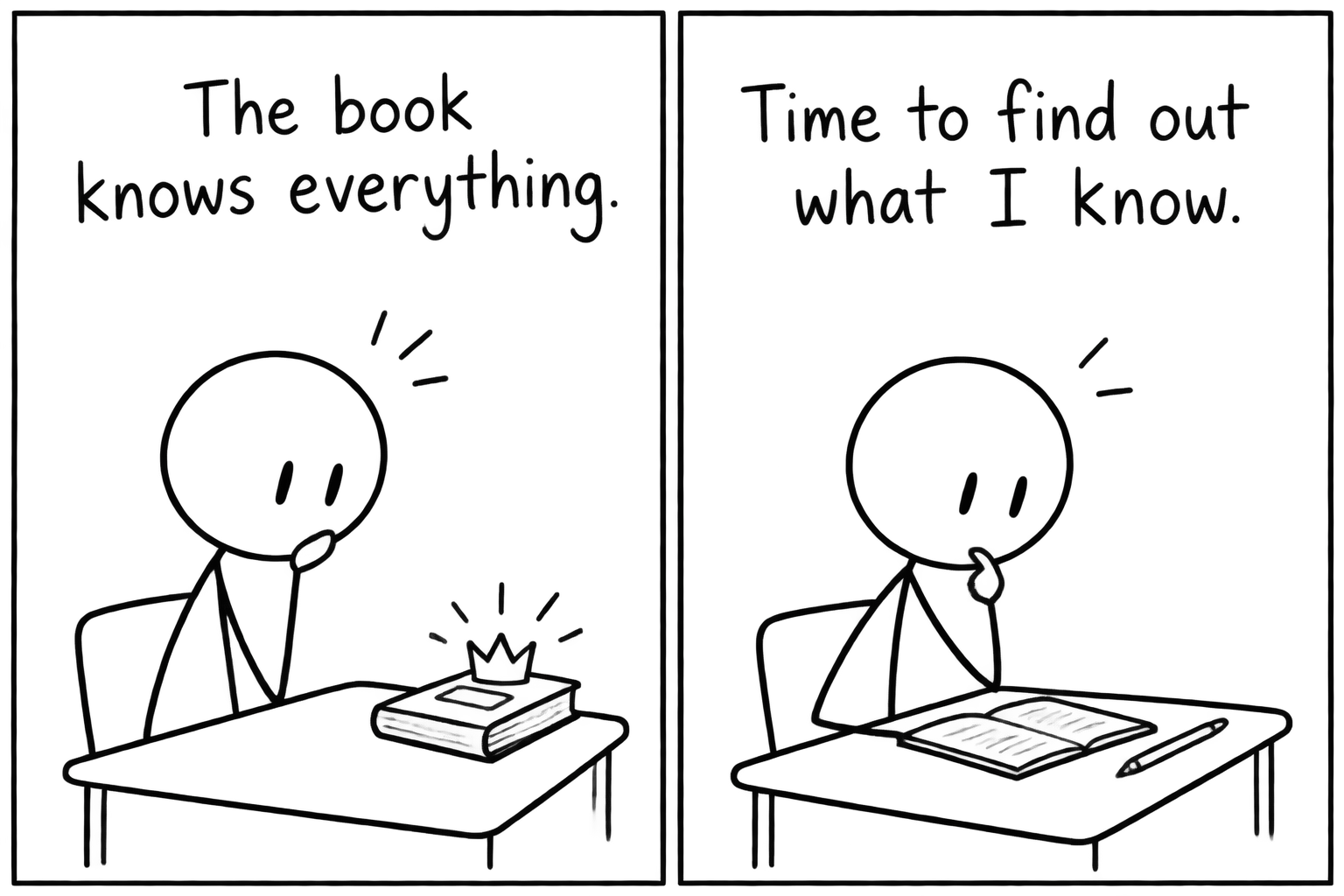 A student discovers the difference between a knowledgeable textbook and their own recall
The active recall checklist
A useful GCSE maths study technique should be simple enough to repeat. For each topic:
- close your notes before beginning;
- retrieve a fact, method or formula from memory;
- answer exam-style questions without copying an example;
- check your answers promptly;
- correct the reasoning, not just the final answer;
- revisit the topic after a gap;
- mix it with older topics once the basic method is secure.
Active recall is not simply doing as many questions as possible. The important cycle is retrieve, check, correct and return.
What research says about active recall revision
Retrieval practice is the act of bringing information to mind rather than seeing it again. A 2021 systematic review of applied research in schools and classrooms found that retrieval practice generally benefited learning across varied subjects and classroom settings.
That does not mean every quiz produces the same result. The design matters. Feedback helps students catch errors before those errors become habits, while repeated retrieval across separate sessions supports longer-term retention better than one successful attempt followed by silence.
There is also an important limitation for maths. Remembering a formula is not the same as recognising when to use it. Research into transfer suggests that practice can help students apply learning to similar problems, but evidence for transfer to very different problems is less certain.
So active recall revision for maths must include more than flashcards. It should retrieve knowledge at three levels:
- Facts: formulas, vocabulary and exact values.
- Methods: the sequence of steps used to solve a familiar problem.
- Decisions: recognising which method fits an unfamiliar question.
This is why MathsGenie’s GCSE revision lessons and exam-style practice are useful together. A lesson can repair understanding, but the questions reveal whether you can retrieve and apply it independently.
How to use active recall for GCSE Maths
Start with a closed-book brain dump
Choose one narrow topic, such as expanding brackets, circle theorems or cumulative frequency. On blank paper, write everything you can remember for two or three minutes.
For solving a quadratic by factorising, for example, you might try to recall that the equation must first be arranged in the form:
ax2+bx+c=0 ax^2+bx+c=0 ax2+bx+c=0Do not worry if the page looks incomplete. Its purpose is diagnosis, not presentation. Open your notes afterwards, add what was missing in another colour and turn each gap into a question for your next session.
Retrieve a method before using it
Before answering a question, say or write the method from memory. For a percentage increase, that might include forming the multiplier:
1+r100 1+\frac{r}{100} 1+100rThen apply it without looking at a worked solution. This separates remembering the process from merely following somebody else’s steps.
If you cannot recall the method, briefly return to the relevant revision lesson. Close it again and reproduce the key steps immediately. The second attempt is where retrieval begins.
Use questions, mark schemes and video solutions
Maths is partly remembered through doing. After recalling the method, answer several questions that vary in wording or structure. Check each response with a mark scheme or video solution.
Record the cause of each error:
- knowledge gap: a formula or fact was missing;
- method gap: you knew the topic but not the steps;
- decision gap: you chose the wrong technique;
- accuracy gap: your method was sound, but arithmetic or algebra failed.
This produces better next steps than writing “careless mistake”. If the method is missing, return to a lesson. If accuracy is the problem, practise a small set slowly. If the decision was wrong, mix the topic with similar-looking questions.
MathsGenie’s guide to redoing past papers explains how a second attempt can test whether a correction has lasted rather than merely repeating the original paper.
Space your retrieval
One long session can create short-term fluency. GCSE exams require knowledge to survive for weeks or months. Return to a topic after increasing gaps, adjusting them according to performance rather than following a rigid formula.
A practical pattern is:
- first retrieval on the day you learn or revise the topic;
- another attempt a few days later;
- a further check the following week;
- later retrieval inside mixed questions or a past paper.
Topics you forget should return sooner. Secure topics can wait longer. The GCSE maths revision timetable guide gives a broader structure for balancing topic work, mixed practice and papers.
Once this cycle feels like a lot to organise, build your active recall sessions in the Revision Planner instead of holding the whole schedule in your head.
A sample week of active recall for GCSE Maths
This example assumes five manageable sessions. Adapt the length around school, homework and other subjects.
| Day | Active recall task | Feedback and follow-up |
|---|---|---|
| Monday | Brain dump one weak algebra topic, then answer focused questions | Check solutions and label each error by cause |
| Tuesday | Recall key geometry facts and formulas from a blank page | Repair gaps, then retry missed questions without notes |
| Wednesday | Complete mixed questions from Monday’s algebra and an older topic | Note which questions you failed to identify correctly |
| Thursday | Retrieve methods for ratio, percentages and fractions | Use short practice sets, checking after each set |
| Friday | Complete a timed section from a past paper | Mark it and select two topics to revisit next week |
| Weekend | Retry errors from the week without viewing corrections first | Schedule forgotten topics sooner and secure topics later |
The student in our example no longer measures revision by pages read. They measure it by what can be produced without help, what the mark scheme exposes and what needs to return next week.
When full papers become appropriate depends on how much content you have covered and how close the exams are. The guide to when to start GCSE past papers can help you place them sensibly. If time is already short, the one-month GCSE Maths revision plan offers a more compressed structure.
Common active recall mistakes
Turning every topic into flashcards
Flashcards suit formulas, definitions and short prompts. They are less effective for multi-step reasoning if the answer is reduced to one line. Use full questions when you need to choose and carry out a method.
Checking too quickly
Looking after ten seconds turns retrieval into recognition. Give yourself enough time to reconstruct the idea. A genuine attempt, even an unsuccessful one, gives you useful evidence.
Practising errors without feedback
Repeated recall does not guarantee correct recall. Check answers promptly with mark schemes or video solutions, then explain why the correction works.
Repeating only comfortable questions
Success feels encouraging, but a page of nearly identical questions may not prepare you to identify a method in an exam. Once a skill is stable, mix it with other topics and vary the wording.
Treating active recall as a complete revision system
Active recall cannot replace first learning, careful explanation or extended problem-solving. If you never understood vectors, repeatedly testing yourself on vectors will mostly confirm the gap. Use a revision lesson to build understanding, then retrieve and apply it.
It also cannot predict an exact grade. Exam performance depends on topic coverage, reasoning, accuracy, timing and how well you respond to unfamiliar questions. Active recall is a tool for making knowledge accessible, not a shortcut around the specification.
Turn retrieval into a schedule
The student’s real improvement was not that revision suddenly became easy. It was that each session produced a clear next step. The remaining challenge was following those steps consistently as fixed exam dates moved closer.
You have seen how a week of active recall can work. Your turn: build your schedule in the Revision Planner and map each weak topic to its next retrieval session.















