

How to Revise Maths in 20 Minutes a Day
How to revise maths in 20 minutes a day using recall, focused questions and checking, with a realistic plan for steady GCSE or A Level progress each week.

A parent looks through a half-open bedroom door. The maths book is on the desk, but so are six other subjects, an unfinished homework task and a phone displaying the time. The student is not lazy. The problem is that “revise maths” feels too large to begin.
Here is the direct answer to how to revise maths in 20 minutes a day: spend the first 333 minutes recalling a method, the next 121212 minutes answering questions, and the final 555 minutes checking your work and recording one weakness. Repeat this on most days, rotating topics and returning to mistakes later in the week.
Twenty focused minutes will not replace longer exam practice. It can, however, build knowledge, reveal gaps and make GCSE revision or A Level revision easier to sustain.
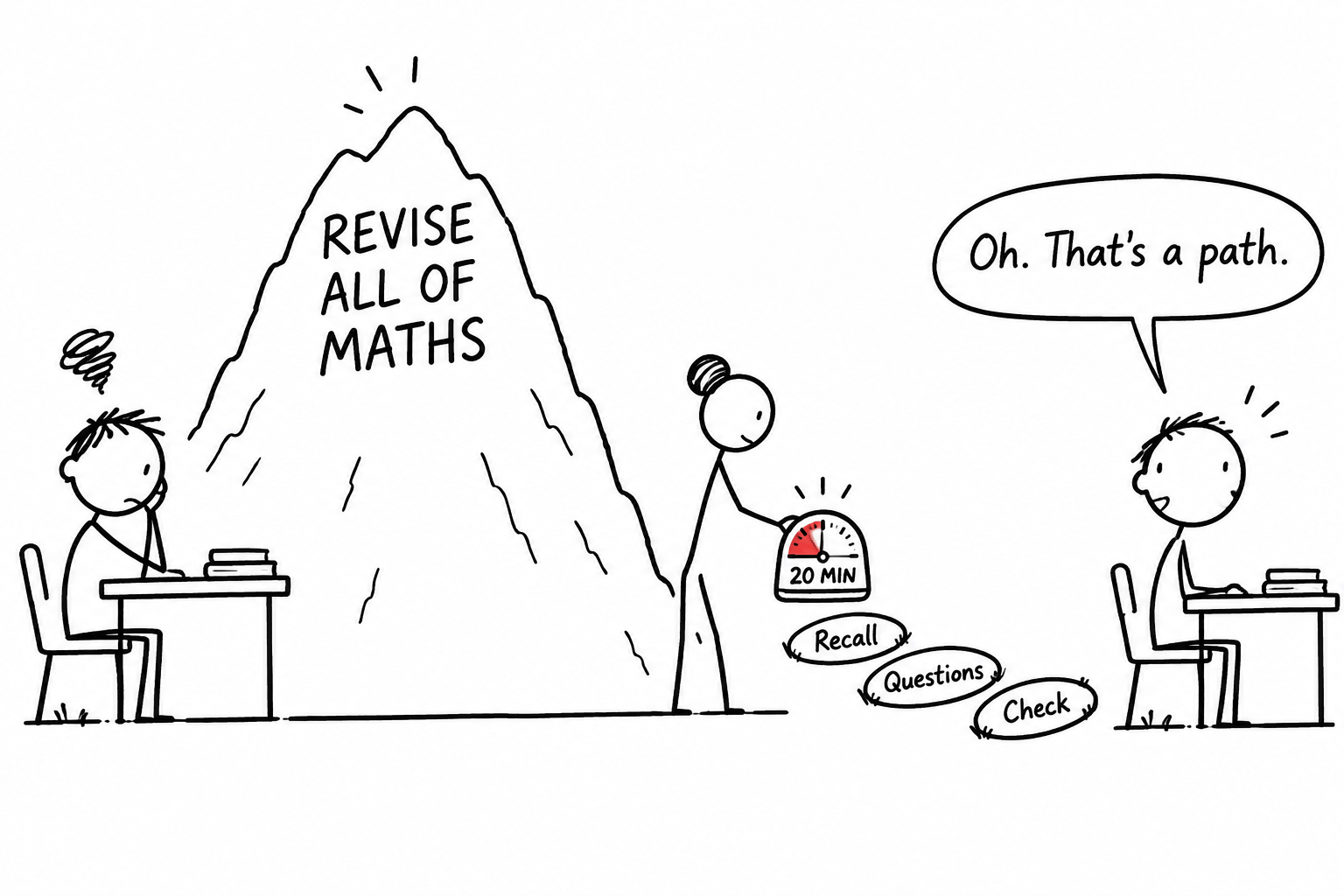 A student discovers that twenty minutes of maths revision is a path rather than a mountain
Your 20-minute maths revision checklist
Before starting, choose one narrow topic. “Algebra” is too broad; “factorising quadratics” or “changing the subject of a formula” is manageable.
Use this routine:
- Minutes 000-333: recall. Without notes, write down the method, facts or steps you remember.
- Minutes 333-151515: practise. Answer a small set of questions at the right level.
- Minutes 151515-181818: check. Use answers, worked solutions or a mark scheme.
- Minutes 181818-202020: record. Write down the error you made and decide when to revisit it.
You need a pen, paper, a timer and questions selected before the session begins. Choosing the topic during the 202020 minutes quietly consumes the time you meant to use.
Why a short daily routine can work
Maths is learnt through retrieval and application, not simply by looking at familiar pages. Recalling a method from memory makes you test what you actually know. Answering questions then reveals whether you can apply that knowledge independently.
Spacing matters too. Returning to a topic after a gap is usually more useful than completing one long session and never revisiting it. A Monday mistake can become Wednesday’s recall task and Saturday’s mixed question.
Consistency also lowers the emotional cost of starting. A student who promises to revise for three hours may postpone the task. A clearly defined 202020-minute session has an end in sight.
For the wider structure around these sessions, use the GCSE maths revision timetable guide. If you are deciding how this fits alongside other subjects, compare the advice in how many hours to revise each day and how long to revise GCSE maths.
A practical weekly revision plan
The routine stays the same, but the purpose changes across the week.
| Day | Focus for the 202020 minutes |
|---|---|
| Monday | Learn or refresh one weak topic |
| Tuesday | Practise a different weak topic |
| Wednesday | Return to Monday’s topic without notes |
| Thursday | Complete mixed questions from both topics |
| Friday | Correct errors and repeat difficult questions |
| Saturday | Attempt a timed section from an exam paper |
| Sunday | Rest, catch up or review the coming week |
This is a framework, not a rule. Students approaching an exam may need longer sessions for complete papers, while those starting early can make strong progress through short, regular practice.
If setting up the rotation feels like another revision task, build your day-by-day schedule in the Revision Planner and protect the same 202020-minute slot each day.
What to do during each part
Recall for 333 minutes
Close the revision guide. Write everything you remember about the chosen method. You might list the stages of solving a simultaneous equation, sketch the shape of a graph or state which information a probability tree needs.
Then compare your recall with a reliable lesson. MathsGenie’s GCSE maths revision resources organise materials by exam board, including Edexcel, AQA, OCR and Eduqas. A Level students can choose their specification through the A Level maths revision hub.
Practise for 121212 minutes
Choose enough questions to keep moving, but not so many that checking becomes impossible. Start without notes. If you are completely stuck, review the relevant explanation or video solution briefly, then hide it and try again.
Aim for useful difficulty. Questions that are always effortless do not expose gaps; questions far beyond your current understanding create confusion. GCSE students should also use resources matched to foundation or higher tier.
Check for 333 minutes
Marking is part of revision, not an administrative task at the end. Compare every line with the solution or mark scheme. In a multi-step question, the final answer alone cannot show where the reasoning changed direction.
Once exam technique becomes important, use GCSE past papers and mark schemes. Longer paper practice should sit beside the daily routine rather than being squeezed into it.
Record for 222 minutes
Keep a short error log with three details:
- the topic;
- what went wrong;
- the next action.
For example, the problem might be a forgotten rule, an incorrect calculator entry, weak algebra or a misread command word. The next action should be specific: repeat two questions tomorrow, revisit the lesson, or practise the same skill within a mixed paper.
Adjusting the study technique for your stage
If the exam is months away, use the routine mainly for topic knowledge and spaced practice. When the exam is closer, include more mixed questions, timed sections and past-paper corrections. MathsGenie’s one-month GCSE maths plan offers a more intensive structure when time is short.
A Level students can keep the same timing but choose more demanding questions. Some questions will take longer than 121212 minutes. In that case, use one session to begin the problem and the next to finish and analyse it. The goal is focused thought, not rushing to satisfy a timer.
Parents can help by protecting the routine rather than supervising every calculation. Ask, “Which topic is today?” or “What did the mark scheme reveal?” Those questions encourage planning and reflection without turning revision into a daily confrontation.
Common mistakes to avoid
Watching without practising. A video can explain a method, but the student must then attempt questions independently.
Changing topics every day without returning. Rotation only works when previous material reappears. Schedule weak topics more than once.
Marking only the final answer. Method marks matter in GCSE and A Level exams. Check the reasoning as well as the result.
Using all 202020 minutes to organise resources. Select the lesson, worksheet or paper beforehand.
Assuming short sessions are always enough. Daily practice builds fluency, but complete papers require longer timed blocks. Add these as exams approach.
Treating a missed day as failure. Resume at the next available slot. Do not turn one missed session into an abandoned week.
Turn 20 minutes into a schedule you can follow
Knowing the routine is simpler than deciding which topic to revise every day until the exam. In the opening scenario, the useful change is not a heroic evening at the desk; it is replacing a vague paper plan with a clear next task. Your turn: enter your exam date, available revision time and topics, then let the planner organise the route ahead. Build your 202020-minute schedule in the Revision Planner.















