How to Revise in the Final Week Before GCSEs
How to revise in the final week before GCSEs: follow a calm seven-day plan using past papers, targeted recall, sleep and realistic daily priorities now.
The final week can make an organised student feel suddenly unprepared. Several exams are approaching, notes remain unfinished and every subject seems urgent. The temptation is to revise everything at once.
The practical answer to how to revise in the final week before GCSEs is to prioritise the nearest exams, test yourself, repair important weaknesses and protect your sleep. You are making what you already know easier to retrieve under exam conditions.
Your final-week revision checklist
Before creating a timetable:
- Confirm every exam date and start time.
- Prioritise the papers taking place first.
- Identify two or three weaknesses for each upcoming paper.
- Use active recall, exam questions and past papers.
- Mark your work and revisit mistakes.
- Prepare equipment and travel arrangements early.
- Keep meals, breaks and sleep consistent.
For a broader structure, use the GCSE revision timetable guide to build a realistic schedule.
Build the week around exam order
Panic makes every subject appear equally urgent. The calendar gives you a clearer starting point. If biology is on Tuesday and history is on Friday, biology should normally receive attention first, while history retains shorter sessions.
List your exams chronologically. Under each paper, record the exam board, paper name, assessed topics, your confidence and the resources you need. Check details against your school timetable and specification.
“Revise maths” leaves another decision for later. “Complete an algebra mini test, mark it and correct every error” tells you exactly what to do.
The guide to daily GCSE revision hours can help with workload. Let paper order, concentration and recovery guide your final week, rather than chasing an ambitious hours target.
Follow a flexible seven-day pattern
Apply this pattern to each approaching paper. Your subjects will overlap, so adjust it around your actual timetable.
At the beginning of the week
Check the specification or teacher checklist for the nearest papers. Use short quizzes, mini tests or selected questions to diagnose gaps, then begin repairing them. Avoid spending the whole session assessing yourself.
Start with the MathsGenie GCSE maths revision area to find relevant resources. Select the correct exam board and foundation or higher tier before practising.
Three or four days before each paper
Use focused recall and exam practice. Close the book and write what you remember, explain a process aloud or answer questions without checking the solution. Then assess your response.
A highlighted page shows what you have read. A marked question gives evidence of what you can do independently.
Use the GCSE maths past paper guidance to plan a longer diagnostic task. Edexcel students can also use a MathsGenie 45-minute test when a full paper would leave too little correction time.
One or two days before each paper
Concentrate on remaining mistakes. Reattempt questions without copying the mark scheme. Practise essential facts, methods, quotations or terminology briefly, then test your recall later.
For maths, categorise errors: a missing fact, uncertain method, calculator mistake, misread question or insufficient working. Each category suggests a different remedy. Misreading requires closer attention to instructions; an uncertain method needs explanation and fresh practice.
The evening before
Keep revision short and familiar. Review your mistake list, complete manageable questions and prepare equipment. Avoid starting a large new topic unless your teacher has specifically advised it.
Teenagers generally need eight to ten hours of sleep. Protect your normal bedtime so revision does not crowd out the rest you need for concentration.
Use the MathsGenie Revision Planner to turn these priorities into daily tasks.
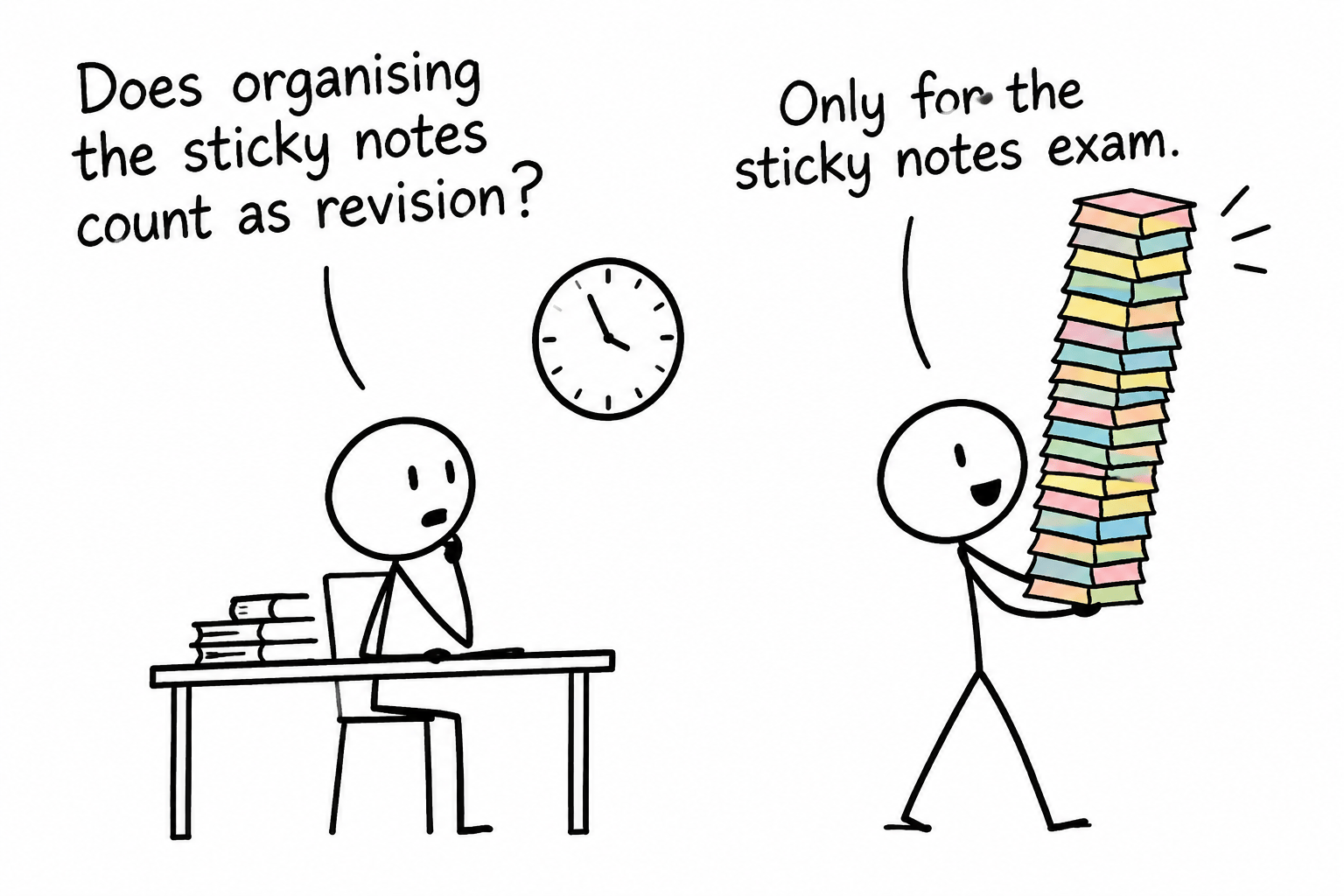 XKCD-style comic of students wondering whether organising sticky notes counts as revision
Use past papers as feedback
A past paper becomes useful when it changes your next revision decision. Repeated attempts without correction can leave the same weaknesses untouched.
Follow this cycle:
- Attempt a paper, section or question group under suitable conditions.
- Mark it using the relevant mark scheme.
- Record why you lost each mark.
- Review the underlying topic, using revision lessons or video solutions where needed.
- Reattempt missed questions independently.
- Check the skill later with a fresh question.
The guide to how many GCSE past papers to complete offers wider context. In the final week, leave enough time to act on what each paper reveals.
Predicted papers provide additional practice, but cannot tell you exactly what will appear. Keep specifications, official past papers and mark schemes central.
How parents can help
Practical support often matters most. Help confirm exam times, protect a quiet working period and prepare food or equipment.
Ask, “What is your next specific task?” This helps your child make a decision without having to judge whether they have revised “enough”. Testing flashcards or listening to an explanation can also help.
If anxiety is affecting sleep, eating or everyday functioning, contact the school and seek appropriate health support.
Common final-week revision mistakes
Covering every topic equally
Give priority to upcoming papers and weaknesses you can realistically improve. Secure topics may need only a brief check.
Rereading without testing
Recognition can feel reassuring. Check whether you can retrieve and apply the material with your notes closed.
Finishing papers without correction
Allow time for marking and reattempts. Understanding a lost mark should inform your next task.
Revising late and repeatedly replanning
Set a stopping time. Once your timetable is workable, follow it and adjust only when priorities change.
Make the final week specific
A clear plan cannot remove every worry, but it can reduce repeated decisions. Give each session a paper, a weakness and a task. Start with MathsGenie's free revision resources, practise independently and use feedback to choose what comes next.