Edexcel GCSE Maths Grade 2 Boundary Explained
Edexcel GCSE maths grade 2 boundary guide with dated past marks, tier advice and a practical revision plan for students and parents.
A Year 11 student opens a past paper, adds up their marks and reaches the question that can make revision feel strangely uncertain: “Is this enough for a grade 2?”
The short answer is that the Edexcel GCSE maths grade 2 boundary is not fixed in advance. In the June 2025 Edexcel GCSE Maths foundation exams, a grade 2 required 67 marks out of 240. In June 2024, it required 65 marks out of 240. These are useful reference points, not promises about a future exam series.
Grade 2 is available on the foundation tier, where students can achieve grades 1-5. It is not awarded on the higher tier.
The answer at a glance
- Edexcel GCSE Maths is assessed across three papers worth 808080 marks each.
- The total available mark is therefore 240240240.
- A grade 2 is available on foundation tier.
- The June 2025 grade 2 boundary was 676767 marks.
- The June 2024 grade 2 boundary was 656565 marks.
- Boundaries are set after the exams and may change between series.
- A sensible revision target should sit above previous boundaries rather than exactly on one.
Students can explore the full foundation course through Edexcel GCSE Maths revision on Maths Genie.
Which tier includes grade 2 maths?
Edexcel GCSE Maths has foundation and higher tiers. Foundation tier covers grades 1-5, while higher tier covers grades 4-9, with a possible grade 3 for a candidate who narrowly misses grade 4.
That makes foundation tier the relevant route for a student targeting grade 2 maths. Its papers are labelled 1F, 2F and 3F:
- Paper 1F is non-calculator.
- Papers 2F and 3F allow a calculator.
- Each paper is worth 808080 marks.
The qualification boundary applies to the combined mark across all three papers:
80+80+80=240 80+80+80=240 80+80+80=240A student does not need to reach a separate official grade 2 boundary on every paper. It is the final total that determines the qualification grade.
Past Edexcel GCSE maths grade 2 boundaries
Official Pearson Edexcel boundaries provide the clearest historical examples.
| Exam series | Tier | Grade 2 boundary | Maximum mark | Percentage equivalent |
|---|---|---|---|---|
| June 2024 | Foundation | 656565 | 240240240 | approximately 27.1%27.1\%27.1% |
| June 2025 | Foundation | 676767 | 240240240 | approximately 27.9%27.9\%27.9% |
The percentages come from dividing the boundary by the total available marks. For June 2025:
67240×100≈27.9% \frac{67}{240}\times 100\approx27.9\% 24067×100≈27.9%This does not mean that 28%28\%28% will always secure a grade 2. It means that 676767 was the minimum total for that grade in the June 2025 series.
The student in our example might look at a practice total of 707070 and feel reassured. That result would have exceeded both boundaries shown above. Yet treating 707070 as a guaranteed future boundary would be risky, because the next set of papers may produce a different threshold.
Turning a total boundary into a paper target
A total such as 676767 can feel abstract. Dividing it equally across three papers gives a rough average:
67÷3≈22.3 67\div3\approx22.3 67÷3≈22.3So the June 2025 boundary was equivalent to an average of just over 222222 marks per paper. This is only a planning guide. A student could score 181818, 232323 and 303030, giving:
18+23+30=71 18+23+30=71 18+23+30=71That total would have been above the June 2025 grade 2 boundary, even though the paper marks were uneven.
For revision, aiming merely for the historical minimum leaves little room for a difficult question, a calculator mistake or a misunderstood instruction. A more resilient personal target could be around 25−3025-3025−30 marks per paper. This is not an official predicted boundary. It is simply a buffer that makes the plan less dependent on one exact historical figure.
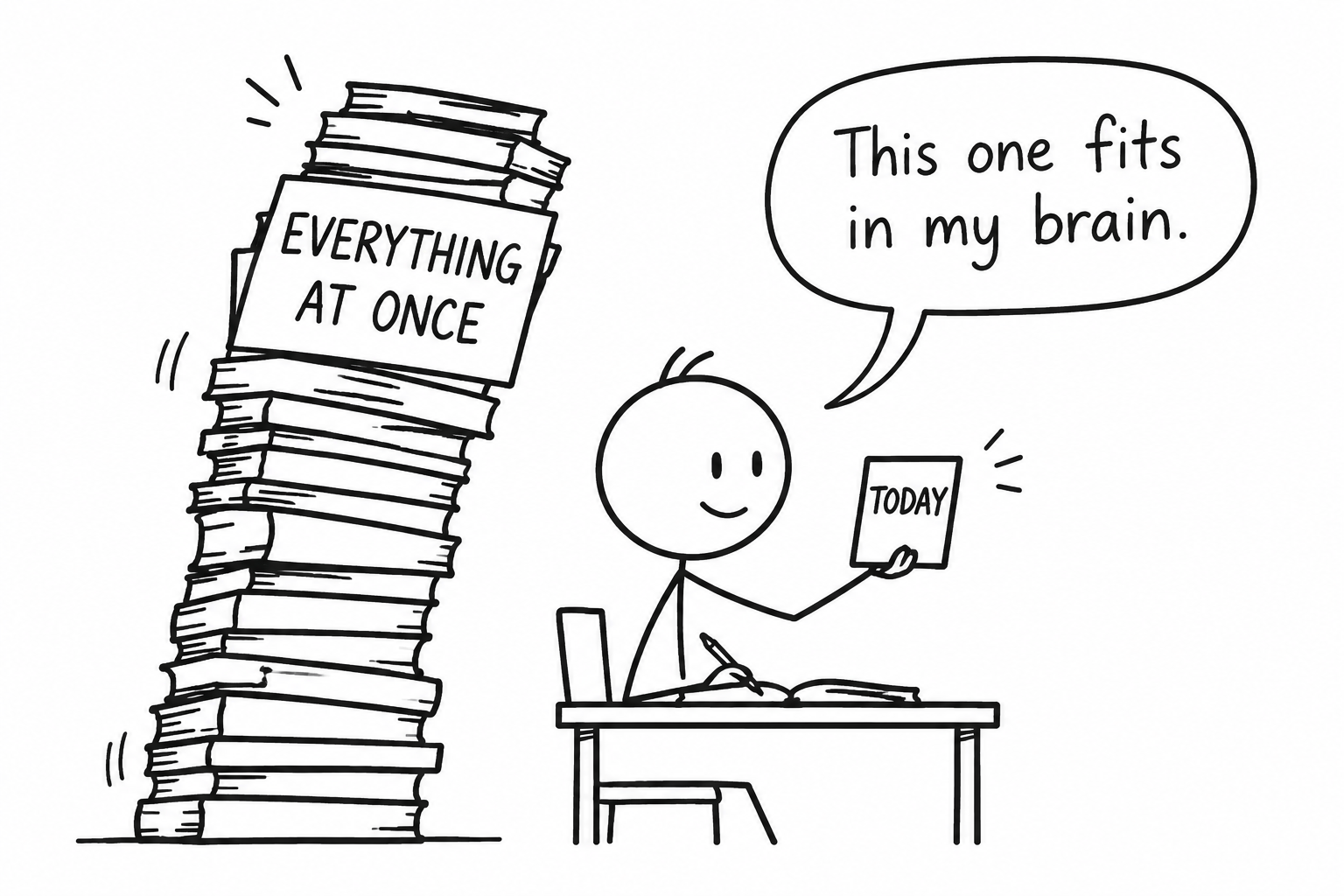 A Year 11 student chooses one manageable revision task instead of everything at once
Why Edexcel grade boundaries change
Grade boundaries exist to translate raw marks into grades. They are set after exam scripts have been marked, with attention paid to the difficulty of that examination series and the expected standard of work.
If one set of papers proves more demanding, students may generally earn fewer raw marks and a boundary may be lower. If the papers prove more accessible, the boundary may be higher. This helps keep the meaning of a grade reasonably consistent even though no two exam series contain identical questions.
That is why students should not rely on claims that a particular percentage is “always” a grade 2. The specification describes the content and assessment, but the final raw-mark boundary belongs to a particular exam series.
Past boundaries are best used for context. For an honest progress check, complete a full set of papers under timed conditions, mark them consistently and add all three results. Maths Genie’s Edexcel exam booklets and topic worksheets can help turn weaknesses identified in a paper into focused practice.
The topics most likely to move the mark
At this stage, revision does not need to mean attempting the hardest questions in the paper. Marks often become more reachable when a student secures core methods and learns to recognise familiar question types.
Priorities should include:
- accurate addition, subtraction, multiplication and division
- place value, negative numbers and ordering
- fractions, decimals and percentages
- fractions and percentages of amounts
- ratio and simple proportion
- basic algebra and substitution
- perimeter, area and units
- averages, tables and straightforward probability
The exact mix varies from paper to paper, so a complete course remains important. However, these foundations support many later topics as well. Students can use the Edexcel topic heatmap to review commonly appearing areas, then return to lessons and practice questions rather than simply rereading notes.
The GCSE Maths topics by exam board and tier guide also helps students and parents check that revision matches Edexcel foundation content rather than a different board or tier.
A calm revision routine for reaching grade 2
The student who scored 707070 does not need to revise everything equally. They need to discover where those marks came from and which missed marks are realistic to recover.
A practical routine is:
- complete a foundation paper in timed conditions
- mark it and record the score from each question
- label mistakes as knowledge, method, calculator or reading errors
- choose two weak topics with accessible marks
- watch the relevant Maths Genie revision lessons
- complete practice questions and a mini test
- return to a fresh paper and compare the total
Calculator use deserves deliberate practice because two of the three papers permit one. The GCSE Maths calculator paper tips explain habits that can reduce avoidable input and rounding errors.
Progress is not always dramatic. Moving from 191919 to 242424 marks on one paper may look modest, but repeating that improvement across three papers adds 151515 marks to the qualification total.
Common mistakes when using grade boundaries
Treating an old boundary as a prediction
A June 2025 boundary describes June 2025. It cannot guarantee the result of a later series.
Looking at one paper in isolation
The final grade uses the combined total across three papers. One weaker paper can be balanced by stronger performances elsewhere.
Confusing foundation with higher
Grade 2 belongs to foundation tier. A higher-tier boundary table will not show it.
Assuming a percentage is permanent
The raw mark and percentage needed can change. Always date any boundary you use.
Aiming for the exact minimum
A target equal to an old boundary provides no safety margin. Revision should aim to build a buffer through secure, repeatable methods.
Build the next marks with Maths Genie
The useful question is not only, “What was the boundary?” It is, “Which marks can I learn to collect next?”
Start with Maths Genie’s Edexcel GCSE Maths revision lessons, concentrating on number skills, fractions, percentages, ratio and the other foundation topics that can move the total most reliably. Combine the videos with practice questions, mark schemes, mini tests and past-paper work.
A grade boundary is outside a student’s control. The next well-practised method is not. That is where progress begins.