How to Get Grade 9 GCSE French: Habits That Work
How to get grade 9 GCSE French through active recall, daily listening, accurate grammar, speaking practice and thoughtful past-paper review.

The difference between a strong GCSE French student and a grade 9 student is rarely a single brilliant revision session. It is usually a collection of small habits: vocabulary recalled without prompts, listening completed regularly, speaking practised aloud and mistakes corrected before they become permanent.
If you are asking how to get grade 9 GCSE French, the short answer is this: study Higher tier, understand your exam board's current specification, practise all four language skills and build a feedback loop around every mistake. Grade 9 performance comes from accurate, flexible French under exam conditions, not simply owning detailed notes.
The methods below focus on the revision changes that tend to make the greatest difference. They also complement the active practice used in effective GCSE maths revision: attempt, mark, diagnose, repair and retest.
Your grade 9 French checklist
Use this as a quick overview before building your revision plan:
- Confirm your exam board, tier and current specification.
- Learn vocabulary through retrieval rather than rereading.
- revise high-value grammar until it is accurate and flexible.
- Listen to short French extracts frequently.
- Speak aloud several times each week.
- Practise reading for meaning, detail and inference.
- Complete timed writing and check it against the mark criteria.
- Use official past or sample assessments in the correct format.
- Keep an error log and revisit mistakes.
- Protect consistency by making sessions short enough to repeat.
This is not a promise that following a checklist automatically produces a grade 9. Grade boundaries vary between examination series, and your final grade depends on your total performance. The checklist simply concentrates your effort on the behaviours that develop exam-ready language.
Know what your GCSE French assessment requires
Students taking the reformed GCSE French qualification from summer 2026 onwards study a specification first taught in September 2024. This matters because older papers may not perfectly reflect the current assessment structure.
The current qualifications assess listening, speaking, reading and writing. Across regulated GCSE French specifications, the assessment objectives are weighted as follows:
- AO1: understanding and responding to spoken language: 35%35\%35%
- AO2: understanding and responding to written language: 45%45\%45%
- AO3: accurate application of prescribed grammar and vocabulary: 20%20\%20%
Speaking contributes 25%25\%25% of the qualification. Current tasks can include reading aloud, role play, discussion of visual material and unprepared interaction. Students must also be ready for dictation within listening assessment and for inferring the meaning of unfamiliar vocabulary from context.
Check the specification and sample assessment materials for your actual board, whether that is AQA, Pearson Edexcel or Eduqas. Formats, timings and task details can differ. You must take every assessment at the same tier, and a grade 9 is available only through Higher tier.
One useful lesson from maths is that revision becomes more precise once you know the paper you are preparing for. MathsGenie's guide to GCSE topics by exam board and tier illustrates the same principle: specifications are maps, not paperwork to ignore.
Replace vocabulary exposure with vocabulary retrieval
Looking at a French word and thinking, "I knew that," is recognition. Producing it from an English prompt, hearing it in a sentence or using it spontaneously is recall. Examinations require the second skill.
Build vocabulary practice around several directions:
- English to French for productive recall
- French to English for comprehension
- audio to meaning for listening
- meaning to spoken French for pronunciation
- vocabulary inside sentences rather than permanently isolated
Keep daily sets manageable. After testing yourself, separate secure words from uncertain ones and review the uncertain group more frequently. Include gender, articles, accents and spelling rather than learning only an approximate meaning.
Prescribed vocabulary deserves systematic coverage, but do not treat it as a bag of disconnected labels. Pair verbs with useful structures, adjectives with agreement patterns and nouns with their articles. A word becomes more useful when you know how it behaves.
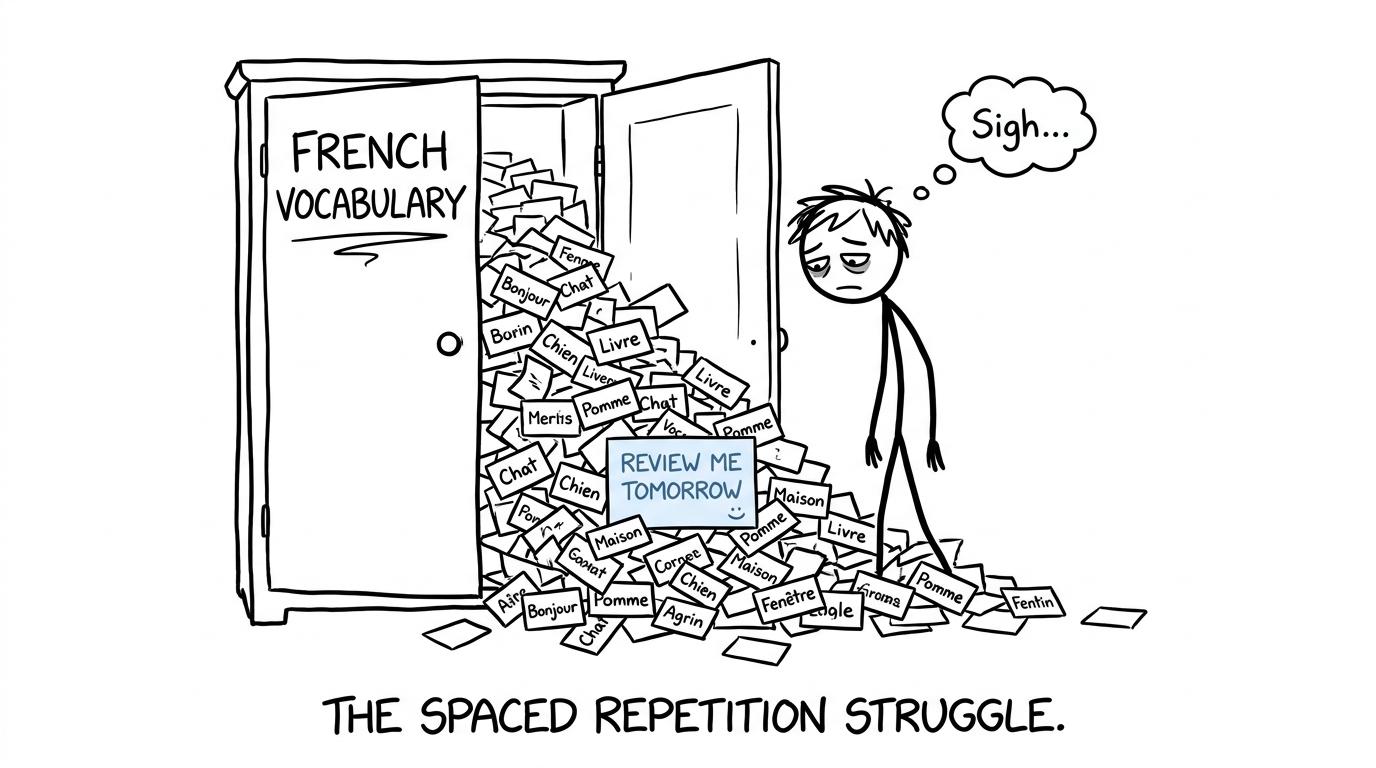 A GCSE student discovers that the French vocabulary wardrobe has rather too many contents
Make grammar accurate before making it impressive
Grade 9 writing and speaking should show range, but range without control can become a pile of avoidable errors. Secure the structures that let you communicate across different time frames and topics:
- present, past and future reference
- common irregular verbs
- negatives
- adjective agreement and position
- pronouns
- comparisons
- questions
- connectives and subordinate clauses
- justified opinions
Do not memorise ambitious phrases that you cannot adapt. Learn sentence frameworks whose vocabulary, subject and tense can change. Then test whether you can create fresh sentences without looking at a model.
A productive grammar session has a narrow purpose. Choose one structure, recall its rule, produce several original sentences, check them and correct every error. Return to it later without notes. This resembles the learn-practise-retest cycle in MathsGenie's one-month GCSE revision plan, even though the subject content is different.
Train listening little and often
Listening can feel unpredictable because speech disappears. You cannot stare at it in the way you can stare at a paragraph. The solution is frequent contact with short, level-appropriate audio rather than an occasional exhausting session.
Use a layered routine:
- First listen: identify topic, speakers and overall meaning.
- Second listen: capture names, opinions, negatives, time markers and changes of tense.
- Check the transcript or answer material where available.
- Replay the lines you missed.
- Write down the sound pattern or vocabulary that caused the problem.
Pay particular attention to small words that reverse meaning. A familiar noun is often less important than a negative, qualifier or contrast word. Practise dictation too: hearing a phrase and writing it accurately exposes weak sound-spelling connections immediately.
Do not always slow recordings down. Slower audio can help you learn, but normal examination speed must eventually feel familiar.
Speak before you feel ready
Speaking improves through speaking. Silent rehearsal cannot fully train pronunciation, response speed or recovery when a sentence changes direction.
Several times a week, record short answers to unpredictable prompts. Listen back for clarity, verb accuracy and whether you actually answered the question. Practise reading aloud, asking questions and extending answers with a reason or contrasting detail.
Your aim is not a theatrical accent. It is clear, comprehensible French delivered with enough control to communicate. If you forget a word, practise paraphrasing rather than stopping. That recovery skill matters in an unprepared interaction.
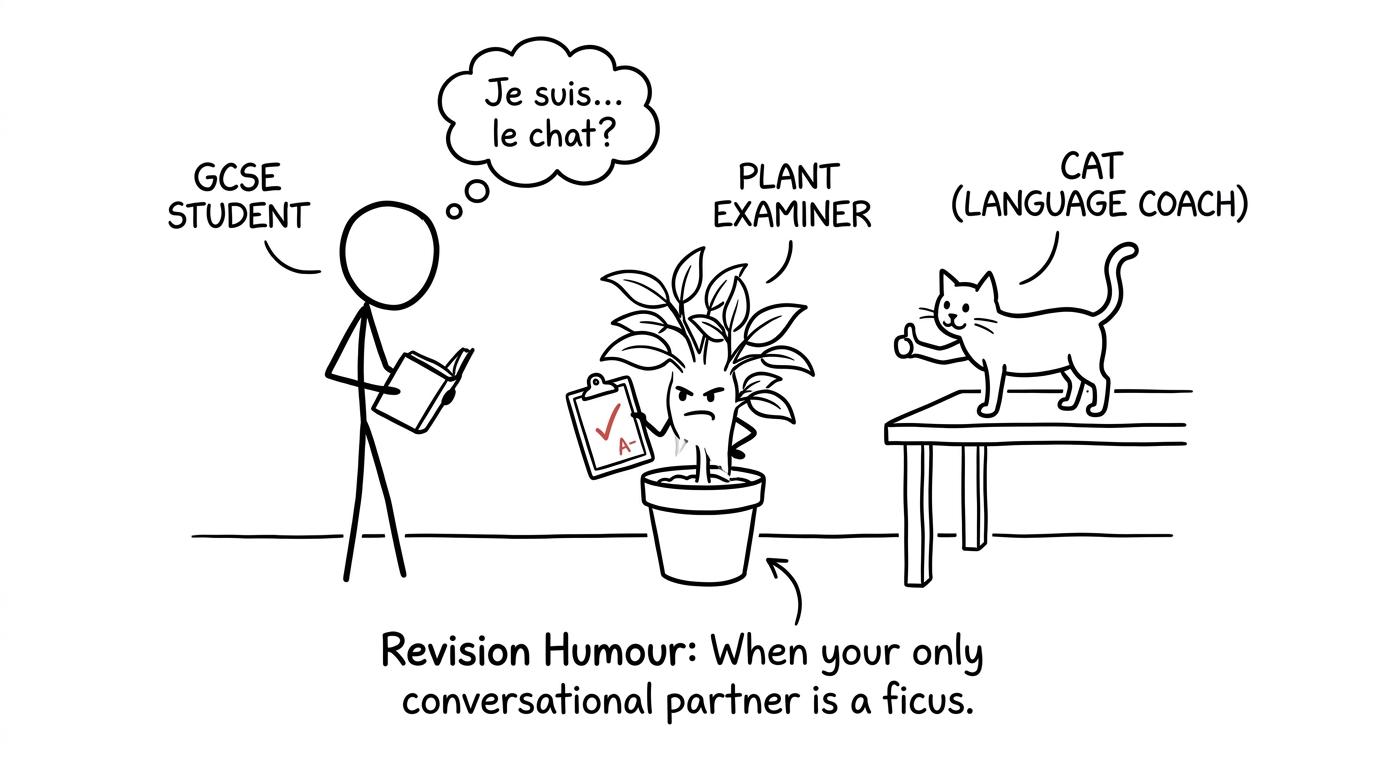 A student practises French with an unexpectedly strict botanical examiner
Read for structure as well as vocabulary
Strong readers do not understand every word. They use grammar, context and structure to decide which details matter.
When practising reading, mark:
- who is speaking
- when events happen
- whether an opinion is positive, negative or mixed
- pronouns and what they refer to
- contrast words that change the direction
- evidence supporting your answer
For an unfamiliar word, inspect its surroundings before guessing. Its position may reveal whether it is a noun, verb or adjective; a familiar word family may suggest meaning; the wider sentence may rule out several possibilities. This is particularly important under the current subject content, where students can be asked to infer plausible meanings from context.
Translation should preserve meaning rather than mechanically copying French word order. Check tense, subject, negatives and natural English expression before moving on.
Write under constraints and edit deliberately
Untimed writing with notes open can create attractive work without creating examination independence. Begin with short closed-book responses, then progress to full tasks under your board's conditions.
Before writing, identify every bullet point and decide which tense or idea will address it. While writing, prioritise communication and accuracy. Afterwards, complete a focused check:
- Have all parts of the task been answered?
- Are verbs matched to their subjects?
- Are time frames clear and controlled?
- Have adjectives been checked for agreement?
- Are negatives complete?
- Are accents and spellings accurate?
- Does the response contain developed ideas rather than a list?
Keep a bank of flexible language, but never force a memorised paragraph into an unsuitable task. Examiners reward a relevant response. A polished answer to a different question is still the wrong answer.
Use papers as diagnosis, not decoration
Past papers and official sample materials are useful only when they change what you do next. Because GCSE French was reformed for first assessment in 2026, confirm that each resource matches your specification and recognise when an older paper is being used only for additional skill practice.
After every timed section, classify mistakes:
- unknown vocabulary
- misunderstood grammar
- missed sound
- inaccurate spelling
- incomplete response
- weak timing
- avoidable misreading
Then choose a repair action. Learn the missing vocabulary, replay the audio, revise the grammar or repeat the task. A mark without a correction is merely a record of the past.
This principle applies across GCSE subjects. The MathsGenie guide to starting GCSE past papers explains why students should grow into timed papers rather than waiting until revision feels complete. Its companion guide on using the right number of past papers makes the equally important point that careful review matters more than collecting paper totals.
Build a weekly routine you can sustain
A grade 9 plan should touch every skill without turning every evening into a marathon. A balanced week might contain:
- brief vocabulary retrieval on most days
- two focused grammar sessions
- several short listening activities
- two speaking recordings
- one reading or translation task
- one timed writing task
- one mixed assessment section followed by corrections
The exact frequency should respond to your weaknesses. If listening costs most of your marks, giving every skill identical time is not balance; it is avoidance disguised as organisation.
Schedule correction time as part of the task. A practical revision timetable needs both practice and feedback, as explained in MathsGenie's GCSE revision timetable guide. Leave catch-up space too. A plan that collapses after one difficult week was too fragile from the beginning.
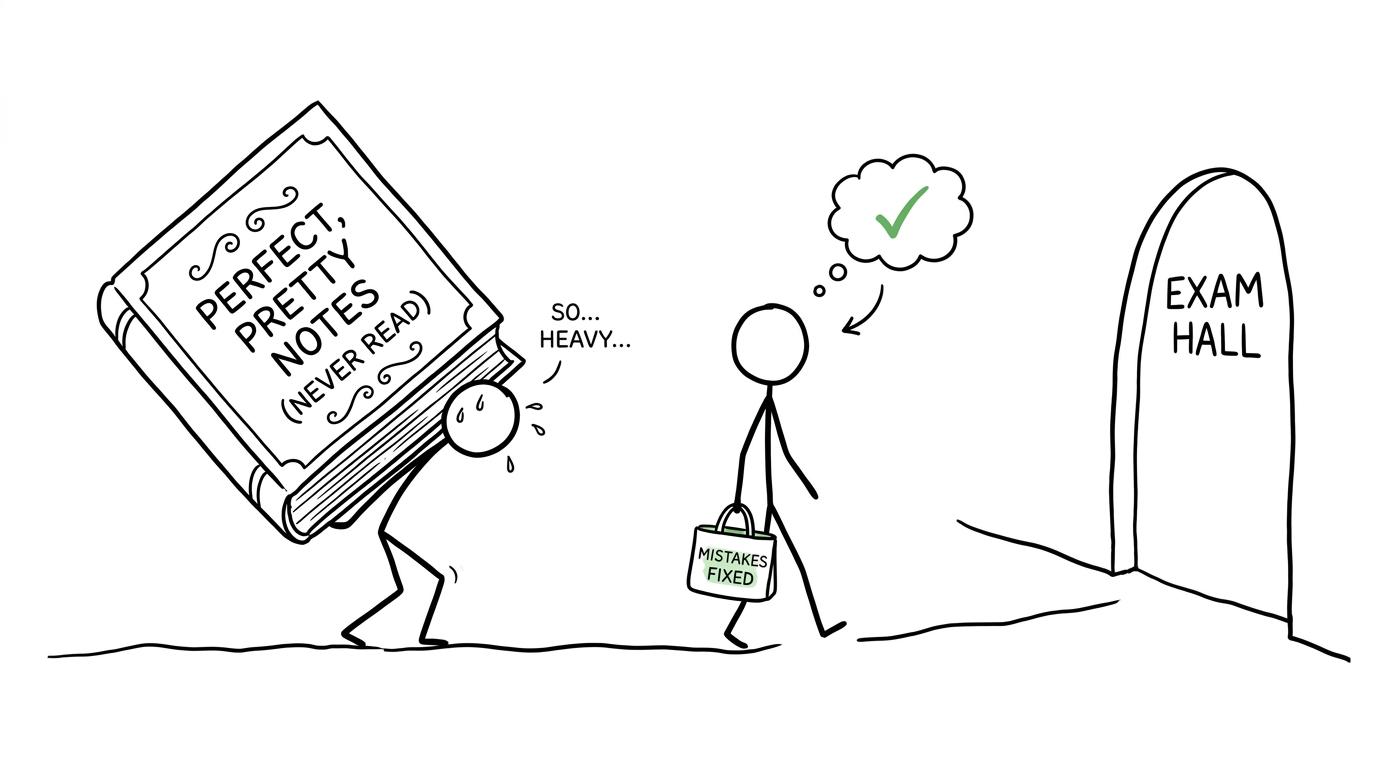 One student brings perfect notes while another carries the mistakes they have actually fixed
Common mistakes that hold students below grade 9
Revising only favourite topics
Family and holidays may feel comfortable, but unfamiliar contexts expose whether your vocabulary and grammar are genuinely flexible. Rotate across the complete specification.
Making beautiful notes without testing recall
Notes can support learning, but copying is not evidence that you can produce French independently. Close the book and retrieve.
Avoiding speaking until lessons
Occasional classroom answers do not provide enough repetition. Record yourself at home and practise responding without a script.
Treating every error as "careless"
A repeated error has a cause. Name it precisely: agreement, tense recognition, missed negative or misunderstood instruction. Precise diagnoses create useful revision.
Using old papers without checking the format
Older materials can still develop language skills, but they may not represent the reformed assessment. Prioritise current specifications and sample materials for exam simulation.
Cramming on the final evening
Vocabulary and listening need repeated contact. The final evening is for calm retrieval, familiar corrections and preparation, not rebuilding the course. The wider principles in MathsGenie's GCSE night-before plan apply here too: choose a small task, fix familiar errors and protect sleep.
Turn small corrections into a grade 9 campaign
Grade 9 French is not built by trying to sound impressive every time you open your book. It is built by noticing what fails under pressure and returning to it with patience: one missed negative, one uncertain verb, one answer that needed a clearer reason.
Start today with a short diagnostic across listening, speaking, reading or writing. Record the three most important weaknesses and schedule the first repair session. Then repeat the cycle: retrieve, attempt, check, correct and revisit.
For your maths preparation alongside French, make MathsGenie your free revision base. Use revision lessons and practice questions to repair individual topics, mini tests to check recall, and past papers or predicted papers to develop exam technique. Mark schemes and video solutions then turn mistakes into specific next steps: the same quiet process that makes ambitious grades possible in any subject.