How to Get Grade 6 GCSE Arabic: A Practical Plan
How to get grade 6 GCSE Arabic with focused vocabulary, regular speaking, timed practice and a simple plan for improving every exam skill.
A student can spend hours copying Arabic vocabulary and still feel no more prepared for the examination. The notes look impressive; the words disappear under pressure. If you are wondering how to get grade 6 GCSE Arabic, the answer is not to revise everything for longer. You need to enter Higher tier, build usable vocabulary, practise all four skills and turn every mistake into a specific follow-up task.
This guide refers to Pearson Edexcel GCSE Arabic specification 1AA0, the current GCSE Arabic qualification most students are likely to encounter. Check your entry with your school because specifications and arrangements can change. The central idea is simple: grade 6 performance grows from balanced, exam-specific practice rather than passive familiarity with the language.
Your grade 6 checklist
Use this as your starting point:
- Confirm that you are entered for Higher tier, because Foundation tier offers grades 1 to 5.
- Practise listening, speaking, reading and writing every week.
- Learn vocabulary through retrieval rather than copying.
- Prepare flexible language across every specification theme.
- Record yourself speaking and listen back critically.
- Complete timed questions without a dictionary.
- Mark work carefully and maintain a short corrections log.
- Revisit weaknesses after a gap to prove that they have improved.
You can organise the same evidence-led process across your subjects with the MathsGenie GCSE revision hub, which brings together revision lessons, questions, papers and solutions for GCSE maths.
Understand what a grade 6 requires
Edexcel GCSE Arabic assesses four skills: listening, speaking, reading and writing. Each contributes 25%25\%25% of the qualification. That balance matters. Strong conversation cannot completely rescue neglected reading, just as accurate writing cannot compensate for repeatedly missing information in listening tasks.
Higher-tier speaking contains a role play, a picture-based task and a conversation. Reading includes a translation from Arabic into English, while Higher-tier writing includes two open responses and a translation into Arabic. Dictionaries are not permitted, including during speaking preparation.
Grade boundaries are set after the examinations and vary between series, so there is no permanent grade 6 mark. For context, the Higher-tier grade 6 boundary was 156156156 out of 280280280 in June 2025, compared with 146146146 in 2024 and 141141141 in 2023. Use the MathsGenie Edexcel GCSE Arabic grade boundaries to understand previous outcomes, but never treat an old boundary as a prediction.
The more useful target is a safe margin across all four components. Aim to improve the skill that currently loses the most marks rather than chasing one historic total.
Replace vocabulary copying with active recall
Vocabulary matters, but recognition is not enough. Seeing a word and thinking “I know that” is different from producing it during a timed translation or conversation.
Build vocabulary by theme and function. Alongside nouns, learn:
- high-frequency verbs in useful forms;
- opinion phrases and reasons;
- connectives that extend an answer;
- time markers for past, present and future ideas;
- question words and common instructions;
- language for comparison, description and justification.
Keep each revision set small. Look at the English meaning, hide the Arabic and retrieve it. Then reverse the direction. Say the word aloud, write it and place it in a short original sentence. Revisit difficult items after one day, several days and again the following week.
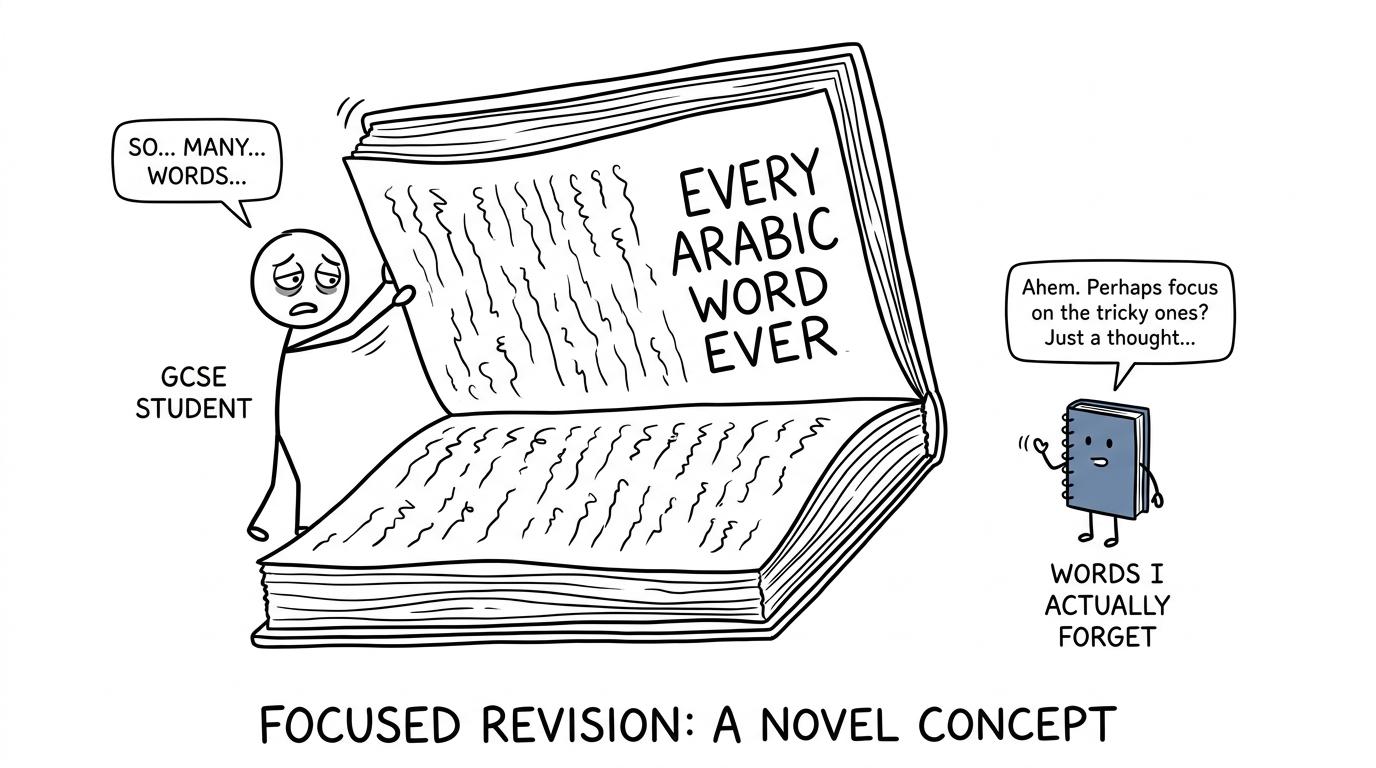 A student chooses between an enormous vocabulary book and a focused list of forgotten words
The important habit is separating secure words from fragile ones. A list containing only words you forget is less attractive than a decorated notebook, but far more useful. The principles in MathsGenie’s guide to stopping GCSE content from being forgotten can be adapted to Arabic: retrieve, check, space and retest.
Build speaking from flexible blocks
Students often prepare speaking by memorising long paragraphs. This can sound fluent until the examiner changes the wording, asks a follow-up question or moves to an unfamiliar theme. Then the whole structure can collapse.
A better approach is to prepare flexible blocks of language. For each theme, become comfortable doing five things:
- state an opinion;
- give a reason;
- describe something in more detail;
- refer to another time frame;
- respond to an unexpected question.
Practise aloud because silent rehearsal does not train pronunciation, pace or spontaneous recall. Record a response, listen back and identify one improvement only. It might be clearer pronunciation, a fuller reason or more accurate verb use. Repeat the same prompt immediately, then return to it later without notes.
For the role play, respond directly to every requirement and prepare the question you are asked to formulate. For the picture task, move beyond listing visible objects: describe the situation, infer what may be happening and express a relevant opinion. In conversation, develop answers naturally rather than rushing towards a memorised speech.
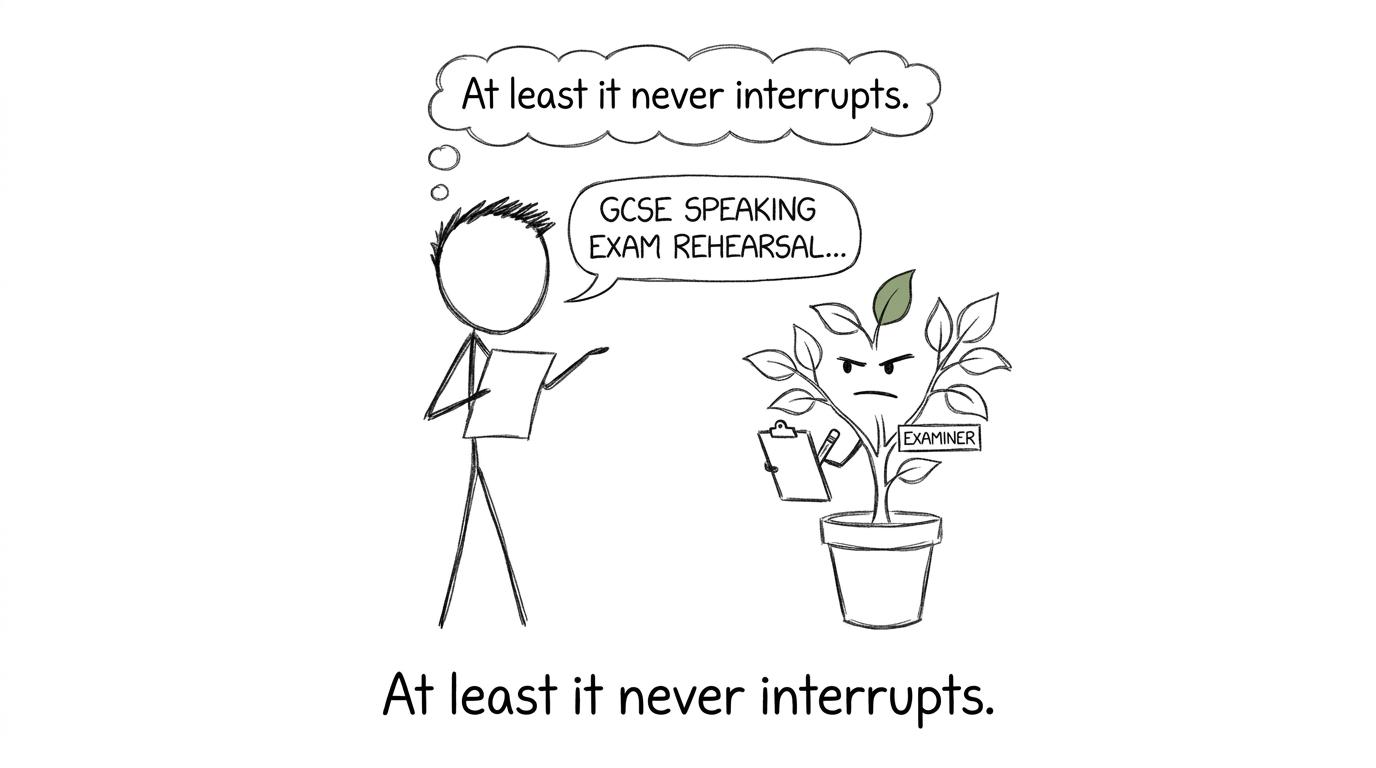 A student conducts a serious speaking rehearsal with a houseplant examiner
Speaking to a teacher or partner is ideal, but practising with a recording device is still valuable. The examination rewards communication and interaction, not a perfectly theatrical performance.
Train listening without relying on every word
Listening becomes intimidating when students believe they must understand the complete recording. Usually, the task is to locate particular information: who did something, when it happened, what opinion was expressed or why a decision was made.
Before the audio begins, read the question carefully and predict the category of information required. During the recording, listen for meaning rather than trying to translate every word. Pay special attention to negatives, changes of opinion, numbers, dates, time expressions and contrasting connectives.
After practice, classify each error:
- the vocabulary was unknown;
- the word was known but not recognised at natural speed;
- a negative or contrast was missed;
- the correct detail was heard but written unclearly;
- attention remained on an earlier question.
Each diagnosis demands a different repair. Unknown vocabulary belongs in your retrieval list. A familiar word missed at speed should be replayed and repeated aloud. A concentration error requires more timed listening, not more copying.
Make reading an evidence-finding exercise
Reading improves when you stop treating a passage as one large translation problem. Begin with the question, identify what evidence is needed and scan for the relevant section. Cognates and familiar roots can help, but context must decide the meaning.
Underline words that signal tense, comparison, cause, contrast and negation. If a question is answered in English, make the response precise enough to communicate the correct idea. Do not add an unsupported assumption simply because it sounds plausible.
For translation into English, preserve the meaning, tense and relationships between ideas. Natural English is preferable to awkward word-for-word rendering, provided no information is lost. Build stamina by translating short passages under time pressure, checking them and recording recurring gaps.
This diagnostic mindset resembles the process in how to find your weakest GCSE topics: gather evidence, label the weakness, repair it narrowly and test it again.
Improve writing through control, not decoration
Grade 6 writing does not require every sentence to be spectacular. It requires relevant content, developed ideas and enough grammatical control to make the message clear.
Plan briefly before writing. Check every bullet point in the prompt and decide which time frames, opinions and reasons you will use. A useful response normally includes varied sentences, but complexity should remain manageable. One accurate developed sentence is worth more than an ambitious sentence whose meaning becomes unclear.
When checking, work in layers:
- Have you addressed every required point?
- Are the verbs consistent with the intended time?
- Do agreements and pronouns make sense?
- Have you used connectives accurately?
- Is the handwriting legible and the meaning unambiguous?
- Have you stayed close to the required length and task?
Do not repeatedly rewrite the same memorised answer. Adapt prepared language to different prompts so that you learn to make decisions. That is what the examination will require.
Use a weekly revision rhythm that survives busy days
A strong plan is deliberately repeatable. Four focused sessions are better than one exhausting weekend block.
A practical weekly pattern
- Session one: vocabulary retrieval and a short reading task.
- Session two: listening practice followed by error classification.
- Session three: recorded speaking across one specification theme.
- Session four: timed writing or translation, followed by correction.
- Weekend review: retest the week’s weakest vocabulary and grammar without notes.
Keep a daily minimum small enough to complete when motivation is low. MathsGenie’s 20-minute GCSE revision routine shows how brief retrieval, practice and immediate feedback can form a sustainable habit. If the examination is approaching, adapt the structure in the one-month GCSE revision plan across your subjects.
As confidence grows, introduce complete timed sections and then full papers. The guidance on when to start GCSE past papers explains why papers are most useful when there is still time to repair what they reveal.
Turn every paper into the next revision plan
A paper is not finished when you calculate the mark. The valuable part begins afterwards.
For every dropped mark, record the paper, skill, cause and next action. Keep labels specific: “missed negative in listening”, “past-tense verb insecure” or “did not answer the second bullet point”. Then complete a short repair task and retest the same skill with different material.
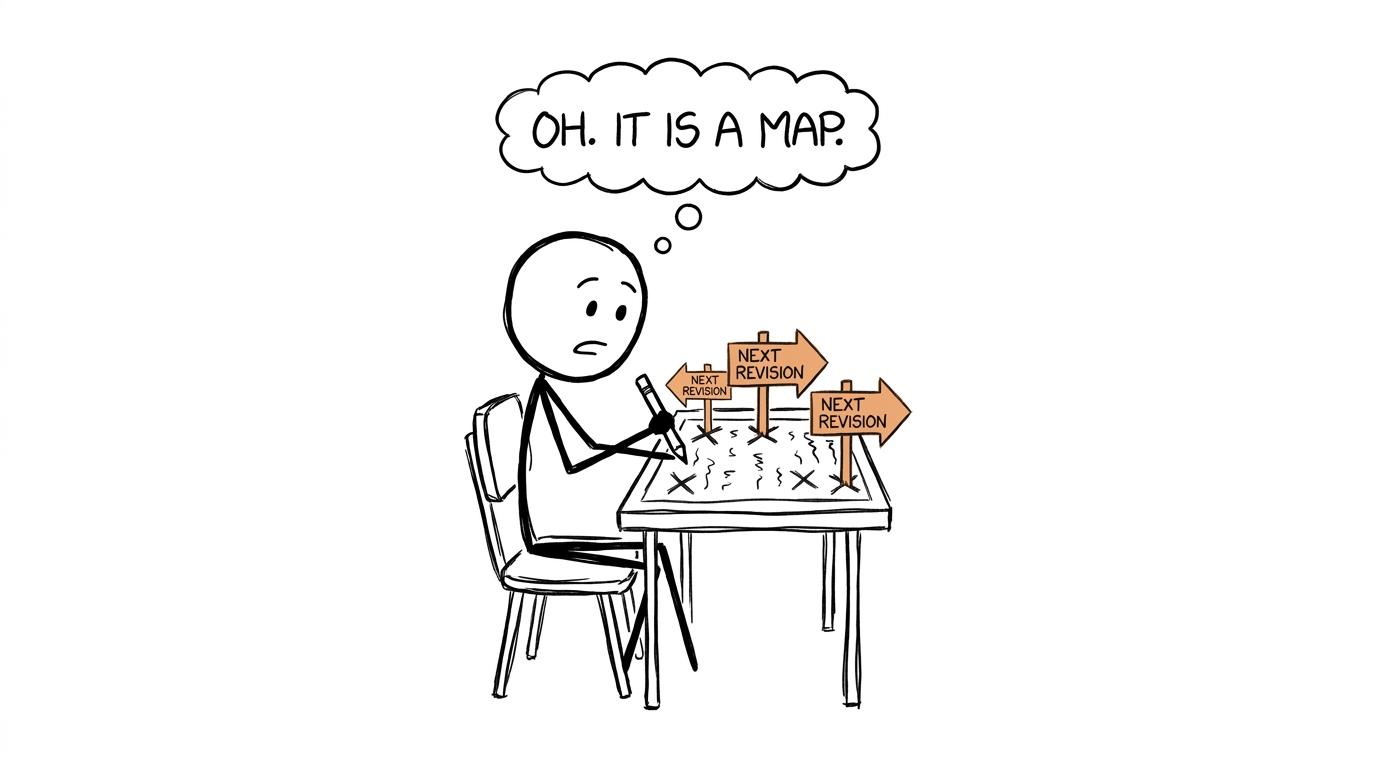 Errors on a practice paper transform into signposts for the student's next revision session
Use official papers and mark schemes supplied through your school or exam board for Arabic. For maths, MathsGenie’s GCSE maths revision resources and Edexcel GCSE mini tests make the same paper, mark, repair, retest cycle easy to repeat. Near the maths examinations, Edexcel predicted papers provide fresh practice alongside genuine past papers rather than replacing them.
Common mistakes that hold students below grade 6
Revising only the strongest skill
Comfortable practice feels productive, but balanced weighting means neglected skills remain expensive. Give additional time to your weakest component while keeping all four active.
Memorising scripts without practising follow-up questions
Prepared content is useful; dependence on one exact wording is fragile. Rehearse the same ideas in different orders and answer unpredictable questions aloud.
Copying vocabulary instead of retrieving it
Copying improves familiarity, not necessarily recall. Hide the answer and force yourself to produce it before checking.
Ignoring the question instructions
Marks are lost when a response is linguistically impressive but misses a bullet point, writes in the wrong time frame or answers a different question. Underline every task requirement.
Using old boundaries as a guaranteed target
Boundaries change each series. Treat previous figures as context and build a margin rather than aiming at the lowest historic mark.
Correcting work without retesting
Reading a correction creates recognition. Redoing the skill after a delay creates evidence that you can now perform it independently.
Make grade 6 the result of a system
The distance between grade 5 and grade 6 is rarely crossed by one heroic revision day. It is crossed through small corrections: one listening trap noticed, one speaking answer extended, one unreliable verb retrieved and one writing error prevented next time.
Start by confirming Higher-tier entry and completing one honest diagnostic task in each skill. Build a short weakness list, revise from it and retest weekly. Meanwhile, let MathsGenie organise the mathematical side of your GCSE preparation. Use its free revision lessons, practice questions, mini tests, past papers, predicted papers, mark schemes and video solutions to apply the same calm improvement cycle to maths.
Open the MathsGenie GCSE maths revision hub, choose your exam board and turn today’s first mistake into tomorrow’s secure mark.