How Stressful Is GCSE Further Maths?
How stressful is GCSE Further Maths? See how it compares with other subjects, why it feels demanding, and how to revise calmly and effectively for exams.
There is a particular moment in Further Maths revision when an ordinary-looking algebra question fills most of a page. Nothing is obviously impossible, yet every line seems to depend on the one before it. That is often when students wonder: how stressful is GCSE Further Maths, really?
The short answer is that it is usually one of the more demanding qualifications taken alongside GCSEs, but not automatically the most stressful. Students who are secure in higher-tier GCSE Maths often find its logical structure more manageable than subjects involving extensive memorisation, coursework or long written answers. The greatest pressure usually comes from its pace, unfamiliar content and status as an additional qualification.
Stress is personal, too. Difficulty, confidence, teaching time and workload all matter. A hard subject that you enjoy can feel lighter than an easier subject you dread.
GCSE Further Maths stress at a glance
- Academic difficulty: high, especially if higher-tier algebra is not yet secure.
- Content volume: moderate, but topics are often deeper and more connected.
- Memorisation: generally lower than in content-heavy subjects.
- Exam pressure: high because multi-step questions can punish small errors.
- Workload: varies significantly between schools.
- Best suited to: students working confidently towards grades 777 to 999 in GCSE Maths.
- Overall position: commonly perceived as an upper-middle or high-stress option, rather than universally the most stressful GCSE subject.
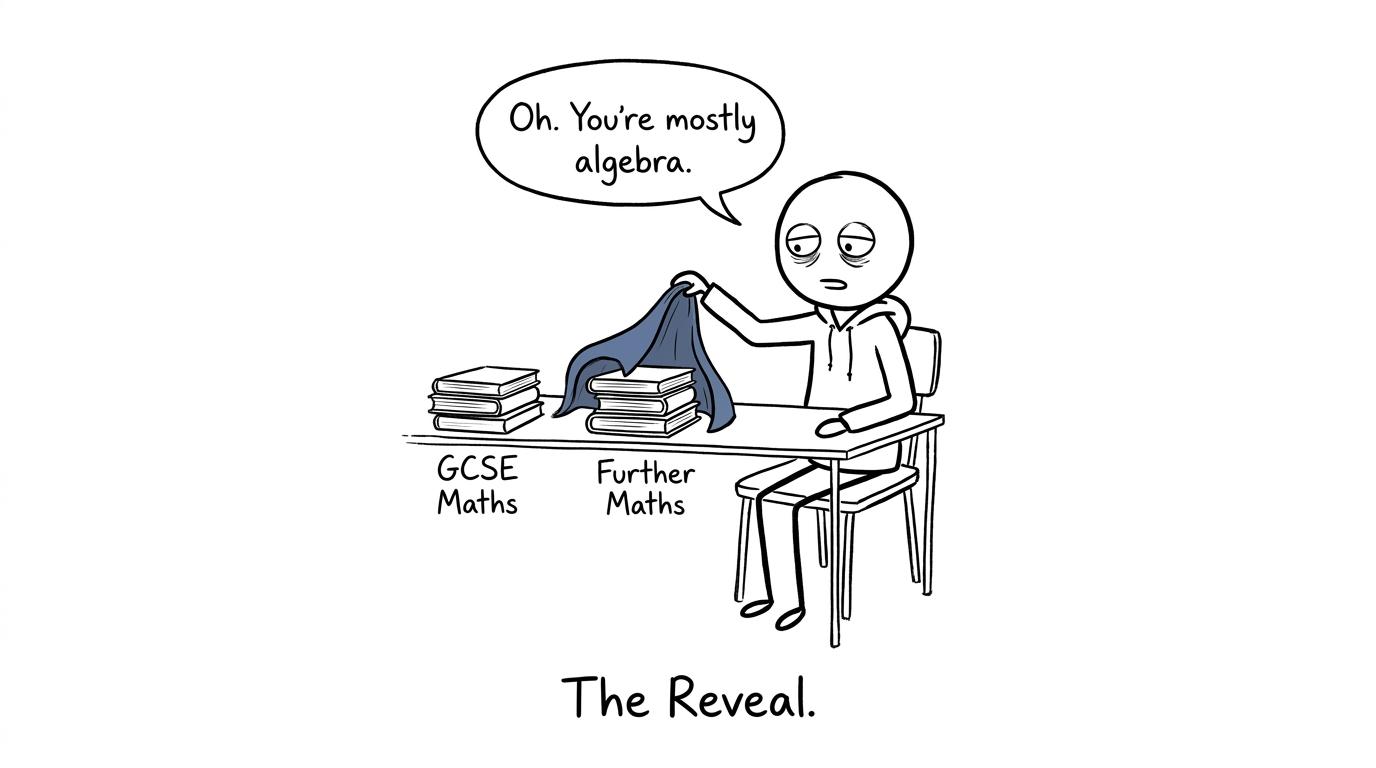 A GCSE Further Maths revision pile loses its dramatic villain cape
Is GCSE Further Maths actually a GCSE?
The name is commonly used as shorthand, but schools offer several different qualifications.
A widely used route is the AQA Level 2 Certificate in Further Mathematics. AQA describes it as an additional qualification for learners who are expected to achieve grades 777, 888 or 999 in GCSE Mathematics and may continue to A Level Maths or Further Maths. It is not a replacement for GCSE Maths.
The AQA course extends algebra and geometry while introducing areas such as calculus and matrices. It is linear and untiered, with two written papers. One is non-calculator and one allows a calculator; each lasts one hour and 454545 minutes and carries 808080 marks.
Some schools use alternatives. Pearson Edexcel's Level 2 Extended Mathematics Certificate, first assessed in 202520252025, also builds on GCSE Maths through two papers, but uses Pass, Merit, Distinction and Distinction* rather than grades 999 to 111. Other centres may offer OCR's Additional Mathematics qualification. Your teacher can confirm the exact specification and assessment structure.
That distinction matters because the phrase “GCSE Further Maths” does not describe one identical national course. Always revise from the specification and papers for the qualification you are actually taking.
Where does Further Maths rank for stress?
There is no authoritative national league table measuring the stress caused by each GCSE subject. Official research shows that perceived difficulty is highly individual, while national polling conducted for the Curriculum and Assessment Review found that just over half of surveyed key stage 444 learners found coping with exam-period stress difficult. That finding concerns the whole exam season, not Further Maths alone.
Informal student polls offer a rougher picture. One published in 202520252025 placed GCSE Further Maths sixth among subjects voted hardest. Such polls reflect genuine student opinions, but they are self-selecting and do not control for ability, school entry policies or qualification type. They should be treated as a clue, not a scientific ranking.
A fair conclusion is that Further Maths tends to sit towards the harder end academically, but its stress ranking changes according to the student:
| Subject type | Common source of pressure | Comparison with Further Maths |
|---|---|---|
| Sciences | Large specifications, required practical knowledge and calculations | Often broader; Further Maths is usually narrower but more abstract |
| English | Interpretation, extended writing and uncertain-feeling answers | Further Maths is more exact, which some students find reassuring |
| Modern languages | Vocabulary, listening and speaking performance | Often more memorisation; Further Maths demands more chained reasoning |
| Art and design | Sustained portfolio workload and deadlines | Usually less exam-like but potentially more time-consuming |
| History and geography | Detailed knowledge and extended responses | Broader recall burden; Further Maths has greater algebraic intensity |
| Computer science | Abstract concepts, programming and written theory | Can feel similarly logical and cumulative |
Students who enjoy rules, patterns and definite answers may therefore rank Further Maths below English, art or languages for stress. Students who dislike algebra may put it near the top.
Why Further Maths can feel unusually stressful
It exposes weak foundations quickly
Further Maths assumes that core GCSE techniques are available when needed. Rearranging expressions, factorising, working with surds and interpreting graphs are not isolated chapters anymore. They become tools inside harder problems.
This makes the course cumulative. If factorising is slow, a later question involving the factor theorem becomes harder for two reasons: the new idea is unfamiliar, and the old technique is not yet automatic.
Before pushing further, use the MathsGenie GCSE Maths revision hub to strengthen the higher-tier skills beneath the new material. Foundations are not a retreat. They are what make advanced questions feel shorter.
Some ideas are genuinely new
Calculus and matrices can initially look like A Level material arriving early. AQA also develops functions, trigonometry, coordinate geometry and algebra beyond their usual GCSE depth.
The important point is that unfamiliarity is not the same as inability. A symbol such as
dydx\frac{dy}{dx}dxdymay look intimidating before it has meaning. Once it is connected to the gradient of a curve, it becomes part of a system rather than a mysterious decoration.
It may receive less timetable time
Schools deliver the qualification differently. Some teach it through regular lessons; others use lunchtime, after-school or compressed sessions. Two students taking the same paper can therefore experience very different workloads.
If the course feels rushed, a simple GCSE maths revision timetable can protect regular Further Maths practice without allowing it to consume every evening.
The questions demand connected thinking
Standard practice often tells you which technique to use. Exam questions may not. You must recognise the structure, choose a method and carry it through accurately.
That is cognitively demanding. Research into GCSE maths difficulty identifies factors including topic complexity, question length, wording and the number of steps required. Further Maths often combines several of these pressures in one place.
When Further Maths may feel less stressful than other subjects
Further Maths has one quiet advantage: its rules are consistent. Once a method is understood and practised, it tends to remain useful.
There is also less dependence on remembering long case studies or producing pages of prose. Answers can still require rigorous reasoning, but success usually comes from understanding, selection and accurate execution.
For students considering A Level Maths, the course can also reduce future uncertainty. Meeting functions, matrices or differentiation at Level 222 does not make A Level easy, but it can make some terminology less surprising. The qualification is preparation, not a requirement, and students can succeed at A Level Maths without having taken it.
The deciding question is not simply, “Is this hard?” A better question is, “Does this kind of hard suit me?”
How to make GCSE Further Maths less stressful
Separate foundation problems from new-content problems
After marking practice, label each lost mark:
- Foundation gap: an error in ordinary higher-tier GCSE Maths.
- Further Maths gap: the new concept was not understood.
- Exam error: the method was known, but timing, notation or accuracy failed.
Each category needs a different response. Use GCSE topic practice for the first, a clear revision lesson for the second, and timed questions for the third.
The one-month GCSE maths revision plan provides a practical structure that can be adapted around your Further Maths course.
Practise little and often
A short session on algebra several times a week is usually more useful than one exhausting weekend block. Frequent retrieval keeps techniques available, which reduces the mental load of multi-step questions.
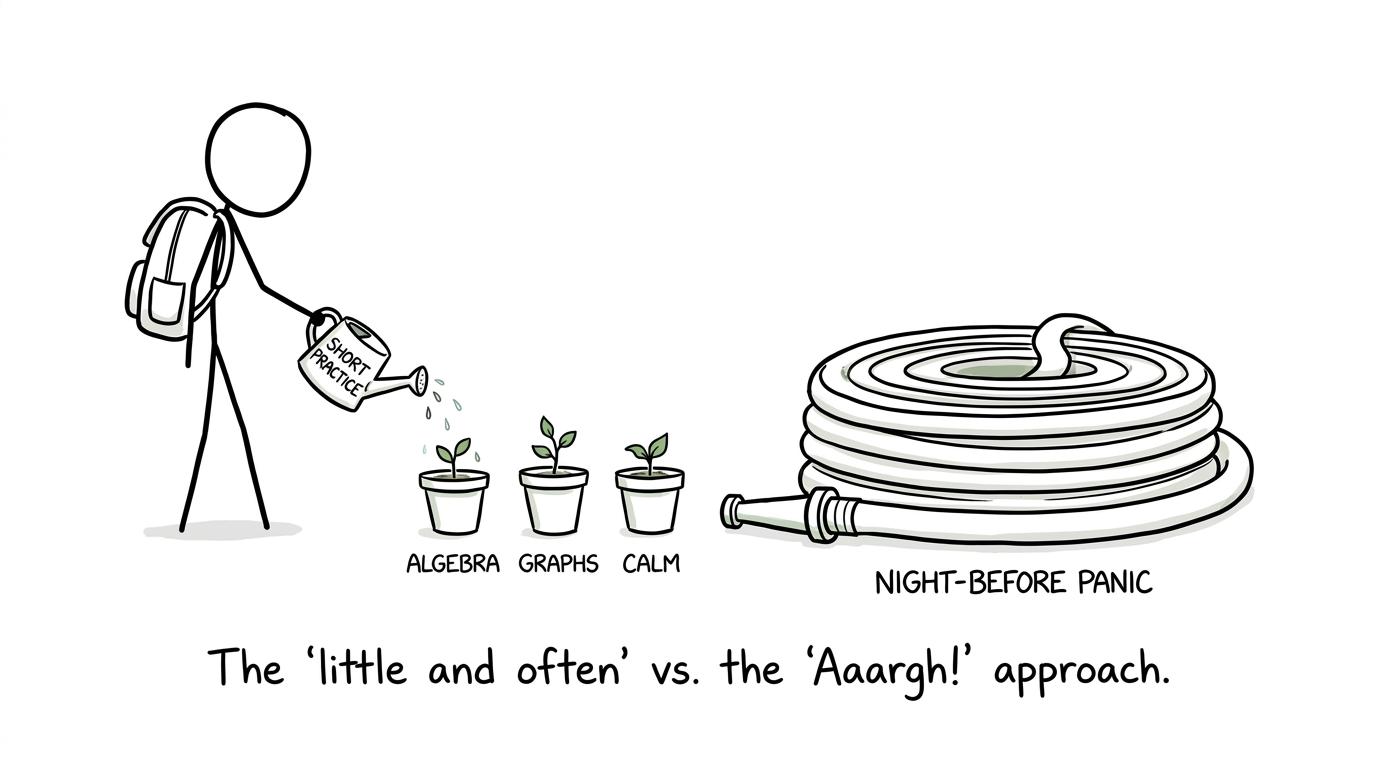 Short practice waters algebra, graphs and calm while panic owns a fire hose
A balanced session might contain:
- a brief review of an older skill;
- focused questions on one current topic;
- careful marking;
- one correction completed without copying the solution.
If GCSE Maths and Further Maths are competing for time, prioritise the main GCSE qualification first. Further Maths depends on it, not the other way around.
Use papers as diagnosis, not judgement
Past papers reveal whether the problem is knowledge, method selection or stamina. Start with individual questions or short sections, then build towards complete timed papers.
MathsGenie's Edexcel GCSE Maths predicted papers can strengthen the higher-tier foundations shared with advanced work. Predicted papers should complement specification coverage and official past papers, never replace them. The guide to using GCSE predicted topics responsibly explains why guessing the paper is not a revision strategy.
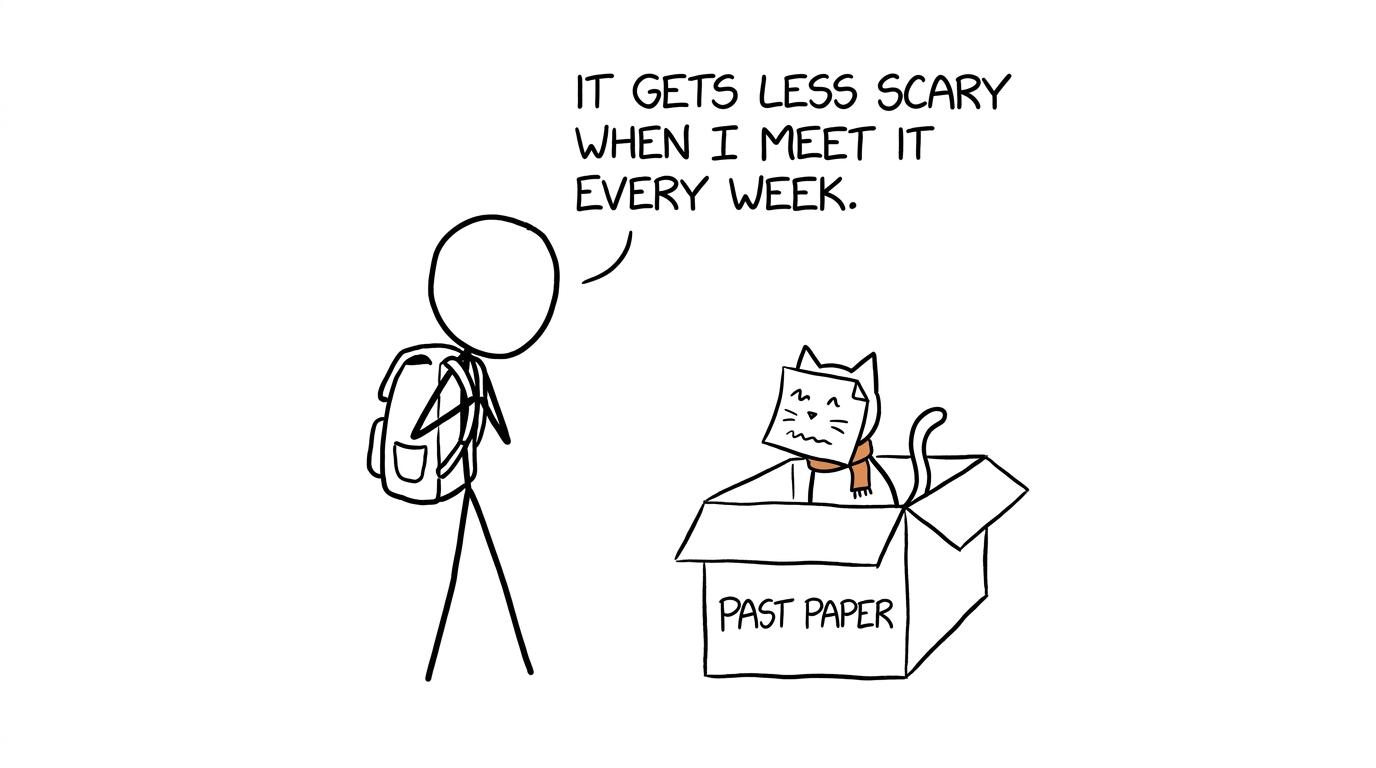 A student becomes less frightened of the exam-paper cat by meeting it weekly
Make the mark scheme part of revision
Do not stop at a total. Ask where the first incorrect step appeared and what evidence the mark scheme expected. Then redo the question later from a blank page.
This turns mistakes into information. It also prevents one poor score from becoming a judgement about your ability.
For broader exam preparation, the guide to revising Edexcel GCSE Maths efficiently shows how to combine topic lessons, practice questions and paper review.
Common mistakes that increase Further Maths stress
Treating it as entirely separate from GCSE Maths
The two courses overlap heavily. Ignoring higher-tier GCSE weaknesses makes Further Maths revision slower and less secure.
Revising only the most advanced topics
Calculus and matrices attract attention because they look new. Yet demanding algebra, functions, surds, graphs and trigonometry can account for many important marks. Follow your full specification.
Measuring progress by hours
Three hours spent rereading notes may produce less improvement than 303030 focused minutes of questions, marking and correction. Measure completed practice and repaired mistakes instead.
Starting full papers too early or too late
A complete paper before learning the content can be demoralising. Waiting until the final week gives you no time to fix patterns. Build gradually from topic questions to sections and then timed papers.
Sacrificing sleep for one more session
Tired revision often creates the illusion of effort without much retention. Near an exam, use a controlled plan such as the GCSE maths night-before checklist, then stop at a sensible time.
The honest verdict
So, how stressful is GCSE Further Maths compared with other GCSEs? For most students taking it, it is academically demanding and often sits towards the higher end of the stress range. However, it is not automatically more stressful than sciences, languages, English or coursework-heavy options. Its narrower, logical structure can make it feel surprisingly manageable for students with strong algebra and regular teaching.
The subject becomes most stressful when foundations are shaky, teaching time is limited and difficult papers are left until the end. All three problems can be reduced.
Start with MathsGenie's free revision lessons and practice questions to secure GCSE techniques. Use mini tests to build speed, mark schemes and video solutions to understand lost marks, and past papers to develop stamina. Add predicted papers only after covering the specification. With a realistic revision planner and repeated, focused practice, Further Maths stops looking like a verdict on your intelligence and becomes what it really is: a collection of skills that can be learned.