

How Parents Can Help with GCSE Maths Revision
How parents can help with GCSE Maths revision: create a calm routine with realistic planning, useful check-ins and focused question practice at home.

Imagine a parent outside a closed bedroom door. Inside, a GCSE student has a maths book open but no clear idea where to begin. Another reminder about revision may sound like criticism.
This is the difficulty behind how parents can help with GCSE Maths revision. The most useful role is to help the student build a realistic routine, find appropriate resources, practise actively and review progress without turning every conversation into an argument.
A starting checklist is simple:
- agree when revision will happen;
- choose specific topics;
- use questions, marking and corrections;
- revisit weak topics;
- keep check-ins predictable;
- protect sleep, breaks and family life.
Reduce the number of decisions
Students do not always avoid revision because they are unwilling. “Revise maths” contains several decisions: which topic, which resource, how long to work and what to do when something goes wrong.
Begin by confirming the student's exam board, such as Edexcel, AQA, OCR or Eduqas, and whether they take foundation or higher tier. The GCSE Maths revision hub provides access to topic materials, exam questions and past papers.
Then ask:
“Which three maths topics currently feel least secure?”
The answer might be simultaneous equations, circle theorems and probability. Those topics can become specific tasks rather than worries sitting in the background. Teacher feedback and marked mock papers can help identify gaps if the student is unsure.
Build a weekly plan together
A revision plan should fit around school, homework, other subjects and rest. Begin with a short weekly conversation. Agree on a few maths sessions, name each topic and decide what the student will produce.
| Stage | Student action |
|---|---|
| Recall | Write remembered facts or methods without notes |
| Relearn | Use a lesson or video to repair a gap |
| Practise | Complete questions independently |
| Mark | Check answers using the mark scheme |
| Record | Note errors and what needs revisiting |
This gives each session a clearer purpose than a timetable block labelled “maths”. The GCSE Maths revision timetable guide explains how to organise focused sessions. The guide to how many hours to revise each day can help families consider a manageable workload.
For busy evenings, try the 20-minute maths revision routine. A short, completed session is more useful than a longer block repeatedly postponed. Use the MathsGenie Revision Planner to organise agreed topics and available days.
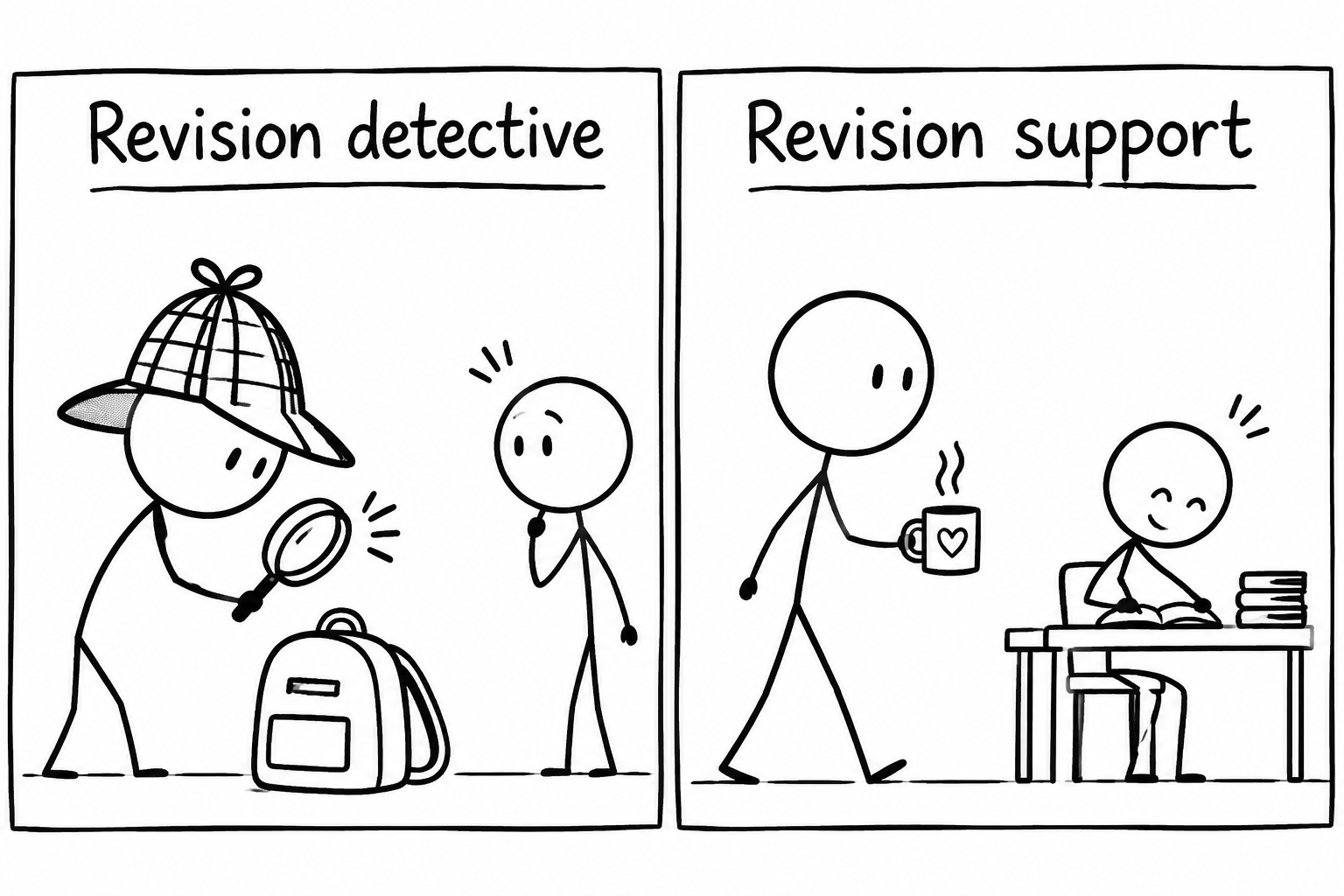 A revision detective learns that quiet support works better than investigating
Support active revision
Reading notes can feel reassuring because everything looks familiar. GCSE Maths requires students to choose and apply methods independently, so revision should include plenty of question practice.
Parents do not need to understand every method. Ask the student to explain what a question requires, why their method applies and where an error occurred. If they cannot explain, encourage them to check a lesson or worked solution before attempting another question independently.
Completing questions from memory uses retrieval practice. Returning to a topic after a gap creates spaced practice. Both are established approaches to learning; families do not need a perfect spacing formula to use them.
Revisit a difficult topic later in the week, again the following week and eventually within mixed practice. MathsGenie's revision lessons, practice questions, mini tests, mark schemes and video solutions support this process without requiring parents to teach the specification.
Make marking part of revision
Finishing a worksheet is not the end of a session. Marking reveals the difference between what felt secure and what the student could complete independently.
Encourage prompt marking and separate errors into three categories:
- Knowledge gap: a fact or method was not known.
- Application gap: the method was known but not recognised.
- Accuracy error: the approach was correct but the execution failed.
A knowledge gap may need another lesson. An application gap needs varied questions. An accuracy error calls for clearer working or careful checking. Ask the student to correct mistakes, then attempt similar questions without looking at the solution.
Use past papers to practise selecting methods across a full paper. Predicted papers can provide additional practice, but should supplement broad specification coverage rather than encourage guessing which topics will appear.
Check in without taking control
An agreed weekly check-in gives the student ownership while keeping support available. Focus on three questions:
- What was completed?
- What did the marking reveal?
- What should change next week?
This directs attention towards evidence. If a session was missed, find out why and adjust the plan. A timetable should help the student organise work, not become another source of conflict.
The guide to supporting GCSE revision without nagging explores calm routines and agreed boundaries. For students struggling to start, the manageable GCSE revision guide offers a smaller first step.
Common mistakes parents can avoid
Measuring only time spent
An hour at a desk does not necessarily mean an hour of learning. Ask what was practised, corrected and understood.
Correcting every error immediately
Allow thinking time before stepping in. Ask the student to identify the topic or compare their working with a mark scheme. Offer support when they cannot make progress.
Comparing students
A sibling's timetable or classmate's mock result does not identify this student's next useful task. Use their topic gaps and teacher feedback.
Filling every free evening
Leave space for rest, deadlines and unexpected events. A workable plan should survive an ordinary week.
Treating one poor paper as a verdict
A past paper reveals weaknesses in knowledge, timing and technique. Use it to choose revision tasks rather than treating the result as a final prediction.
Turn support into a schedule
Parents can make revision easier to start and easier to sustain. Choose weak topics together, encourage independent practice and use marking to guide what happens next.
Start with the coming week. Build a manageable schedule in the MathsGenie Revision Planner, then review it together after the first sessions.















