

How Long to Revise GCSE Latin Per Week
How long revise GCSE Latin per week? See realistic targets by months remaining, plan effective sessions and protect enough time for GCSE maths revision too.
The hardest part of revision is often not the work itself. It is deciding how much time each subject deserves. Latin can feel especially demanding because vocabulary, grammar, translation and set texts all compete for attention. Meanwhile, your GCSE maths papers still require regular question practice.
So, how long revise GCSE Latin per week? As a realistic starting point, aim for around 1.51.51.5 to 222 hours a week when the exam is more than six months away, rising gradually to 333 to 555 hours during the final two months. Students with substantial gaps may temporarily need more, but consistent, focused sessions are usually more useful than an occasional marathon.
These figures refer to independent Latin revision outside lessons. If your teacher sets substantial Latin homework, count productive homework towards the total rather than accidentally planning the same hours twice.
Your GCSE Latin revision checklist
Before building a timetable, make five decisions:
- Confirm whether you take OCR or Eduqas GCSE Latin.
- Check the exact language, literature and civilisation components you will sit.
- Estimate your current gaps using translation, vocabulary and set-text questions.
- Choose a weekly total that leaves enough time for maths and your other GCSEs.
- Divide the time into short sessions across several days.
There is no official exam-board rule prescribing a certain number of revision hours. The right total depends on how long remains, your present knowledge and the grade you are targeting. Your teacher is best placed to adjust the estimate because they know your course coverage and recent assessment performance.
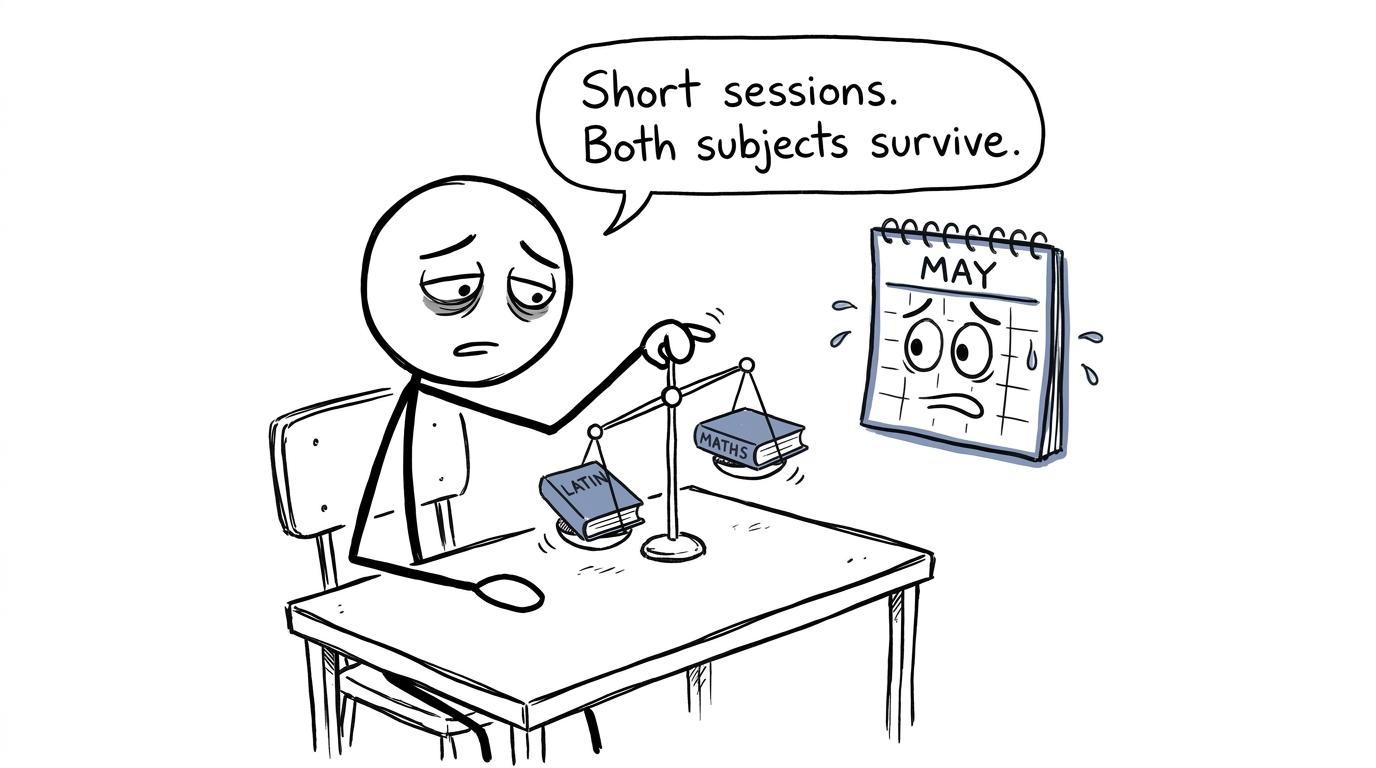 A student balancing Latin and maths revision books on a nervous calendar
A realistic weekly estimate by time remaining
The useful question is not simply how many hours sound impressive. It is how many focused hours you can repeat without pushing maths, sleep or every other subject out of the week.
| Time before the exam | Suggested independent Latin revision | Main priority |
|---|---|---|
| More than 666 months | 1.51.51.5 to 222 hours each week | Vocabulary, core grammar and steady set-text learning |
| 333 to 666 months | 222 to 333 hours each week | Translation practice, retrieval and closing topic gaps |
| 666 to 121212 weeks | 333 to 4.54.54.5 hours each week | Timed questions, detailed corrections and mixed recall |
| 333 to 666 weeks | 4.54.54.5 to 666 hours each week | Exam-style practice and targeted repair work |
| Fewer than 333 weeks | Up to 666 to 888 hours temporarily | Prioritised recall, papers and high-value weaknesses |
The final range is not a command. Eight productive hours may be appropriate for a student who has missed content, but excessive revision that damages sleep or concentration can be counterproductive. If you already translate confidently and know your prescribed material, a smaller total used precisely may be enough.
Start near the lower end of the range. Increase the total only when your marked work shows that important gaps remain.
Why Latin needs regular sessions rather than one long block
Latin combines different kinds of memory. Vocabulary needs rapid recall. Grammar requires accurate recognition and application. Translation asks you to hold several possibilities in mind before choosing clear English. Literature and civilisation require knowledge, evidence and analysis.
Research on learning supports spacing revision over days and retrieving information without looking at notes. OCR has also published guidance explaining that spaced review and interleaving help students revisit learning rather than compressing it into one block. That makes three sessions of 303030 to 404040 minutes generally more useful than saving everything for one tired Sunday evening.
A manageable early-stage week might contain:
- one vocabulary and grammar session;
- one unseen translation session;
- one literature or civilisation retrieval session;
- a short correction session after marking.
The rhythm matters more than making every week identical. If a literature assessment is approaching, move more time towards set texts. If translation is repeatedly costing marks, increase language practice for a fortnight and then reassess.
Match your time to the GCSE Latin specification
Revision becomes easier to plan when you know what the qualification actually assesses. Do not rely on a generic Latin checklist copied from someone taking a different board or option.
OCR GCSE Latin
Under the OCR specification, the compulsory Language component is worth 50%50\%50% of the qualification. Students also complete two optional components, each worth 25%25\%25%, selected from prose literature, verse literature and Literature and Culture options.
The language paper assesses vocabulary, accidence and syntax through comprehension, translation and either grammar analysis or short English-to-Latin translation. Literature options involve prescribed texts, while Literature and Culture uses ancient sources and Roman civilisation themes. Set texts and topics can change between examination cycles, so use the current materials supplied by your school and exam board.
For many OCR students, a sensible default is to devote roughly half of weekly Latin revision to language. The other half can be divided between the two chosen options. Change that balance when diagnostic questions reveal a clear weakness.
Eduqas GCSE Latin
The Eduqas specification also gives Latin Language 50%50\%50% of the qualification. Latin Literature and Sources contributes 30%30\%30%, with the remaining 20%20\%20% coming from either Latin Literature Narratives or Roman Civilisation.
This means language should not disappear from your timetable while you memorise set-text notes. Translation and grammar need continuing practice because together they represent a substantial part of the qualification. Equally, knowing vocabulary alone will not prepare you to analyse literature or evaluate ancient sources.
Whichever board you take, check your entry route with your teacher. Revise the prescribed material for your examination series rather than an older text found in a previous paper.
Build sessions that produce evidence
A revision hour is not automatically a useful hour. Reading a translation while highlighting familiar words can feel fluent because the answers are already visible. The exam asks you to retrieve and apply knowledge without that support.
Give each session a visible result:
- a vocabulary score from closed-book recall;
- a completed translation that has been corrected;
- a grammar error added to a short repair list;
- a set-text paragraph planned from memory;
- an exam question marked against the relevant scheme.
The same principle works for maths. MathsGenie's guide to finding your weakest GCSE topics explains how evidence from questions can replace guesswork. For maths preparation, use the GCSE Maths revision hub to select your board, tier and weak topics rather than revising whatever feels most comfortable.
A simple Latin session can follow four stages: retrieve, apply, check and record. Begin from memory, use the knowledge in a question, compare your response carefully with an answer or mark scheme, and write one precise correction. The correction should name the problem, such as confusing a case ending or overlooking a verb tense, rather than saying only that the translation was wrong.
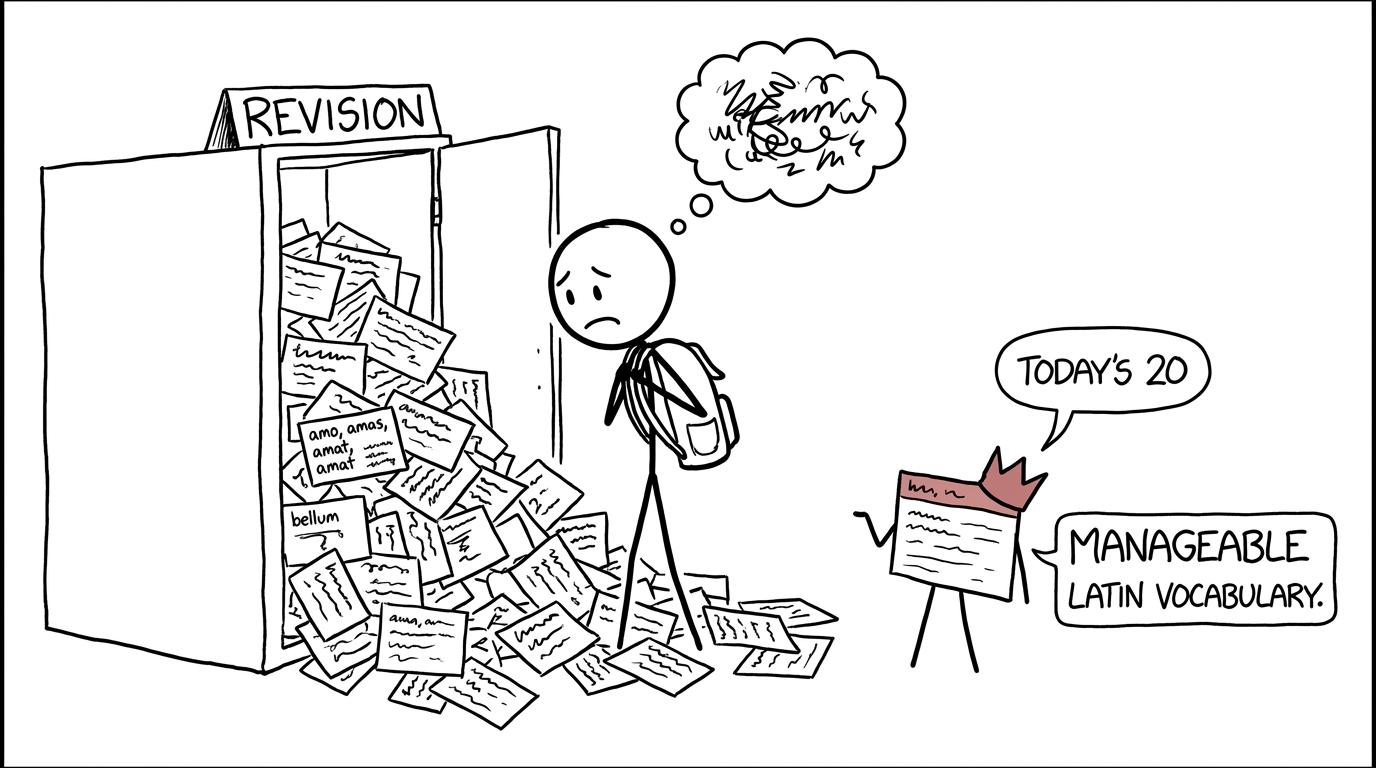 A calm flashcard survives an avalanche from the revision cupboard
Balance Latin with GCSE maths revision
Latin rewards precise recall; maths rewards precise methods. Both decline when they are left untouched for weeks and then attacked in one enormous session.
Begin with fixed weekly anchors. Give Latin two or three short slots and maths several recurring practice slots. The GCSE maths revision timetable guide can help you organise topic practice, timed work and rest around school commitments. On especially busy days, the twenty-minute GCSE maths revision routine provides a smaller structure that still includes recall, questions and correction.
Do not reduce maths revision to reading formulae while every active session goes to Latin. Maths needs written practice. Use revision lessons to refresh a method, complete practice questions without looking at solutions, and then mark the work. As exams approach, introduce the correct papers for Edexcel, AQA, OCR or Eduqas at your foundation or higher tier.
If you have one month remaining, compare your whole timetable with the GCSE one-month maths revision plan. It is better to discover an overloaded week on paper than halfway through it.
Adjust the hours using results, not anxiety
At the end of each week, ask:
- Did my vocabulary recall improve?
- Can I identify grammar without prompts?
- Are my translations becoming more accurate?
- Can I support literature answers with precise references?
- Did I complete the maths practice I had planned?
If Latin performance is improving and your schedule is sustainable, keep the total stable. If the same errors persist, first change the activity rather than automatically adding another hour. More rereading will not repair a problem caused by too little retrieval or translation practice.
Reduce time on secure areas and redirect it towards recurring weaknesses. This is also why past papers should be reviewed, not merely completed. MathsGenie's guide to when you should start GCSE past papers shows how paper practice can progress from short sections to timed papers as examinations approach.
Common GCSE Latin revision mistakes
Counting time instead of completed work
Sitting beside an open textbook for an hour is not the same as revising for an hour. Set a specific outcome before starting and remove your phone from reach.
Revising vocabulary but avoiding translation
Vocabulary is essential, but words must be interpreted through endings, syntax and context. Include unseen translation throughout the revision period rather than waiting until the final weeks.
Leaving set texts until the end
Literature knowledge accumulates through repeated retrieval. Learn manageable sections, revisit them and practise explaining how language creates meaning.
Using material from the wrong examination cycle
Prescribed texts and civilisation topics can change. Check your board, component and examination series before investing hours in a resource.
Allowing Latin to consume the entire timetable
An urgent Latin gap does not make GCSE maths less important. Protect recurring maths sessions and use the Edexcel GCSE Maths past papers, or the corresponding area for your board, to keep exam practice realistic.
Cramming late into the night
An extra exhausted hour is not automatically productive. In the final days, prioritise brief recall, corrections and sleep. The principles in MathsGenie's night-before GCSE maths plan apply more widely: narrow the task, avoid panic and stop at a sensible time.
Make the weekly total repeatable
A strong plan is rarely dramatic. It is a small promise kept repeatedly: vocabulary on Monday, translation on Wednesday, literature on Saturday, followed by corrections. As the exam approaches, the sessions grow more exam-focused, but the underlying cycle remains stable.
Choose your range from the timetable, confirm the current OCR or Eduqas components with your teacher, and schedule the first three sessions now. Then protect your maths preparation with MathsGenie's free GCSE Maths revision resources: use revision lessons and practice questions to repair skills, mini tests to check recall, and past papers, predicted papers, mark schemes and video solutions to build exam readiness.
You do not need a perfect timetable. You need one you can follow, measure and improve next week.










