Home-Schooled GCSE Statistics: Entry Guide
Home-schooled GCSE Statistics explained: choose an exam board, find a private-candidate centre, meet entry deadlines and prepare for exam day.
Yes, home-educated students can sit GCSE Statistics. The qualification must be entered through an approved UK exam centre, where the student is registered as a private candidate. The difficult part of home schooled GCSE Statistics is therefore not gaining permission to take the qualification. It is finding a centre that accepts the chosen exam board and specification, completing its registration process and meeting its internal deadline.
That administrative work matters. A student may know how to interpret cumulative frequency diagrams or assess sampling methods, but none of it reaches an examiner until an approved centre has made the entry. The best approach is to organise the exam first, then build revision around a confirmed board, tier and timetable.
The essential checklist
Before beginning detailed revision, make sure you can answer each of these questions:
- Which GCSE Statistics specification will you take?
- Will you enter at foundation or higher tier?
- Which approved centre will make your private-candidate entry?
- What is the centre's own entry deadline?
- What is included in its fee?
- Does the centre require photo identification or previous candidate details?
- Are any access arrangements needed?
- Have you received and checked your statement of entry?
- Do you know where and when both papers will be sat?
A useful starting point for the academic side is the free GCSE Statistics revision hub, where resources are organised by exam board.
How home-schooled students enter GCSE Statistics
Home education changes where learning happens, but it does not create a separate GCSE route. An awarding organisation does not normally accept an exam entry directly from a family. An approved school, college or independent examination centre must enter the student.
In exam administration, that student is a private candidate: someone taking a qualification at a centre without being enrolled there for full-time teaching.
Choose the specification before contacting centres
GCSE Statistics is not offered by every exam board. Current options in England include:
- Pearson Edexcel GCSE Statistics, specification code 1ST0;
- AQA GCSE Statistics, specification code 8382.
CCEA also provides a Statistics route in Northern Ireland. Do not assume that a centre offering GCSE Maths through Edexcel, AQA, OCR or Eduqas will automatically offer GCSE Statistics as well.
The exact specification matters because the centre must be approved and willing to enter that qualification. It also determines the papers, assessment structure and subject content you need to revise. MathsGenie's Edexcel GCSE Statistics resources include lessons, questions, worksheets and past papers for specification 1ST0.
Both AQA and Pearson Edexcel make GCSE Statistics available to private candidates. Pearson's current information also confirms availability for the June 2027 series. Nevertheless, availability at qualification level does not guarantee that a particular local centre will accept the entry.
Decide between foundation and higher tier
GCSE Statistics has foundation and higher tiers. The papers taken must belong to the same tier and assessment series, so this decision needs to be agreed before the centre submits the entry.
Foundation tier targets grades 111 to 555, while higher tier targets grades 444 to 999, with an allowed grade 333 in limited circumstances under awarding arrangements. Higher is not automatically the better choice. It contains more demanding content and questions, so the sensible tier is the one that gives the student the strongest opportunity to demonstrate what they know.
Use specification-matched papers rather than choosing by instinct. The GCSE Statistics grade-boundary history can add context, but boundaries change after each examination series. They should never be treated as a promised target for a future paper.
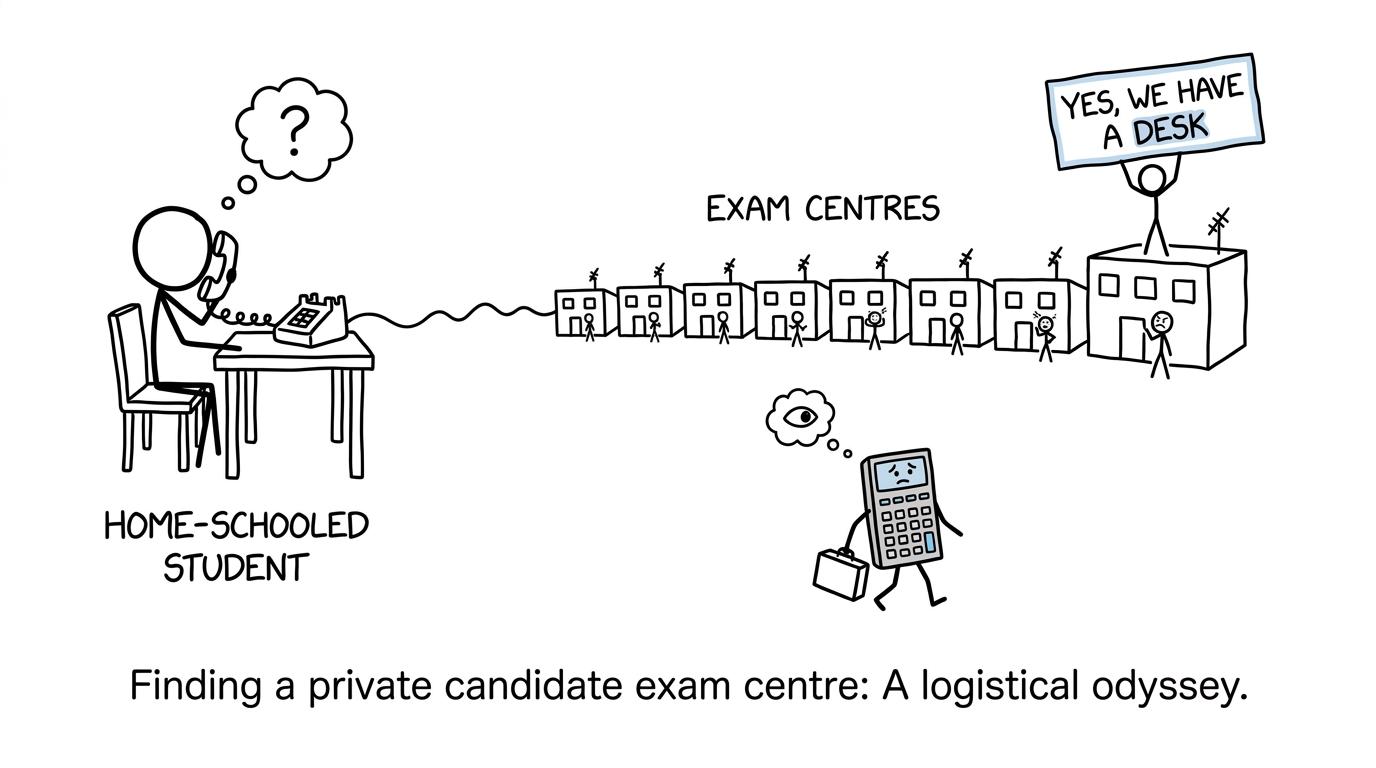 A student finally finds an exam centre with a desk for a private candidate
Finding a private-candidate exam centre
The official JCQ private-candidate search facility is the natural place to begin. It allows families to search for centres that have indicated a willingness to accept private candidates. Its listings are a starting point, not a guarantee of space or subject availability.
Contact several centres as early as possible. Some centres accept private candidates for GCSE Maths but not Statistics. Others work with only certain exam boards, limit candidate numbers or stop accepting entries well before the awarding organisations' final deadline.
Your enquiry should state clearly:
- the qualification title;
- the awarding organisation;
- the specification code;
- the required tier;
- the intended examination series;
- whether access arrangements may be needed;
- the student's age and private-candidate status.
Ask for the response in writing. A helpful question is not simply, “Can we sit GCSEs here?” but, “Can you enter a private candidate for Pearson Edexcel GCSE Statistics 1ST0 at higher tier in the June series?” Precision saves long exchanges and reduces the risk of an incorrect entry.
Questions to ask before paying
Centres set their own fees and procedures. Ask:
- What is the complete charge, including awarding-organisation and administration fees?
- Is the fee for the whole qualification or each paper?
- What is the centre's standard-fee deadline?
- When do late fees begin?
- What identification and candidate information are required?
- Can the centre arrange approved access arrangements?
- How will results and certificates be provided?
- What is the cancellation or refund policy?
A centre may request photo identification and details such as a Unique Candidate Identifier from previous examinations. If the student has never taken a public examination, the centre can explain what needs to be created.
GCSE Statistics entry deadlines
There is no single safe deadline that families should apply every year. JCQ and awarding organisations publish deadlines for each examination series, but centres commonly set earlier internal dates so their exams officers have time to verify information, collect payment and submit entries.
For context, the common deadline for GCSE entries in the June 2026 series was 21 February 2026. That date should not be reused for a later series. Always check the current year's official key dates and, more importantly, the chosen centre's own deadline.
A calm timetable looks like this:
Early autumn
Confirm the board, specification and likely tier. Begin contacting centres before spaces become scarce.
Autumn to early winter
Choose the centre, submit its registration documents and discuss access arrangements. Ask when payment is due and whether the entry is confirmed immediately or only after processing.
Before the centre's internal deadline
Pay the required fee and check every entry detail. Waiting for the awarding organisation's final deadline can mean facing late charges or finding that the centre is already full.
After entry
Request or await the statement of entry. Check the candidate's name, date of birth, board, specification, tier and paper entries. Report errors immediately.
Access arrangements require particularly early attention. Extra time, a reader, a scribe, modified papers or use of a word processor cannot simply be requested on exam morning. The centre must consider the evidence, establish the candidate's normal way of working where required and complete the relevant process by the published deadline.
What the GCSE Statistics assessment involves
GCSE Statistics is a separate qualification from GCSE Maths. There is overlap in areas such as probability, averages, data representation and cumulative frequency, but Statistics places greater emphasis on the statistical enquiry cycle, sampling, interpreting evidence and evaluating conclusions.
For Pearson Edexcel 1ST0, candidates take two equally weighted written papers at the same tier. Each lasts 111 hour 303030 minutes and carries 808080 marks. Calculators are permitted on both papers. AQA has its own paper timings and structure, so always use the specification and past papers for the board actually entered.
There is no controlled assessment in the current Pearson Edexcel qualification. Understanding investigations is assessed through written examination questions. That makes it comparatively practical for private candidates, since families do not need to locate a centre willing to authenticate a coursework project.
You can inspect the format through the Edexcel higher-tier specimen Paper 1 and then compare answers with an official-style GCSE Statistics mark scheme. Make sure the tier and paper match before using any resource.
Preparing once the entry is confirmed
A confirmed examination entry turns a vague ambition into a dated project. Begin with the specification and identify which topics are secure, partly understood or unfamiliar.
Statistics revision should include:
- planning investigations and understanding the enquiry cycle;
- populations, samples and sampling methods;
- types and sources of data;
- averages and measures of spread;
- charts, diagrams and misleading representations;
- probability and risk;
- correlation, association and interpretation;
- cumulative frequency, box plots and grouped data;
- drawing conclusions and evaluating their reliability.
Where GCSE Maths overlaps with the course, resources such as averages from frequency tables and cumulative frequency revision can strengthen the underlying techniques. They should supplement, not replace, specification-specific Statistics revision.
Move from lessons and focused practice questions to mixed questions, mini tests and full papers. Mark schemes matter because GCSE Statistics often rewards precise interpretation, contextual conclusions and justified comparisons, not merely a numerical answer. The GCSE Statistics resit revision plan provides a useful paper-mark-repair cycle even for first-time candidates.
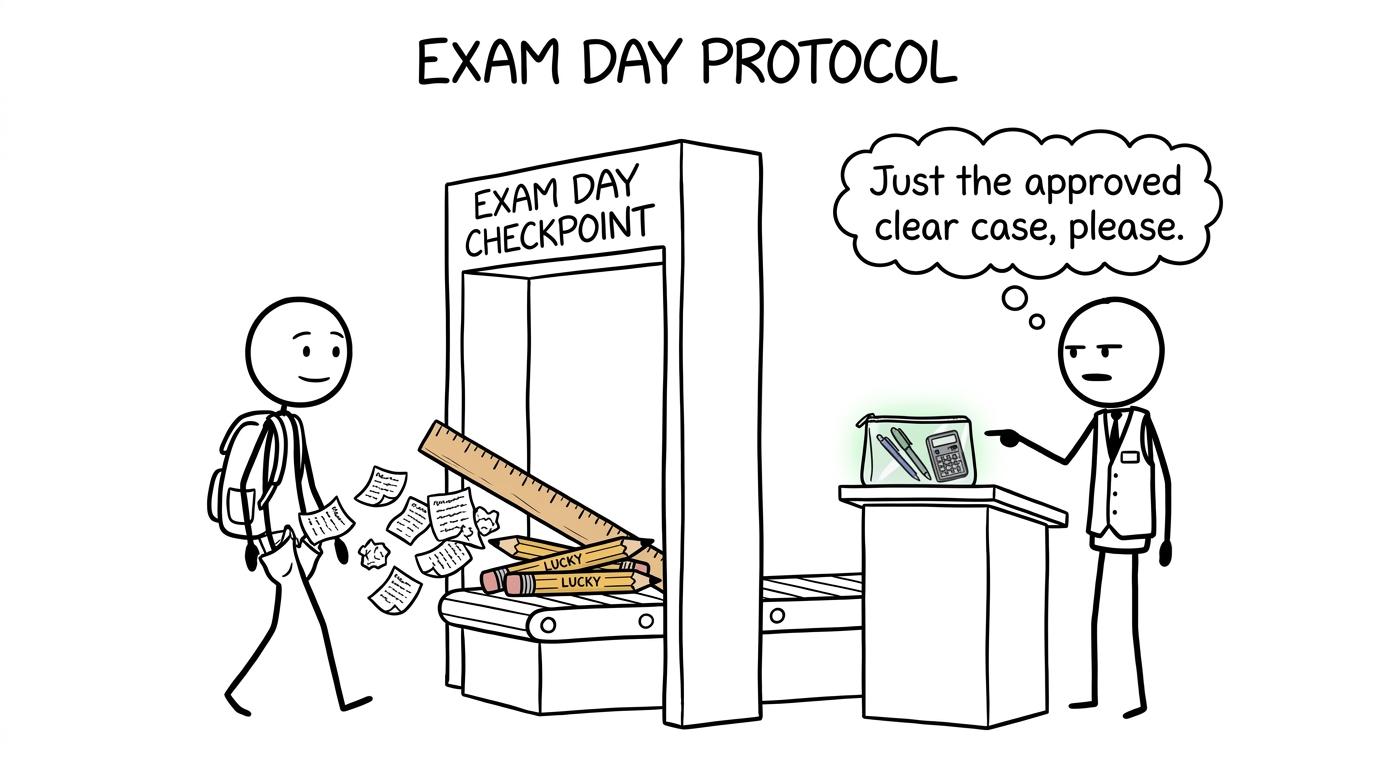 A private candidate passes through a comically serious exam-day checkpoint
Preparing for exam day and results
The centre should provide the venue, arrival instructions and timetable. Check whether photo identification is required and what calculator or equipment may be brought into the room. Follow the current JCQ rules supplied by the centre.
Plan the journey in advance, particularly if the centre is outside your local area. Both papers must be completed in the correct series, so transport arrangements are part of the exam plan rather than an afterthought.
Results are normally collected from or released through the entering centre. The centre also handles certificates and is the first contact for post-results services, such as access to scripts or a review of marking. Ask about its procedure before results day, since deadlines apply.
Common mistakes to avoid
Revising before confirming the exam board
Topic overlap can create false confidence. Different specifications use different structures and resources. Confirm the board and code first.
Assuming any school will accept the entry
Approval as an exam centre does not oblige a school to accept private candidates. Contact several centres and obtain written confirmation.
Treating the official entry deadline as the practical deadline
A centre's internal deadline may be weeks or months earlier. Late entries may cost more and depend on remaining capacity.
Leaving access arrangements until spring
The centre needs time to review evidence and meet formal deadlines. Raise the issue during the first enquiry.
Paying without checking the tier and total fee
Confirm the specification, tier, series, included papers and complete charge before payment. Then inspect the statement of entry.
Turn the entry into a revision plan
Home-schooled students can sit GCSE Statistics, and the route is straightforward once its order is understood: choose the specification, find an approved centre, register before its deadline, check the entry and prepare using the correct papers.
Start early enough that administration does not steal attention from learning. Then let each practice paper reveal the next useful task. MathsGenie brings together free revision lessons, worksheets, practice questions, past papers, predicted papers where available, mark schemes, video solutions and mini tests. Visit the GCSE Statistics revision centre, choose your exam board and turn a confirmed exam date into a focused route towards your best grade.