Home Schooled GCSE Food and Nutrition: Entry Guide
Home schooled GCSE Food and Nutrition: choose a board, secure a centre for supervised NEA, meet entry deadlines and prepare with confidence.
The difficult part of taking a GCSE independently is often not learning the subject. It is finding somewhere willing to assess it. For families researching home schooled GCSE Food and Nutrition, the short answer is yes, it can be possible, but the route is more complicated than booking a written paper.
The qualification normally includes compulsory non-exam assessment, or NEA. You therefore need an approved centre that can do more than enter you for an examination. It must be prepared to oversee the required teaching and assessment arrangements, supervise practical work, authenticate the student's evidence, mark the NEA and submit it for moderation. You must also choose an exam board whose specification is available to private candidates.
That means the centre comes first. Revision comes second.
The essential checklist
Before buying a course or beginning assessed work, confirm all of the following:
- the exact qualification title, exam board and specification code
- whether that specification accepts private candidates
- whether the centre will teach or administer both NEA tasks
- where practical investigations and cooking assessments will happen
- the centre's own registration and payment deadline
- the full fee, including administration, practical facilities and NEA marking
- arrangements for photographic evidence, authentication and secure storage
- whether access arrangements can be supported
- the date and location of the written examination
Do not rely on a general statement that a centre accepts private candidates. A centre might accept private entries for GCSE Maths while declining Food Preparation and Nutrition because of its kitchen, staffing and assessment requirements.
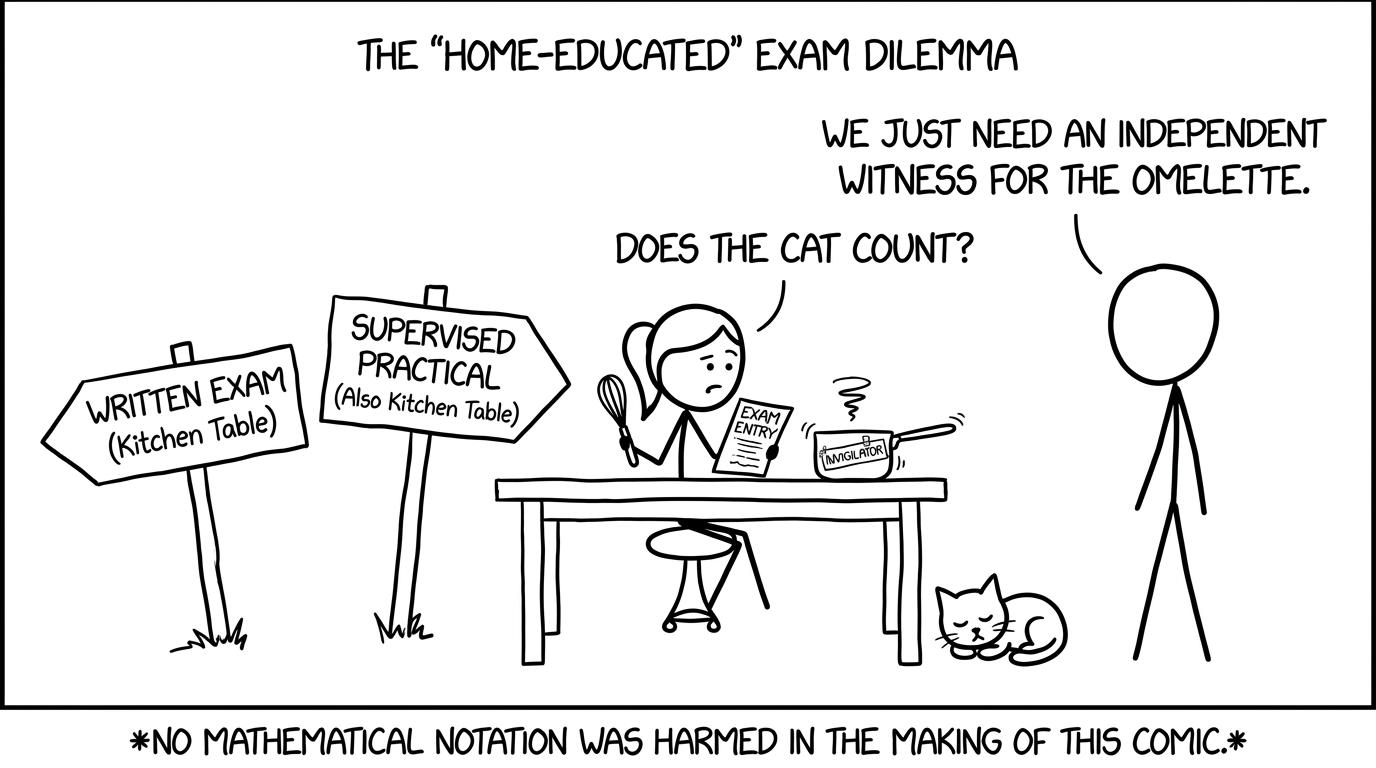 A home-educated student choosing between a written exam and a supervised practical
Why GCSE Food Preparation and Nutrition is different
For linear GCSE specifications in England, the qualification is commonly divided equally between a written examination and NEA. The typical structure is:
- a written examination worth 50%50\%50%
- a food investigation task worth 15%15\%15%
- a food preparation task worth 35%35\%35%
The investigation examines the scientific behaviour of ingredients through practical experimentation. The preparation task usually involves planning, preparing, cooking and presenting three dishes, with the final practical completed during a supervised session of no more than three hours.
The precise rules, timings and evidence requirements depend on the specification. However, the central point remains the same: the NEA is not optional coursework that can simply be completed in a home kitchen and posted to an exam board.
Current JCQ instructions require the entering centre to handle the relevant supervision, authentication and marking arrangements. Distance-learning candidates must register or enrol with an approved centre before beginning assessed NEA work. This protects the integrity of the qualification, but it also explains why suitable centres can be hard to find.
Choose the exam board before choosing a course
The familiar GCSE title can hide an important difference between awarding organisations.
AQA
AQA's current GCSE Food Preparation and Nutrition specification, code 858585858585, states that it is not available to private candidates. A family should not purchase an independent AQA course on the assumption that any local school can later submit the work.
If a school teaches and enters the student under an arrangement that makes them an internal candidate, the situation may be different. That must be agreed with the school and AQA in advance; it should never be assumed.
OCR
OCR's current GCSE Food Preparation and Nutrition specification, code J309, states that private candidates may enter for OCR assessments. The student must be based in the UK and use an approved centre.
That does not mean every OCR centre will accept the entry. The centre still needs the staff, facilities and willingness to administer both NEA tasks correctly. Ask specifically whether it accepts private candidates for J309, not merely whether it offers OCR examinations.
Eduqas
Eduqas also offers GCSE Food Preparation and Nutrition with a written component and two internally assessed, externally moderated NEA tasks. Availability and practical arrangements should be confirmed directly with both the prospective centre and the awarding organisation before enrolment.
Specifications and administrative guidance can change. Always ask the centre to check the current version for the intended examination series.
How to find a centre that can make the entry
The official JCQ private-candidate search facility is a sensible starting point. Search by postcode, qualification and awarding organisation, then contact each centre directly. JCQ makes clear that listed centres set their own fees, internal deadlines and acceptance policies.
Send a short, precise enquiry containing:
- the student's age and intended examination year
- the complete qualification title and specification code
- whether the student is home educated or using a distance-learning provider
- confirmation that the course includes NEA
- a request for details of teaching, supervision, practical facilities and marking
- any access-arrangement needs
Contact schools, further education colleges, independent exam centres and approved distance-learning providers. Be prepared to travel. A nearby centre that offers written GCSE papers may not have an appropriate food room or a qualified assessor available.
Keep a record of replies, quoted fees and deadlines. A simple spreadsheet is enough. The goal is not to find a centre that says “perhaps”. It is to obtain written confirmation that the centre can enter the candidate for the complete qualification.
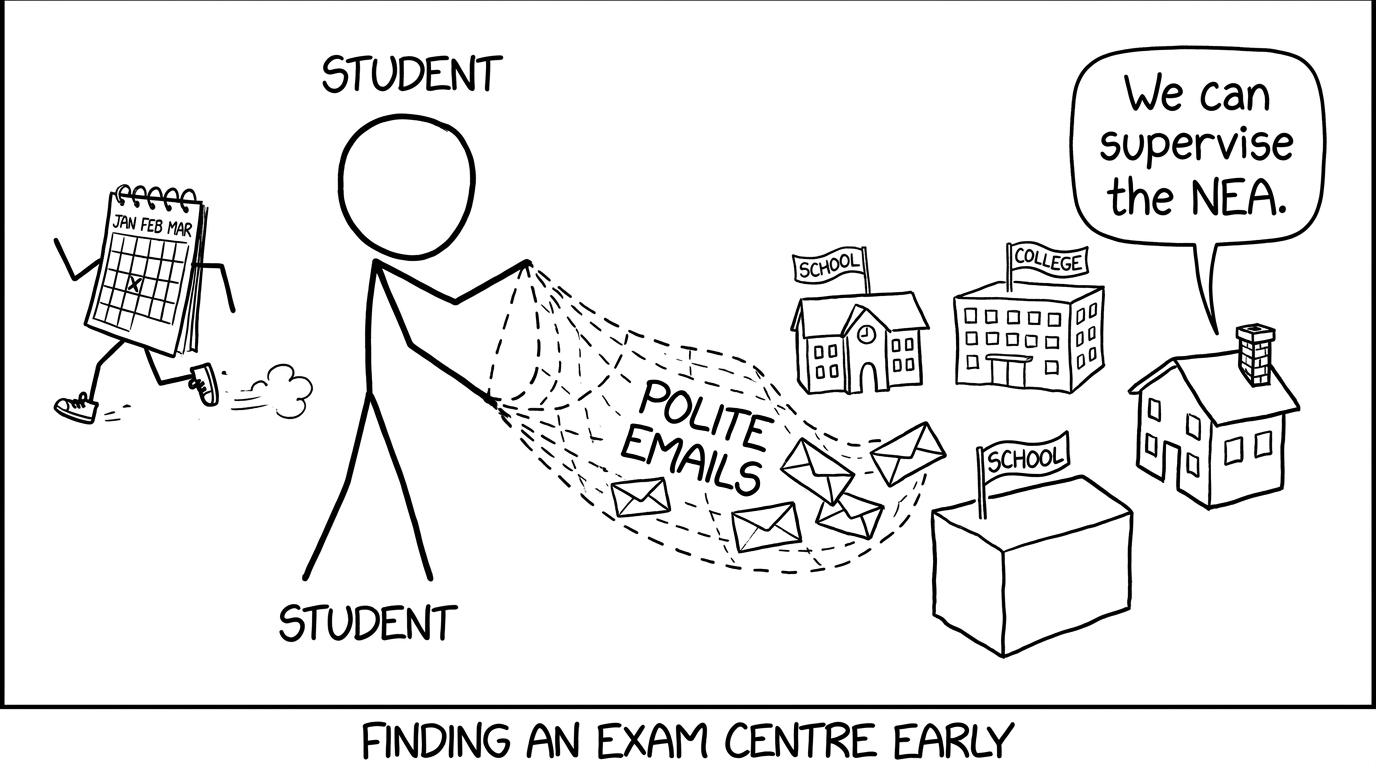 A student casting a wide net of enquiries while the calendar runs away
What to ask before paying a centre
A centre's answer should cover the whole assessment journey. Useful questions include:
- Will you enter a home-educated candidate for this exact specification?
- Will the candidate be treated as a private candidate, distance learner or enrolled student?
- Who will teach, set, supervise, authenticate and mark the NEA?
- Must practice sessions take place at the centre?
- How many visits will be required?
- Are ingredients and equipment included in the fee?
- What photographic evidence is required?
- What is your internal entry deadline?
- What happens if an NEA session is missed?
- Can you arrange extra time or other approved access arrangements?
- When will we receive the statement of entry?
Ask for the complete cost in writing. Private-candidate fees are not nationally standardised. Food qualifications may cost more to administer than written-only subjects because the centre must provide specialist rooms, staff time, ingredients management, assessment and moderation paperwork.
Entry deadlines and the safest timeline
There is no single deadline that a candidate can safely use. Awarding organisations publish final entry dates for centres, but centres normally impose earlier internal deadlines. They need time to verify identity, collect fees, arrange NEA, process access arrangements and complete the entry.
Waiting for an awarding organisation's late-entry period is particularly risky here. A late fee cannot create kitchen space, an assessor or enough supervised time to complete compulsory work.
At least a year before the examination
Compare specifications and identify possible centres or approved providers. Confirm availability before committing to learning materials.
Before assessed NEA begins
Complete enrolment with the entering centre. Agree how teaching, supervision, authentication and marking will work. Do not begin an official assessment task independently and expect a centre to authenticate it afterwards.
During the autumn term
Confirm the candidate's legal name, date of birth, photo identification and any existing Unique Candidate Identifier. Apply for access arrangements as early as possible because the centre must assess the need and hold suitable evidence.
Before the centre's entry deadline
Pay the agreed fee and check the exact qualification code. Once the centre makes the entry, request and carefully inspect the statement of entry. A wrong board or specification can make months of preparation unusable.
During the final assessment year
Follow the centre's NEA timetable, retain evidence as instructed and prepare separately for the written examination. Confirm practical dates early enough to plan travel and ingredient requirements.
How maths supports Food and Nutrition
For a student also preparing for GCSE Maths, these subjects reinforce one another. Recipe scaling is direct proportion. The general relationship is:
new amount=original amount×new number of servingsoriginal number of servings\text{new amount}=\text{original amount}\times\frac{\text{new number of servings}}{\text{original number of servings}}new amount=original amount×original number of servingsnew number of servingsPercentages appear in nutritional information, costing and comparisons. Units matter when moving between quantities such as grams and kilograms. Sensory testing can involve frequency tables, averages, charts and the careful interpretation of data.
MathsGenie's proportion and recipe revision is particularly relevant to ingredient scaling, while the GCSE Statistics revision hub supports the presentation and interpretation of investigation results.
The broader GCSE Maths revision hub lets students choose their board and work through revision lessons, practice questions, mark schemes and past papers. These are useful whether the student takes foundation or higher tier Maths; Food Preparation and Nutrition itself is not normally divided into those tiers.
Plan both subjects without creating two crises
NEA deadlines and maths papers reward different kinds of preparation. Food work needs early organisation and access to supervised facilities. Maths improves through frequent retrieval, correction and timed practice.
Put every confirmed practical session, centre deadline and examination date into the MathsGenie revision planner. Then build shorter maths sessions around those fixed commitments.
A manageable pattern is to use revision lessons for weak methods, practise topic questions, check the mark scheme and revisit errors. Short GCSE Maths mini tests can maintain momentum during busy NEA weeks. The GCSE maths revision timetable guide offers a fuller structure for balancing topics and timed papers.
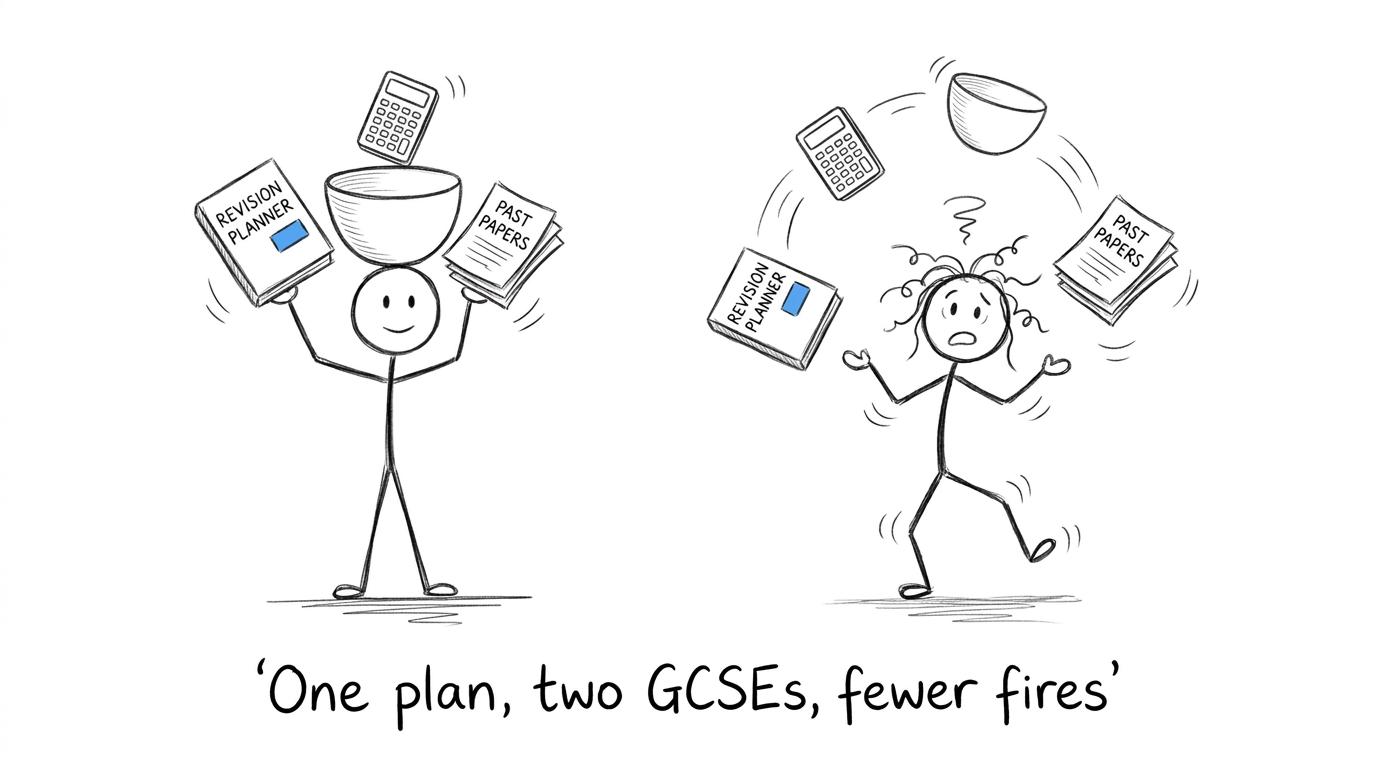 A calm student balancing a revision planner, calculator, mixing bowl and papers
Common mistakes to avoid
Buying a course before securing assessment
Course access does not guarantee an examination or NEA place. Obtain written confirmation from an approved centre first.
Asking only whether private candidates are accepted
Ask about the exact board, specification code and NEA components. General acceptance is not enough.
Assuming home practical work can be submitted later
Official NEA must follow the centre's supervision and authentication procedures. Unsupervised work may be impossible to accept.
Using the awarding organisation's deadline
The centre's internal deadline is the one the family must meet. It may be months earlier.
Leaving access arrangements until exam season
Extra time, supervised rest breaks or other support must be discussed when registering. The centre needs time to assess evidence and complete the required process.
Revising only the practical element
Half of the qualification is typically assessed through a written paper. Knowledge of nutrition, food science, safety, choice and provenance deserves its own revision timetable.
Make the administrative decision first
A home-educated student may be able to sit GCSE Food Preparation and Nutrition, but the path depends on the specification and an approved centre capable of delivering the complete assessment. Start early, treat the NEA arrangements as essential and never rely on a verbal promise or a generic private-candidate listing.
Once the entry is secure, revision becomes much calmer. Use MathsGenie's free GCSE revision resources to strengthen proportion, percentages, statistics and wider maths skills. Combine revision lessons and practice questions with mini tests, mark schemes, video solutions, past papers and carefully used predicted-topic guidance. One confirmed centre and one realistic plan can remove a surprising amount of uncertainty.