

Higher Tier GCSE Arabic Sixth Form Guide
Higher tier GCSE Arabic sixth form requirements vary. Learn when Foundation grade 5 is enough, when Higher matters and how to protect your maths choices.
The worry often begins with a sentence heard in a corridor: “Sixth forms only accept Higher tier.” It sounds official. Usually, it is not.
For students searching for higher tier GCSE Arabic sixth form requirements, the short answer is this: Higher tier Arabic is not normally a universal requirement for entering sixth form. A strong Foundation result can be enough when a sixth form asks for a grade 444 or 555 in a set number of GCSEs. Higher tier becomes important if you need a grade above 555, particularly for a demanding overall entry profile or an A Level Arabic course with a higher subject-specific requirement.
The detail that matters is not the word “Higher” on its own. It is the published admissions policy of the sixth form you want to attend.
The quick answer and decision checklist
Use this checklist before worrying about changing tier:
- Find the sixth form’s general GCSE entry requirements.
- Check whether Arabic can count among the required GCSE subjects.
- Look for separate requirements for each A Level you want to study.
- Confirm the required GCSE Maths and English grades.
- If you want A Level Arabic, check its specific Arabic requirement.
- Ask admissions whether a Foundation grade 555 is accepted if the wording is unclear.
- Discuss your likely Arabic grade and tier with your teacher before entries are finalised.
A sixth form might ask for several GCSEs at grades 999-555, while another might use grades $9$-$4$. More selective providers may expect a stronger overall profile. These are local admissions decisions, not one national rule applied identically everywhere.
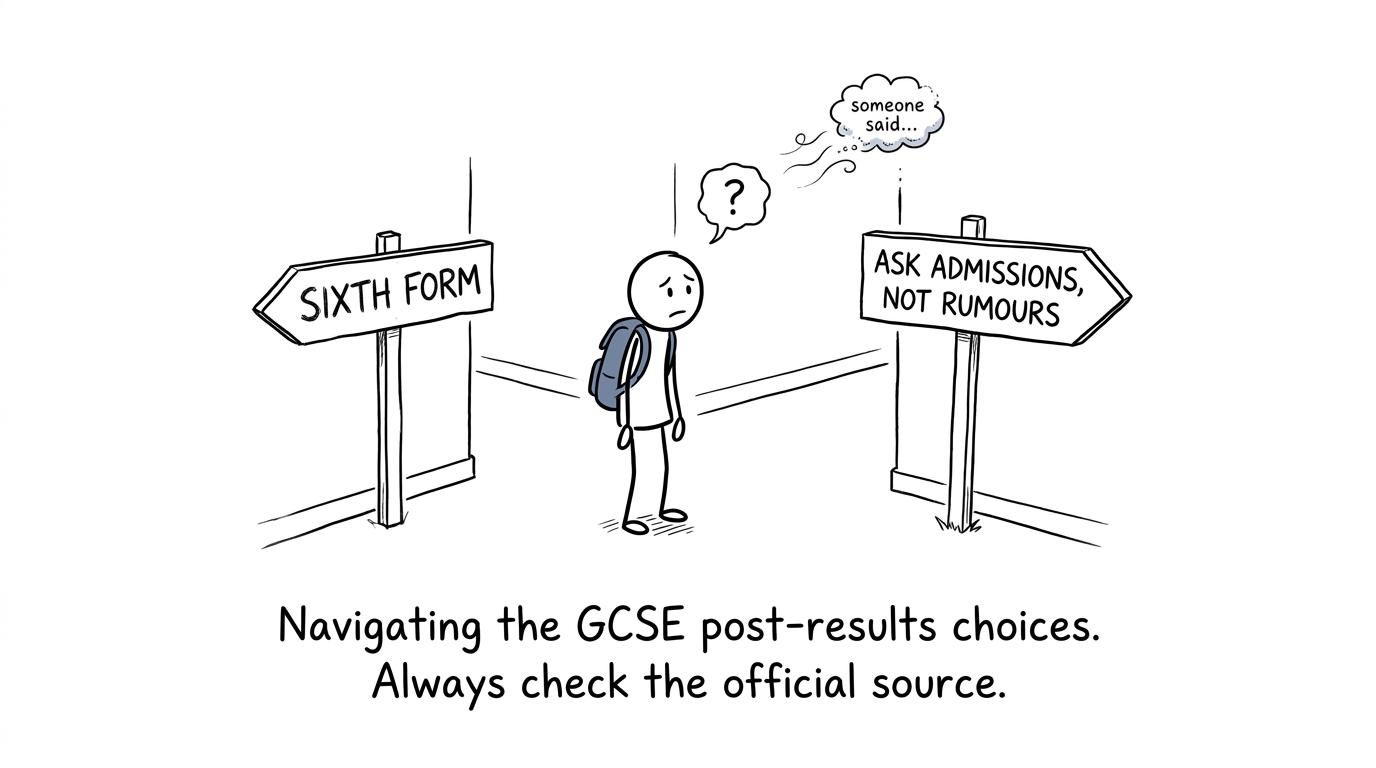 A student follows the sensible admissions sign while a rumour floats away
What Foundation and Higher tier mean in GCSE Arabic
The current Pearson Edexcel GCSE Arabic qualification has Foundation and Higher tiers. Students are entered for one tier across the qualification’s listening, speaking, reading and writing assessments.
The central difference is the range of grades available:
| GCSE Arabic tier | Target grade range | Highest available grade |
|---|---|---|
| Foundation | 111-555` | 555 |
| Higher | 444-999` | 999 |
Higher tier is therefore necessary if your target is grade 666 or above. Foundation is capable of producing a grade 555, which can be a strong and useful GCSE result.
Higher papers are not automatically the wiser choice. They contain more demanding language, and a student should be entered for the tier that gives them the most suitable opportunity to demonstrate what they know. Your school makes the entry decision, so discuss evidence from assessments rather than relying on assumptions about which tier “looks better”.
Grade boundaries also change between examination series. Historical results can provide context, but they cannot tell you the exact marks that will be required in a future series. You can review the published Edexcel GCSE Arabic grade boundaries, while remembering that the grade awarded matters more to admissions teams than a guessed future boundary.
Is a Foundation grade 5 enough for sixth form?
In many cases, yes.
If a sixth form requires five GCSEs at grade 444 or 555 and accepts Arabic as one of those qualifications, a Foundation grade 555 can satisfy that part of the policy. The certificate records the GCSE grade. The practical limitation is simply that Foundation cannot produce anything higher than 555.
However, a grade 555 may not be enough in three situations.
The general entry threshold is higher
Some sixth forms require several grade 666 results or calculate an admissions score from a student’s best GCSE grades. In that situation, Foundation Arabic may still count, but its grade 555 ceiling could make the overall threshold harder to reach.
That does not mean Higher Arabic is compulsory by name. It means the grades available on Foundation may not meet the numerical profile being requested.
You want to take Arabic at A Level
A provider offering A Level Arabic may set a subject-specific requirement, perhaps grade 555, 666 or another published standard. If it asks for grade 555, a Foundation grade 555 may be acceptable unless the policy explicitly says otherwise. If it asks for grade 666 or above, Higher tier is necessary because Foundation cannot award that grade.
Do not infer the rule from another school. Check the course guide for the exact year in which you plan to enter and contact the admissions team if it does not explain how tier is treated.
Arabic affects a competitive overall score
Where places are oversubscribed, meeting the minimum requirements may not guarantee admission. A sixth form may rank eligible applicants using its published oversubscription criteria or GCSE profile. A higher Arabic grade could strengthen that profile, but only if the school includes Arabic in the calculation.
This is why “Is Higher necessary?” and “Would Higher be useful?” are different questions.
Does Arabic tier affect A Level Maths entry?
Usually, the decisive qualification for A Level Maths is GCSE Maths, not the tier taken in GCSE Arabic.
Sixth forms commonly publish both general entry conditions and subject-specific conditions. A student might need a collection of suitable GCSE grades for admission, then a particular grade in GCSE Maths to join A Level Maths. Published requirements vary: some providers ask for grade 666, while many ask for grade 777, and selective courses may set a higher threshold.
Your Arabic result could contribute to your overall GCSE profile, but Higher tier Arabic does not replace the required Maths grade. If A Level Maths is your goal, protect the qualification directly connected to that course.
Start with the free GCSE Maths revision hub, where you can choose Edexcel, AQA, OCR, Eduqas and other exam boards. If you want to understand the next stage before choosing your sixth-form subjects, explore Edexcel A Level Maths revision.
How to check a sixth form policy properly
Admissions documents can feel dense because several requirements often appear together. Separate them into three questions.
Can you enter the sixth form?
Look for the minimum number of GCSE qualifications and the grades required. Check whether English and Maths must be included. Then find out whether only full GCSE qualifications count and whether the school calculates a score from your best results.
Can you enter your chosen courses?
Read the requirement beside each intended A Level or Level 333 course. Mathematics, Further Mathematics, sciences and modern foreign languages may have subject-specific conditions above the general minimum.
What happens if you narrowly miss a condition?
Do not assume that flexibility exists, but do not assume that it never exists either. Admissions policies may explain how borderline applicants, equivalent qualifications or courses with remaining capacity are handled. Ask the sixth form directly and request written confirmation where possible.
A useful email can be very short:
I am entered for Foundation tier GCSE Arabic, where the highest available grade is 555. Would a grade 555 count towards your general sixth-form entry requirement, and would it meet the requirement for my intended courses?
That question is far more reliable than asking whether the school “likes Higher tier”.
Choosing Arabic tier without sacrificing maths revision
Tier decisions involve opportunity and risk. If school assessments consistently indicate performance above grade 555, Higher tier may open grades that Foundation cannot. If performance is less secure, your Arabic teacher can judge which paper is more appropriate using classwork, mock results and familiarity with the specification.
The important thing is not to let uncertainty consume revision time across every subject. Once you have checked the policy and spoken to your teacher, turn the decision into a plan.
 A timetable offers to carry oversized Arabic and maths revision suitcases
For maths, use a repeatable weekly cycle:
- learn or revisit one weak topic;
- complete focused practice questions;
- mark the work and record why marks were lost;
- retest the topic later;
- complete timed paper practice at the correct tier.
Short testing is useful when another GCSE also needs attention. MathsGenie’s GCSE mini tests provide focused checks without requiring a full paper every evening. A realistic GCSE revision timetable can help you divide time between Arabic, maths and your other subjects.
Build the GCSE Maths grade your course requires
Once you know the sixth form’s Maths condition, revise towards evidence rather than hope. Choose the correct board and tier, then use official-style practice to diagnose gaps.
Edexcel students can use Edexcel GCSE Maths past papers, while equivalent collections are available for AQA GCSE Maths past papers and OCR GCSE Maths past papers. Complete papers under timed conditions, use the mark schemes carefully and return to the topics responsible for repeated lost marks.
Nearer the examinations, Edexcel GCSE Maths predicted papers can provide fresh practice modelled on the current format. They should supplement past papers, not replace them.
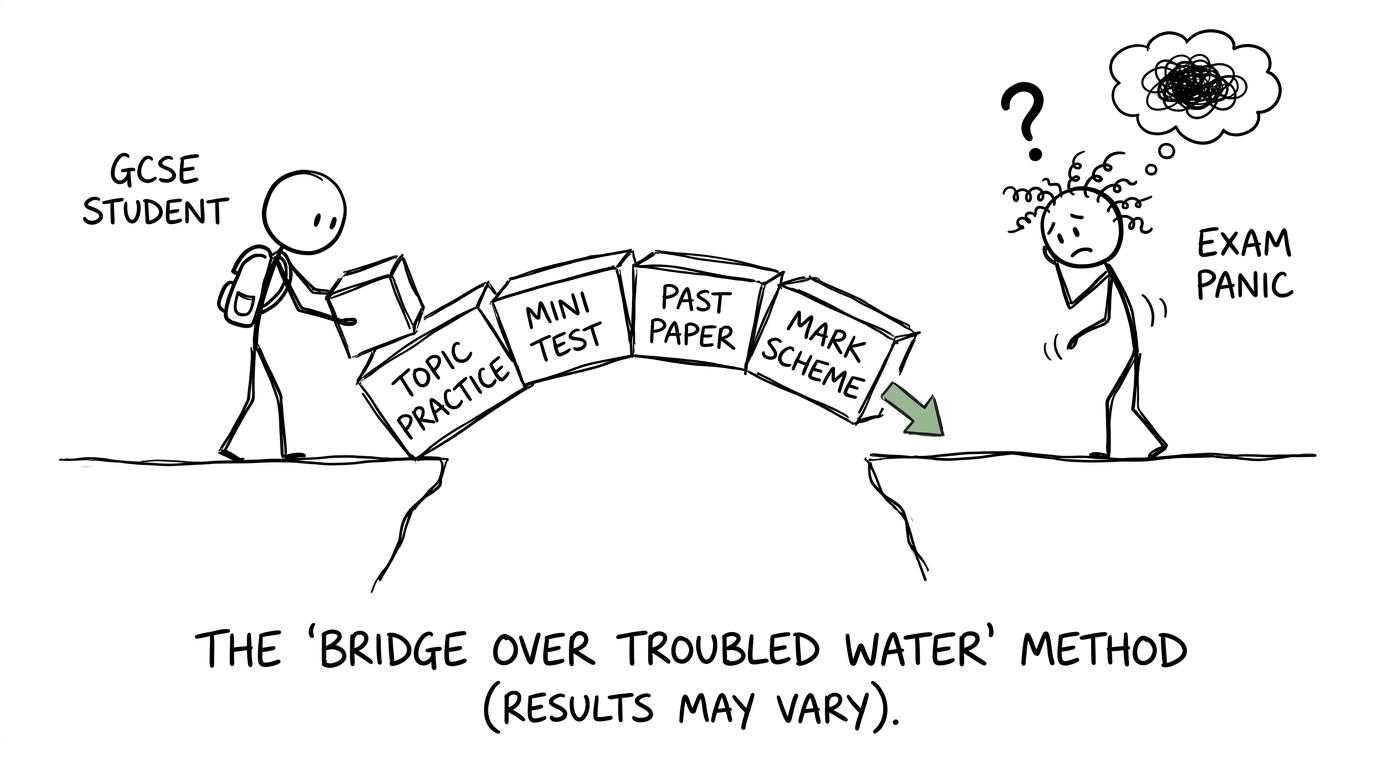 A revision bridge keeps exam panic safely on the other side
Common mistakes when deciding whether Higher Arabic is necessary
Treating a rumour as an admissions rule
Another student’s sixth form, course or entry year may have different requirements. Use the current published policy for your chosen provider.
Confusing general entry with course entry
Being admitted to sixth form does not automatically qualify you for every A Level. Check both layers, especially if you want Maths, Further Maths or Arabic.
Assuming Foundation means a weak result
A Foundation grade 555 is a valid GCSE grade and may satisfy many general entry thresholds. Its limitation is the grade ceiling, not that the qualification somehow disappears.
Assuming Higher tier guarantees a higher grade
Higher tier makes grades above 555 available; it does not guarantee one. Entry should be based on demonstrated readiness and teacher guidance.
Neglecting GCSE Maths while worrying about Arabic
For A Level Maths, your GCSE Maths grade is normally the subject-specific evidence that matters. Keep Arabic in perspective and give maths enough structured practice.
Make the decision from facts, then return to revision
Higher tier GCSE Arabic is not automatically necessary for sixth form. A Foundation grade 555 may be completely sufficient where the general requirement is grade 444 or 555 and your intended courses impose no higher Arabic condition. Higher becomes necessary when you need grade 666 or above, whether for A Level Arabic or a stronger overall GCSE profile.
Check the policy. Ask admissions. Speak to your Arabic teacher. Then stop feeding the uncertainty and return to the work that can still change your results.
For maths, make MathsGenie’s free GCSE revision resources your starting point. Combine revision lessons and practice questions with mini tests, past papers, predicted papers, mark schemes and video solutions. A sixth-form offer is shaped by requirements, but your preparation is built one corrected mistake at a time.











