Have I Revised Enough GCSE Statistics?
Have I revised enough GCSE Statistics? Use an evidence-based checklist to test coverage, accuracy, interpretation, timing and genuine exam readiness.
Revision has an awkward feature: the more seriously you take it, the easier it is to believe you have not done enough. Notes remain unread. Questions still feel uncertain. Someone else always appears to be revising more.
If you are asking, “have I revised enough GCSE Statistics?”, the honest answer should come from evidence, not anxiety. You have probably revised enough when you can cover the required content, answer unfamiliar questions without support, interpret results in context and repeat that performance under timed conditions. Feeling completely calm is not part of the test.
This guide gives you a realistic way to measure readiness. It applies to statistics within GCSE Maths and, with your full specification checklist, the separate GCSE Statistics qualification. Begin at the GCSE Statistics revision hub to select resources that match your course and exam board.
The quick GCSE Statistics readiness checklist
You are approaching exam readiness if you can honestly tick most of these statements:
- I have checked my current specification rather than revising from memory.
- I can identify the right statistical method without being told which one to use.
- I can complete mixed questions without notes, videos or hints.
- I can explain conclusions using the context of the data.
- I know the difference between an incorrect method and a calculator slip.
- I have completed timed exam-style practice for my board and tier.
- I mark strictly and record why each mark was lost.
- My recent results are reasonably consistent rather than dependent on a familiar paper.
- I have returned to weak topics after a delay and improved.
- I can manage a difficult question without letting it consume the rest of the paper.
A long revision timetable does not prove these things. Your answers do.
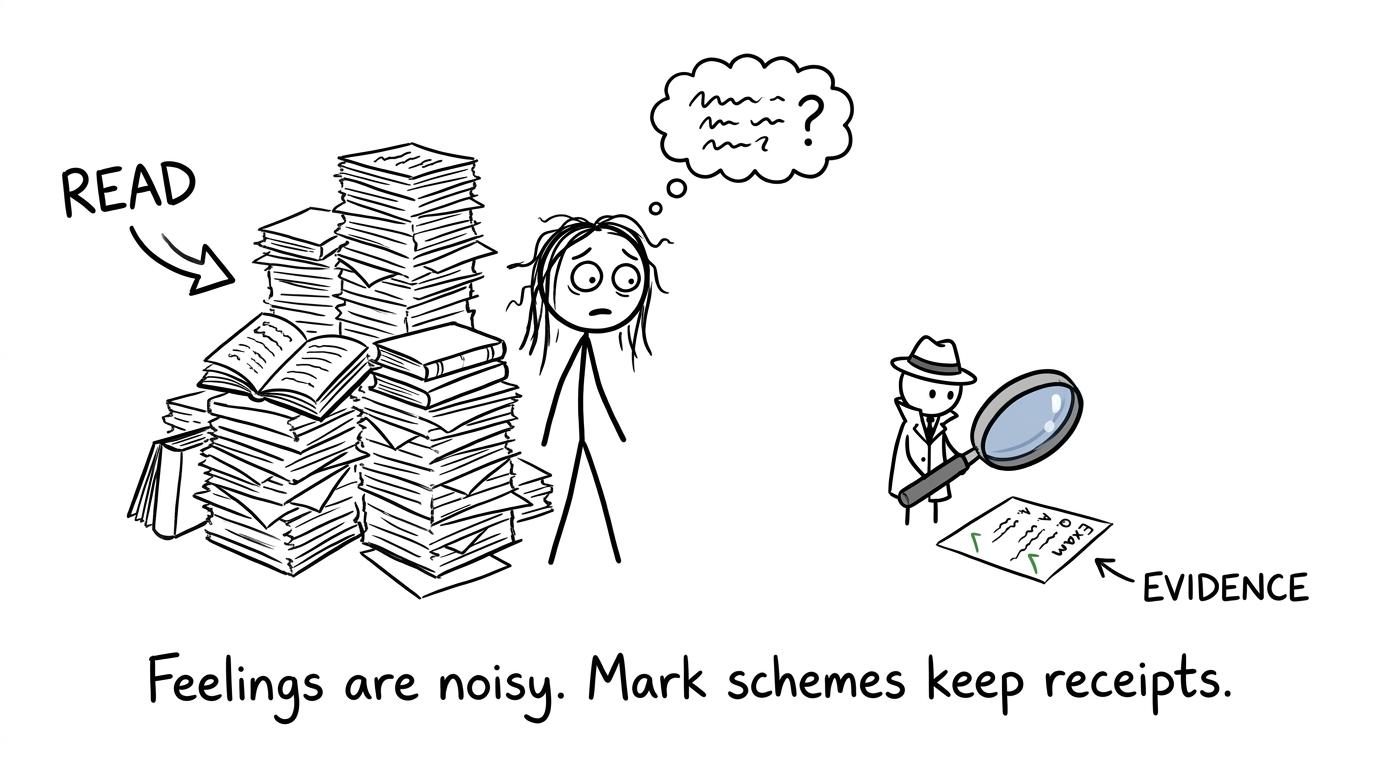 A revision detective looks for evidence while notes tower over a worried student
Replace revision hours with five kinds of evidence
Time spent matters, but it is a poor measurement on its own. One focused hour of retrieval and question practice can reveal more than an evening spent highlighting familiar notes.
A better judgement uses five tests: coverage, retrieval, application, interpretation and performance.
Coverage: have you visited the whole course?
Start with the exact specification used by your school. Statistics within GCSE Maths commonly includes sampling, charts and diagrams, averages, measures of spread, grouped data and scatter graphs. Higher-tier content can include cumulative frequency, box plots and histograms with unequal class intervals.
A separate GCSE Statistics course is broader. Depending on the specification and tier, it may include the statistical enquiry cycle, data collection, sampling methods, probability, time series, index numbers and more advanced analysis. Do not assume that a generic GCSE Maths checklist covers the separate qualification.
Create a simple traffic-light audit:
| Status | Meaning | Next action |
|---|---|---|
| Green | I can answer mixed questions independently | Recheck through timed practice |
| Amber | I understand it but hesitate or need prompts | Complete focused questions |
| Red | I cannot select or carry out the method | Relearn the topic before testing it |
Coverage does not mean every row must feel effortless. It means there are no hidden chapters you have never tested. Edexcel students taking the separate qualification can use the Edexcel GCSE Statistics revision area to connect lessons, worksheets and exam-style questions.
Retrieval: can you begin without help?
Recognition feels like knowledge. You watch a video, see the next step and think, “I knew that.” Sometimes you did. Sometimes the screen supplied the part your memory could not retrieve.
Close the notes and ask yourself to state the method, identify the necessary information and begin the question. If you repeatedly need the first step, that topic is not secure yet.
This does not mean memorising disconnected sentences. You should understand ideas such as why a suitable sample matters, why correlation does not establish causation and why histogram area represents frequency. The aim is accessible knowledge: information you can retrieve when the question changes its wording.
Application: can you choose the method?
Topic worksheets are useful because they build technique. Their weakness is that the heading often reveals what to do. A page called “cumulative frequency” has already made the first decision for you.
Mixed practice removes that clue. You must decide whether the question needs an average, a measure of spread, a graph, a sampling criticism or a probability method. That decision is part of exam readiness.
Use focused resources to repair individual gaps, such as the cumulative frequency revision guide, box plots revision guide, scatter graphs revision guide and histograms revision guide. Then return to mixed questions, where the method is not announced in advance.
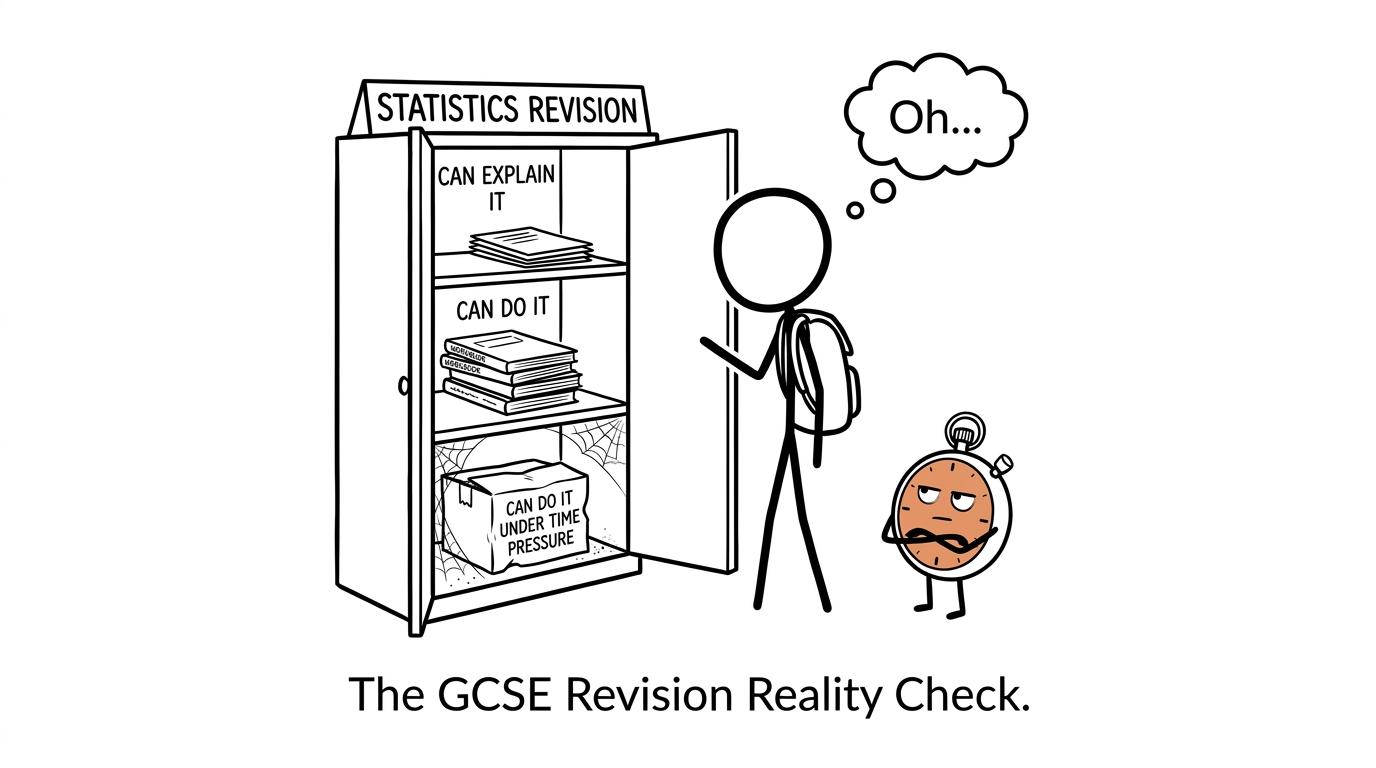 A stopwatch discovers the neglected shelf of timed statistics practice
Interpretation: can you turn a result into a conclusion?
Statistics is not only calculation. Official GCSE Statistics assessment objectives include interpreting information in context, reasoning statistically and assessing methods or conclusions through the statistical enquiry cycle. GCSE Maths also assesses reasoning and problem-solving, not just routine procedures.
After any calculation or graph, ask:
- What does the value mean in this situation?
- Have I compared both centre and spread where appropriate?
- Did I include units or refer to the groups named in the question?
- Is the conclusion supported by the sample?
- Could bias, sample size, an outlier or extrapolation weaken the claim?
- Have I confused association with causation?
A correct value followed by a vague sentence can still lose marks. Practise writing conclusions that use the data and remain appropriately cautious.
Performance: can you reproduce it under pressure?
One strong paper is encouraging, but it may contain favourable topics. Readiness is better shown by several attempts using different material.
For each timed section or paper, calculate your percentage mark consistently:
Percentage mark=marks earnedmarks available×100\text{Percentage mark}=\frac{\text{marks earned}}{\text{marks available}}\times 100Percentage mark=marks availablemarks earned×100Do not treat one universal percentage as the definition of “enough”. Grade boundaries vary by qualification, tier, board and exam series. Compare your raw marks with the relevant official boundaries when appropriate, and allow a sensible margin above the level you need.
More importantly, look for stability. For a small set of comparable attempts, you can monitor:
score range=highest percentage mark−lowest percentage mark\text{score range}=\text{highest percentage mark}-\text{lowest percentage mark}score range=highest percentage mark−lowest percentage markA narrowing range suggests your performance is becoming more dependable. A large swing tells you that particular topics, question styles or timing conditions still have too much influence.
Use GCSE past papers for your exam board and follow MathsGenie’s guide to using past papers properly. Preserve some unseen material for genuine timed checks rather than reading every paper in advance.
Build an error log that changes what you revise
A score tells you how the attempt went. An error log tells you what to do tomorrow.
For every lost mark, record the topic and one reason. Useful categories include:
- Knowledge gap: I did not know the fact or definition.
- Selection gap: I knew several methods but chose the wrong one.
- Process error: My method was suitable but incomplete.
- Interpretation gap: I calculated correctly but did not answer in context.
- Presentation error: My graph, scale, labels or working were unclear.
- Careless error: I copied, rounded or entered a value incorrectly.
- Timing issue: I could answer it, but not efficiently enough.
Then count marks lost by category:
marks leak for a category=∑marks lost in that category\text{marks leak for a category}=\sum \text{marks lost in that category}marks leak for a category=∑marks lost in that categoryFix the largest leak first. This is more useful than revising the topic you happen to like. MathsGenie’s guide to finding your weakest GCSE topics explains how to turn paper evidence into focused practice.
Retest the same skill with different questions after a gap. A correction made while the mark scheme is open proves little. A correct response later, without support, is stronger evidence that learning has lasted.
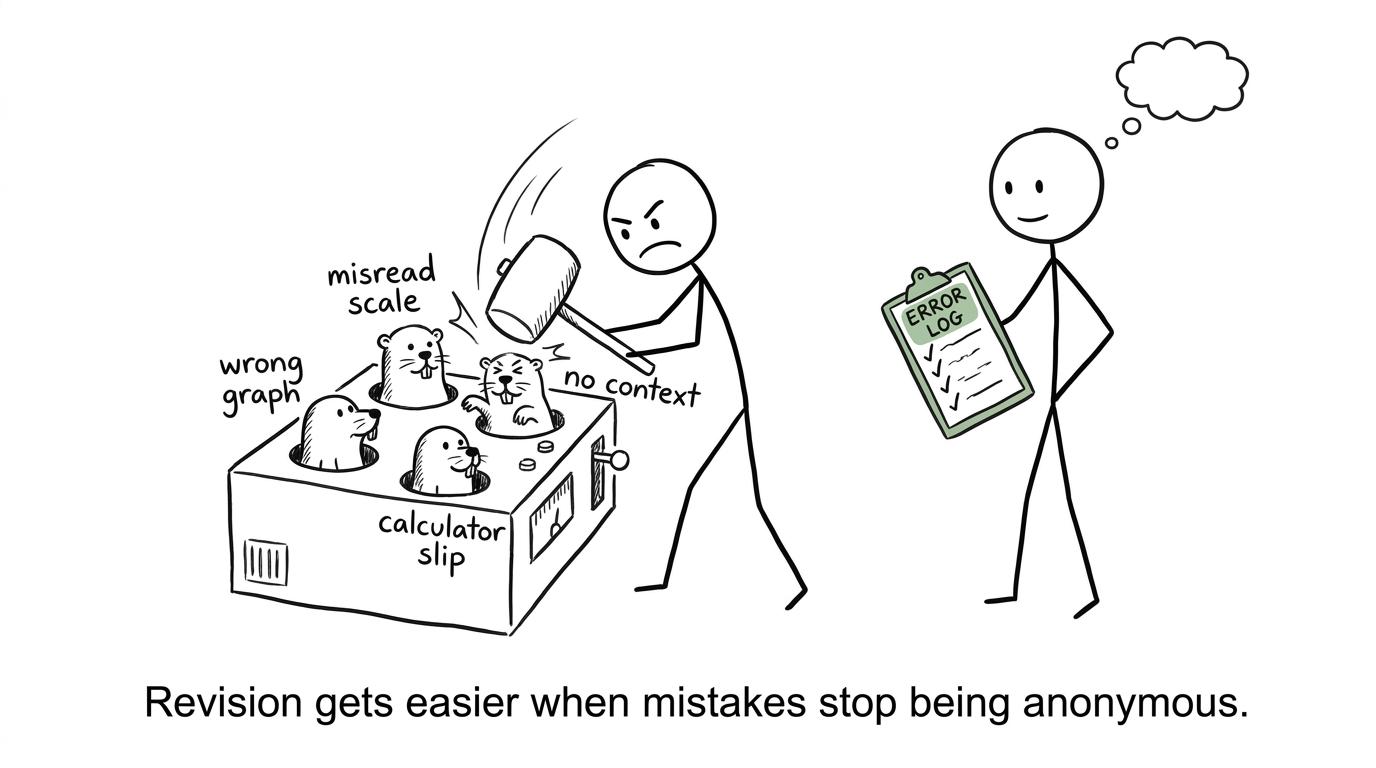 A student uses an error log to tame recurring exam mistakes
Use a realistic final readiness test
When the exam is getting close, run this sequence:
Test without support
Complete a suitable unseen paper or substantial mixed section under the correct conditions. Use the timing and equipment specified by your own board. Do not pause the clock, check a video or look up a definition.
Mark without generosity
Use the mark scheme. Award method marks only where your written work earns them. Do not convert “I nearly did that” into a mark.
Diagnose every lost mark
Separate missing knowledge from interpretation, presentation and timing. A lower score caused by two unfamiliar topics needs a different response from the same score caused by repeated careless errors.
Repair narrowly
Return to the smallest useful topic. Use a revision lesson, practise a short set of questions and check the solutions. Avoid responding to one histogram error by rereading the entire statistics course.
Retest after a delay
Use a mini test, a different question set or another timed section. You are looking for transfer: can you apply the repaired skill when the numbers, context and wording change?
You have revised enough when this loop produces only limited, identifiable gaps and your results are sufficiently consistent for your target. That is a more credible standard than waiting to feel fearless.
Common mistakes when judging whether revision is enough
Counting resources instead of capabilities
Finishing three revision guides does not prove that you can answer three questions independently. Track what you can retrieve and apply, not what you have viewed.
Revising only comfortable topics
Familiar questions create reassuring scores while preserving your weakest areas. Your error log should decide a substantial part of your next session.
Using only topic-labelled practice
Topic questions develop methods, but mixed questions test selection. You need both before the exam.
Treating every mistake as carelessness
Calling an error “silly” can hide a pattern. Repeated calculator slips may reveal rushed input, missing estimates or weak checking routines. Name the exact cause.
Ignoring written interpretation
Students sometimes focus on calculations while neglecting comparisons, limitations and contextual conclusions. Statistics questions can reward the quality of your reasoning as well as numerical accuracy.
Chasing a fixed number of hours
There is no official number of revision hours that guarantees a grade. Prior knowledge, target grade, tier and the quality of practice all matter. Set evidence-based goals instead: complete, mark, diagnose, repair and retest.
You do not need to feel finished
Good revision rarely ends with a dramatic sense of completion. It ends more quietly: fewer surprises, more reliable methods and a clear plan when something goes wrong.
Use the MathsGenie GCSE Statistics hub to check your course, repair gaps with free revision lessons and practice questions, and test your performance with past papers and mark schemes. Where available for your course, add video solutions, mini tests and predicted papers to your revision planner.
Do not ask anxiety to decide whether you have done enough. Give the decision to your evidence. Choose one mixed test, mark it honestly and let the lost marks tell you what to revise next.