

Have I Revised Enough for GCSE English Language?
Have I revised enough GCSE English Language? Use an evidence-based check for reading, writing, timing and feedback, not anxious feelings.
Revision creates a strange problem: the more seriously you take it, the easier it is to feel that you have not done enough. If you are asking, “have I revised enough GCSE English Language?”, the honest answer will not come from counting hours or waiting to feel confident. It comes from evidence.
You have probably revised enough when you can complete the main reading and writing tasks for your exam board, under realistic time pressure, at a standard close to your target grade, and when your remaining mistakes are specific rather than mysterious.
That does not mean producing a perfect paper. It means knowing what each question requires, managing the clock, selecting useful evidence, explaining effects clearly and writing accurately for a stated audience and purpose.
This article gives you a practical way to test that readiness, particularly if you are also balancing English with GCSE maths revision.
The quick GCSE English Language readiness checklist
You are approaching exam readiness if you can honestly say:
- I know which exam board I am sitting: AQA, Edexcel, OCR or Eduqas.
- I know the structure and timing of each paper in my specification.
- I can explain what the reading questions are assessing without relying on notes.
- I can analyse language and structure rather than simply identifying techniques.
- I can compare ideas and perspectives where my paper requires it.
- I can plan and complete extended writing within the available time.
- I adapt my tone, form and register to the audience and purpose.
- I leave time to check spelling, punctuation and sentence control.
- I have completed timed sections using unseen texts.
- I have used mark schemes, teacher feedback or examiner materials to review my work.
- I can identify my three most common causes of lost marks.
- I have retested those weaknesses and seen evidence of improvement.
One uncertain answer does not mean you are doomed. It tells you what to do next. That is the difference between useful concern and vague panic.
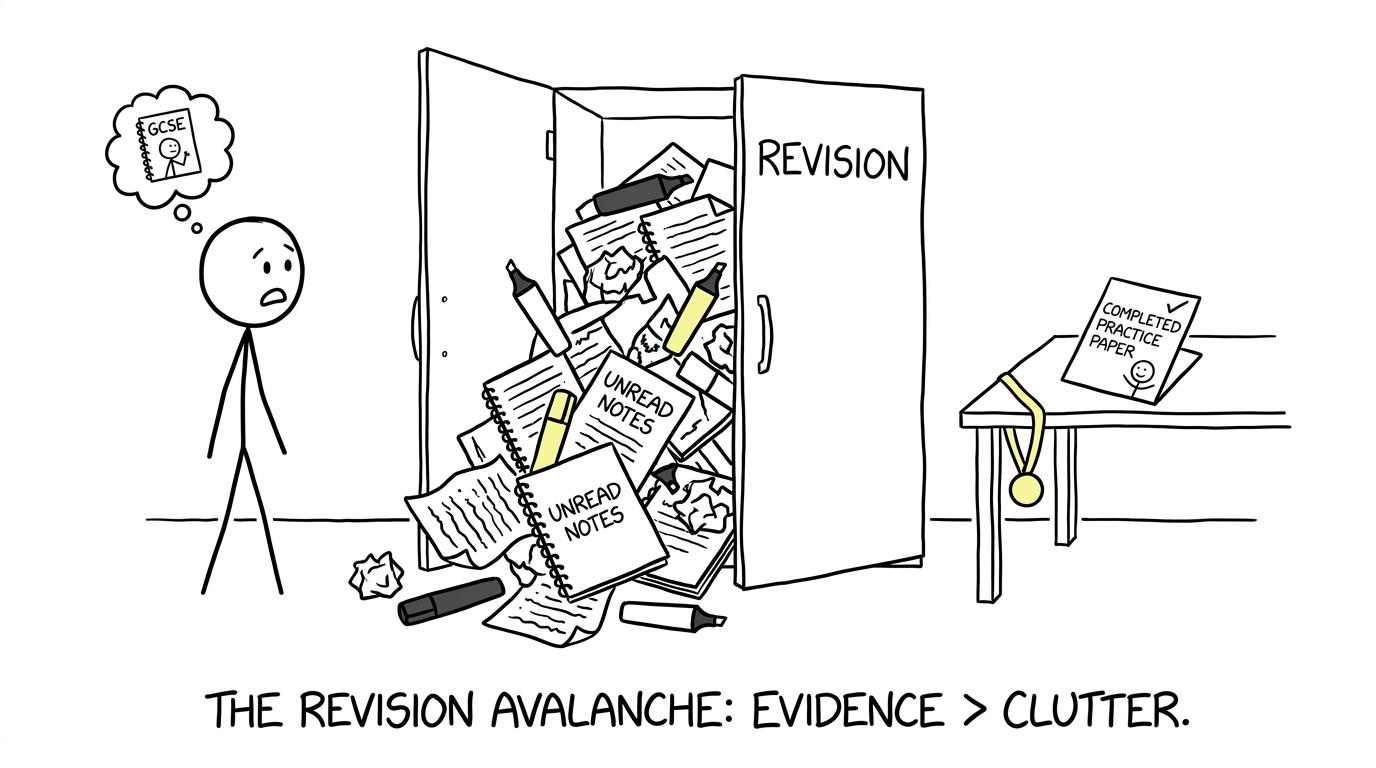 A completed practice paper calmly defeats an avalanche of unused revision notes
Measure performance, not hours
Revision hours are easy to count because time is visible. Learning is harder to see.
A student might spend an evening highlighting model answers and feel productive. Another might complete one timed reading section, discover that their analysis is too general, rewrite two paragraphs and retest the skill later. The second session may be shorter, but it produces stronger evidence.
Use this revision cycle:
- Attempt: answer an unseen question without notes.
- Mark: use the relevant mark scheme or teacher feedback.
- Diagnose: identify the precise reason marks were lost.
- Repair: practise that skill in isolation.
- Retest: answer a fresh question without support.
This is similar to the approach explained in MathsGenie’s guide to stopping yourself from forgetting GCSE content. The subject changes, but the principle survives: retrieval followed by feedback is more revealing than recognition.
If you only recognise a good answer once somebody else has written it, the skill is not yet secure. You need to produce it yourself.
Test the skills your exam actually rewards
GCSE English Language is not a memory test in the same way as some content-heavy subjects. The examination texts are unseen, so memorising one impressive paragraph cannot prove readiness.
Across the main exam boards, the assessment objectives cover closely related abilities. These include:
- identifying explicit and implicit information;
- selecting and synthesising evidence;
- analysing language and structure;
- comparing ideas and perspectives;
- evaluating texts critically;
- communicating clearly for different forms, purposes and audiences;
- using vocabulary, sentence structures, spelling and punctuation accurately.
Technical accuracy under AO6 accounts for 20%20\%20% of the qualification across GCSE English Language specifications. It deserves deliberate practice rather than a rushed check at the end.
The spoken language assessment is a separate compulsory endorsement and does not contribute to the numerical grade for the written qualification. You should still complete it properly, but do not confuse success in a presentation with readiness for the written papers.
Check your own specification
The assessment objectives are shared, but paper structures are not identical. AQA, Edexcel, OCR and Eduqas can use different question sequences, timings, source combinations and writing tasks.
Before judging your readiness, confirm:
- the exact qualification and exam board;
- the number and length of papers;
- which reading skills appear on each paper;
- the available marks for each task;
- the expected writing forms;
- any changes communicated by your school or exam board.
Do not revise from a generic online checklist without comparing it with your current specification. There is no foundation or higher tier in GCSE English Language, so every candidate needs to prepare for the full range of assessed skills.
Use a three-part readiness test
A realistic judgement needs more than one good essay or one disappointing mock. Use three kinds of evidence.
Coverage
First, ask whether you have practised every major task in your papers. Coverage does not mean reading notes about each task. It means producing answers.
Create a simple list containing every question type. Label each one:
- Secure: I can answer this independently and explain what the examiner rewards.
- Developing: I can answer it, but quality or timing varies.
- Uncertain: I cannot yet produce a reliable response without help.
If several tasks remain uncertain, you have not finished revising. If most are secure and the rest are developing, you are in the polishing stage.
Quality
Next, examine the quality of your responses. A completed answer is not automatically an effective answer.
For reading, check whether you:
- answer the exact question;
- choose concise, relevant evidence;
- explain how choices create meaning or effects;
- develop an interpretation rather than listing techniques;
- compare ideas and methods when required.
For writing, check whether you:
- establish a clear purpose and viewpoint;
- organise ideas deliberately;
- sustain an appropriate tone;
- vary sentences for clarity and effect;
- use vocabulary precisely rather than forcing elaborate words;
- control paragraphing, spelling and punctuation.
A mark scheme is not merely a device for producing a score. It describes the gap between what you wrote and what stronger responses do consistently.
Reliability under time pressure
Finally, repeat the skill under realistic conditions. Readiness means being able to perform when the text is unfamiliar and the clock continues moving.
Complete at least one timed section from each paper, followed eventually by complete papers where practical. Use the correct time allowance, avoid notes and do not pause the timer when a question becomes uncomfortable.
One result can be distorted by tiredness, a friendly source or an unusually difficult task. Look for a pattern across several attempts. The same principle appears in MathsGenie’s advice on when to begin GCSE past papers: papers are most useful while there is still time to respond to what they reveal.
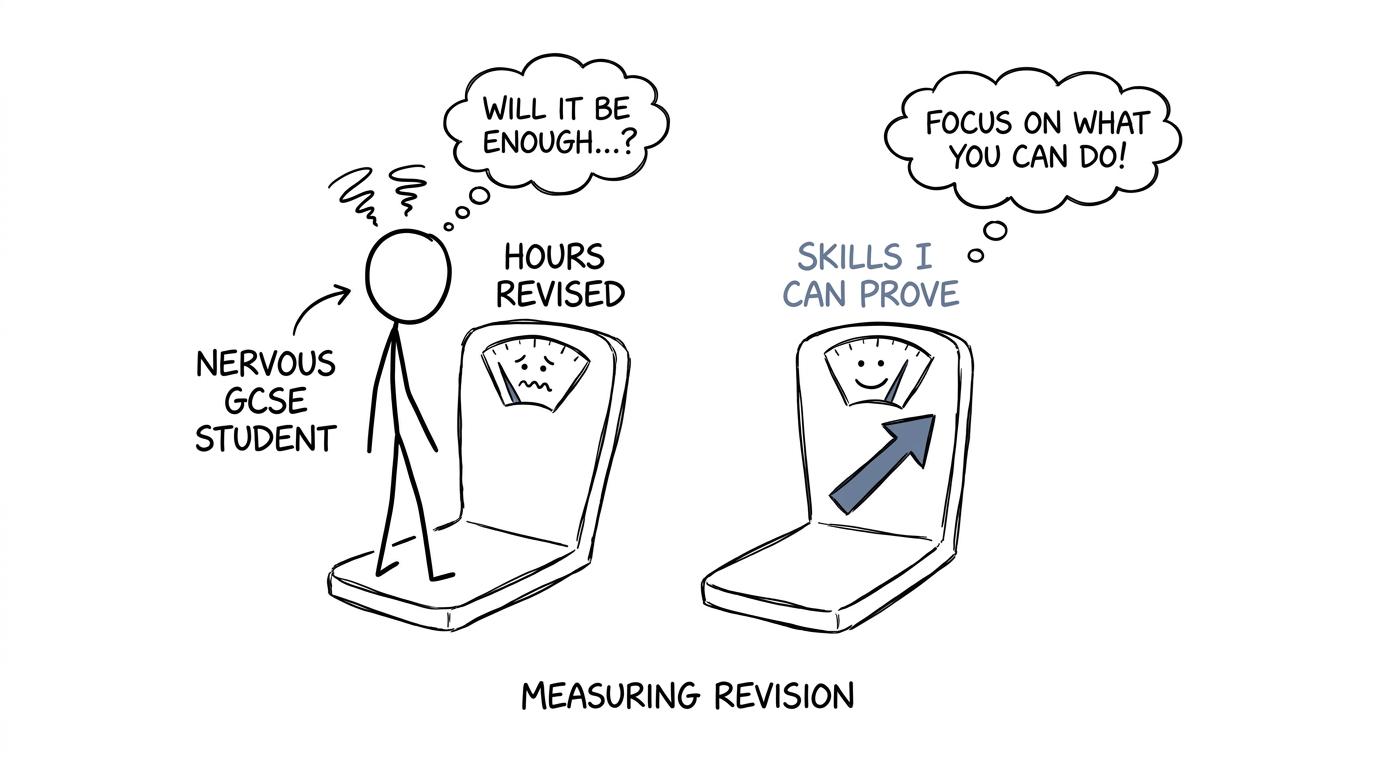 A student compares revision hours with skills they can actually prove
Keep a marks-leak log
After each timed task, record lost marks under one of four headings:
- Knowledge of the task: I misunderstood what the question required.
- Analysis: I selected evidence but did not explain it sufficiently.
- Writing control: My structure, register or technical accuracy weakened.
- Exam management: I rushed, overwrote or ran out of time.
The log should be specific. “Bad at analysis” is too broad. “I identify a language feature but do not connect it to the writer’s viewpoint” creates an action.
You have stronger evidence that you have revised enough when the same major error stops recurring. New, smaller mistakes will always appear. Progress often looks less like perfection and more like increasingly precise problems.
Balance English Language with GCSE maths
Many students asking this question are not revising English in isolation. Maths may be only a day or two away, and neglecting it completely can create a second wave of anxiety.
During an English-heavy week, keep maths alive with short, closed tasks. The GCSE English Language exam-week checklist suggests combining focused English preparation with brief maths maintenance rather than attempting two exhausting revision days at once.
Useful options include:
- one topic-focused mini test;
- a short set of practice questions;
- correcting questions from an earlier paper;
- one revision lesson followed by independent recall.
The MathsGenie GCSE maths revision hub brings together free lessons, topic questions, revision guides, mini tests, past papers and predicted papers across boards including Edexcel, AQA, OCR and Eduqas. If time is limited, the twenty-minute GCSE maths routine gives you a contained way to maintain fluency.
Revision is partly the management of attention. A realistic plan protects your most urgent subject without allowing every other subject to disappear.
Common mistakes when deciding whether you have revised enough
Waiting to feel completely confident
Anxiety is not an accurate progress tracker. You can feel nervous and still be ready. You can also feel calm because you have avoided testing yourself. Use completed work, feedback and repeated performance as your evidence.
Counting resources instead of corrected mistakes
Watching videos and collecting notes can support learning, but quantity does not show whether you can answer an unseen question. Count tasks completed, weaknesses repaired and skills retested.
Practising only favourite tasks
Creative writing may feel more enjoyable than comparison, or retrieval questions may feel safer than evaluation. Your revision should be shaped by your weakest recurring skill, not the activity that makes the session feel easiest.
Treating one mock grade as a final verdict
A mock is valuable evidence, not a prophecy. Break the result down by task, timing and assessment objective. Then test whether targeted practice changes those areas.
Completing papers without reviewing them
A pile of marked papers can conceal repeated mistakes. Spend substantial time reviewing, correcting and reattempting. MathsGenie’s explanation of how to use past papers properly is written for maths, but its central lesson applies here: a paper becomes useful after you diagnose what went wrong.
Revising until exhaustion
A final tired session rarely compensates for lost sleep and poor concentration. Near the exam, use the calm principles in the GCSE night-before plan: choose a small task, review a short mistake list, prepare what you need and stop at a sensible time.
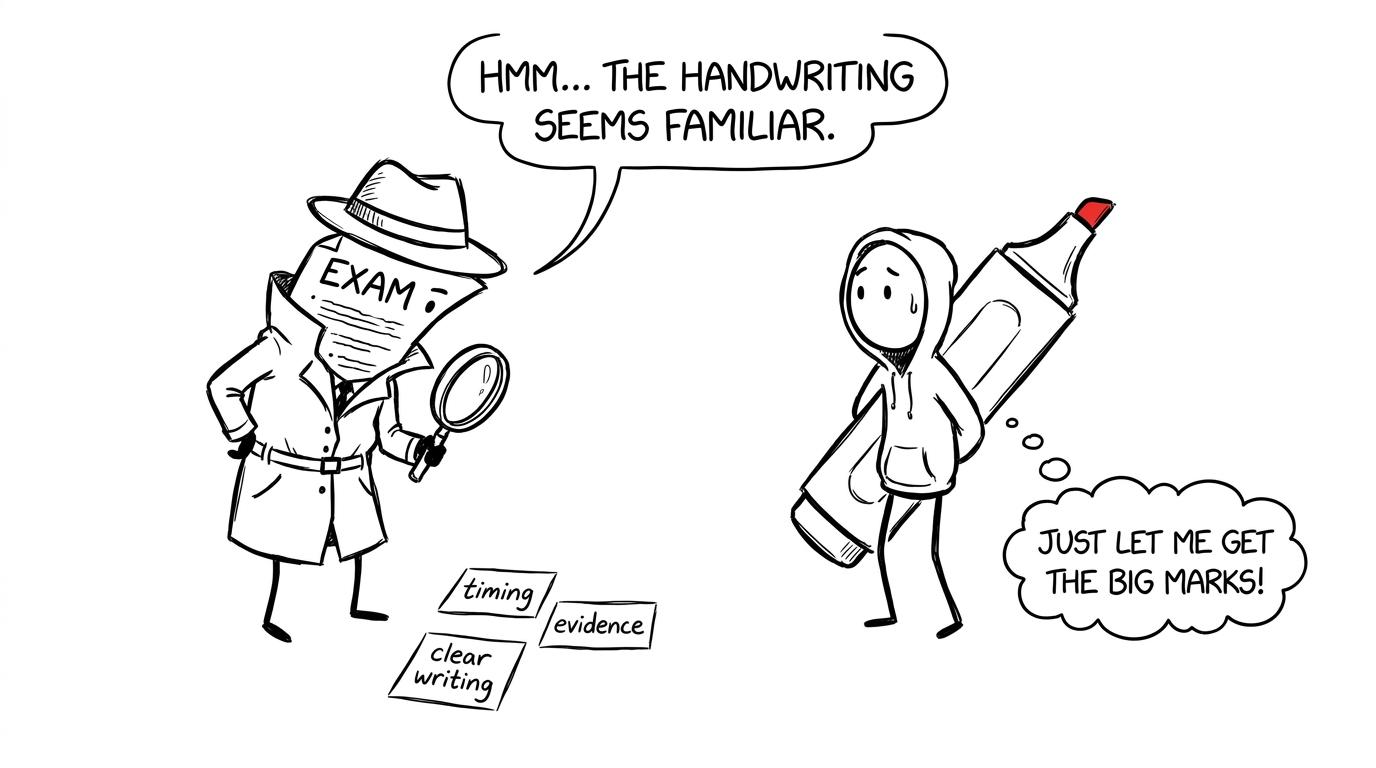 An exam-paper detective investigates timing, evidence and clear writing
What to do if the evidence says “not yet”
Do not respond by trying to revise everything again. Choose the two weakest, highest-impact skills from your log.
For each one:
- review the exact question requirements;
- study feedback or a reliable model response;
- complete one focused attempt;
- mark or discuss it;
- rewrite the weakest part;
- retest with a fresh task on another day.
A timetable can stop this work expanding into every available hour. MathsGenie’s GCSE revision timetable guide shows how to combine focused practice, feedback and timed work while leaving room for school and rest.
You are looking for readiness, not certainty
You have revised enough for GCSE English Language when your preparation has become observable: you know your paper, have covered its tasks, can produce effective responses independently, manage the time and correct recurring weaknesses.
You may still feel anxious. That feeling is not proof that another three hours of vague revision will help. Run the readiness test, follow the evidence and give your final sessions a precise purpose.
Then protect your other subjects. Use MathsGenie for free GCSE maths revision, including revision lessons, practice questions, mini tests, mark schemes and video solutions. As your maths exams approach, move into GCSE predicted papers and past-paper practice so that confidence comes from the same place it should in English: work you can actually prove.










