Hate GCSE English? How to Revise Language & Literature
Hate GCSE English Language and Literature? Learn practical ways to start revising, remember texts, practise exam skills and balance maths revision.
Sometimes the hardest subject to revise is not the one you find most difficult. It is the one you resent opening.
If you have searched hate GCSE English Language and Literature how to revise, the practical answer is this: stop waiting to enjoy the subject. Make each session short, specific and active. Practise one exam skill, check your work and leave with a clear next step. Motivation often arrives after you begin, not before.
This matters when you are also preparing for maths exams. English can expand until it consumes an evening: rereading a novel, highlighting poems and wondering whether any of it is going in. A defined task protects both your energy and your GCSE maths revision.
Your quick survival checklist
When English is not clicking, use this approach:
- Confirm your exam board and exact papers.
- Separate English Language from English Literature.
- Reduce revision to one small, visible task.
- Retrieve ideas from memory instead of repeatedly reading notes.
- Practise the form of the examination question.
- Mark or review every attempt.
- Keep a short record of recurring weaknesses.
- Alternate English with a subject you find easier to start.
You do not need to become someone who loves analysing weather imagery. You need a system that works even when enthusiasm is absent.
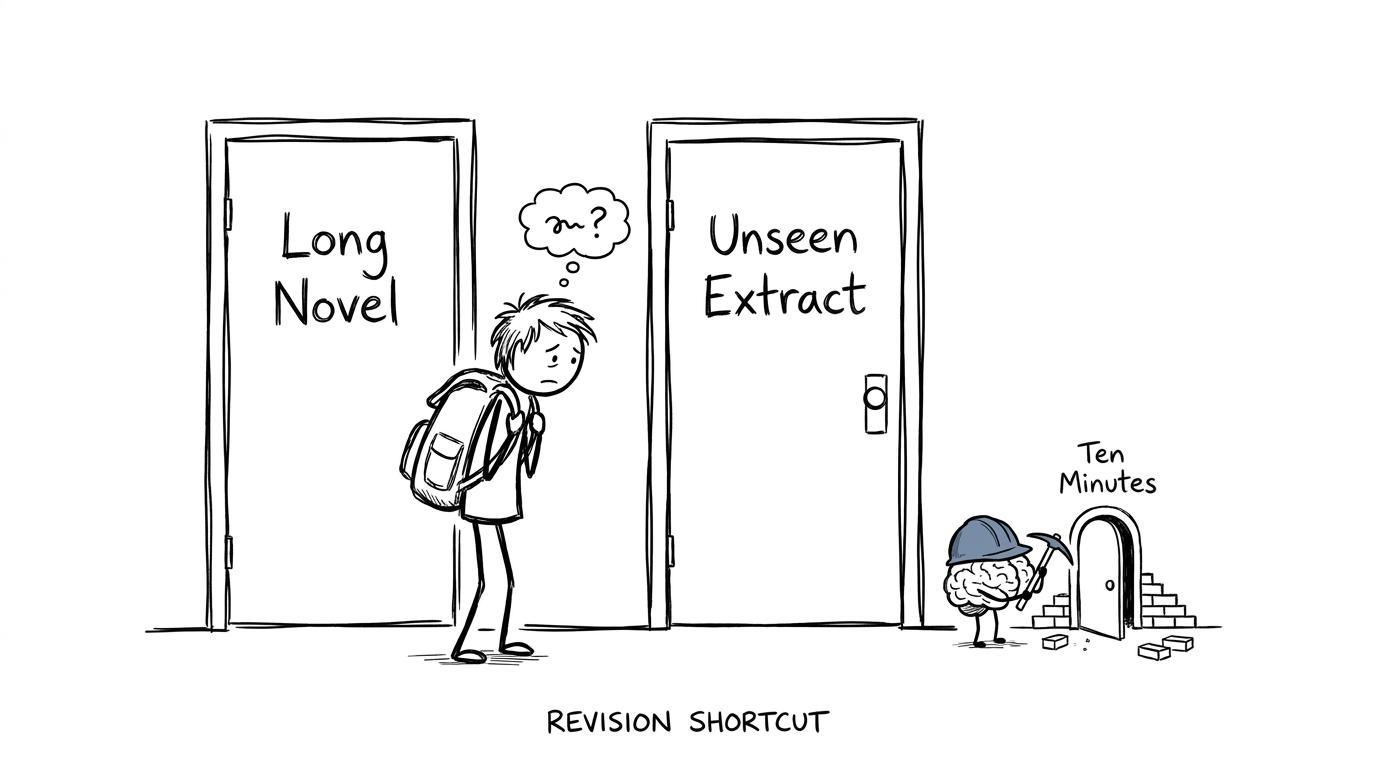 A tired student discovers the much less frightening ten-minute door into revision
Work out what you actually hate
“I hate English” can describe several different problems. Perhaps the texts feel slow. Perhaps you understand them in class but cannot write quickly. You might dislike learning quotations, or find unseen extracts unpredictable. Sometimes the real problem is uncertainty: you sit down without knowing what a useful session looks like.
Name the obstacle precisely. Then choose the matching action.
- The text feels confusing: review one scene, chapter or poem and summarise its purpose.
- You cannot remember evidence: retrieve a small quotation bank without notes.
- Your paragraphs wander: plan one response around the question and assessment objective.
- Timing causes panic: complete one section with a realistic time limit.
- You avoid starting: set a minimum session of just 101010 minutes.
A vague dislike creates a vague revision plan. A specific weakness gives you somewhere to begin. The same principle helps in maths: finding your weakest topics is more useful than announcing that you are “bad at algebra”.
Separate Language from Literature
English Language and English Literature overlap, but they are not the same revision problem.
How to revise GCSE English Language
Language papers assess transferable reading and writing skills. Depending on your board, Edexcel, AQA, OCR and Eduqas organise their components differently, so use the specification and materials your school has confirmed.
Your revision should usually include:
- identifying explicit and implicit information;
- analysing a writer’s language and structure;
- comparing viewpoints where required;
- evaluating a text using relevant evidence;
- planning and producing clear, controlled writing;
- improving spelling, punctuation, vocabulary and sentence control.
You cannot memorise the unseen source that will appear in the examination. You can rehearse what you will do with it. Practise recognising command words, selecting evidence, explaining effects and controlling your time.
Do not revise Language by reading model answers for an hour. Read one, identify what makes it successful, close it and produce a plan or paragraph yourself. The attempt is where the learning happens.
How to revise GCSE English Literature
Literature requires secure knowledge of your set texts alongside analysis. National assessment objectives cover responding to texts, supporting interpretations with textual references, analysing language, form and structure, and understanding relevant relationships between texts and contexts. Exact question formats and weightings depend on your board and specification.
Build a compact map for each text:
- the central plot or argument;
- the main characters or speakers;
- a manageable set of themes;
- flexible quotations or precise textual references;
- significant structural choices;
- context that genuinely supports interpretation.
Do not try to memorise every classroom note. Select evidence that can serve several themes or characters. Then practise recalling it and linking it to a possible question.
Use action before motivation
Disliked subjects encourage elaborate avoidance. You reorganise folders, choose a playlist and decide that tomorrow will be more productive. The problem is not laziness. The task simply feels too large and emotionally expensive.
Lower the entry cost. A useful session could be:
- recall 555 quotations;
- plan one Language response;
- analyse one short extract;
- write one Literature paragraph;
- revise one poem comparison;
- check one answer against feedback or a mark scheme.
Set the materials out before you begin. Put your phone beyond reach. Start with the smallest physical action, such as writing the question at the top of the page.
This is why a repeatable routine beats a heroic timetable. MathsGenie’s GCSE 202020-minute maths revision routine uses the same useful idea: recall, practise, mark and choose the next task. You can borrow that structure for English.
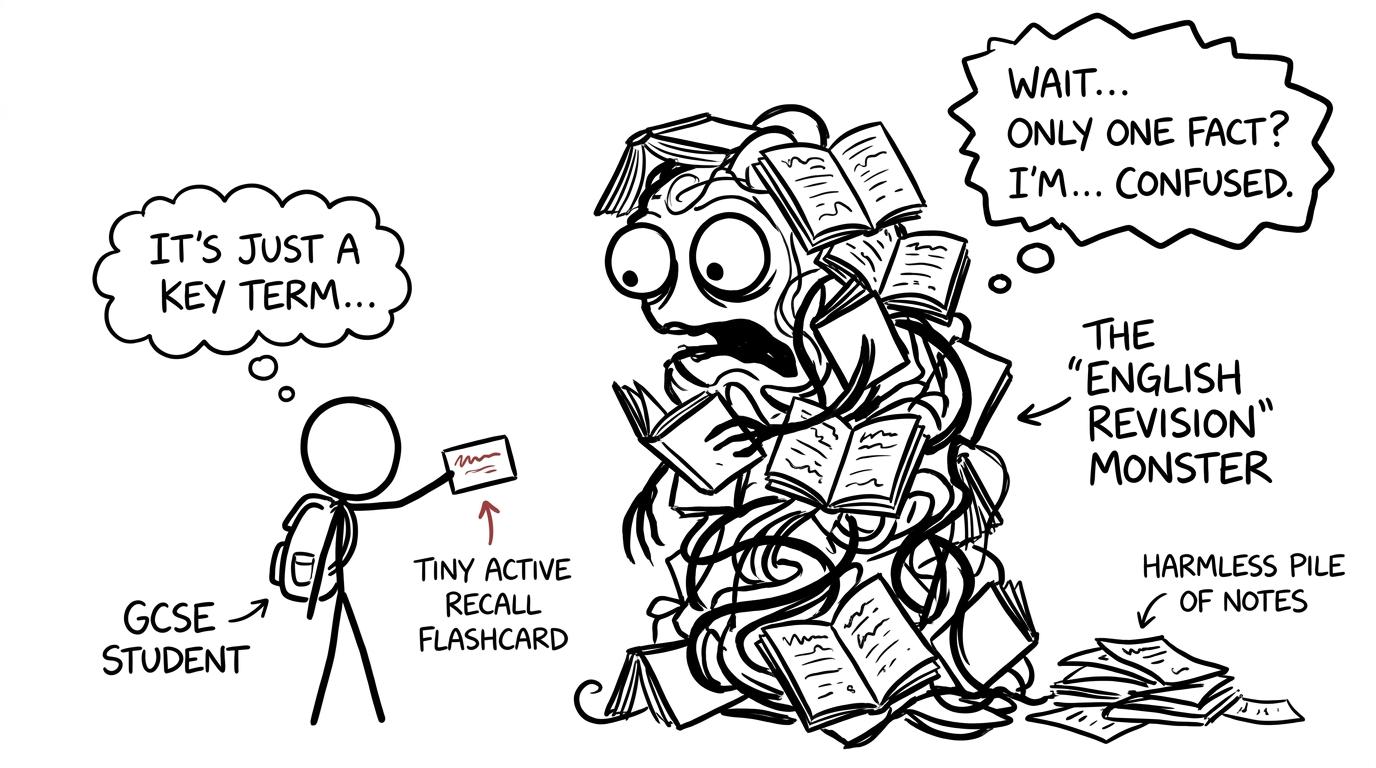 A book monster is unexpectedly defeated by one tiny flashcard
Revise by retrieving, not decorating
Neat notes can feel productive because they create something visible. But recognition is not recall. A quotation looks familiar when it is in front of you; the examination asks you to produce and use knowledge without that support.
Research reviewed by the Education Endowment Foundation supports low-stakes quizzing and spaced retrieval as useful ways to strengthen memory. Feedback matters too, because repeatedly retrieving an incorrect idea can reinforce the mistake.
Try these active methods:
- Cover your notes and reconstruct a character or theme map.
- Write everything you remember about one poem, then check omissions.
- Put a quotation cue on one side of a card and the quotation, speaker and uses on the other.
- Say a paragraph plan aloud without looking at a model.
- Return to the same material after a delay rather than cramming it once.
Keep the test small enough to complete. Six carefully chosen cards that you revisit are worth more than sixty cards abandoned in a drawer.
Practise the examination, not an imaginary subject
You are not preparing to know everything ever written about a novel. You are preparing to respond to the tasks on your specification.
Download or ask your teacher for the correct exam-board materials. Study the wording of questions and the relevant assessment objectives. Notice what changes between short reading questions, extended analysis, comparison and transactional or creative writing.
For each practice task:
- read the question before reaching for memorised material;
- identify its focus and command word;
- choose evidence because it answers that question;
- write or plan under a clear time limit;
- compare your response with the mark scheme, model material or teacher feedback;
- record one improvement to apply next time.
Treat feedback as instructions, not a verdict. “Analyse methods more closely” is still broad. Convert it into an action such as: “After each quotation, name the deliberate choice and explain how it shapes meaning.”
Balance English revision with GCSE maths
A disliked subject should not be allowed to sabotage every other one. Give English a boundary.
You might alternate a short English task with a maths task you can measure clearly. For example, complete one quotation retrieval session, take a brief break, then use a MathsGenie revision lesson and its practice questions. The contrast can make both blocks easier to start.
A realistic weekly pattern could include:
- two short Literature retrieval sessions;
- one Language reading task;
- one timed writing plan or paragraph;
- one longer examination-style English task;
- separate, protected maths blocks for topic practice and papers.
The proportions should reflect your actual needs and examination dates. Maths students can use the GCSE maths revision timetable or the one-month revision plan to stop English from crowding out foundation or higher-tier preparation.
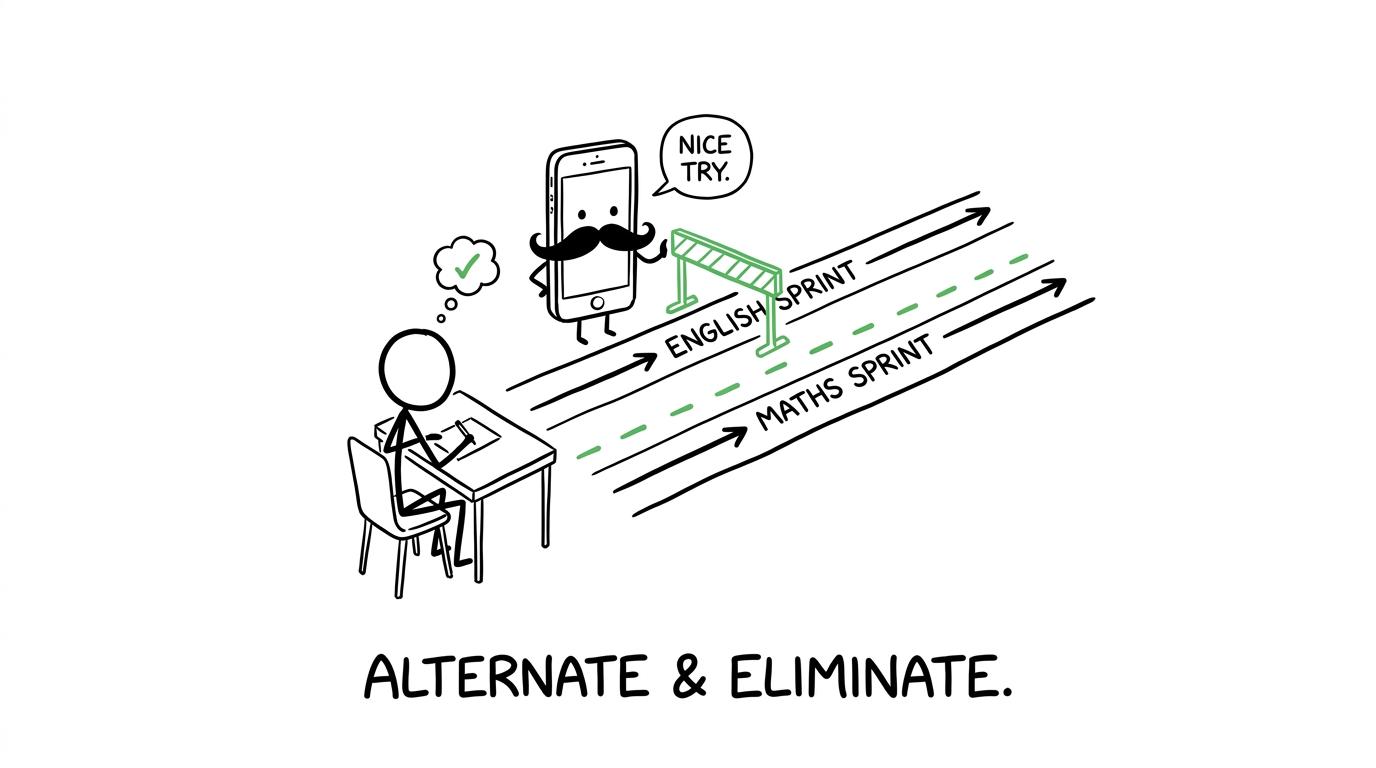 A suspiciously disguised phone is refused entry to two focused revision sprints
What to do on a very low-motivation day
Bad days need a minimum standard, not an ambitious rescue operation.
Choose one task that takes between 101010 and 151515 minutes. Retrieve a handful of quotations, annotate a paragraph or plan the opening of a writing response. Stop when the timer ends if you need to. Record what comes next.
This preserves continuity. More importantly, it avoids the damaging belief that revision only counts when it lasts for hours.
If maths is also competing for attention, use a mini test or part of a paper rather than abandoning the subject entirely. The guide to when to start GCSE past papers explains how shorter paper practice can grow into full timed work. Edexcel students can also use the verified Edexcel GCSE maths past papers, with mark schemes and worked solutions where available.
Common mistakes when revising a subject you hate
Waiting to feel inspired
Motivation is unreliable. Decide the time, place and first action beforehand. Starting creates evidence that the task is manageable.
Treating both English GCSEs as one enormous subject
Language is primarily about practising transferable reading and writing skills. Literature combines text knowledge with interpretation and analysis. Give each a separate task list.
Rereading instead of recalling
Rereading has a place when understanding is weak, but it should lead quickly to retrieval or application. Close the book and prove what you know.
Memorising essays
A memorised response may not answer the question set. Learn adaptable evidence, interpretations and paragraph habits instead.
Ignoring the exam board
Do not assume a video, checklist or paper format matches your qualification. Confirm whether you take AQA, Edexcel, OCR or Eduqas and use the correct specification.
Revising English until maths disappears
Guilt is not a timetable. Protect planned maths sessions, especially as papers approach. Use MathsGenie’s free board-specific revision resources to keep those sessions focused rather than spending time searching for questions.
You do not have to love it to improve
There is relief in dropping the demand that English must suddenly become your favourite subject. Your job is smaller: understand your papers, identify the next skill and complete one active task.
Start today with 101010 minutes of English retrieval. Then move to the MathsGenie GCSE maths revision hub and choose the correct board and tier. Use free revision lessons and practice questions to repair individual topics, mini tests to check progress, and past papers or predicted papers to build examination confidence. Mark your work with the available mark schemes and use video solutions when a method still feels unclear.
You are not waiting for motivation. You are building a routine that can carry you when motivation fails.