

Hate GCSE Dance? How to Revise When Motivation Is Low
Hate GCSE Dance? How to revise with short sessions, active recall and realistic goals while protecting the time you need for GCSE maths revision.
There is a particular kind of frustration in revising a subject you no longer enjoy. You open your notes, recognise that the exam matters, and still feel no desire to begin. If your search was “hate GCSE dance how to revise”, the practical answer is this: stop waiting to feel motivated. Break the course into small, mark-focused tasks, revise actively for short periods and keep a clear boundary around the time needed for GCSE maths and your other subjects.
You do not have to fall in love with Dance. You need a system that works even when enthusiasm does not.
Your quick GCSE Dance revision checklist
Use this as your starting point:
- Check exactly which parts of the course you still need to complete.
- Separate practical preparation from written Dance Appreciation revision.
- Choose one small task before each session begins.
- Test yourself rather than repeatedly reading notes.
- Use the specification language in written responses.
- Practise comparing professional works under timed conditions.
- Ask your teacher for feedback on one precise weakness at a time.
- Put Dance into a wider timetable so it does not consume your maths revision.
The aim is not to create a perfect revision plan. It is to remove enough friction that you can start.
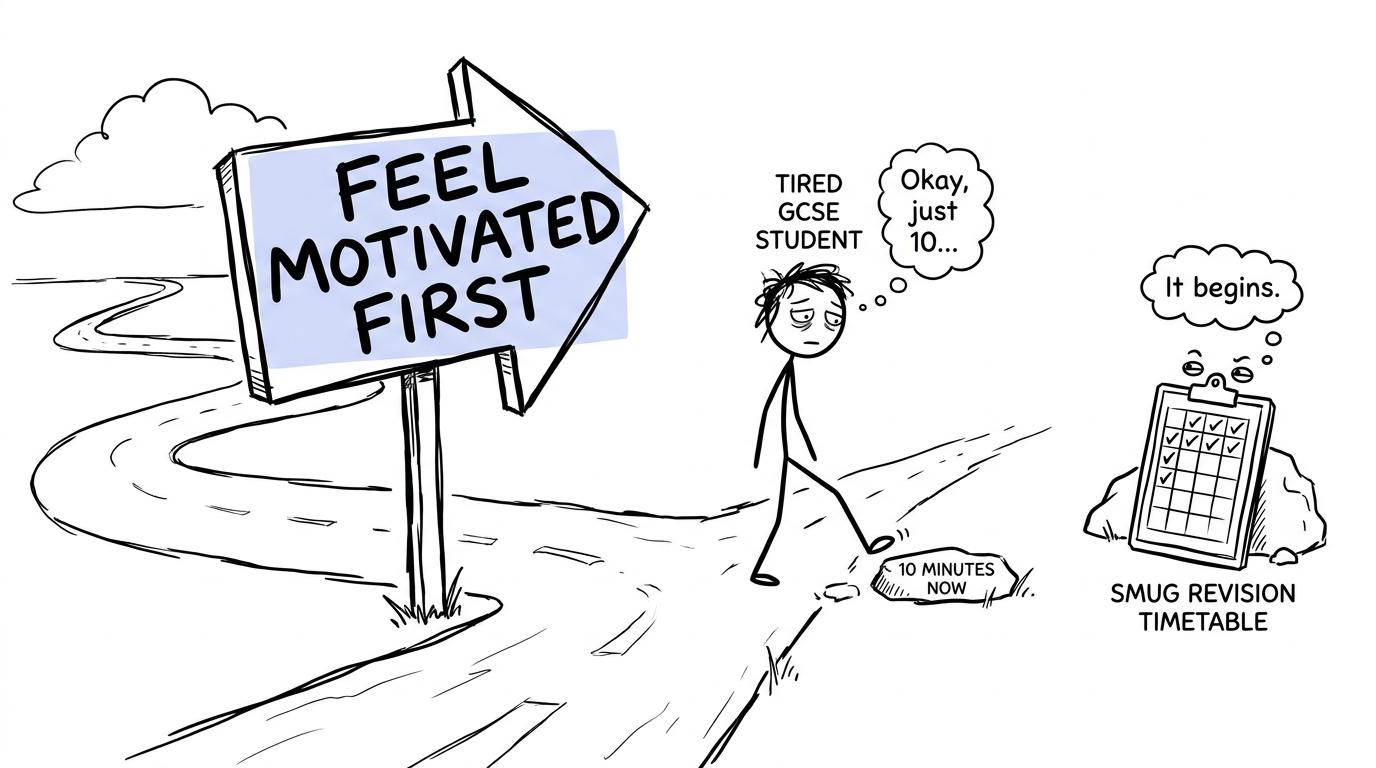 A student choosing ten minutes of revision instead of waiting for motivation
Why hating the subject makes revision feel harder
When you dislike a subject, every task can feel larger than it is. “Revise Dance” sounds vague and endless. “Recall five expressive skills” is finite. The second instruction gives your brain somewhere to begin.
This distinction matters because motivation often follows action rather than preceding it. A short completed task creates evidence that progress is possible. Waiting for the right mood gives the subject control over your timetable.
Try replacing emotional decisions with a fixed rule: on a planned Dance day, complete one focused block before deciding whether to continue. The block could involve flashcards, an anthology comparison, terminology recall or one written response. Starting is compulsory; continuing is optional.
That is a kinder system than demanding hours of concentration from yourself. It is also more realistic during GCSE preparation, when Dance must compete with English, science and maths.
Know what you are revising for
For the current AQA GCSE Dance specification, Performance and Choreography is worth 60%60\%60% of the qualification and is assessed through non-exam assessment. Dance Appreciation is worth 40%40\%40% and is assessed through a written examination lasting 1121\frac{1}{2}121 hours, marked out of 808080.
The written paper includes multiple-choice, short-answer and extended-response questions. It covers knowledge of choreographic processes and performing skills, critical appreciation of your own work, and critical appreciation of professional works from the GCSE Dance Anthology.
That structure gives you three useful revision folders:
- Performance and choreography: physical, technical, expressive and mental skills; choreographic processes; devices; structures; intentions and aural settings.
- Your own work: what you performed or choreographed, the decisions you made and how effectively those decisions communicated an intention.
- Professional works: features of the anthology works, their production elements and justified comparisons.
Check your teacher’s guidance and the current specification before planning, particularly for assessment tasks and deadlines. Do not revise from a generic online list without confirming that it matches your course.
Build the smallest revision session that still counts
A useful session does not need to be long. It needs a visible outcome.
Try this structure:
- Opening recall: write everything you remember about one work, skill or process without notes.
- Focused repair: check your notes and fill only the gaps you exposed.
- Exam action: answer one question, create comparison prompts or explain a term from memory.
- Final check: record what you still cannot recall.
This works because it turns revision into a feedback loop. Educational evidence on retrieval practice suggests that attempting to recall information can support learning more effectively than simply restudying it. Feedback is essential, however: an incorrect answer should be checked and corrected rather than repeatedly rehearsed.
The same principle applies to maths. MathsGenie’s GCSE maths revision hub combines topic lessons, questions and short tests so that you can learn, attempt and check rather than passively read.
Use active recall for Dance terminology
Dance contains vocabulary that may feel disconnected when it appears as a long list. Do not begin by copying every definition. Group terms according to their purpose.
You might create separate sets for:
- physical, technical, expressive and mental skills;
- actions, space, dynamics and relationships;
- choreographic devices and structuring devices;
- production elements such as lighting, costume, set and accompaniment;
- analytical verbs, including describe, explain, analyse, evaluate and compare.
Write the term on one side of a card and a precise definition or question prompt on the other. Say the answer before turning the card over. Put uncertain cards into the next session and delay secure cards for longer.
You can also use blank-page retrieval. Choose an anthology work and reconstruct its key information from memory: choreographic intention, movement content, dancers, accompaniment, costume, lighting and set. Then compare your page with reliable class materials.
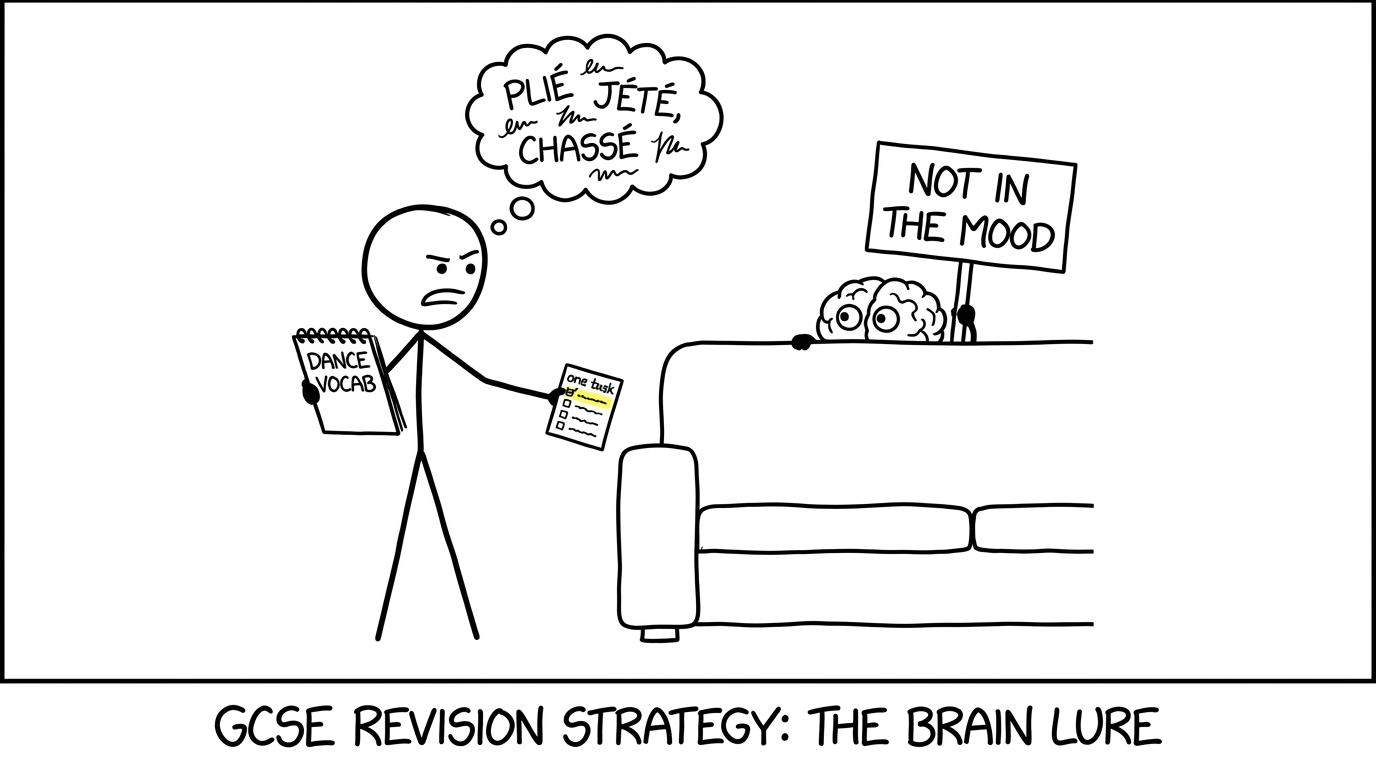 A reluctant brain being tempted out by one manageable revision task
Turn anthology knowledge into usable exam answers
Knowing facts about a professional work is not the same as being able to use them. Written responses may require you to identify evidence, explain its effect and connect it to choreographic intention.
Revise each work through questions rather than decorative notes:
- What is the intention of the work?
- Which movement or production features communicate it?
- What precise evidence could support that interpretation?
- How does another anthology work create a similar or contrasting effect?
- Which technical terms make the explanation more accurate?
Create comparison grids containing only the features you could genuinely discuss. A small bank of precise evidence is more useful than pages of facts you cannot retrieve under pressure.
Pay close attention to the command word. A description states what can be seen. An explanation develops how or why a feature creates an effect. An evaluation requires a supported judgement. If the question asks for comparison, both works need to remain present in the answer.
Revise your own practical work while it is still memorable
Questions about your own performance and choreography become harder when you rely on a general memory of “what we did”. Record precise details while they are fresh, following any instructions from your school about assessment materials.
For performance, consider the skills you used, where they appeared and how they helped communicate the choreographic intention. For choreography, record your stimulus, intention, selected movement material, devices, structure, aural setting and the reasons behind important decisions.
Avoid empty judgements such as “it looked effective”. Ask what was effective, what evidence supports that judgement and what effect it created for the audience.
Where possible, ask your teacher for one targeted improvement. “How can I improve?” is difficult to answer. “Is my explanation of how dynamics communicated tension specific enough?” is much more useful.
Protect your GCSE maths revision time
Disliking Dance can create two opposite problems. You may avoid it until it becomes an emergency, or spend an entire evening fighting one task and lose the time intended for maths. A timetable should prevent both.
Give Dance a fixed, limited place in the week. Then plan maths by exam board, tier and weak topic rather than writing “revise maths”. The GCSE maths topics by exam board and tier can help you distinguish Foundation and Higher priorities across Edexcel, AQA, OCR and Eduqas.
If organising the week feels harder than the revision itself, use the structure in the GCSE maths revision timetable. Students closer to the examinations can adapt the one-month GCSE maths revision plan or the more concentrated one-week revision plan.
Keep the subjects separate inside each block. Dance might involve retrieving terminology and planning one extended response. Maths should involve doing questions, checking solutions and correcting errors. Switching resources repeatedly can make a short evening disappear without producing much work.
Make progress visible without chasing perfection
A useful tracker records actions, not moods. After each Dance session, note:
- the topic covered;
- what you recalled successfully;
- one gap to revisit;
- the next specific task.
Do not rate the session according to whether it felt enjoyable. You are measuring whether useful work happened.
Use the same logic for maths: record topics that cost marks, repair them with targeted questions and return to them later. Once topic knowledge is developing, GCSE past paper guidance can help you decide when to introduce timed papers. Edexcel students can then use Edexcel GCSE maths past papers with mark schemes and available solutions.
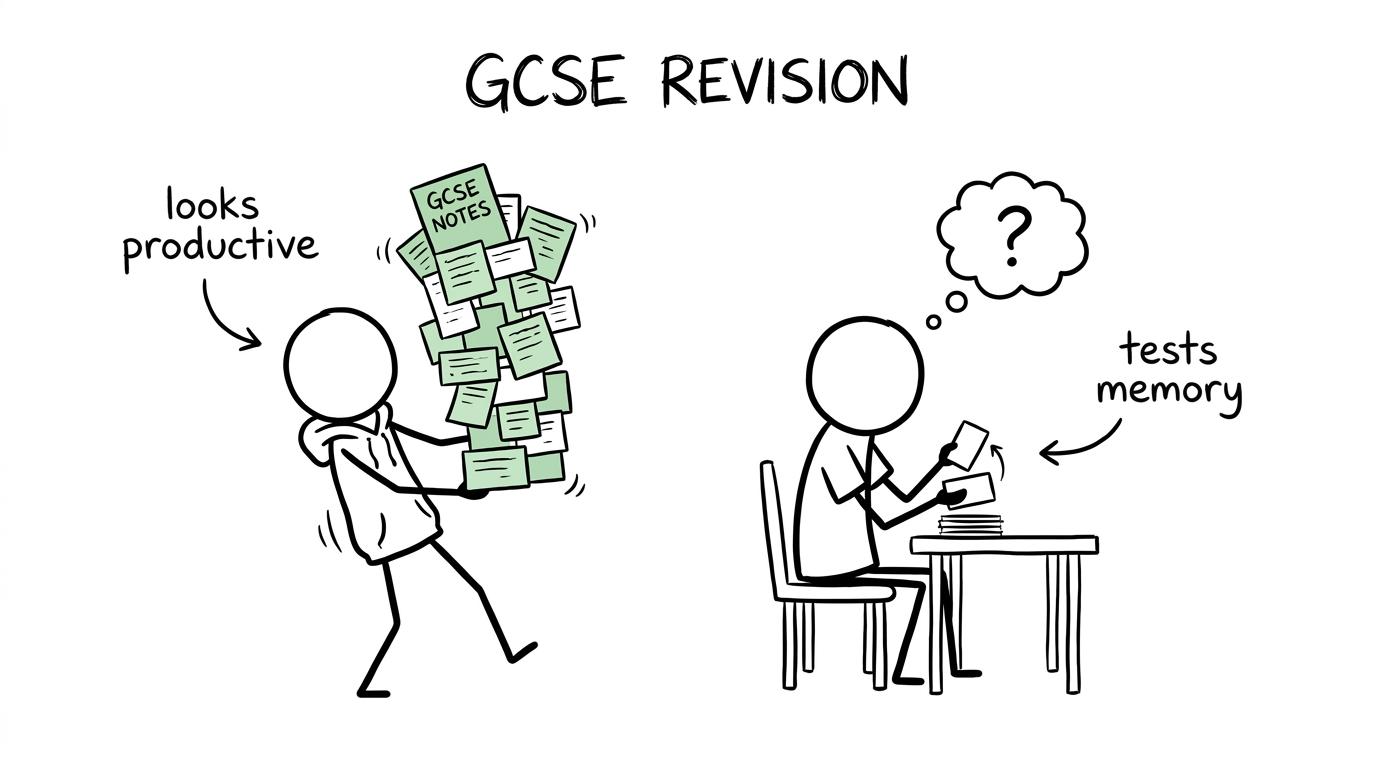 Colour-coded notes competing with active question practice
Common mistakes when revising a subject you hate
Waiting until you feel interested
Interest is helpful but not required. Decide the task and start time in advance so that your mood does not have to make the decision.
Making beautiful notes without testing memory
Colour-coded pages can organise information, but they do not prove that you can retrieve it. Close the notes and answer a question before assuming the topic is secure.
Revising every anthology work in one sitting
This creates overload and weak recall. Study one feature or a small pair of works, then return after a gap. Spacing revision across different days is generally more useful than relying on one large session.
Memorising generic sentences
Prepared phrases cannot replace relevant evidence. Learn the vocabulary and structure of analysis, but adapt each response to the precise work, feature and command word.
Ignoring the practical component
Written revision matters, but Performance and Choreography form the larger proportion of AQA GCSE Dance. Use teacher feedback and assessment criteria to identify practical priorities while there is still time to improve them.
Letting Dance displace maths
An unfinished Dance task can expand to fill the evening. Set a stopping point and move to the next subject. For final maths preparation, use GCSE predicted papers after topic revision and past-paper practice rather than treating predictions as a substitute for the full specification.
You do not need to love it to finish well
There is freedom in lowering the emotional requirement. You do not need to become passionate about GCSE Dance. You need to know the assessment, choose small tasks, retrieve information, check your answers and return to weak areas after a gap.
Begin with one action today: recall one anthology work, organise your own-work evidence or answer one written question. Then stop at the planned time and protect the rest of your revision timetable.
For maths, let MathsGenie remove the decisions. Open the free GCSE revision hub, choose your board and tier, and move from revision lessons to practice questions, mini tests, past papers and mark schemes. Nearer the exams, add predicted papers and video solutions. Progress rarely begins with a dramatic burst of motivation. More often, it begins with a task small enough to start.











