

Is a Grade 6 GCSE Russian Good for Sixth Form?
Grade 6 GCSE Russian sixth form entry explained: check A Level Russian requirements, overall GCSE thresholds and the maths grade your chosen course needs.
A results sheet can make one number feel larger than everything around it. If that number is a grade 6 in Russian, the immediate question is not simply whether it is “good”. It is whether it opens the door you actually want.
For anyone searching grade 6 GCSE Russian sixth form requirements, the short answer is encouraging: a grade 6 is enough for A Level Russian at some sixth forms and colleges, but not all of them. You must also meet the institution’s overall entry requirements, any conditions attached to your other A Level choices, and its minimum grades in English and maths.
A grade is evidence. An admissions policy is a decision rule. You need to look at both.
The quick sixth form entry checklist
Before deciding whether your grade 6 is enough, check these points:
- Does the sixth form or college offer A Level Russian?
- Does its Russian course require grade 6, grade 7 or a higher GCSE grade?
- Are there separate tests, interviews or language assessments?
- Do you meet the overall GCSE profile required for admission?
- Have you achieved the required grades in GCSE English and maths?
- Do your other proposed A Levels have higher subject requirements?
- Are the published requirements guaranteed thresholds or minimum conditions for consideration?
The first point matters more than it may appear. Russian is not available in every sixth form, so a grade that satisfies one course cannot help you join a course that is not running. Check the current prospectus and contact the admissions team rather than relying on an old subject list.
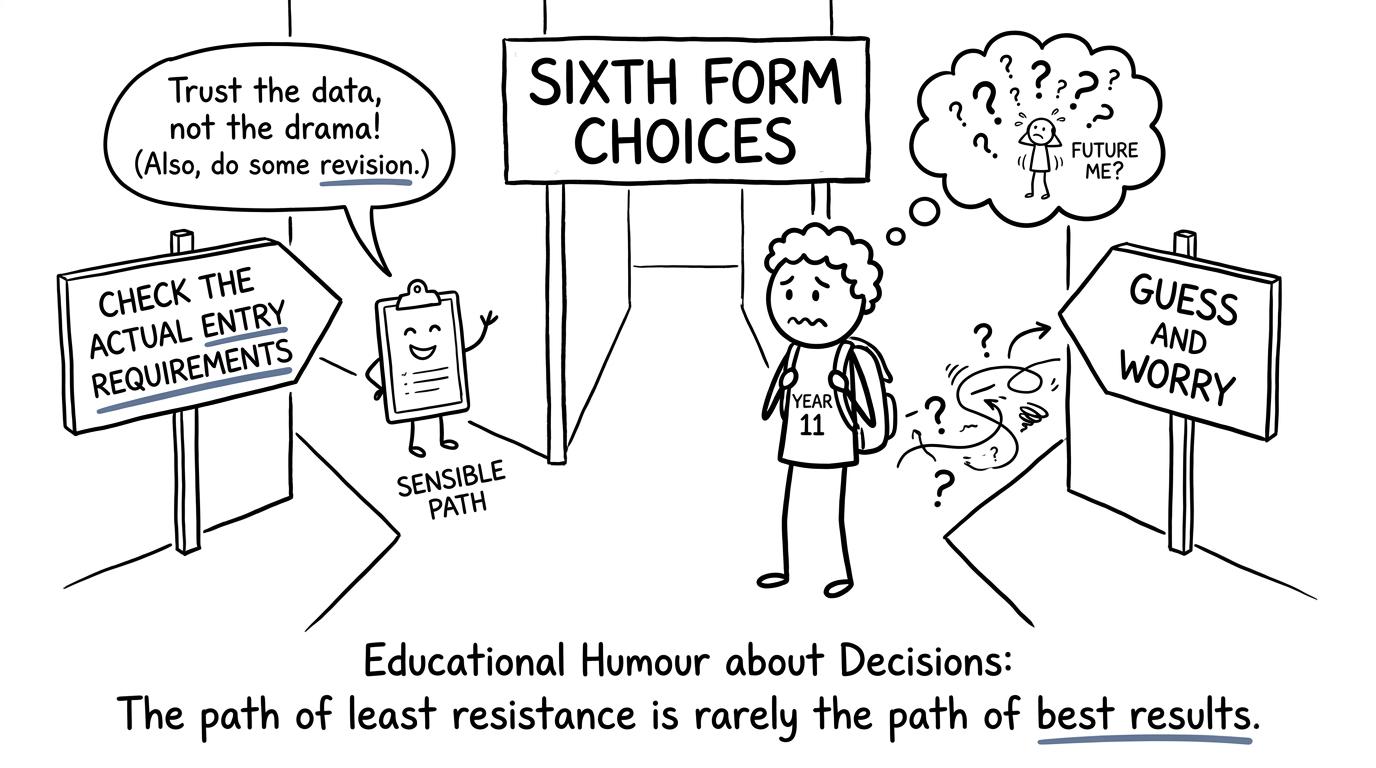 A student choosing between checking entry requirements and guessing
Is a grade 6 in GCSE Russian a good result?
Yes. A grade 6 is a solid GCSE result and sits above grades 4 and 5 on England’s grade 9-1 scale. However, the current numerical scale is not directly equivalent to the former letter system. Official guidance provides comparison points at grades 1, 4 and 7 rather than a precise letter equivalent for every grade.
More importantly, “good” depends on purpose.
If your chosen sixth form asks for grade 6 in Russian, your result meets that subject threshold. If it asks for grade 7 or 8, the same result falls short of its published requirement. Neither fact changes the quality of the work you did; it changes what that particular institution permits.
Current entry policies illustrate this variation. Some schools publish grade 6 as the requirement for A Level Russian or modern foreign languages. More selective providers may expect grade 7, 8 or 9, or assess applicants through an entrance task and interview. Government careers guidance also advises that A Level students will normally need five GCSEs at grades 9-4 and around grade 6 in the subjects they intend to continue, while stressing that exact requirements belong to the school or college.
So there is no universal national rule saying that every A Level Russian course must accept grade 6.
What the A Level Russian specification requires
The qualification and the sixth form are responsible for different things.
Pearson Edexcel’s A Level Russian specification does not impose a formal GCSE entry grade. It says that students likely to benefit will normally have prior Level 2 learning, such as GCSE Russian. Assessment is conducted in Russian and develops listening, reading, translation, writing, cultural analysis and speaking.
The exam board therefore defines the qualification. The sixth form decides whom it admits to the course.
That distinction explains why two schools offering the same Edexcel A Level can publish different entry thresholds. One may accept grade 6 because its department believes that students at that level can progress with appropriate work. Another may ask for grade 8 because of course pace, competition for places or its admissions policy.
Ask what the published grade really means
When you contact a sixth form, ask a precise question:
Is grade 6 in GCSE Russian sufficient for admission to A Level Russian, provided I also meet the general sixth form requirements?
You can then ask whether the department considers:
- a teacher reference;
- performance across speaking, listening, reading and writing;
- an admissions assessment;
- experience speaking Russian outside school;
- predicted grades if you are applying before results day;
- applications from students who narrowly miss the requirement.
Do not assume flexibility, but do not assume an automatic rejection either. Ask before removing a course from your plans.
Your whole GCSE profile still matters
A sixth form application is usually tested against more than one threshold.
A provider might require a minimum number of GCSEs at grades 9-4 or 9-5, a particular average or total grade profile, and specific grades in English and maths. It can then add individual conditions for each A Level. Meeting the Russian requirement does not automatically satisfy the general requirement.
Imagine a student who has grade 6 in Russian but wants to take Russian, chemistry and maths. The relevant questions are separate:
- Is grade 6 sufficient for Russian?
- Are the science grades sufficient for chemistry?
- Is the GCSE maths grade high enough for A Level Maths?
- Does the complete set of results meet the sixth form’s overall rule?
This is not a worked mathematical example. It is an admissions map: each condition must be checked independently.
A Level Maths often has a higher GCSE subject threshold than many other A Levels. Published school policies commonly ask for grade 7, while Further Maths may require grade 8 or another strong indication of algebraic fluency. Your Russian result cannot replace a missing maths requirement.
If maths is part of your intended sixth form programme, use the GCSE Maths revision hub to select your exam board and tier. The full GCSE topic list by board and tier can help you identify what remains to be secured before the exams.
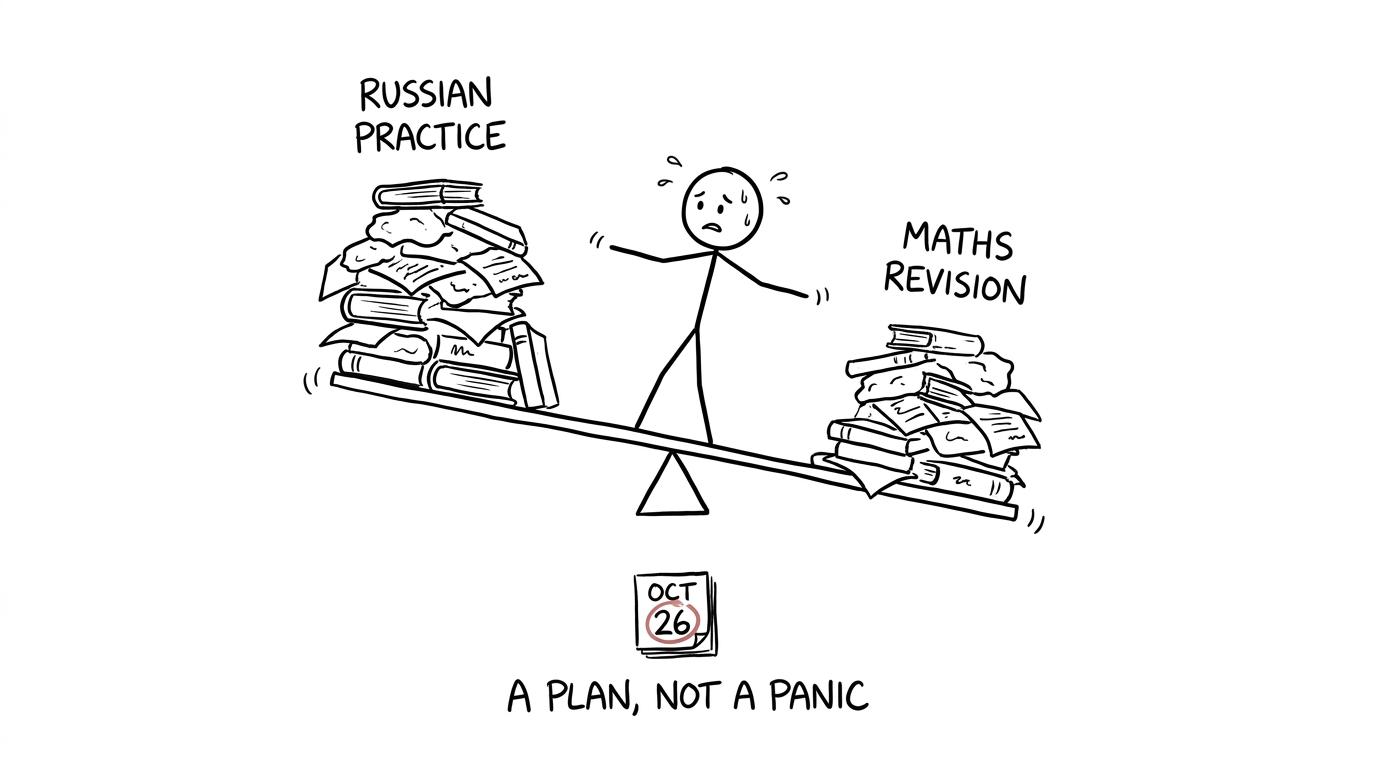 A student balancing Russian practice and maths revision
How to check whether your preferred course will accept you
Read the current admissions documents
Use the sixth form’s own website and look for:
- the admissions policy;
- course prospectus;
- general entry requirements;
- subject-specific requirements;
- oversubscription rules;
- application and results-day procedures.
Check the year carefully. Requirements can change between admission cycles, and an older prospectus may no longer describe the course you are applying for.
Separate three different questions
Students often blend these into one:
- Can I enter the sixth form? This depends on the general GCSE profile.
- Can I take Russian? This depends on course availability and the Russian requirement.
- Can I take my complete combination? This depends on the conditions for every chosen subject and whether the timetable permits it.
A “yes” to one does not guarantee a “yes” to all three.
Contact admissions if anything is unclear
Keep the message short. State your achieved or predicted Russian grade, your proposed subjects and your other relevant predicted grades. Ask whether grade 6 meets the published condition and whether any further assessment applies.
Written confirmation is useful because it replaces guesswork with information you can act upon.
Keep a sensible alternative
An alternative is not an admission of defeat. It is protection against a decision you do not control.
You could identify another provider with a grade 6 threshold, consider a related course, or ask whether Russian can be studied through another approved arrangement. Availability and funding will vary, so obtain confirmation directly from the provider before making plans.
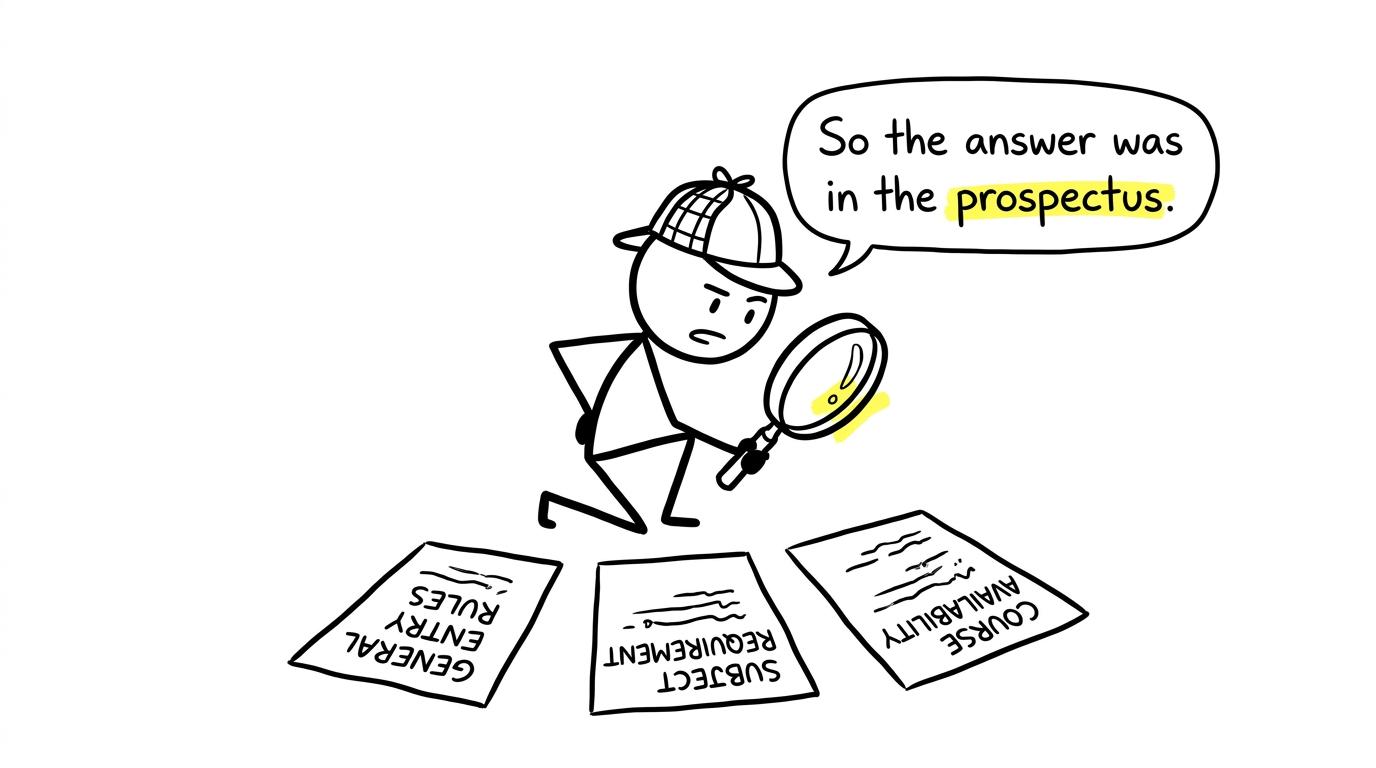 A student detective finding the answer in a prospectus
Protecting your maths grade while revising Russian
Students applying for sixth form can become so focused on one borderline subject that they neglect a wider entry condition. The solution is not to revise everything equally. It is to allocate time according to consequence and weakness.
Begin with a diagnostic maths paper or mini test. Mark it, identify the topics losing the most marks, and place those topics into the free MathsGenie revision planner. A dependable weekly cycle is:
- learn or revisit one weak topic through a revision lesson;
- complete focused practice questions;
- mark the work and record why each mark was lost;
- reattempt the difficult questions later;
- finish the week with a mini test or timed paper section.
If you follow Edexcel, use the Edexcel GCSE Maths past papers. AQA students can work from the AQA GCSE Maths revision area. Whatever your board, the principle is the same: the paper reveals the gap, but correcting the gap creates the improvement.
The GCSE one-month maths revision plan provides a manageable structure if exams are approaching. Closer to the final papers, use GCSE predicted papers alongside past papers, not instead of them.
Common mistakes when judging sixth form entry
Treating grade 6 as a universal entry ticket
Grade 6 is a common subject threshold, not a national guarantee. Every provider can publish its own lawful admissions criteria.
Looking only at the Russian grade
English, maths and the grades linked to your other A Levels may determine whether the full programme is available to you.
Confusing an exam board specification with admissions policy
Pearson can set the A Level content without setting your school’s entry grade. The provider makes the admissions decision.
Using an old prospectus
Course availability and thresholds can change. Check the document for your intended year of entry.
Assuming predicted and achieved grades are treated identically
Predicted grades may support an initial offer, while final admission normally depends on achieved results and the conditions stated by the provider.
Letting uncertainty consume revision time
One clear email can answer an admissions question. Repeatedly worrying about it cannot. Check the rule, save the response and return to the work that can still raise your results.
A grade 6 can be enough: verify the door
A grade 6 in GCSE Russian is a respectable result and is sufficient for A Level Russian at some sixth forms. It is not automatically sufficient everywhere. The decisive evidence is the current admissions policy for your chosen provider, read alongside its general GCSE requirements and the conditions for your complete subject combination.
Once you have checked those rules, focus on what remains within your control. Use MathsGenie’s free revision lessons to repair weak methods, practice questions and mini tests to build accuracy, mark schemes and video solutions to understand lost marks, and past papers and predicted papers to prepare under exam conditions.
Your Russian grade may open one door. A strong, balanced GCSE profile gives you more doors to choose from.











