Grade 5 GCSE Statistics: Enough for Sixth Form?
Grade 5 GCSE statistics sixth form guidance: see whether your result meets general and course entry rules, and what to check before applying in 2026.
A results sheet can make one number feel larger than it is. You see a grade 555 in GCSE Statistics and immediately wonder whether it has closed a door you hoped to walk through.
The short answer to the grade 5 GCSE statistics sixth form question is reassuring: a grade 555 will often contribute positively towards general sixth-form or college entry requirements. However, it does not automatically qualify you for every course. Your GCSE Maths grade, English grade, overall results and the subject-specific rules for your chosen programme may matter more.
A grade 555 in Statistics is a respectable GCSE result. The important task now is not deciding whether it is universally “good” or “bad”. It is checking whether it meets the published requirements for the course you actually want.
The quick sixth-form entry checklist
Before worrying about one result, check these five things:
- Does the sixth form count GCSE Statistics among the qualifications used for its overall entry requirement?
- How many GCSEs at grades 444, 555 or 666 does it require?
- What grades are required in GCSE Maths and English?
- Does your chosen course have separate subject-specific conditions?
- Are the published requirements guaranteed thresholds, typical offers or minimum conditions?
Current admissions policies for sixth-form entry vary considerably. Some providers ask for five GCSEs at grade 444 or above, while others expect several grades at 555 or 666. Selective providers may use an average grade or require stronger results across a larger group of subjects.
That variation is why the prospectus matters more than a general answer found online.
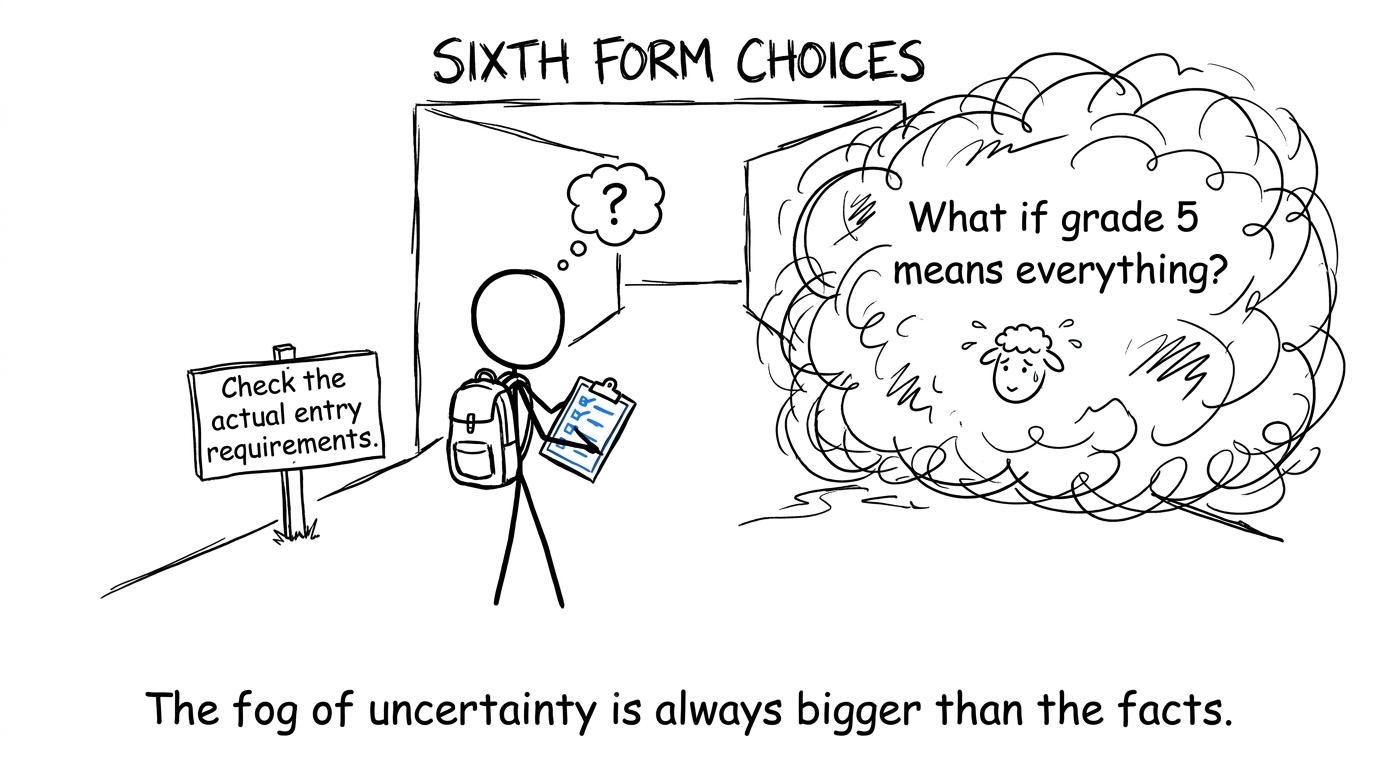 A student discovering that checking actual sixth-form requirements is more useful than worrying in a cloud of uncertainty
What does a grade 5 in GCSE Statistics mean?
GCSE Statistics is graded from 999 to 111, with 999 as the highest grade. A grade 555 sits above the grade 444 standard-pass threshold used across GCSE qualifications in England.
Statistics is tiered. Foundation tier offers grades 111 to 555, while Higher tier normally offers grades 444 to 999, with a narrow grade 333 safety net for candidates just below grade 444. A grade 555 earned on Foundation tier represents the same grade as a 555 earned on Higher tier. The certificate does not show the tier taken.
The result indicates that you have demonstrated useful knowledge of areas such as data collection, probability, sampling, interpreting diagrams and evaluating statistical conclusions. These skills can support subjects including psychology, geography, biology, economics, business and sociology.
You can review the complete course through the free GCSE Statistics revision hub, with separate resources for different exam boards.
Is a grade 5 enough for general sixth-form entry?
It can be, but one grade is rarely considered alone.
Many sixth forms set an overall requirement based on a collection of GCSE results. A typical policy might require a certain number of passes at grade 444 or 555, alongside specific grades in English and Maths. In that situation, GCSE Statistics may count as one of the qualifying subjects.
But policies differ. A provider may:
- count your best five, six or eight GCSEs;
- calculate an average grade;
- require a minimum number of grades at 666 or above;
- distinguish between A Level and vocational pathways;
- apply additional requirements to individual subjects;
- decide whether particular qualifications count within its total.
Never assume Statistics will replace GCSE Maths. They are separate qualifications, and post-161616 providers commonly state explicit conditions for GCSE Maths and English.
If a school asks for five GCSEs at grade 555 or above and accepts Statistics in that total, your Statistics result satisfies that part of the condition. It does not prove that the other four grades, English and Maths requirements, or course conditions have also been met.
Will a grade 5 get you onto the course you want?
This is the more useful question. The answer depends on the destination.
A Level Maths and Further Maths
For A Level Maths, providers normally focus on your GCSE Maths result rather than GCSE Statistics. Current published entry requirements commonly ask for grade 666 or 777 in GCSE Maths, although the exact threshold varies. More selective routes may ask for a higher grade.
Further Maths usually has a higher GCSE Maths threshold and requires you to take A Level Maths as well. A grade 555 in Statistics can show relevant interest and data-handling ability, but it is unlikely to override a missing GCSE Maths requirement.
If this is your intended route, compare your Maths result with the provider's exact policy and explore the A Level Maths revision resources to understand the transition ahead.
Psychology, sciences and data-related subjects
Statistics is useful preparation for subjects that involve evidence, experiments and data interpretation. That does not mean every department uses GCSE Statistics as its formal entry measure.
Psychology courses may specify grades in GCSE Maths, English or Science. Biology, Chemistry and Physics commonly use Science and Maths grades. Economics may have a separate Maths condition, even when GCSE Economics was not taken.
A sixth form offering a dedicated statistics or data-related course might consider GCSE Statistics directly. Another may use GCSE Maths as the principal requirement. Read the subject page rather than relying only on the general admissions page.
Humanities, creative subjects and vocational courses
For courses such as History, Art, Media Studies or Sociology, your Statistics grade may simply contribute to the overall GCSE total. The provider may care more about English, a related GCSE subject, a portfolio or another course-specific condition.
Level 333 vocational and applied programmes sometimes have different overall thresholds from programmes containing three A Levels. Again, there is no single national admissions rule that makes grade 555 sufficient everywhere.
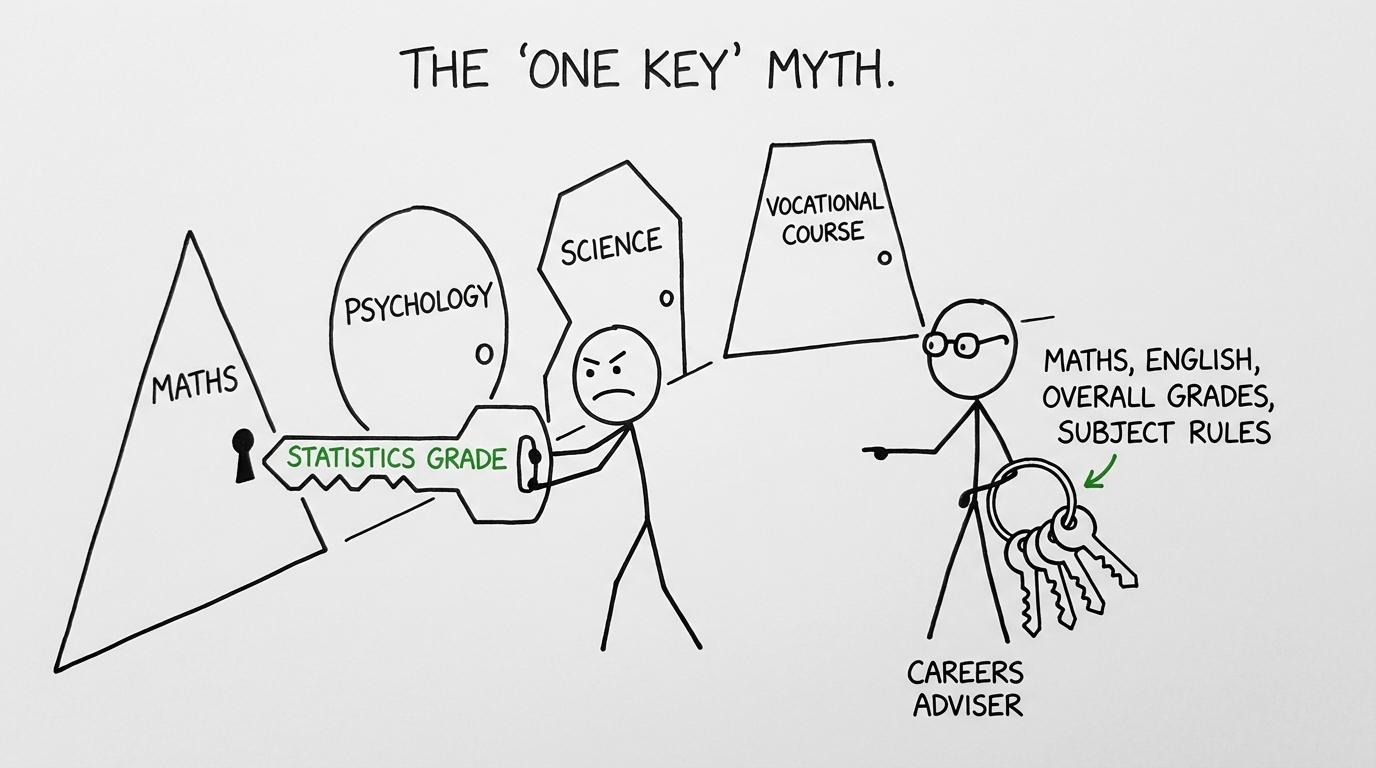 One Statistics grade cannot unlock every course door without the rest of the admissions keyring
How to check your position accurately
Create a small comparison sheet for every sixth form or college you are considering. Record:
- the general entry requirement;
- the required Maths and English grades;
- the condition for each chosen subject;
- whether GCSE Statistics counts towards the overall total;
- what happens if you miss a condition by one grade;
- the admissions team's contact details.
Use the provider's current prospectus or admissions policy for your intended year of entry. Requirements can change, so an older screenshot or a friend's experience may no longer be reliable.
If the wording is unclear, ask admissions directly. A precise question works best: “I have grade 555 in GCSE Statistics and grade XXX in GCSE Maths. Would these results meet the published entry condition for this course?”
You should also distinguish between a minimum requirement and a guaranteed place. Meeting the academic threshold may make you eligible, but availability, oversubscription rules and the provider's admissions policy can still affect an offer.
What if you are still preparing for the exam?
If the result is not yet final, treat grade 555 as a milestone rather than a ceiling. A higher grade may strengthen your overall application, especially where a sixth form uses an average or expects several grades at 666 and above.
Start with one paper from the correct board and tier. MathsGenie provides dedicated AQA GCSE Statistics revision and Edexcel GCSE Statistics revision, including questions, worksheets, papers and mark schemes.
After marking the paper, separate lost marks into clear categories:
- missing statistical knowledge;
- inaccurate calculations;
- weak interpretation;
- incomplete comparisons or conclusions;
- misreading the question;
- poor timing.
Then revise the cause, not merely the question. The GCSE Statistics grade-boundary guide can provide historical context, but future boundaries cannot be known before papers are marked. Build a margin above previous thresholds rather than aiming for one exact raw mark.
A steady revision sequence is more dependable than a dramatic final week: learn the idea, answer questions, check the mark scheme, correct the error and return to it later.
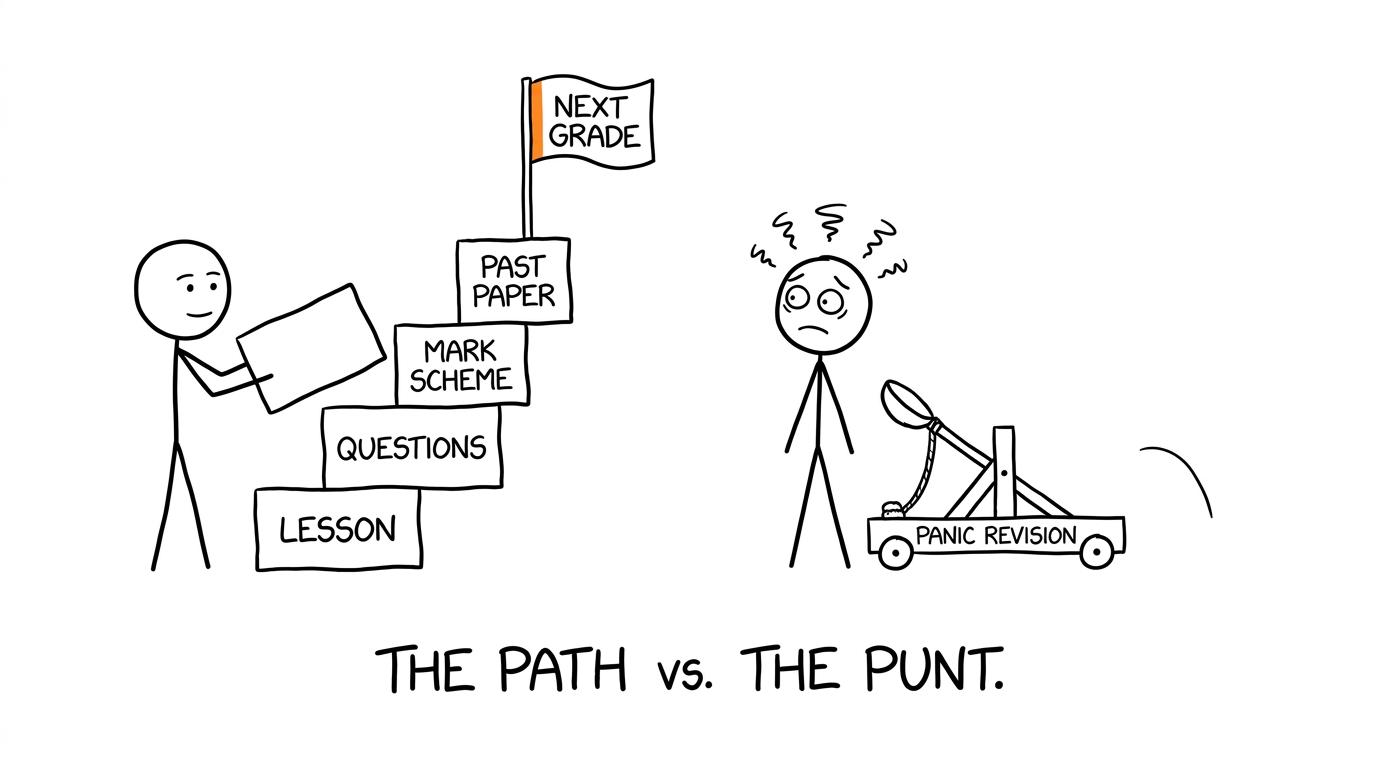 A calm revision staircase proving more useful than a panic-powered catapult
What if you already received a grade 5?
First, confirm whether it creates a real admissions problem. Do not arrange a resit simply because the result feels disappointing.
If grade 555 meets your overall and subject-specific requirements, your time may be better spent preparing for Year 121212, strengthening GCSE Maths or completing any summer transition work.
If the result blocks a particular route, speak to the sixth form before making assumptions. Ask whether it considers the complete grade profile, whether an alternative course combination is available, and whether a resit would change your eligibility.
If the result was unexpectedly low, follow the practical steps in GCSE Statistics lower-grade guidance. This includes checking marks and boundaries, discussing the result with your school and deciding whether a review or resit is appropriate.
Common mistakes when judging a grade 5
Treating Statistics as a substitute for Maths
GCSE Statistics and GCSE Maths are separate qualifications. A course requiring grade 666 in GCSE Maths will not normally be satisfied by grade 666 in Statistics unless its published policy explicitly says so.
Looking only at general entry requirements
You might meet the sixth form's overall threshold but miss the separate requirement for Maths, Physics, Psychology or another chosen subject. Check both layers.
Assuming every sixth form follows the same rules
Admissions conditions are set by individual schools and colleges. One provider may accept your profile while another asks for higher grades.
Calling grade 5 a failure
A grade 555 is above the standard-pass threshold. Whether it is enough is a question about a particular destination, not your intelligence or potential.
Ignoring your GCSE Maths result
For many quantitative A Levels, GCSE Maths carries more admissions weight than GCSE Statistics. If Maths needs attention, use the GCSE Maths revision hub for board-specific resources covering Edexcel, AQA, OCR and Eduqas.
Revising without diagnosing lost marks
Repeating comfortable questions creates activity, not necessarily improvement. A structured GCSE maths revision timetable can help you combine topic practice, feedback and timed papers.
Your next decision matters more than one number
A grade 555 in GCSE Statistics is often enough to make a useful contribution to a sixth-form application. It may satisfy one part of an overall entry profile, and it reflects statistical skills that remain valuable across many courses.
But it cannot answer the whole admissions question by itself. Check the current general requirements, the conditions for your chosen subjects and, especially, any specified GCSE Maths grade. If you are close to a threshold, contact the provider rather than guessing.
Then turn uncertainty into a practical revision plan. Start with MathsGenie's free GCSE Statistics resources, choose your exam board and use revision lessons, practice questions and mini tests to repair weak areas. Build confidence with past papers, predicted papers, mark schemes and video solutions. One result may influence the route, but your next informed step is what keeps the journey moving.