Grade 5 GCSE Further Maths: Enough for Sixth Form?
Grade 5 GCSE Further Maths sixth form entry depends on the course. Learn which grade matters, how to check requirements and what to do after results day.
The envelope opens, the results appear, and one number suddenly seems to carry the weight of your whole sixth-form plan. If you are asking whether a grade 555 GCSE Further Maths sixth form application is good enough, the short answer is: it may be, but the grade that usually matters most is your main GCSE Mathematics grade and the entry requirement for your chosen course.
A grade 555 in Further Maths does not automatically prevent you from entering sixth form. It may satisfy a general admissions rule or support an application for many non-maths subjects. However, A Level Mathematics commonly has a higher subject-specific requirement, while A Level Further Mathematics may require an even stronger main GCSE Mathematics grade. Every school and college sets its own conditions, so the published course requirements must make the final decision.
The quick sixth-form entry checklist
Before worrying about one result, check these five things:
- Your main GCSE Mathematics grade: this is usually more important than your Further Maths result.
- The general sixth-form requirement: for example, a specified number of GCSEs at certain grades, often including English and Mathematics.
- The course-specific requirement: A Level Mathematics, Physics or Further Mathematics may have separate conditions.
- Which qualification you took: what schools call “GCSE Further Maths” may officially be a Level 222 certificate or another additional maths qualification.
- Whether the requirement is absolute: some providers consider near-misses, waiting-list places, aptitude tests or individual circumstances.
Write down the exact wording from each provider rather than relying on what a friend remembers. Admissions decisions turn on published criteria, not playground averages.
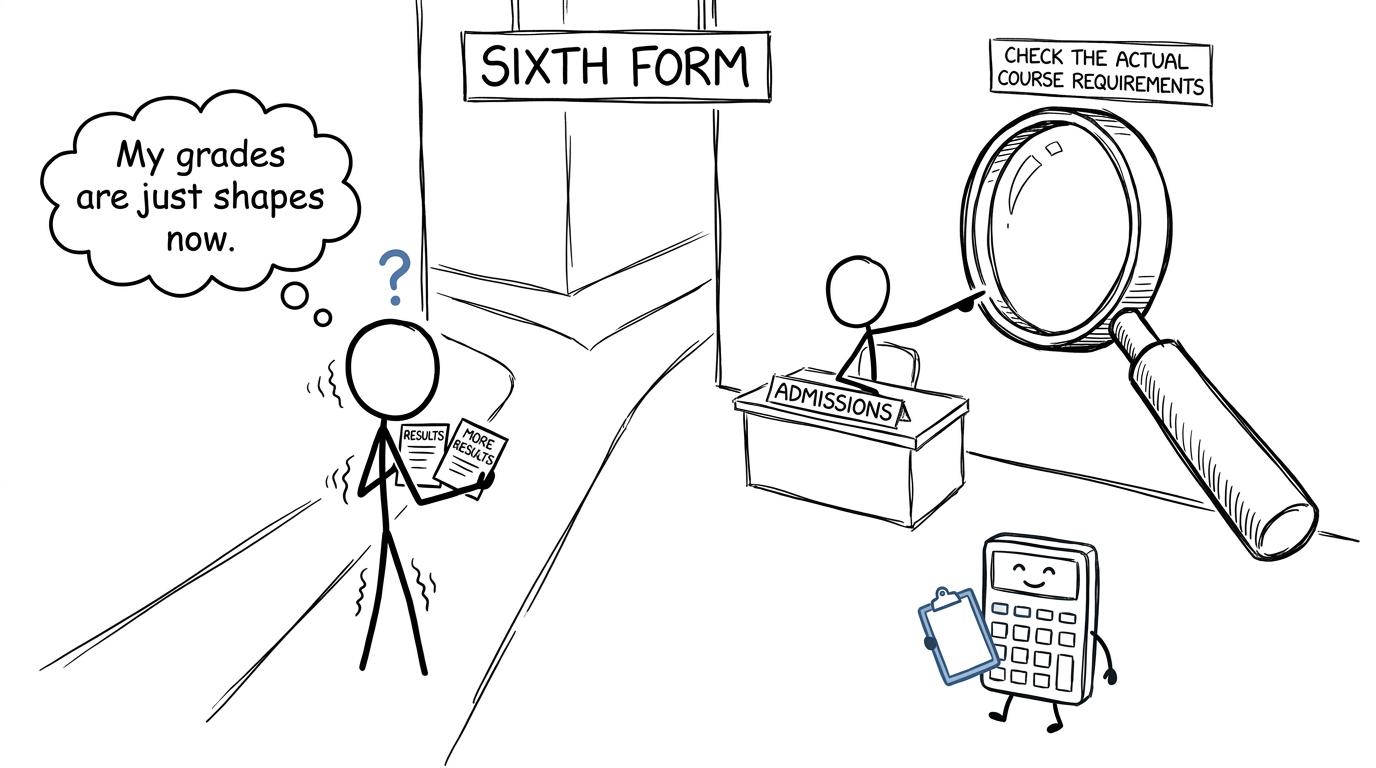 A student discovers that checking the actual course requirements is more useful than guessing
Is grade 5 in GCSE Further Maths good?
A grade 555 is a recognised result in a demanding additional maths qualification. It shows that you have engaged with material beyond ordinary GCSE Mathematics, potentially including deeper algebra, functions, coordinate geometry, trigonometry, matrices or introductory calculus, depending on your specification.
For example, the AQA Level 222 Certificate in Further Mathematics is an untiered additional qualification. AQA describes it as being intended for learners expected to achieve grades 777, 888 or 999 in GCSE Mathematics and who may progress to Level 333 mathematics. It is not a replacement for GCSE Mathematics.
That context matters. A grade 555 in an extra qualification should not be read as if it were a grade 555 in the main GCSE. You attempted a course designed to stretch stronger mathematicians. At the same time, sixth forms are entitled to decide that A Level Mathematics or Further Mathematics requires greater fluency than this result alone demonstrates.
The calm conclusion is that grade 555 is neither a disaster nor a universal passport. Its meaning depends on the course beside it and, especially, your standard GCSE Mathematics result.
Which grade will sixth forms actually use?
Admissions usually involve two separate gates.
General entry to the sixth form
A school or college may ask for a particular collection of GCSE results, with minimum grades in English Language and Mathematics. A grade 555 in Further Maths could count as one of your Level 222 qualifications if the provider recognises that qualification within its admissions policy.
This can make it useful even when you do not plan to continue with maths. It may strengthen the overall set of results used for courses such as history, geography or business. But you must check whether the provider counts your exact qualification and whether it has additional requirements for the subjects you want.
Entry to an individual A Level
Subject requirements can be higher than the general sixth-form threshold. Current published examples differ between providers, but grade 777 in main GCSE Mathematics is a frequent requirement for A Level Mathematics. Some providers consider grade 666 applicants in particular circumstances, while others maintain a firm grade 777 threshold.
For A Level Further Mathematics, published requirements are often higher still. Some sixth forms ask for grade 777 in GCSE Mathematics, while others specify grade 888. Students normally study A Level Mathematics alongside A Level Further Mathematics.
This means a student with grade 555 in GCSE Further Maths and grade 888 in main GCSE Mathematics may meet an A Level Further Mathematics requirement at some providers. A student with grade 555 in Further Maths and grade 666 in main GCSE Mathematics may not qualify for A Level Mathematics at a provider requiring grade 777.
The main GCSE Mathematics grade is often the hinge on which the door turns.
Is grade 5 enough for the course you actually want?
The answer changes according to your destination.
A Level Mathematics
Look first for a requirement written specifically as “GCSE Mathematics”. Do not assume that a Further Maths qualification replaces it. If the course asks for grade 777 and your main GCSE Mathematics result is grade 777 or above, a grade 555 in Further Maths may not block your application.
If your main result is below the requirement, contact admissions. Ask whether the provider offers an aptitude assessment, summer work, a review after enrolment or any discretion for near-miss applicants. Do not describe yourself vaguely as “good at maths”; provide your exact qualifications and grades.
You can also explore the topics waiting beyond GCSE through the free A Level Maths revision hub. Looking at the algebra and functions content can help you judge whether the course interests you enough to justify the work required.
A Level Further Mathematics
This is usually the strictest route. Providers may focus primarily on a high main GCSE Mathematics grade because A Level Further Mathematics moves quickly and is taken alongside A Level Mathematics.
Your grade 555 in Further Maths is still evidence that you have encountered additional content. It does not, however, override a stated grade 888 requirement in GCSE Mathematics. Check whether the provider wants an additional maths qualification at all; many specify only the main GCSE grade.
Physics, computer science and economics
These courses may contain substantial mathematical reasoning, but their entry conditions vary. Physics may require particular science results as well as a Mathematics grade. Computer science and economics sometimes specify Mathematics even when the student has not studied the subject at GCSE.
Read every subject page separately. General admission to the sixth form does not guarantee admission to every combination of A Levels.
Non-mathematical A Levels and vocational courses
For a course without a high subject-specific Mathematics requirement, grade 555 in Further Maths may simply form part of your overall GCSE profile. In that situation, English, your main Mathematics grade and the result in the subject closest to your intended course may carry more weight.
Different colleges also offer different Level 333 vocational and applied routes. “Not eligible for this A Level at this provider” is not the same statement as “not eligible for sixth form or college”.
How to check your position before results day
Create a short list with one row for each provider and record:
- the general admissions requirement;
- the main GCSE Mathematics requirement for your intended subject;
- any Further Maths or science condition;
- whether a near-miss can be considered;
- the admissions contact details and enrolment deadline.
Check the prospectus for your year of entry. Requirements can change, and conditions used by one sixth form do not establish a national rule for another.
If the wording is unclear, send a precise question such as: “I am applying for A Level Mathematics. If I achieve grade 666 in GCSE Mathematics and grade 555 in AQA Level 222 Further Mathematics, would I be considered?” A specific question is easier to answer accurately.
What to do if grade 5 is below the requirement
A disappointing result can feel permanent because it is printed. Your next decision is not.
First, speak to your current school and the admissions team. Confirm whether you have genuinely missed a compulsory threshold or only a recommended grade. Ask what evidence they will consider and whether another course combination remains available.
Next, diagnose the mathematical gaps rather than repeatedly revisiting the total grade. Use the GCSE Maths revision hub to select your exam board and identify weaker topics. If algebra caused difficulty, that deserves particular attention before A Level because manipulation, graphs and equations continue to matter.
For the additional qualification itself, complete an AQA Further Maths past paper, use the mark scheme and classify each lost mark. A useful cycle is:
- complete a timed section;
- mark it accurately;
- label each topic gap;
- revisit the relevant lesson;
- practise fresh questions;
- retest without notes.
The guide to using GCSE past papers properly explains how to turn a score into an error log and a practical revision plan. If you are preparing for Edexcel GCSE Mathematics, Edexcel predicted papers can provide further unseen practice after you have repaired the underlying topics.
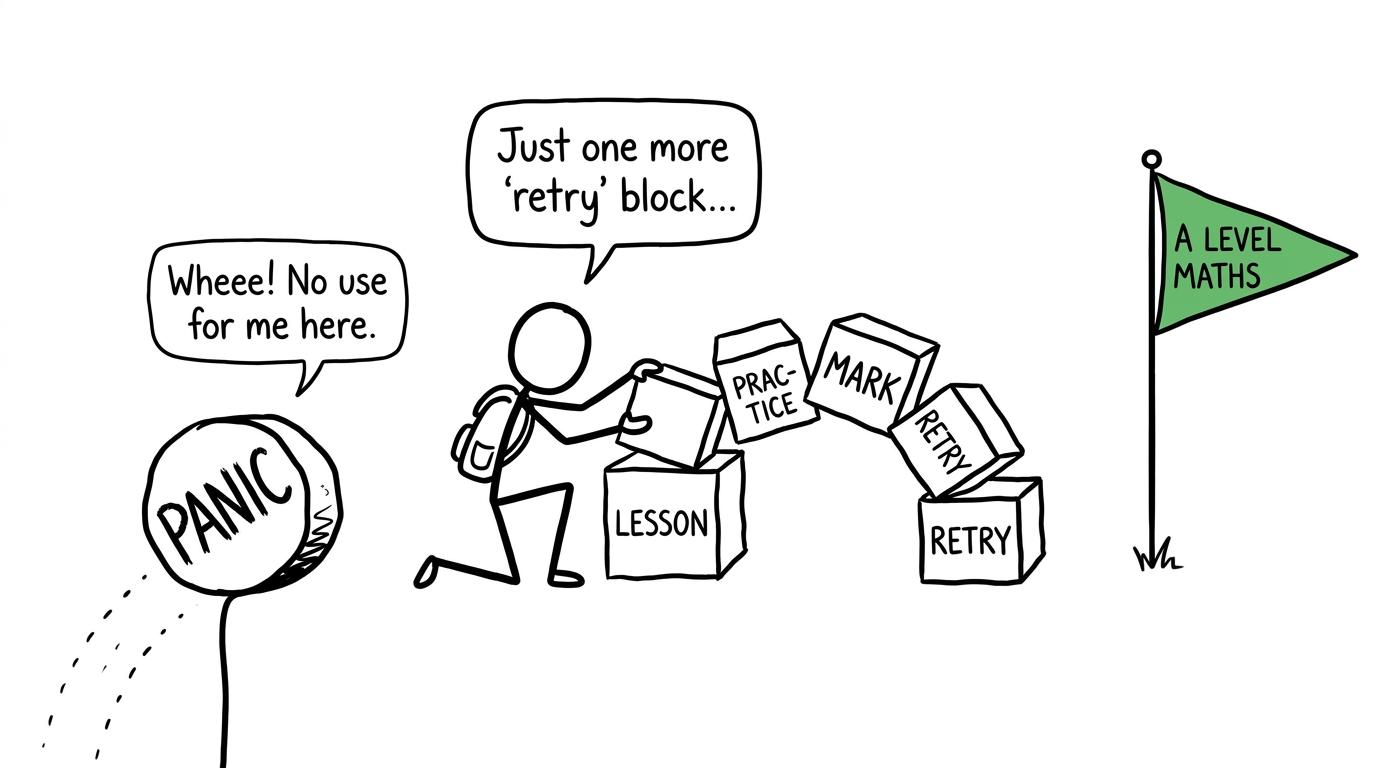 A student builds a steady bridge to A Level Maths while the panic block rolls away
Building evidence that you are ready for A Level Maths
A single grade summarises one examination series. Readiness is broader, although admissions teams must still apply their policies.
Before the course begins, focus on mathematical habits that survive harder questions:
- rearranging formulae accurately;
- factorising and solving quadratics;
- working confidently with indices and surds;
- interpreting functions and graphs;
- showing a logical chain of reasoning;
- checking answers rather than trusting the first result.
Use a realistic schedule rather than a burst of anxious revision. The GCSE maths revision timetable can help you combine lessons, practice questions and timed work. If you later join A Level, board-specific resources such as OCR A Level Maths revision and AQA A Level past papers will let you continue the same learn-practise-mark-fix cycle.
Common mistakes when judging a grade 5 result
Treating Further Maths as the main GCSE
The qualifications are separate. Check whether an entry condition refers to GCSE Mathematics, Further Mathematics or both.
Assuming every sixth form uses the same threshold
There is no single grade that guarantees entry everywhere. Compare the current criteria for each school or college on your list.
Looking only at general admissions
Meeting the sixth form’s overall requirements may not qualify you for A Level Mathematics, Further Mathematics, Physics or another course with higher subject conditions.
Deciding that one result proves you cannot do A Level Maths
A result provides evidence, but it is not a complete description of your potential. Seek accurate admissions advice, review your topic-level performance and consider every suitable route.
Revising papers without correcting mistakes
Completing more papers is not enough. The improvement happens when you use mark schemes and video solutions, repair the weak method and then attempt a fresh question independently.
Make the next decision from evidence
So, is a grade 555 in GCSE Further Maths good enough for sixth form? It can be good enough for general sixth-form entry and many courses, but it may not by itself meet the requirements for A Level Mathematics or Further Mathematics. Your main GCSE Mathematics grade and the provider’s current subject-specific policy usually matter more.
Check the exact course. Ask admissions if the wording is uncertain. Then work on the skills you can still change.
MathsGenie gives you one free place to do that: start with revision lessons, strengthen weak topics through practice questions, test yourself with mini tests, and build exam confidence using past papers, predicted papers, mark schemes and video solutions. A grade records where you finished one course. Your revision habits help decide what happens next.