Grade 4 GCSE Statistics and Sixth Form Entry
Grade 4 GCSE Statistics sixth form guidance: discover which courses it may unlock, where Maths grades matter, and how to check entry requirements.
A results sheet can turn one small number into a very large question. You see a grade 4 in GCSE Statistics and immediately wonder whether it keeps your sixth form plans alive.
If you searched for grade 4 GCSE Statistics sixth form entry guidance, the short answer is this: a grade 4 is a standard pass and may help you meet the general entry requirements for many sixth forms and colleges, but it does not guarantee admission to every course. Your GCSE Maths and English grades, overall results and subject-specific requirements may matter more.
Most importantly, GCSE Statistics is a separate qualification from GCSE Maths. A pass in Statistics does not normally replace a required grade in Maths.
The quick sixth form entry checklist
Before deciding whether your grade is enough, check:
- Does the sixth form count GCSE Statistics towards its required number of GCSE passes?
- What are its minimum grades in GCSE Maths and English?
- Does your chosen course have a separate subject requirement?
- Is admission based on your best five, six or eight GCSE results, or an average grade?
- Are there different requirements for A Levels and vocational Level 3 courses?
- Does the published policy apply to your year of entry?
- Can the admissions team consider borderline applicants individually?
The answer is rarely hidden in Statistics itself. It is usually found in the relationship between your full set of results and the exact course you want.
 A student examines the small print of sixth form choices with an enormous magnifying glass
Is a grade 4 in GCSE Statistics a good result?
Yes. A grade 4 is officially treated as a standard GCSE pass. It represents a meaningful Level 2 achievement and is aligned with the lower end of the old grade C standard.
That does not mean every institution must use grade 4 as its entry threshold. Sixth forms and colleges set their own admissions criteria. Some accept a collection of grade 4 passes for particular programmes, while others require several grades at 5 or 6. Selective sixth forms may set higher overall thresholds.
Course requirements can be higher again. An institution might accept you into its sixth form with mostly grades 4 and 5 but require a grade 6 or 7 in a related GCSE before allowing you to take a particular A Level.
So “good enough” has two meanings:
- Good enough as a recognised pass: yes.
- Good enough for a particular sixth form course: only if it meets that course's published criteria.
What a grade 4 may allow you to do
A grade 4 in Statistics can strengthen an application by adding another GCSE pass to your overall profile. Depending on the institution, it may contribute towards entry to:
- a general sixth form or college programme requiring several GCSEs at grades 9-4;
- selected A Level courses without a high subject-specific Maths requirement;
- mixed A Level and vocational programmes;
- Level 3 vocational qualifications whose general threshold begins at grade 4;
- courses where experience of data, graphs and interpretation is useful but not formally required.
Statistics develops relevant skills for subjects such as geography, psychology, biology, sociology and business. However, this does not mean a grade 4 automatically satisfies their entry conditions. Psychology, science or computer science courses, for example, may specify particular grades in GCSE Maths, English or Science.
A qualification can be useful without being the deciding qualification. That distinction matters.
Why your GCSE Maths grade often matters more
GCSE Statistics and GCSE Maths overlap in areas such as averages, probability, sampling and data presentation. They remain separate GCSEs with separate specifications and results.
If a sixth form states that applicants need grade 4 in GCSE Maths, it normally means GCSE Mathematics, not GCSE Statistics. If A Level Mathematics requires grade 6 or 7 in GCSE Maths, a grade 4 in Statistics will not usually compensate for missing that threshold.
Current sixth form entry policies illustrate how much requirements vary. Some institutions set grade 4 in Maths and English as part of general admission, while others ask for grade 5 or 6. A Level Maths commonly has a higher subject-specific threshold, often grade 6 or 7, with some providers asking for grade 8 for Further Maths. These are examples rather than national rules, so always check your chosen provider.
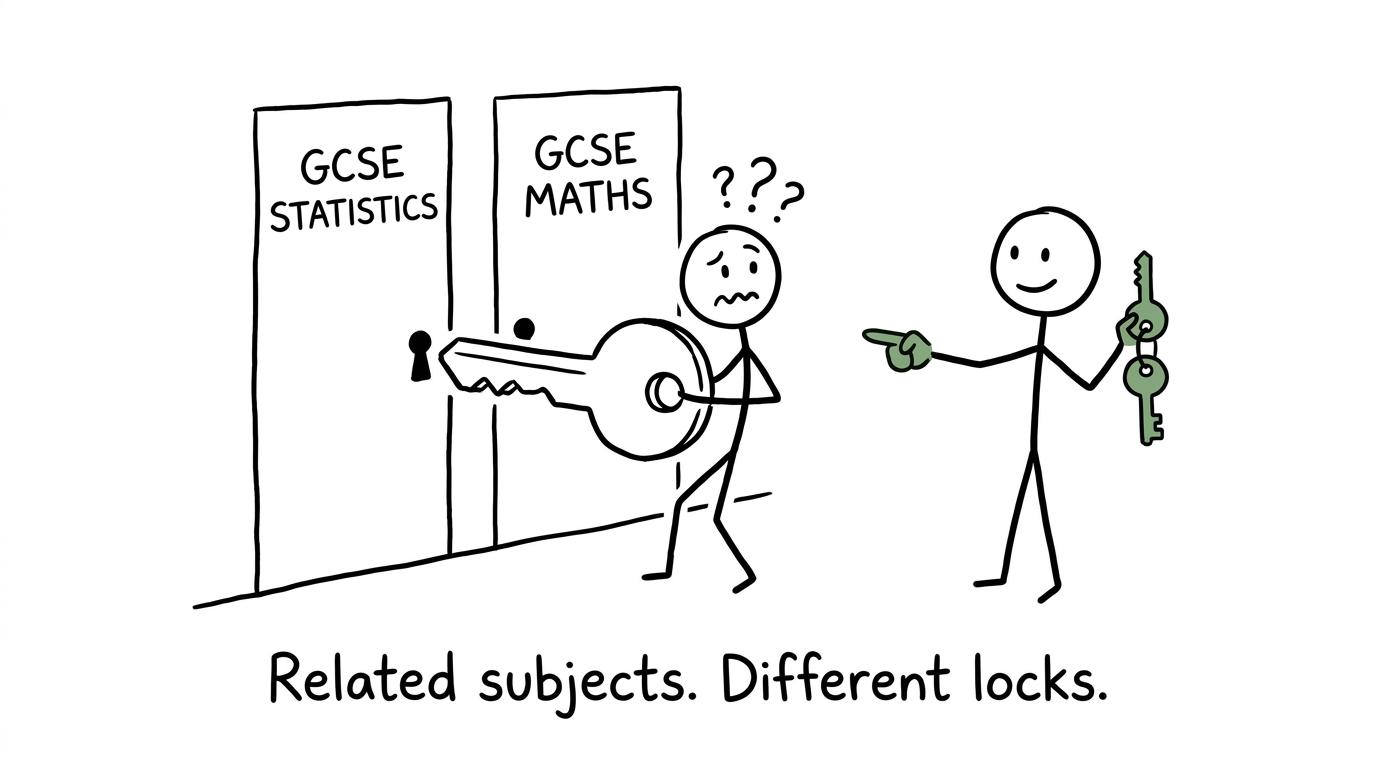 A student discovers that GCSE Statistics and GCSE Maths require different keys
If you need to strengthen your Mathematics result, begin with the free GCSE Maths revision hub. It brings together revision lessons, topic questions and board-specific resources rather than treating “Maths” as one enormous problem.
Is grade 4 enough for the course you actually want?
The course matters more than the building. Being admitted to a sixth form is not the same as being admitted to every subject it offers.
| Intended route | What to investigate |
|---|---|
| A Level Mathematics | The required GCSE Maths grade, which is usually higher than grade 4 |
| A Level Further Mathematics | The GCSE Maths requirement and whether A Level Maths must also be taken |
| Science or Computer Science | Required grades in Maths, Science or the relevant GCSE |
| Psychology, Geography or Business | Any minimum Maths, English or subject-related grade |
| Level 3 vocational course | The number of GCSE passes required and whether Maths and English must be included |
| Core Maths | The provider's GCSE Maths threshold and permitted subject combinations |
If you want to take A Level Maths
A grade 4 in GCSE Statistics by itself is unlikely to secure entry to A Level Maths. Providers generally judge readiness using GCSE Maths because A Level work depends heavily on algebra, functions, trigonometry and mathematical reasoning beyond the GCSE Statistics course.
Do not assume that being interested in data means A Level Maths is impossible, though. Ask whether the provider offers Core Maths, an alternative Level 3 route or any flexibility for a student close to its entry threshold. The answer must come from the institution, not from a general internet rule.
If you want a non-mathematical A Level
Your Statistics result may simply count as one of your GCSE passes. The provider may then focus on your English grade, overall profile or result in the subject you want to continue.
For example, an essay-based course may place more weight on English, while a science course may require stronger Science and Maths grades. Read both the general admissions policy and the individual course page.
If you want a vocational course
Some Level 3 vocational programmes accept students with several GCSEs at grade 4 or above, often including Maths and English. Others have additional conditions. A grade 4 in Statistics may contribute to the total number of passes, but it may not replace either named subject.
What if your GCSE Maths grade is below 4?
In England, students who have not achieved grade 4 in GCSE Maths are generally required to continue studying maths as part of their post-16 programme. A grade 4 in GCSE Statistics does not remove that requirement because the condition concerns GCSE Mathematics.
This does not necessarily prevent you from entering college or sixth form. It may change the programme available to you or mean that a Maths resit is included in your timetable.
Ask the provider three direct questions:
- Can I join my intended course with my current Maths grade?
- Will I need to resit GCSE Maths?
- Does GCSE Statistics count towards the total number of accepted qualifications?
Clear questions tend to produce clearer decisions.
How to verify your entry position
Start with the current prospectus or admissions policy for the year you intend to enter. Requirements can change, so an older screenshot or a friend's experience may no longer apply.
Then look for two separate sets of rules:
- general entry requirements for joining the sixth form or college;
- subject-specific requirements for each course in your proposed programme.
If anything is unclear, email admissions. Include the qualification's full title, exam board, achieved or predicted grade, your GCSE Maths grade and the course you want. Asking whether “Statistics counts” without that context can produce an incomplete answer.
It is also sensible to prepare a first-choice route and a realistic alternative. That might mean applying for a different subject combination, considering Core Maths, choosing a vocational option or improving GCSE Maths before progressing further.
How to move beyond grade 4 in Statistics
If your exam is still ahead, treat grade 4 as a checkpoint rather than a ceiling. Begin with the GCSE Statistics revision hub, then choose the page for your exam board. Edexcel students can use the dedicated Edexcel GCSE Statistics revision resources for lessons, questions, worksheets and past papers with mark schemes.
A productive revision cycle is simple:
- diagnose the topics losing marks;
- revisit the relevant lesson;
- complete practice questions without notes;
- mark them carefully;
- record why each mark was lost;
- retest the same skill after a gap;
- finish with timed paper practice.
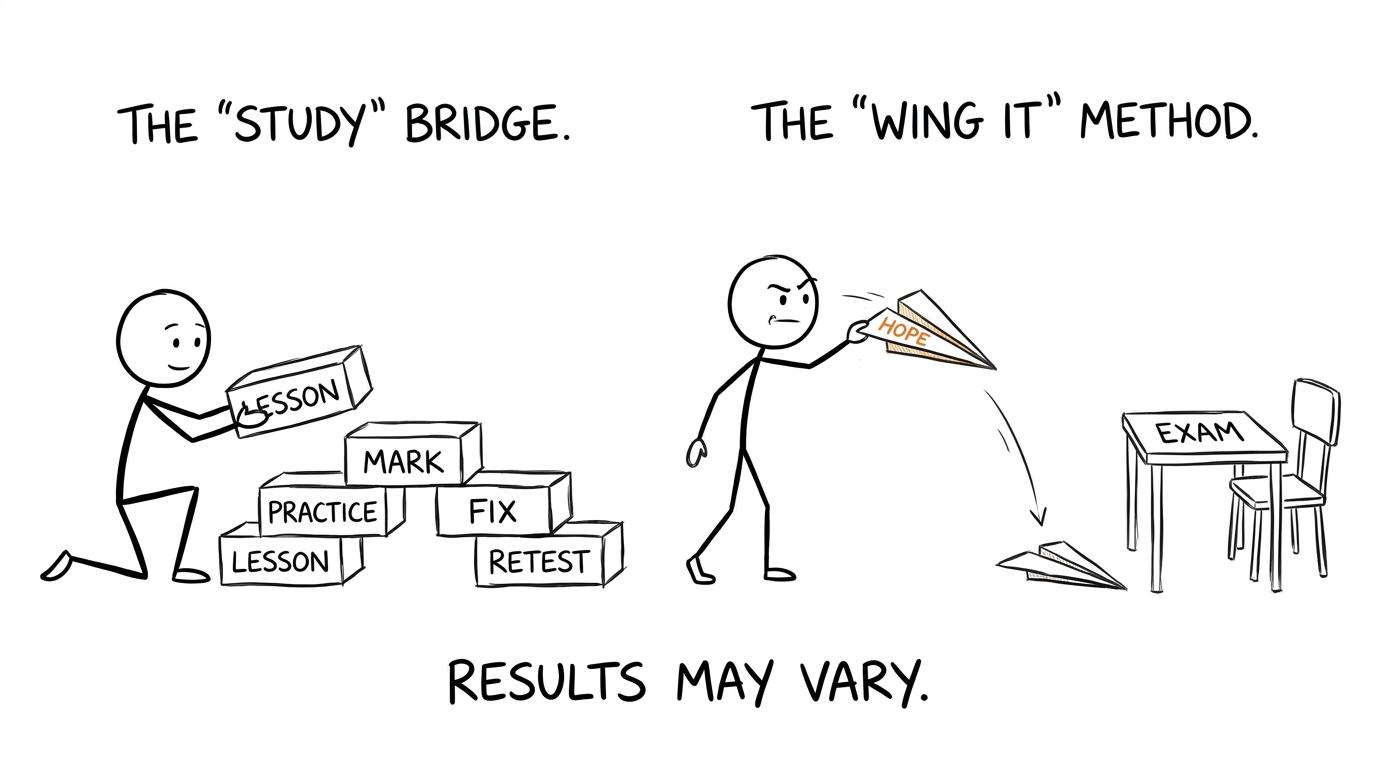 One student builds a revision bridge while another relies on a paper aeroplane labelled hope
Statistics rewards interpretation as well as calculation. Practise explaining conclusions in context, checking whether samples are representative and distinguishing correlation from causation. In related Maths content, the AQA probability revision guide can help reinforce probability reasoning.
For a manageable timetable, adapt the GCSE one-month revision plan. When using full papers, follow the mark-and-repair approach in the guide to redoing GCSE past papers effectively. Predicted papers can add fresh practice, but they should support rather than replace official past papers.
Common mistakes when judging sixth form entry
Assuming every sixth form uses the same rules
There is no single nationwide grade requirement covering every provider and course. Compare policies individually.
Treating GCSE Statistics as a replacement for GCSE Maths
The subjects are related but distinct. If an entry condition names Maths, check whether it explicitly permits another qualification.
Reading only the general admissions threshold
You might meet the minimum for the sixth form but miss the higher threshold for A Level Maths, Science or another chosen subject.
Using an outdated prospectus
Always check that the policy applies to your intended year of entry. If no date is clear, contact admissions.
Revising only comfortable topics
Repeating familiar questions feels productive but often protects your weaknesses. Use a past paper or mini test to identify the topics that genuinely cost marks. The recommended order for learning GCSE Maths topics can help you repair foundational skills systematically.
Your next step
A grade 4 in GCSE Statistics is a worthwhile standard pass. It may count towards sixth form admission and support applications to a range of courses. But the decisive question is not simply whether grade 4 is “good”. It is whether your full result profile meets the published requirements for your chosen provider and subjects.
Check the policy. Check the course page. Ask admissions when the wording is unclear. Then keep improving what remains within your control.
MathsGenie gives you a free place to do that: revision lessons for understanding, practice questions and mini tests for accuracy, past papers for realism, and predicted papers, mark schemes and video solutions for focused exam preparation. Start with your Statistics or Maths revision page today, identify one weakness and turn it into your next secure set of marks.