Grade 4 GCSE Further Maths: Enough for Sixth Form?
Grade 4 GCSE Further Maths sixth form guidance: check entry rules for A Level Maths, Further Maths and other courses, plus your best next steps.
A result can feel much larger when it appears beside a decision about your future. For a grade 4 GCSE Further Maths sixth form application, however, the answer is not simply yes or no. A grade 4 may be enough for general sixth form entry or for courses that do not demand a higher maths grade. It is unlikely, by itself, to meet the usual entry requirement for A Level Maths or A Level Further Maths. The crucial detail is that most providers base those decisions primarily on your ordinary GCSE Maths grade, not your Further Maths result.
That distinction matters. Your grade 4 does not automatically close the sixth form door. It tells you which entry requirements to check and where an honest conversation with the admissions team may be needed.
The short answer
Use this checklist before making assumptions:
- Check the sixth form's general entry requirements.
- Check the separate requirements for the course you want.
- Confirm whether the published requirement refers to GCSE Maths, GCSE Further Maths or both.
- Identify the exact Further Maths qualification on your results slip.
- Ask whether a lower Further Maths grade is considered if your GCSE Maths grade is stronger.
- Contact admissions rather than relying on another student's experience.
Published requirements differ between schools and colleges. Current examples commonly ask for GCSE Maths grade 6 or 7 for A Level Maths, while A Level Further Maths often requires grade 7 or 8 and must normally be taken alongside A Level Maths. Some selective providers set a still higher threshold. These are common patterns, not national rules.
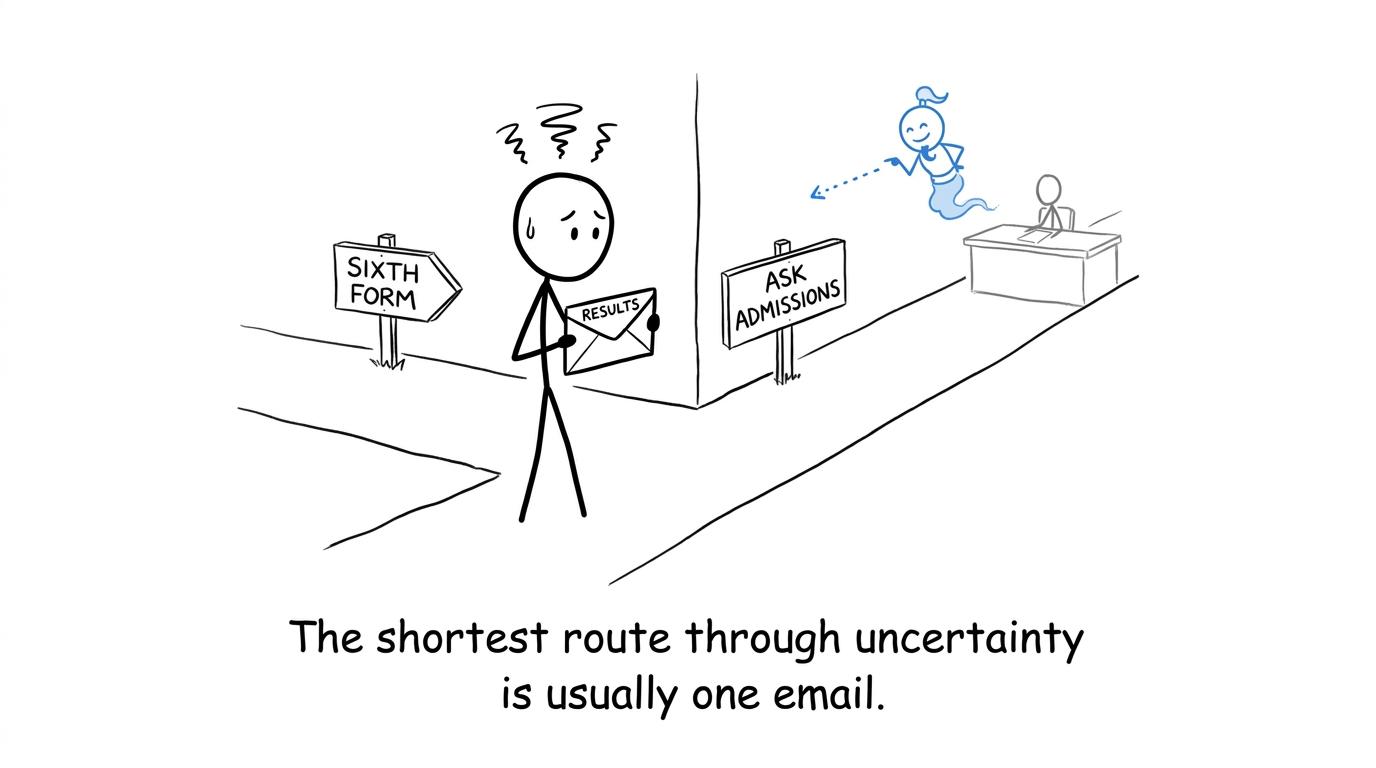 A student discovers that one email can shorten the route through sixth form uncertainty
What does a grade 4 in GCSE Further Maths mean?
First, check what qualification you actually took. Schools sometimes use “GCSE Further Maths” as a convenient label for different qualifications.
A common option in England is the AQA Level 2 Certificate in Further Mathematics. It is not formally a GCSE, although it uses grades 9 to 4 and is commonly studied during Key Stage 4. It is an untiered Level 2 qualification covering extended algebra and geometry alongside introductory calculus and matrices. AQA describes it as being intended for learners who are expected to achieve grades 7, 8 or 9 in GCSE Maths and who may progress to A Level Maths.
A grade 4 is therefore an awarded grade in a demanding additional qualification. It is also the lowest available passing grade for that AQA certificate. Those two facts can coexist: you passed extra mathematics, but the result may suggest that some higher-tier algebra and problem-solving skills need strengthening before A Level.
Other qualifications are different. OCR Additional Mathematics, for example, is a Level 3 Free Standing Mathematics Qualification graded from A to E. Do not convert its grades informally into GCSE numbers. Read the full qualification title and exam board on your statement of results.
Is it enough for the sixth form course you want?
The word “enough” only makes sense when attached to a particular course. Sixth forms usually have both general admission criteria and subject-specific criteria.
General sixth form or college entry
A grade 4 in Further Maths may be perfectly acceptable for general entry if you meet the provider's wider requirements. These may include a specified number of GCSEs at grades 9 to 4 or 9 to 5, together with minimum grades in GCSE English Language and GCSE Maths.
An optional Further Maths result is only one part of that profile. It does not usually cancel stronger results elsewhere. Admissions teams may consider your overall grades, the subjects you wish to take and whether places remain available.
A Level Maths
For A Level Maths, your GCSE Maths grade is usually the decisive result. Recent published entry criteria show that providers commonly ask for grade 6 or 7, although requirements vary.
Consider the possibilities separately:
- A grade 4 in Further Maths with a grade 7 or higher in GCSE Maths may still satisfy a provider whose stated rule refers only to GCSE Maths.
- A grade 4 in both qualifications is unlikely to meet the normal entry requirement for A Level Maths.
- A grade 6 in GCSE Maths may be accepted by some providers but fall below the threshold at others.
- A conditional offer does not override the grades required on results day unless the provider agrees to make an exception.
A Level Maths begins with familiar ideas but develops them quickly. Secure manipulation of expressions, equations, graphs, trigonometry and proof matters more than simply having encountered introductory calculus early. Use the GCSE Maths revision hub to check whether those foundations are reliable.
A Level Further Maths
A Level Further Maths usually has the highest mathematical entry threshold. Current sixth form criteria frequently ask for grade 7 or 8 in GCSE Maths, with some providers requiring grade 9 or a very strong grade 8. Students must normally study A Level Maths alongside it.
A grade 4 in Level 2 Further Maths is unlikely to strengthen this application, but it may not be an automatic rejection if the published rule only specifies GCSE Maths. The provider may look at your ordinary GCSE Maths grade, algebraic fluency, teacher recommendation or an internal assessment.
Do not treat “not required” as “not considered”. Ask a precise question:
I achieved grade 4 in Level 2 Further Maths and grade [your grade] in GCSE Maths. Do I meet the entry requirement for A Level Further Maths, and is the Level 2 result considered separately?
That wording gives admissions staff the information needed to answer properly.
Sciences, economics and computing
Mathematical subjects outside A Level Maths can have their own requirements. Physics, chemistry, economics and computer science may ask for a particular GCSE Maths grade even when Further Maths is not required.
Read each course entry separately. Meeting the sixth form's general threshold does not guarantee admission to every subject combination. Equally, a grade 4 in Further Maths should not prevent entry where the course only requires, for example, a specified result in GCSE Maths or science.
Core Maths and vocational courses
If A Level Maths is not the right route, that does not mean abandoning mathematics. Some providers offer Core Maths, a Level 3 qualification focused on applying mathematical and statistical reasoning beyond GCSE. Entry requirements vary and it is not a substitute for A Level Maths where a university course specifically requires that subject.
Vocational and mixed programmes may also have different thresholds. Compare the actual content and progression routes rather than choosing a course solely because its entry grade is accessible.
Why GCSE Maths usually carries more weight
Level 2 Further Maths is generally an additional qualification taken by a smaller group of students. GCSE Maths is the common baseline used across applicants, so it gives sixth forms a more consistent measure for course entry.
This is why two grades with similar names can play different roles. Your GCSE Maths result often determines eligibility. Your Further Maths result provides extra context about your experience with advanced material.
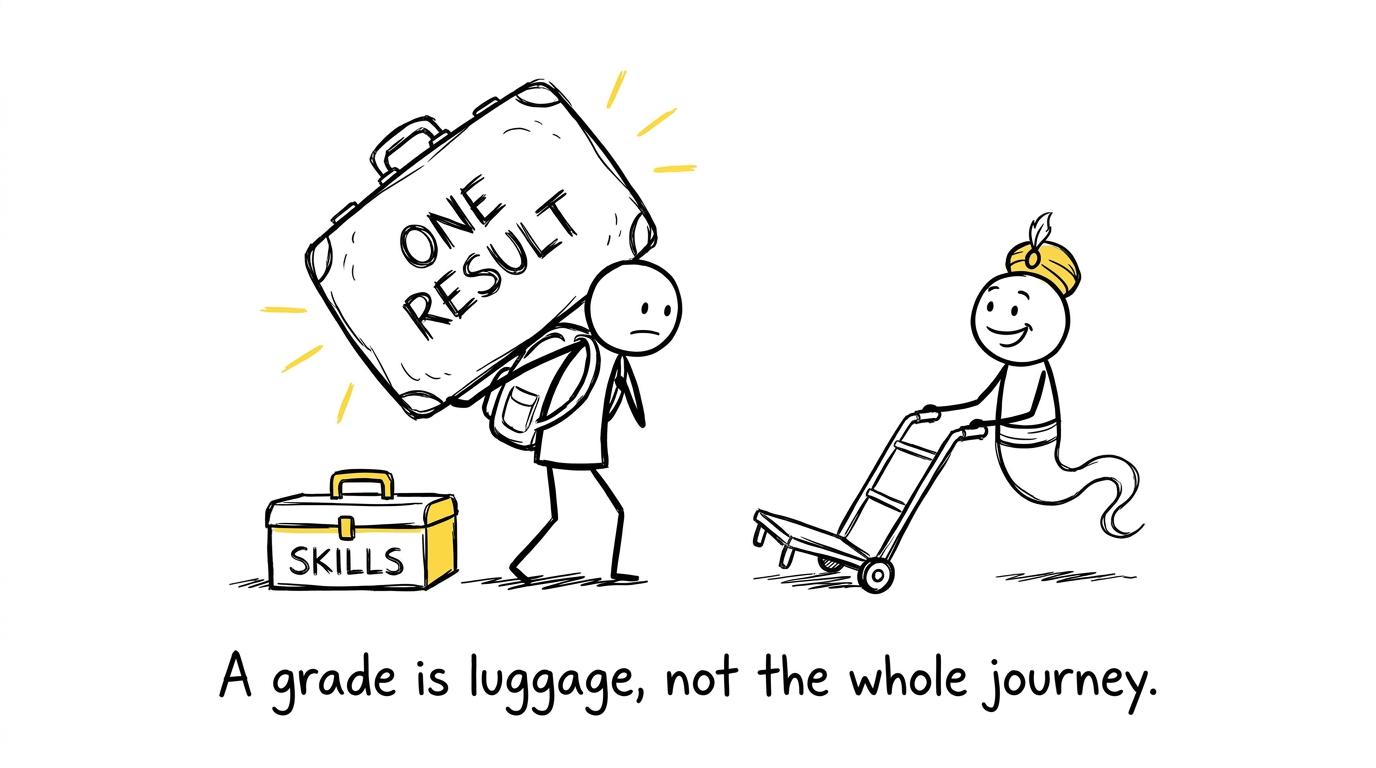 A student learns that one grade is luggage rather than the whole journey
A lower additional result may show that you found the extension course difficult. It does not erase what you achieved in GCSE Maths. Conversely, passing Further Maths does not compensate automatically for missing a provider's stated GCSE Maths threshold.
What to do before results day
Check the written policy
Find the latest prospectus, admissions policy or course page for the year you intend to enter. Requirements can change, so an older screenshot or a friend's offer may be misleading.
Record three things:
- the general sixth form threshold;
- the subject-specific GCSE Maths requirement;
- any rule concerning Further Maths, entrance assessments or teacher recommendations.
If the wording is unclear, email admissions and keep the reply.
Build evidence of stronger foundations
If you are still preparing for your exams, concentrate first on GCSE Maths because it is likely to control your options. Select the correct board and tier through MathsGenie's GCSE topics by exam board and tier.
For a student considering A Level Maths, useful priorities include:
- manipulating and factorising algebraic expressions;
- solving linear, quadratic and simultaneous equations;
- rearranging formulae accurately;
- understanding functions and graphs;
- using trigonometry confidently;
- presenting multi-step reasoning clearly.
Harder topics such as quadratic simultaneous equations can expose weaknesses in substitution, expansion and solving quadratics. The value is not in collecting difficult topic names. It is in discovering which underlying skill breaks first.
Revise through feedback, not hope
Start with a board-matched paper or mini test. Mark it carefully, classify every lost mark and repair the relevant topic. The MathsGenie past papers area brings papers and official mark schemes together, while this guide explains how to use GCSE past papers properly.
Use the cycle:
- attempt under realistic conditions;
- mark using the mark scheme;
- identify the first incorrect step;
- revisit the revision lesson;
- complete focused practice questions;
- retest without notes.
The MathsGenie revision planner can turn that cycle into a manageable schedule. Consistent correction is more useful than repeatedly completing papers without investigating the lost marks.
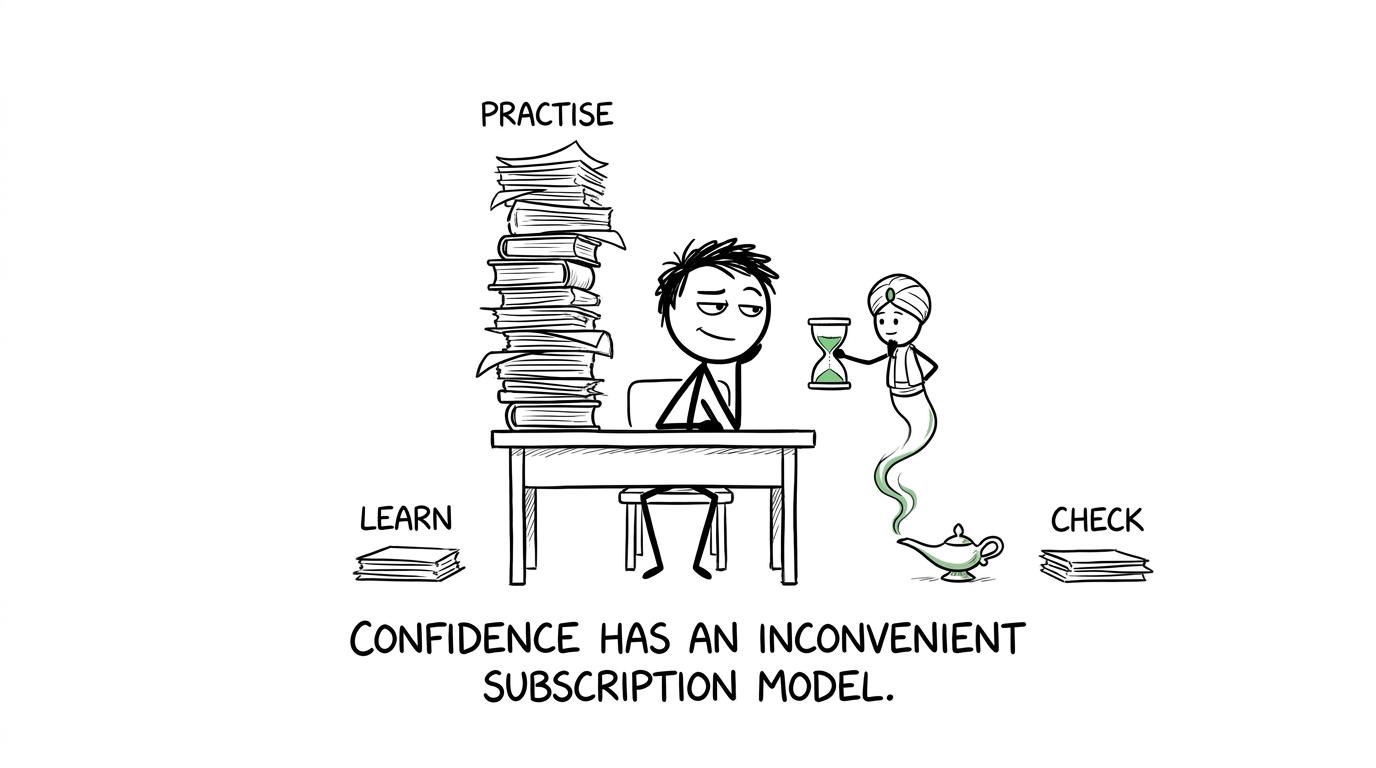 A revision desk reveals that the practice pile is always the largest
What if you miss the entry requirement?
Speak to the provider immediately. Do not assume the answer, positively or negatively.
Ask whether it offers:
- discretion for applicants who narrowly miss the threshold;
- an internal assessment or transition task;
- a place on A Level Maths without Further Maths;
- Core Maths or another suitable Level 3 pathway;
- the possibility of changing subjects after enrolment.
An exception is never guaranteed. Course capacity and admissions policies matter. If A Level Maths remains your goal, compare several local providers because their thresholds can differ.
You should also be realistic about readiness. Admission is one hurdle; coping with the course is the longer journey. Explore the A Level Maths revision hub to see the scale and style of the material before committing. Finding it challenging is normal. Finding the prerequisite algebra consistently inaccessible is a reason to rebuild first.
Common mistakes when judging your options
Confusing GCSE Maths with Further Maths
A provider asking for grade 7 in GCSE Maths is not necessarily asking for grade 7 in Level 2 Further Maths. Quote both results when seeking advice.
Looking only at general admission rules
Being eligible for the sixth form does not mean you meet the requirement for A Level Maths, Further Maths or another demanding subject.
Assuming every sixth form uses the same threshold
There is no single national entry grade for these courses. Schools and colleges set their own admissions criteria.
Treating a grade 4 as either meaningless or disastrous
It is an awarded result in additional mathematics, but it may also indicate gaps that matter at A Level. Both interpretations are more useful than attaching a label such as “good” or “bad”.
Revising only Further Maths content
If progression depends mainly on GCSE Maths, protect that result first. Secure algebra, graphs and trigonometry before spending most of your time on extension material.
Make the next decision from evidence
A grade 4 in GCSE Further Maths can be enough for sixth form in general and for many courses. It is unlikely to be sufficient on its own for A Level Maths or Further Maths, where providers commonly require a stronger GCSE Maths result. The final answer belongs to the admissions policy of the school or college you want to attend.
Check that policy, share both maths grades and ask directly if anything is unclear. Then turn uncertainty into preparation. Start with MathsGenie's free revision lessons, diagnose gaps through mini tests and practice questions, and build towards predicted papers and full past papers. Use the mark schemes and video solutions to understand where marks are earned. One result may shape the next step, but disciplined revision can still shape the result.