

Grade 4 GCSE Art and Design: Sixth Form Entry
Grade 4 GCSE Art and Design sixth form entry explained: check A Level requirements, portfolios, maths grades and practical next steps before results day.
A GCSE result can look like one number while carrying several different meanings. It can be a pass, an entry requirement, a near-miss or simply one part of a much larger application.
For students searching grade 4 GCSE Art and Design sixth form requirements, the short answer is this: a grade 4 may be enough for some A Level or Level 3 Art and Design courses, but it is not enough everywhere. Some providers accept a grade 4, sometimes alongside a portfolio. Others ask for a grade 5 or 6. You must also meet the sixth form or college's general entry requirements, which commonly include GCSE English and maths.
That makes the question less about whether grade 4 is universally good enough and more about whether it meets the rules for the course you actually want.
Your sixth form entry checklist
Before changing your plans, check these five things:
- the provider's general sixth form or college entry requirements
- the subject-specific requirement for Art and Design
- whether the course is an A Level, BTEC or another Level 3 qualification
- whether a portfolio, interview or summer task is required
- the minimum grades needed in GCSE English and maths
Use the requirements published for your intended year of entry. Prospectuses change, and information remembered from an older sibling or friend may no longer be current.
Is grade 4 in GCSE Art and Design a pass?
Yes. In England, grade 4 is officially recognised as a standard pass and is aligned with the lower boundary of the former grade C. It is a credible GCSE result.
However, a pass and a course entry requirement are not the same thing. Exam boards award the qualification, but individual schools and colleges decide who can join their courses.
AQA's A Level Art and Design specification states that there is no formal previous-learning requirement, although it recommends skills and knowledge associated with GCSE Art and Design or an equivalent course. Pearson Edexcel similarly sets no prior-learning requirement in its qualification specification. In both cases, the provider remains free to set its own admissions conditions.
That is why two students with the same grade can receive different answers from two sixth forms.
When is a grade 4 enough for A Level Art?
Current published admissions information shows several possible approaches. Some providers accept grade 4 in an art-based subject. Some accept it only when the student also presents a suitable portfolio. Others set the subject threshold at grade 5 or 6.
A grade 4 is most likely to be enough when:
- the course page explicitly lists grade 4 as its minimum
- you satisfy the provider's wider GCSE profile
- your English and maths grades meet the general conditions
- your portfolio shows sustained development rather than isolated finished pieces
- you complete any interview, enrolment task or summer project successfully
Do not interpret a minimum grade as guaranteed admission. Places may be limited, and an offer can contain several conditions.
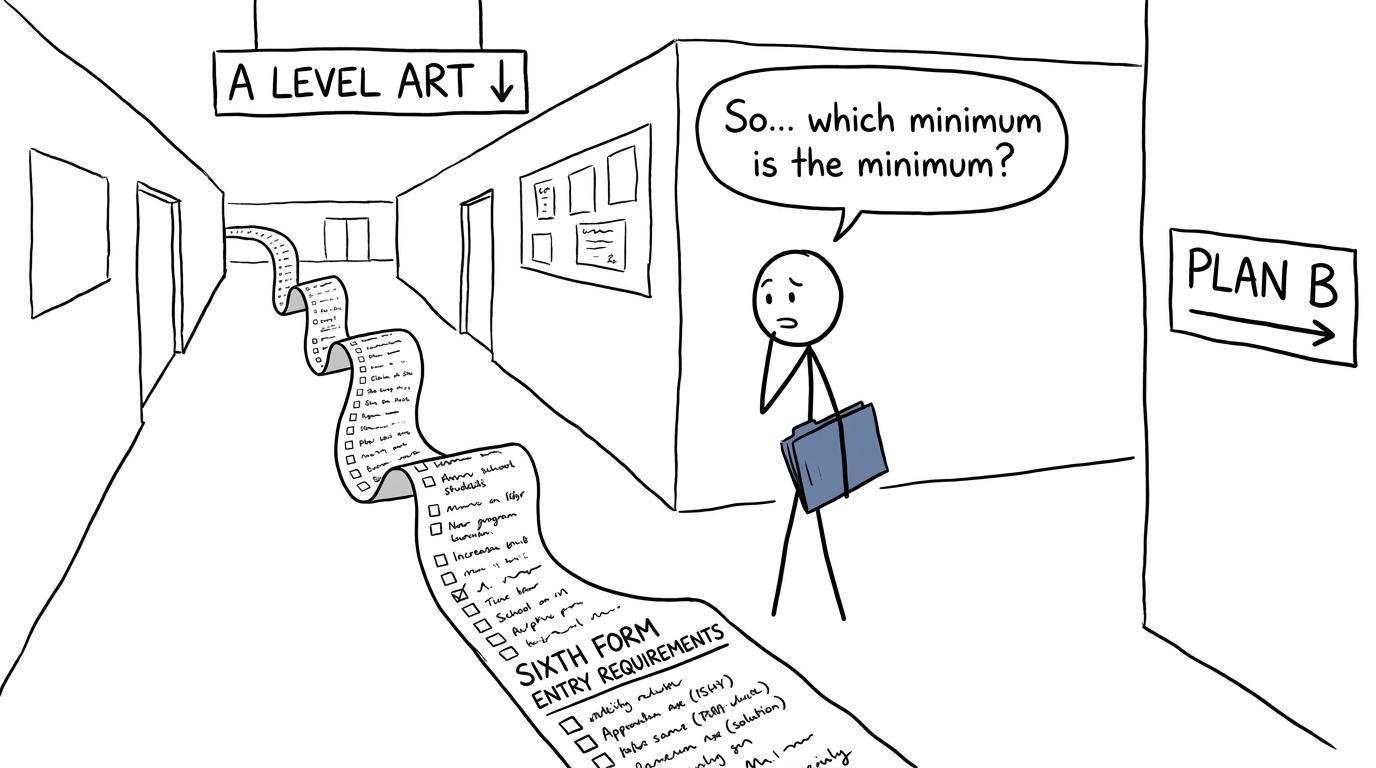 A student choosing between sixth-form routes while holding an art portfolio
When might grade 4 not be enough?
A grade 4 may not secure your preferred place if the provider asks for grade 5 or 6 in GCSE Art and Design. You could also miss the overall entry threshold even when your art grade satisfies the subject rule.
For example, a sixth form might require a certain number of GCSEs at grades 4 or above, stronger grades across an applicant's best subjects, or a particular result in English Language and maths. Selective providers may set higher conditions than the national standard-pass benchmark.
Read two sections of the prospectus rather than one:
General entry requirements
These decide whether you qualify for the provider's overall programme. Look for the number of GCSEs required, the accepted grade range and any compulsory English or maths conditions.
Art-specific requirements
These determine whether you can take the particular Art and Design course. Check which GCSE subjects are accepted, because a provider may distinguish between Fine Art, Photography, Textiles, Graphic Communication and Design and Technology.
If either section is unclear, contact admissions or the art department. Ask a precise question: does your grade meet the published threshold, and can portfolio evidence be considered if it does not?
Why your maths grade still matters
Art may be your intended A Level, but GCSE maths can still affect whether you enter sixth form at all. In England, students who have not achieved grade 4 in GCSE maths must normally continue studying the subject during post-16 education under the funding condition applying to approved institutions.
Some colleges allow a maths resit alongside a Level 3 programme. Others require grade 4 or 5 before admission to particular pathways. The local policy matters.
This is why protecting your maths result is part of protecting your art plan. Start by identifying your board and tier through the GCSE maths topics and exam-board guide. Then use MathsGenie's free GCSE revision resources to concentrate on topics where another hour of practice could recover marks.
Edexcel students can combine Edexcel GCSE Maths past papers with Edexcel predicted papers. Students following AQA can use the AQA GCSE Maths past-paper collection. Always choose the correct foundation or higher tier.
What should your Art portfolio demonstrate?
Where a portfolio is requested, follow the provider's instructions rather than guessing what an impressive portfolio should look like. It may ask for physical work, digital images or a limited selection of pieces.
In general, useful evidence can include:
- observation and recording
- experiments with media, processes or techniques
- research into artists and relevant contexts
- development from an initial idea
- reflection and refinement
- resolved outcomes supported by earlier work
A portfolio is not merely a gallery of polished final pieces. Art courses value the process of investigating, testing, reviewing and developing ideas. Select work that makes that process visible, while staying within any stated limit.
Never invent missing development or present another person's work as your own. If the provider asks for five images, send five carefully selected images rather than twenty unrequested ones.
What to do if your target course requires grade 5 or 6
First, check whether the stated grade is an absolute condition or a preferred level. Those words are not interchangeable.
Next, contact the provider before results day if possible. Explain which course you want, confirm your predicted or achieved grade and ask whether it considers portfolios, interviews or related creative qualifications. A clear answer is more valuable than reassurance based on assumptions.
It is also sensible to apply for more than one suitable route. Your alternatives might include:
- another sixth form with a grade 4 threshold
- a college offering a Level 3 Art and Design qualification
- a provider that assesses applicants through a portfolio
- a broader creative course followed by later specialisation
A backup choice is not a verdict on your ability. It is simply good planning under uncertainty.
Balancing Art coursework with GCSE maths revision
Art can absorb every available hour because a project rarely feels completely finished. Maths presents the opposite problem: improvement comes from answering questions, marking them and returning to exact weaknesses.
 A student balancing art materials, maths revision and a cup of tea
Give both subjects visible boundaries. Schedule defined art sessions, then protect shorter maths blocks for active practice. If you are unsure what to revise first, use the recommended order for learning GCSE maths topics.
For paper practice, follow a repeatable cycle:
- complete questions under appropriate conditions
- mark them using the mark scheme
- identify the topic behind each lost mark
- revisit the relevant revision lesson
- answer fresh practice questions
- retest the topic later with a mini test
The MathsGenie guide to using GCSE past papers properly explains how to turn completed papers into targeted revision. Near the examination, the GCSE maths exam-week checklist can help you keep that routine calm and manageable.
Common mistakes when checking Art entry requirements
Looking only at the Art grade
Meeting the subject requirement does not necessarily satisfy the provider's overall admissions policy. Check English, maths and the required number of GCSE passes as well.
Treating grade 4 as automatic entry
Grade 4 is a standard pass, but sixth forms can set higher course requirements. A pass confirms achievement; it does not compel a provider to offer a place.
Relying on old information
Entry rules can change between admission cycles. Use the current prospectus or course page for your intended start date.
Ignoring portfolio instructions
Do not assume that more work is always better. Follow the requested format, number of pieces and deadline.
Giving up after a near-miss
A missed condition deserves a prompt conversation, not an assumption. Contact admissions on results day, ask whether there is flexibility and keep your alternative route ready. Acceptance is never guaranteed, but silence cannot improve the decision.
Make the requirement part of your revision plan
A grade 4 in GCSE Art and Design can be good enough for sixth form or college, but only where it meets both the course-specific and general entry conditions. Other providers require grade 5 or 6, and some use a portfolio to judge readiness. The decisive evidence is the current admissions information for your chosen course.
Write down the exact conditions now. Then work backwards: protect your Art portfolio, strengthen any borderline subjects and give GCSE maths the focused practice it needs.
MathsGenie gives you a free place to do that work through revision lessons, practice questions, mini tests, past papers, predicted papers, mark schemes and video solutions. Choose your exam board and tier, diagnose the marks you are losing, and begin with one fix today. A sixth-form plan becomes far less frightening when its requirements are no longer vague.











