Grade 1 GCSE Maths Meaning: What to Do Next
Grade 1 GCSE maths meaning explained clearly. Learn how it affects college choices, resits and the practical revision steps that can move you forward.
Opening your results and seeing a grade 111 can make the future feel smaller in an instant. But the grade 1 GCSE maths meaning is straightforward: you received a recognised GCSE grade, above an ungraded result, but you did not reach the grade 444 generally treated as a standard pass in England.
That may affect your next course, apprenticeship or training route. It does not mean those routes have disappeared. Your immediate job is not to solve your entire future on results day. It is to confirm your options and choose the right next maths qualification.
Your results-day checklist
- Speak to your school, college or training provider about your place.
- Check the exact maths requirement for your chosen course.
- Ask whether you should resit GCSE Maths or take an approved alternative.
- Request a copy of your paper breakdown, if available, to identify weak areas.
- Build a realistic revision plan rather than repeating your previous approach.
- Start with the free GCSE Maths revision hub.
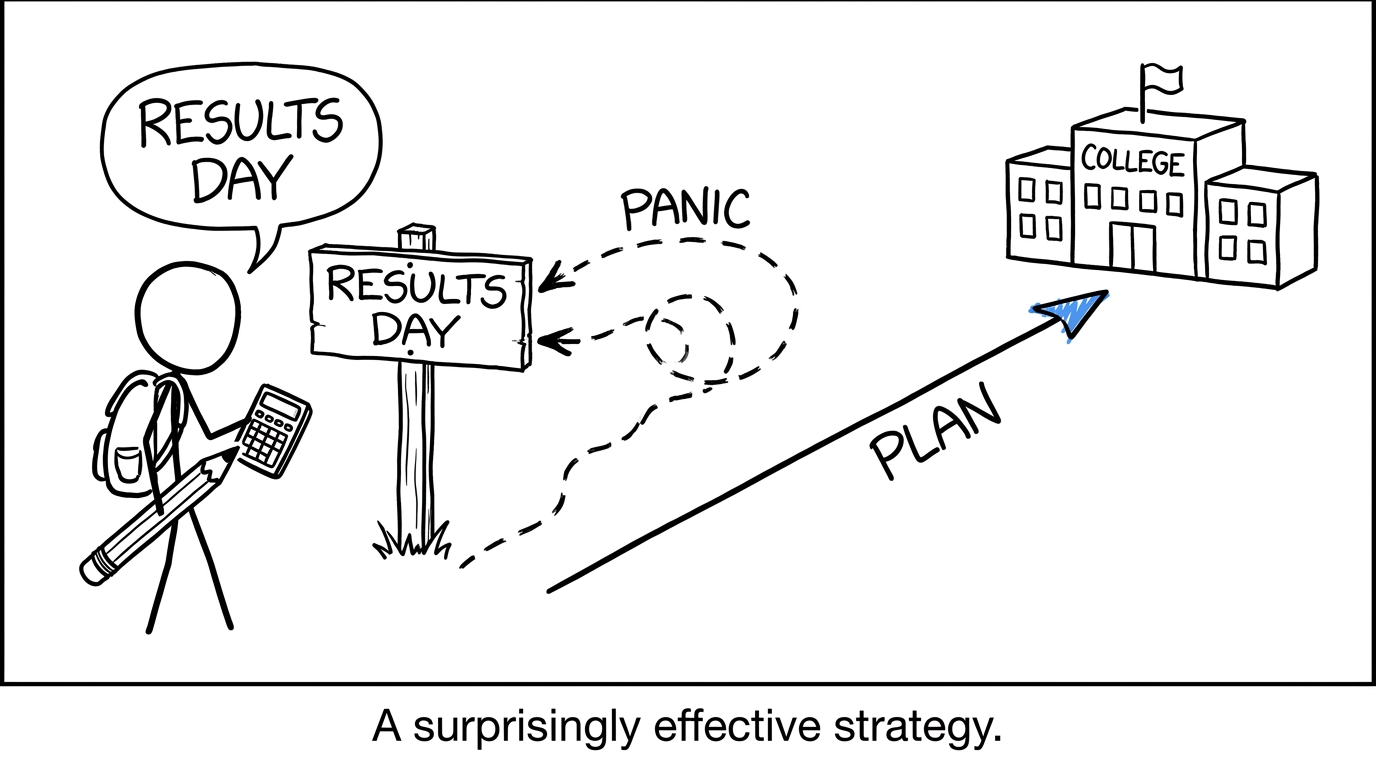 A student choosing a practical plan after results day
What does a GCSE maths grade 111 mean?
GCSEs in England use the 999-111 grading scale, where 999 is the highest grade and 111 is the lowest awarded grade. A result of U means ungraded. Although the newer scale does not translate exactly into the former letter grades, the bottom of grade 111 is aligned with the bottom of the old grade G.
A grade 444 is the standard pass benchmark used by the Department for Education. Colleges, employers and apprenticeship providers can still set their own entry requirements, so a GCSE maths grade 111 does not produce the same outcome everywhere.
Some courses may accept you while requiring continued maths lessons. Others may offer a different course level or ask you to work towards an alternative qualification first. Do not assume that a website summary or a friend's experience applies to you. Ask the provider directly.
What happens after a grade 111 in maths?
For students aged 161616 to 191919 in England, current funding rules require education providers to support students who have not yet achieved grade 444 or above in GCSE Maths.
Students with grade 333 on a full-time programme are generally required to continue towards GCSE Maths. With grade 222 or below, including grade 111, providers have more flexibility: you may study GCSE Maths, Functional Skills or another approved stepping-stone qualification. The correct route depends on your programme and provider.
Your realistic options
Resit GCSE Maths. This is often the clearest route when a future course or career requires grade 444. GCSE Maths is normally available in the November and summer exam series, but your school or college must confirm your entry, board and dates.
Take a stepping-stone qualification. Functional Skills or another approved qualification may help you rebuild essential numeracy before progressing. Check whether it meets the entry requirement for your intended course or apprenticeship.
Adjust your course pathway temporarily. A college might suggest beginning at a different course level while you improve your maths. That is a route forward, not a verdict on your ability.
Ask about a review of marking. If your mark was unexpectedly close to a boundary, speak to your exams officer immediately. Reviews have deadlines, can involve fees and may cause marks to rise, stay unchanged or fall. Your school can advise whether the paper provides reasonable grounds for a review.
How to improve from a grade 111
The temptation is to revise everything. That usually creates a great deal of activity without enough learning. A better plan begins with the foundational topics that support the rest of the foundation-tier paper.
Use the Edexcel GCSE Maths revision area or select your own board from the main GCSE hub. Maths Genie covers Edexcel, AQA, OCR, Eduqas and other UK specifications, helping you practise material relevant to the papers you will actually sit.
Build secure foundations first
Prioritise number operations, place value, negative numbers, fractions, decimals, percentages, basic ratio, simple algebra, angles, area, averages and interpreting charts. The Edexcel GCSE revision guides organise these skills topic by topic.
A useful weekly cycle is:
- learn one method through a revision lesson or video;
- complete a short set of practice questions;
- check every answer and record the reason for each mistake;
- revisit the topic several days later;
- finish with a mini test or mixed set.
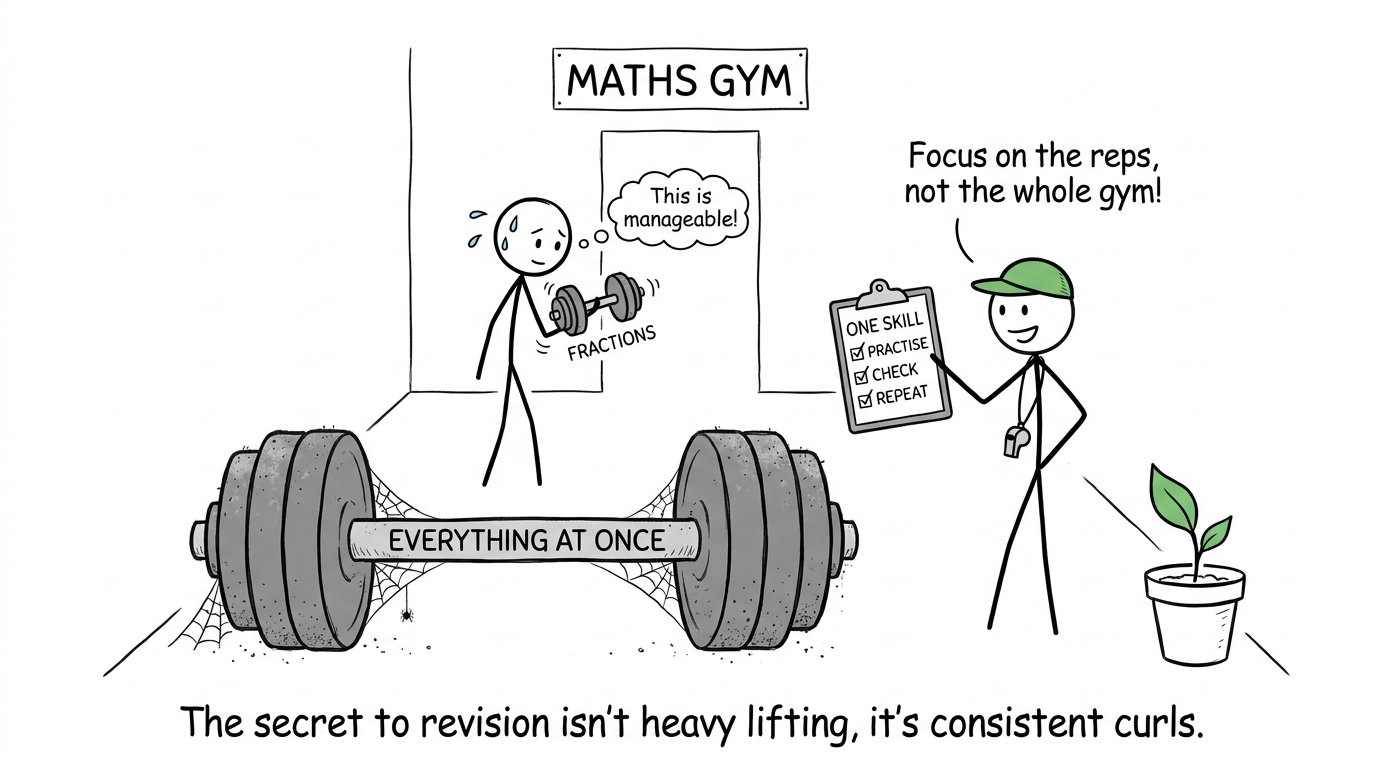 A student building maths strength one topic at a time
Move to papers gradually
A full paper can be overwhelming at first. Begin with topic questions and shorter timed sections. Once the core skills feel more familiar, use the Edexcel GCSE Maths past papers or choose the correct board through the GCSE revision hub.
A paper only becomes useful revision after you mark it. Follow the process in how to use GCSE past papers properly: complete, mark, diagnose, relearn and retest. Later, GCSE predicted papers can provide additional unseen practice, but they should supplement rather than replace past papers.
For a structured timetable, adapt the one-month GCSE Maths revision plan and agree achievable weekly targets with your teacher.
Common mistakes after receiving a grade 111
Waiting until the resit is close
Foundation skills improve through repeated practice. Short sessions across several months are more useful than a frantic final week.
Repeating the same revision method
If rereading notes did not create secure methods, do not simply reread them for longer. Answer questions, mark them and correct them without hiding the difficult parts.
Using the wrong tier or exam board
Check whether you are entered for foundation or higher tier and whether your board is Edexcel, AQA, OCR or Eduqas. Specifications and paper structures differ.
Treating mistakes as evidence that you cannot do maths
A mistake is diagnostic information. Write down whether it came from missing knowledge, arithmetic, misreading or exam timing. Each cause needs a different response.
Your next step starts now
A grade 111 can restrict some immediate choices, but it does not fix your final destination. Speak to your provider, confirm the qualification you need and make the next stage specific.
Then use Maths Genie as your free revision base. Start with revision lessons and practice questions, check your work using solutions and mark schemes, build confidence through mini tests, and progress to past papers and predicted papers. One corrected skill may feel small. Repeated across a term, it becomes a different result.