Best GCSE Subjects to Pair with German
GCSE subjects to pair with German explained clearly. Compare humanities, creative and technical options while avoiding an unnecessarily stressful workload.
Choosing GCSE options can feel strangely permanent. A subject that occupies one box on a form will soon occupy lessons, homework and revision time for two years. If you are searching for the best GCSE subjects to pair with German, the short answer is this: geography or history creates a strong EBacc combination, computer science or business adds a useful analytical dimension, and a creative or practical subject can provide valuable balance.
The right combination is not the one that looks most impressive. It is the one that fits your interests, future plans and capacity to revise consistently while protecting your performance in compulsory subjects such as maths, English and science.
This guide explains which pairings make sense, which combinations may create unnecessary pressure, and how to keep your GCSE maths revision secure alongside German.
A quick GCSE options checklist
Before comparing individual subjects, ask:
- Which subjects are compulsory at your school?
- Does your school organise choices into option blocks?
- Do you want to complete the EBacc subject combination?
- How is each possible subject assessed?
- Does the combination include too many writing-heavy, practical or performance-based courses?
- Which subjects do you genuinely enjoy enough to revise independently?
- Are there GCSE requirements for any sixth-form, college or career route you are considering?
- Will the total workload leave regular time for maths practice?
Schools decide which options they offer and may impose their own rules. Read your options booklet and speak to subject teachers before making a final decision.
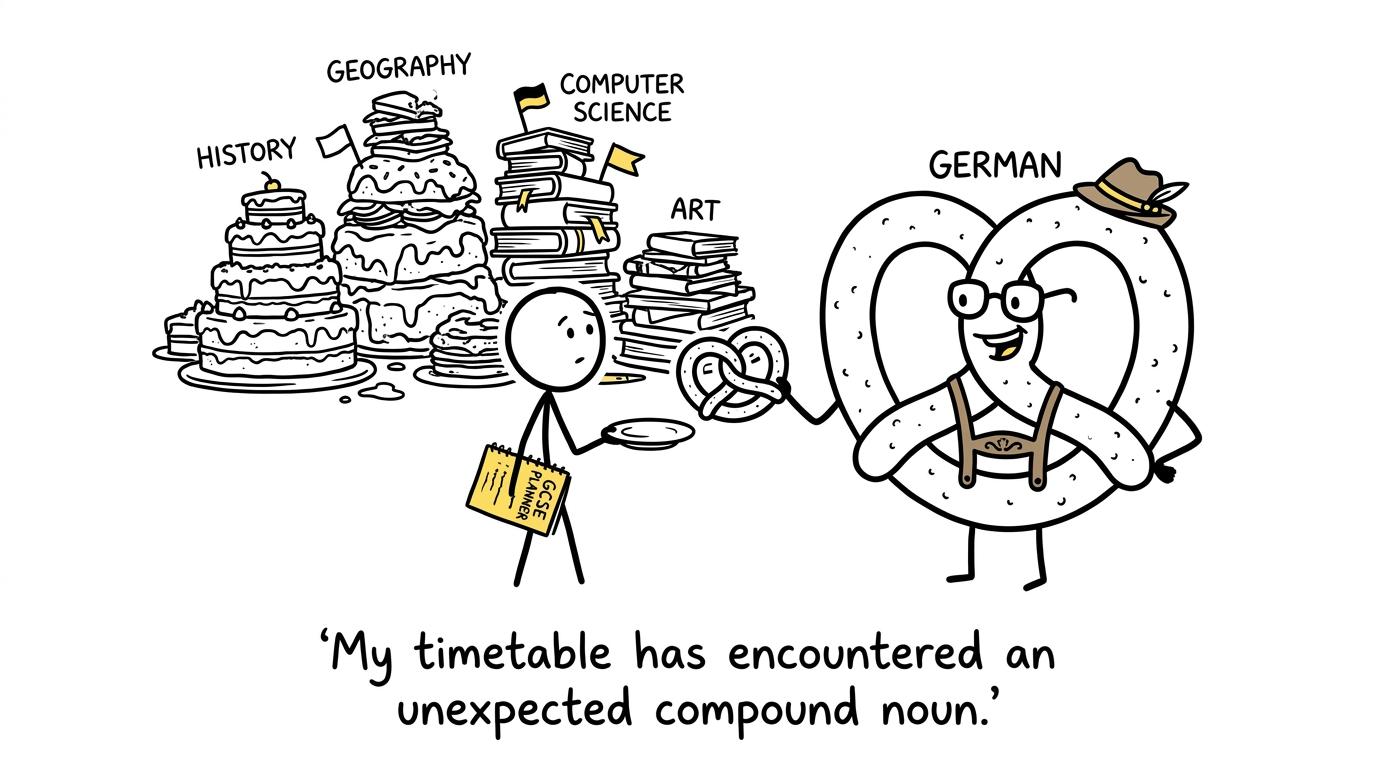 A student encountering an unexpectedly large GCSE options buffet
What studying GCSE German actually involves
German is not simply a vocabulary course. Current GCSE specifications assess listening, speaking, reading and writing, although the precise paper structure and timings depend on your exam board and tier. For example, current AQA and Edexcel specifications divide the qualification between those four skills, with each contributing 25%25\%25%.
The reformed French, German and Spanish GCSE specifications were first taught from September 202420242024, with their first examinations in summer 202620262026. Students choosing German now should therefore check the current specification rather than relying on advice based on an older course.
German revision normally involves frequent vocabulary retrieval, grammar practice, listening and preparation for spoken responses. That pattern matters when selecting other subjects. A sensible companion course either develops overlapping skills or gives you a different kind of work.
Geography or history for an EBacc combination
German already fills the language element of the English Baccalaureate. To complete the humanities element, you would usually need geography or history alongside English language and literature, maths and the required sciences.
The EBacc is a combination of subjects rather than a separate qualification. It can provide a broad academic programme, but it should not be treated as proof that one individual subject combination is automatically best.
German and geography
Geography is often a natural pairing because both subjects encourage awareness of places, communities and global issues. Geography also combines written explanations with data, maps, graphs and numerical interpretation.
That range can suit a student who likes German but does not want every optional subject to involve extended historical arguments. Its data-handling element also connects with skills developed through GCSE Statistics revision, including interpreting information and reaching justified conclusions.
However, geography is not a low-effort option. You may need to remember detailed case-study material, apply knowledge to unfamiliar sources and complete fieldwork-related preparation. Ask your school what its chosen specification requires.
German and history
History pairs well with German if you enjoy evaluating evidence, explaining causation and constructing precise written arguments. The two courses reward careful use of language and an ability to notice how context changes meaning.
The possible pressure comes from volume. German requires vocabulary and grammar retrieval, while history can involve substantial factual recall and extended writing. This is manageable for many students, but less attractive if essay planning already takes you a long time.
Choose between geography and history according to the work you prefer doing repeatedly. Do not choose history solely because it sounds academic, or geography because someone has called it easier. Difficulty depends on your strengths, your school’s specification and the quality of your revision habits.
German with computer science, business or statistics
A language and an analytical subject can create a useful contrast. You move between communication and structured problem-solving rather than repeating the same revision style all evening.
Computer science
Computer science can work well with German for students who enjoy logical thinking, programming and understanding digital systems. It complements the communication skills of a language without duplicating its assessment demands.
The combination still requires caution. Programming improves through regular practice, just as German improves through frequent retrieval. Leaving either course untouched for several weeks creates a difficult catch-up problem. It also sits beside compulsory maths, so students who find abstract reasoning tiring should examine the total load honestly.
Business
Business can add commercial and international context to German. It may appeal if you are interested in organisations, marketing, finance or working across different countries.
It is not a shortcut around writing or numeracy. Business questions can require calculations, interpretation and well-developed explanations. Before choosing it, look at actual specification content and assessment materials rather than relying on the subject’s name.
Statistics
Where your school offers GCSE Statistics, it can strengthen data literacy and reinforce parts of maths. This may be valuable if you enjoy interpreting distributions, probability and real-world information.
There is also overlap with your existing workload. If ordinary GCSE maths already demands substantial attention, adding Statistics may concentrate too much pressure in one area. Explore the Edexcel GCSE Statistics revision resources to understand the style of content before deciding.
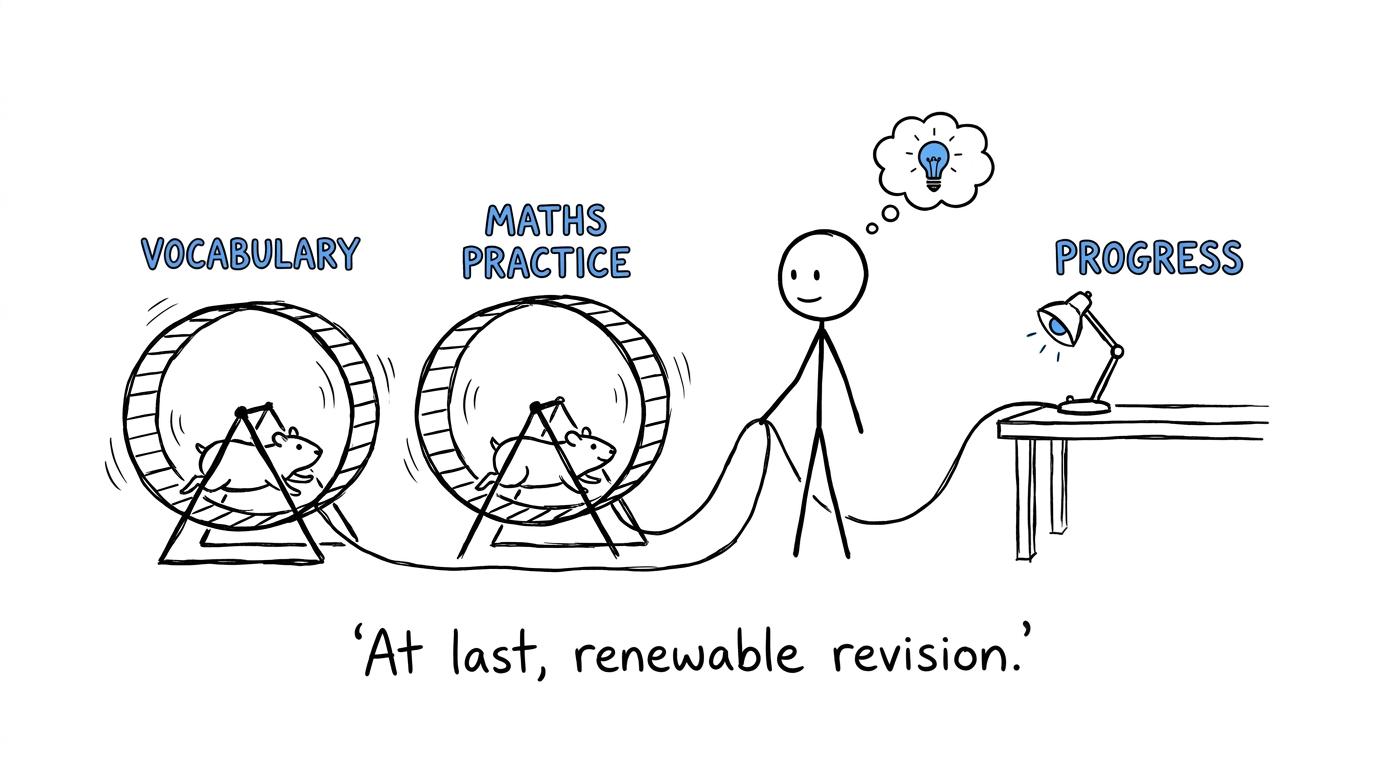 Two revision wheels powering the same lamp of progress
German with a creative or practical subject
Art, music, drama, design and technology, food preparation and nutrition, and PE can give your timetable a different rhythm. That balance can be psychologically useful. After a lesson focused on German grammar or maths equations, making, designing, rehearsing or performing uses attention differently.
But different does not mean lighter.
Art and design courses may involve sustained portfolios and deadlines. Music and drama can include rehearsal or performance preparation. Design subjects may involve iterative project work. PE contains theoretical assessment as well as practical activity. Exact arrangements vary between qualifications and schools.
A creative subject makes sense when you enjoy the process enough to continue when deadlines overlap. It becomes unnecessarily stressful when selected as a supposed break from academic work without understanding its non-exam assessment or practical demands.
Is taking two languages a good idea?
German with French, Spanish or another language can be an excellent choice for a strong linguist. Vocabulary-learning routines, grammatical awareness and confidence in speaking may transfer between courses.
There are two risks. First, similar words or structures can become confused, particularly under exam pressure. Second, both subjects need frequent maintenance across listening, speaking, reading and writing. Revision cannot be compressed comfortably into an occasional long session.
Taking two languages makes sense if you actively enjoy language learning, are performing securely in both and have enough independent revision time. It makes less sense when the second language is chosen merely because it appears related to German.
Subject combinations that can add unnecessary stress
No combination is universally bad. Stress usually comes from the interaction between assessment patterns, personal weaknesses and outside commitments.
Be particularly careful with:
- German plus several content-heavy humanities: regular factual retrieval and extended writing can accumulate.
- German plus multiple portfolio subjects: practical deadlines may arrive together and compete with exam revision.
- German plus another language without enthusiasm: similarity alone will not sustain two sets of vocabulary and speaking practice.
- German plus every supposedly prestigious option: breadth has little value if overload lowers several grades.
- A choice built around friends or teachers: classes and staffing can change, while the specification remains.
A balanced timetable is not necessarily an easy timetable. It is one in which the demanding parts occur in different forms and remain manageable.
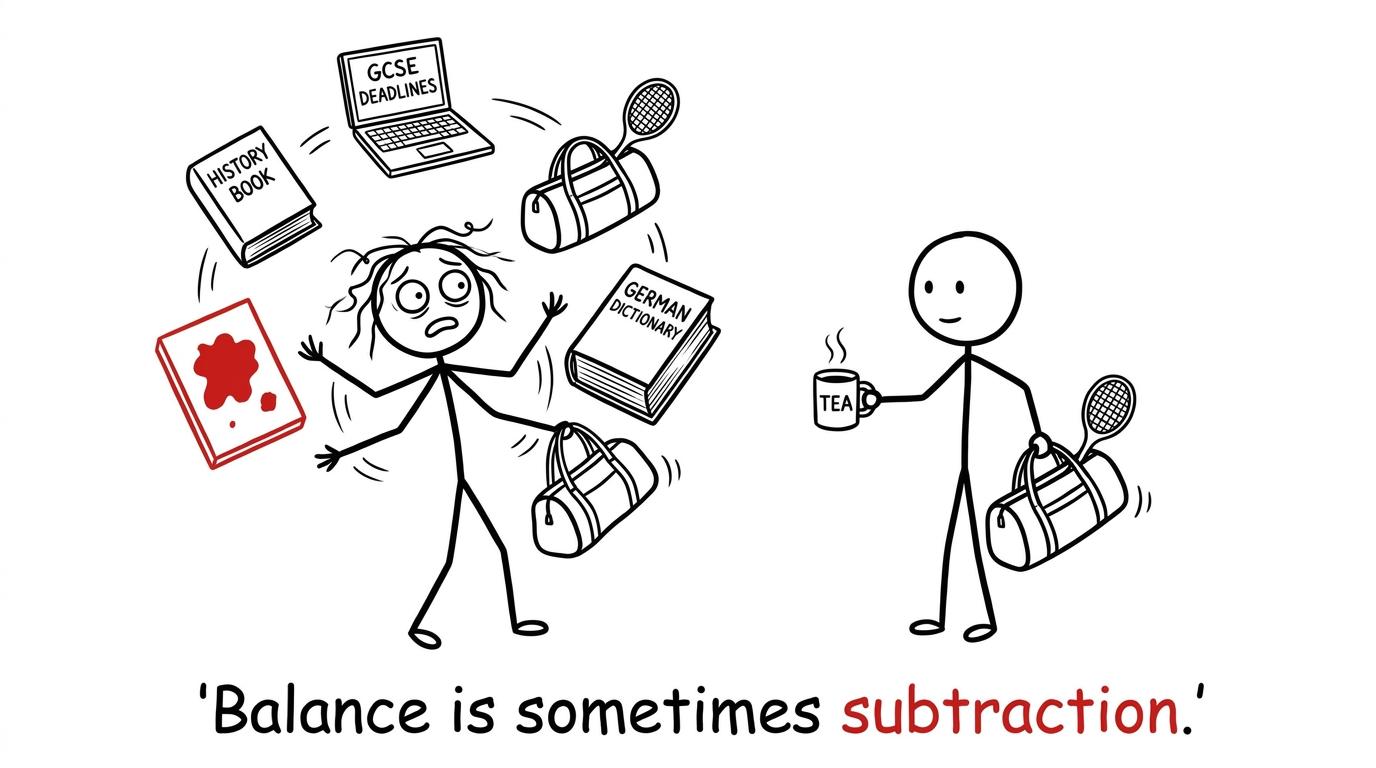 A student discovering that balance sometimes requires subtraction
Protecting GCSE maths while studying German
Maths is compulsory, and future courses commonly pay close attention to your maths and English results. Your option choices should therefore leave space for consistent maths practice at the correct foundation or higher tier.
Start with the GCSE Maths revision hub, where you can select resources for Edexcel, AQA, OCR or Eduqas. If you are unsure what your paper covers, use the GCSE maths topics by board and tier guide.
A workable weekly rhythm is more useful than an ambitious timetable you abandon. Give German several short vocabulary or listening sessions, then protect separate blocks for maths questions. The GCSE maths revision timetable guide can help you organise those sessions around school and other subjects.
When time is limited, diagnosis matters. Use Edexcel GCSE Maths mini tests, where relevant to your board, or the wider MathsGenie resources collection to identify gaps. Then revise the specific topics costing marks rather than rereading everything. The guide to finding your weakest GCSE topics explains this process clearly.
Near the examinations, past papers should build timing and reveal recurring errors. Predicted papers are most useful after broad topic coverage, not as a replacement for it. Edexcel students can use the GCSE Maths predicted papers with mark schemes and worked solutions.
Common mistakes when pairing subjects with German
Assuming there is one perfect combination
There is no universal ranking. German and history may suit one student beautifully while exhausting another. Your interests, attainment and school’s option structure matter more than a generic list.
Ignoring assessment style
Look beyond subject titles. Find out about examinations, speaking assessments, practical work, portfolios and internal deadlines. Two appealing subjects may create an awkward combination if their heaviest demands occur together.
Treating an enjoyable subject as effortless
Enjoyment is a strong reason to choose a course, but it does not remove the workload. A subject you like still requires organised practice and honest marking.
Forgetting future entry requirements
If you have a possible sixth-form, college or career route in mind, check its published requirements. Do not assume that German, computer science or triple science is automatically required without verifying the actual course.
Overloading to impress other people
More demanding options do not guarantee better outcomes. A slightly narrower combination that allows careful revision can be more valuable than a crowded programme completed in permanent catch-up mode.
Choose a combination you can sustain
The most sensible GCSE subjects to pair with German are usually geography or history for academic breadth, computer science or business for analytical contrast, or a creative and practical subject for variety. A second language can also work for students who genuinely enjoy linguistic study.
The deciding question is not, “Which combination sounds strongest?” It is, “Which combination can I revise well, week after week, without sacrificing maths, English, science or rest?”
Once your choices are made, let MathsGenie remove some of the organisational weight. Use the free revision lessons and practice questions to repair individual maths topics, mini tests to check progress, and past papers or predicted papers to practise under pressure. Mark with the provided mark schemes, use video solutions when a method remains unclear, and place each next step into your revision planner. Good options open the door. Consistent revision is what carries you through it.