GCSE Subjects to Pair with English Literature
GCSE subjects to pair with English Literature: compare humanities, languages, sciences and creative options while keeping your workload manageable.
Choosing GCSE options can feel like arranging books on a shelf that you will have to carry for two years. Every subject may look interesting on its own. The weight only becomes obvious when you put them together.
The best GCSE subjects to pair with English Literature are usually History, Religious Studies, Drama, a modern foreign language, Geography or a contrasting subject such as Computer Science. The right combination depends on your interests, future plans and total workload. If several choices require extensive reading, essay writing or coursework-style preparation, adding some variety can make revision more manageable.
There is no single perfect combination. Your aim is to choose subjects that keep useful routes open without creating a timetable that looks impressive but feels impossible.
A quick GCSE options checklist
Before choosing, ask:
- Is the subject compulsory or genuinely optional at my school?
- Do I enjoy the work itself, rather than simply liking the teacher?
- How is the course assessed by my exam board?
- Does it involve long essays, practical work, performances or project deadlines?
- Is it required or recommended for a course I may want after GCSE?
- Does the combination leave enough time for English, science and GCSE Maths revision?
- What would my reserve choice be if timetable blocks clash?
In England, English Language, maths and science form the core curriculum. English Literature is also taken by most pupils, although exact requirements and option systems vary between schools. Check your own options booklet rather than assuming that another school follows the same rules.
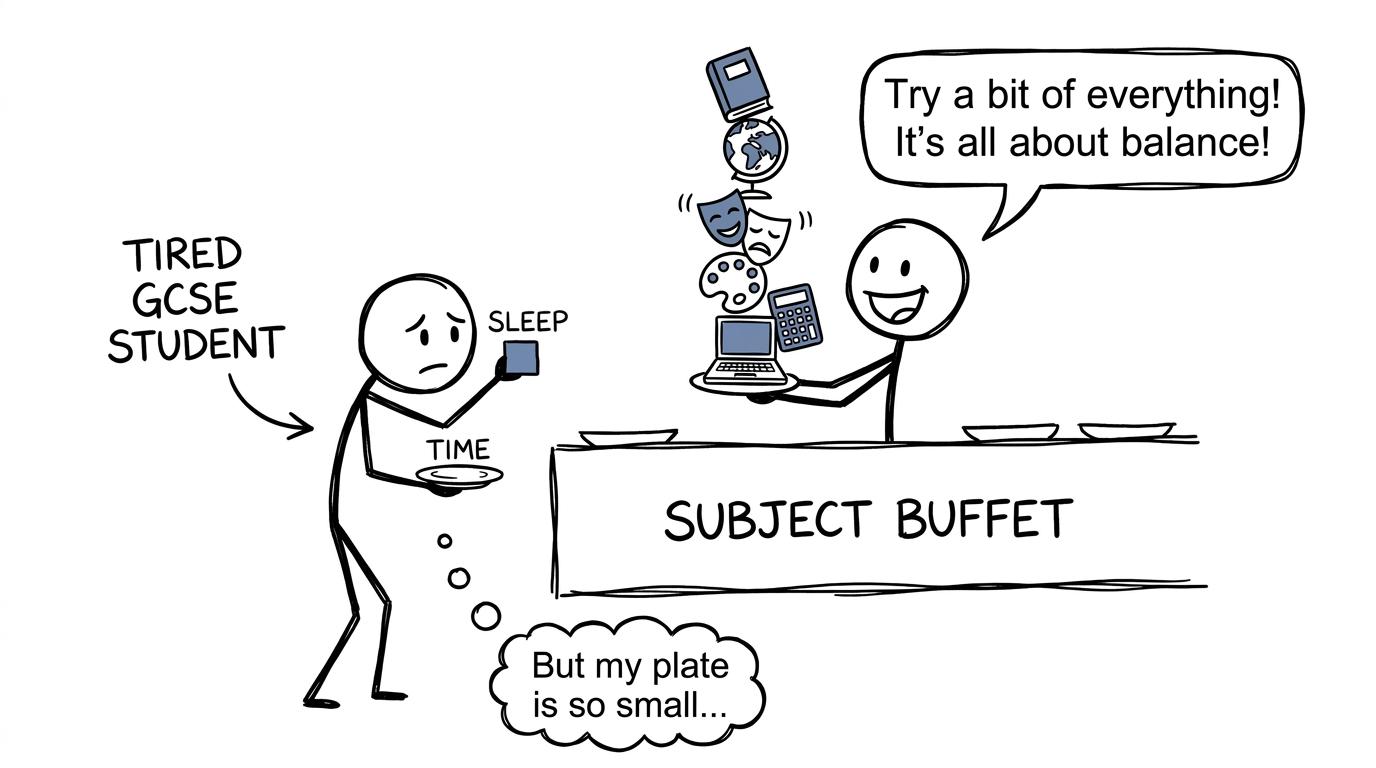 A GCSE student balancing subject choices against limited time
Which subjects pair naturally with English Literature?
English Literature develops close reading, interpretation, argument and evidence-based writing. Across exam boards such as AQA, Edexcel, OCR and Eduqas, students are expected to understand texts, analyse language, form and structure, consider context and communicate clearly.
Subjects that reuse some of these skills can create useful overlap. Yet overlap has a cost: too many similar subjects can produce a relentless stream of reading and extended writing.
History
History is one of the strongest academic pairings. Both subjects reward precise argument, careful use of evidence and an understanding of context. If you enjoy asking why people acted as they did and how different interpretations are constructed, the transition between the subjects can feel natural.
The potential drawback is volume. History brings substantial factual content alongside structured writing. English Literature requires knowledge of characters, themes, quotations and whole texts. Taking both makes sense when you genuinely enjoy reading and can revise content regularly. It is less sensible if extended writing already leaves you exhausted.
History also fulfils the humanities element of the English Baccalaureate, or EBacc. The EBacc is not a separate qualification; it is a group of GCSE subjects consisting of English Language and Literature, maths, sciences, a language, and History or Geography.
Religious Studies
Religious Studies can complement Literature particularly well. Questions about morality, responsibility, conflict, justice and human nature often appear in both classrooms, even though the specifications and evidence are different.
RS normally involves evaluation and reasoned conclusions, so it can strengthen your ability to build an argument. However, it is still an essay-based subject with its own terminology and knowledge. Do not treat it as an easy option simply because some themes sound familiar.
Drama
Drama is a valuable pairing for students who like exploring how characters, dialogue and staging create meaning. It can make plays studied in English Literature feel less like printed objects and more like performances shaped by actors, space and audience response.
The workload is different rather than automatically lighter. Depending on the specification, Drama may include performance, practical preparation and written evaluation. It can offer welcome variety from conventional essays, but rehearsals and group commitments may create pressure at particular points in the year.
Modern foreign languages
French, Spanish, German or another available language can sit well beside English Literature. Languages develop attention to wording, grammar, tone and cultural context. They also add breadth to an otherwise heavily essay-based set of choices and can help complete the EBacc combination.
Choose a language because you are prepared to practise vocabulary, listening, speaking, reading and writing consistently. Language learning responds better to frequent short sessions than to occasional revision marathons.
Geography
Geography is often a balanced alternative to History. It combines written explanation with data, maps, processes, case-study knowledge and numerical interpretation. That variety can suit a student who enjoys English but does not want every optional subject to revolve around long essays.
Geography also fulfils the humanities part of the EBacc. It can therefore keep a broad academic route open while giving your weekly work a different texture.
The best contrasting subjects for a balanced workload
A complementary subject does not have to resemble English Literature. Sometimes contrast is exactly what makes a combination sustainable.
Computer Science
Computer Science develops logical thinking, decomposition and precision. These skills differ from literary interpretation, although both subjects reward carefully structured reasoning.
It may be a strong choice if you enjoy programming and problem-solving. Be cautious if you are choosing it merely because you use computers confidently. The subject involves computational ideas and disciplined technical work, not simply everyday technology.
Strong core maths habits will help with logical subjects. MathsGenie provides separate, specification-focused hubs for AQA GCSE Maths and OCR GCSE Maths, alongside resources for other common boards.
Art, Music and Design subjects
Creative options can provide a different way to think and communicate. Art and Design, Music, Photography or Design and Technology may balance a reading-heavy timetable, particularly when practical work energises you.
But practical does not mean effortless. Portfolio development, rehearsal and project completion can consume significant time outside lessons. Ask when major deadlines occur and whether they are likely to collide with English mock exams or maths paper practice.
Business
Business can combine concise written explanation with calculations, data interpretation and decision-making. It may suit students who enjoy applying ideas to organisations and real commercial situations.
Before selecting it, look at the actual specification used by your school. Course titles can sound straightforward while the assessment still demands accurate terminology, application and evaluation.
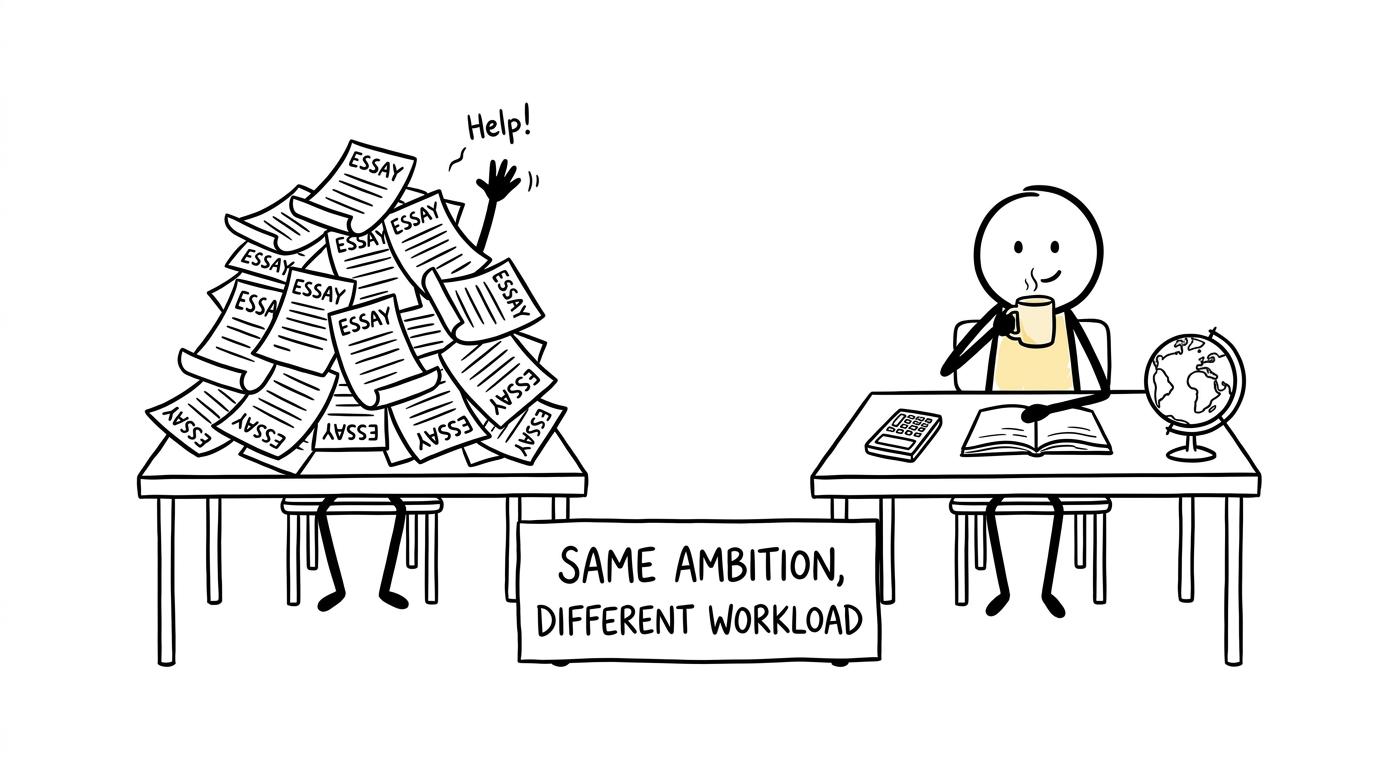 Two students discover that equally ambitious GCSE choices can create very different workloads
GCSE combinations that make sense
Think of these as patterns rather than prescriptions.
| Combination | Why it may work | Main pressure to watch |
|---|---|---|
| English Literature, History and a language | Strong reading, argument and cultural breadth; supports the EBacc route | High content and regular written revision |
| English Literature, Geography and Computer Science | Mixes communication, data and logical problem-solving | Switching between very different methods |
| English Literature, Drama and Religious Studies | Strong thematic and interpretive connections | Performance preparation plus extended writing |
| English Literature, Art and Geography | Balances creative work, writing and analytical content | Portfolio deadlines and case-study recall |
| English Literature, Business and a language | Combines communication with application and cultural breadth | Frequent vocabulary and terminology retrieval |
Your compulsory maths and science courses remain part of the overall workload, even when they do not appear in an option block. That matters. A combination is only balanced if you can maintain every core subject, not just your favourite choices.
Use the MathsGenie revision planner to picture a normal week. Add lessons, homework, retrieval practice and rest. If the plan only works when every evening goes perfectly, it is not yet a realistic plan.
Which combinations may add unnecessary stress?
No subject combination is universally wrong. Stress usually comes from stacking several demands of the same type or choosing subjects for weak reasons.
Too many writing-heavy choices
English Literature, History, Religious Studies and another essay-led subject can be an excellent combination for an enthusiastic writer. It can also become tiring when several assessments require content recall and extended responses in the same week.
Ask yourself whether you enjoy sustained writing under timed conditions. Being capable of it is not the same as wanting most of your timetable built around it.
Several deadline-heavy practical subjects
Art, Drama, Music and Design subjects can be rewarding, but taking several together may concentrate portfolio, rehearsal or project demands. Investigate the calendar rather than judging workload from lesson style alone.
Choosing for prestige rather than fit
A supposedly impressive option is not useful if you disengage from it and sacrifice time needed elsewhere. GCSE choices should preserve future possibilities, but they should also let you earn the strongest grades you reasonably can.
If you have a possible sixth-form course in mind, check its published entry requirements. Schools and colleges set their own conditions, and a subject that is recommended in one place may not be required in another.
Treating maths as separate from the decision
Students who love Literature sometimes assume that maths can be handled later. Yet maths is compulsory, and its skills build cumulatively. Your option workload must leave room for regular problem practice at the correct foundation or higher tier.
Start with the GCSE Maths topics by exam board and tier, then use short revision lessons and questions rather than waiting for mock season. When you are ready for full exam practice, the Edexcel GCSE Maths past papers include mark schemes and available worked support.
A simple way to make your final choice
Score each possible option against four questions: enjoyment, current confidence, future usefulness and workload fit. Use a small scale such as 111 to 555, but do not let the total make the decision for you. The score is there to expose your thinking.
Then speak to the subject teacher and ask specific questions:
- What does a normal homework task involve?
- Which assessment components demand the most preparation?
- Is there practical, spoken or non-exam assessment?
- What do students commonly misunderstand about the course?
- What happens if the subject does not run or clashes with another option?
Finally, test the combination against a difficult week: an English essay, science test, maths mini test and an option deadline. Could you manage that week without abandoning sleep or rushing every task? Balance is not about making GCSEs easy. It is about making sustained effort possible.
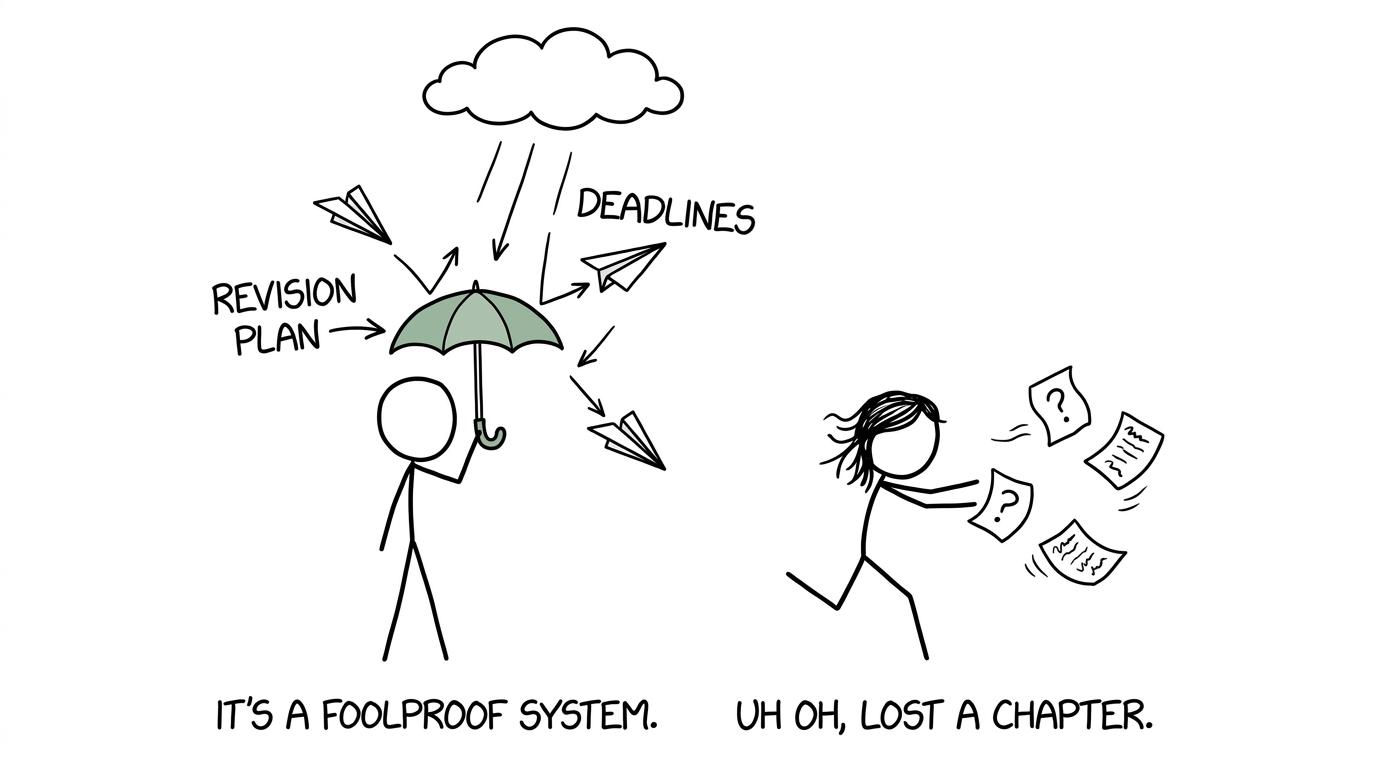 A revision plan turns falling deadlines into manageable paper aeroplanes
Common mistakes when choosing GCSE subjects
Following friends. Timetable groups can change, and your friend may have different strengths or plans.
Assuming a subject is easy. Every GCSE has assessed knowledge and skills. Read the course description and ask how it is examined.
Ignoring reserve choices. Schools cannot always create every requested combination. Choose reserves you would genuinely be willing to take.
Counting only lesson time. Essays, vocabulary practice, portfolios, rehearsals and revision happen beyond the classroom.
Building an entirely similar timetable. Skill overlap can help, but variety may protect your motivation and spread assessment pressure.
Leaving core revision until Year 111111. Keep maths active with mini tests, topic questions and immediate feedback. The guide to finding your weakest GCSE topics can help you focus on marks you are actually losing.
Choose a combination you can sustain
The best subjects to take alongside English Literature are not simply the ones that look most literary. History, RS and Drama offer clear connections. Languages add cultural and linguistic depth. Geography, Computer Science, Business and creative subjects can introduce valuable contrast.
A sensible combination gives you challenge, breadth and enough time to improve. Once your options are chosen, make the core subjects easier to manage through a steady routine. Use MathsGenie's free revision lessons and practice questions to repair individual gaps, then move to GCSE predicted papers, past papers, mark schemes, mini tests and video solutions as your exams approach.
Choose thoughtfully now. Then let consistent practice carry the weight.