GCSE Statistics Tutoring Cost: UK Price Guide
GCSE statistics tutoring cost explained: compare realistic UK hourly rates, total budgets and tutor quality before deciding whether tuition is worthwhile.
A tutoring price can look small when written as an hourly rate. It feels rather different after three months of weekly lessons.
For families researching GCSE statistics tutoring cost, a realistic UK budget is usually around £25\pounds25£25 to £55\pounds55£55 per hour for one-to-one tuition. Less experienced tutors may charge below this range, while qualified teachers, examiners and established specialists can charge £60\pounds60£60 or more. There is no official national tariff, so location, lesson format, experience and availability all influence the final price.
The important question is not simply, "How much is a tutor?" It is, "What am I paying the tutor to change?"
GCSE statistics tutoring cost at a glance
Current UK tutoring listings and provider price guides vary considerably, but this is a sensible planning range rather than a guaranteed quotation:
| Type of GCSE Statistics tuition | Typical price |
|---|---|
| Undergraduate or newer online tutor | £20\pounds20£20 to £35\pounds35£35 per hour |
| Experienced online GCSE tutor | £30\pounds30£30 to £50\pounds50£50 per hour |
| Experienced face-to-face tutor | £35\pounds35£35 to £55\pounds55£55 per hour |
| Qualified teacher or Statistics specialist | £45\pounds45£45 to £70\pounds70£70 per hour |
| Examiner or premium specialist | £60\pounds60£60 to £100\pounds100£100 or more per hour |
| Small-group tuition | Often £10\pounds10£10 to £30\pounds30£30 per student per session |
These bands overlap because the tutoring market is not standardised. A strong tutor charging £35\pounds35£35 may offer better value than a poorly matched tutor charging £65\pounds65£65.
Before booking, check:
- whether the tutor teaches the correct GCSE Statistics specification and tier;
- whether lessons are online, face-to-face or in a group;
- what is included in the fee;
- how progress will be measured;
- the cancellation policy and any platform charges;
- qualifications, references and appropriate safeguarding checks;
- whether free revision can solve part of the problem first.
The GCSE Statistics revision hub is a useful starting point for that final check. It brings together exam-board resources, questions, worksheets and papers without adding another cost.
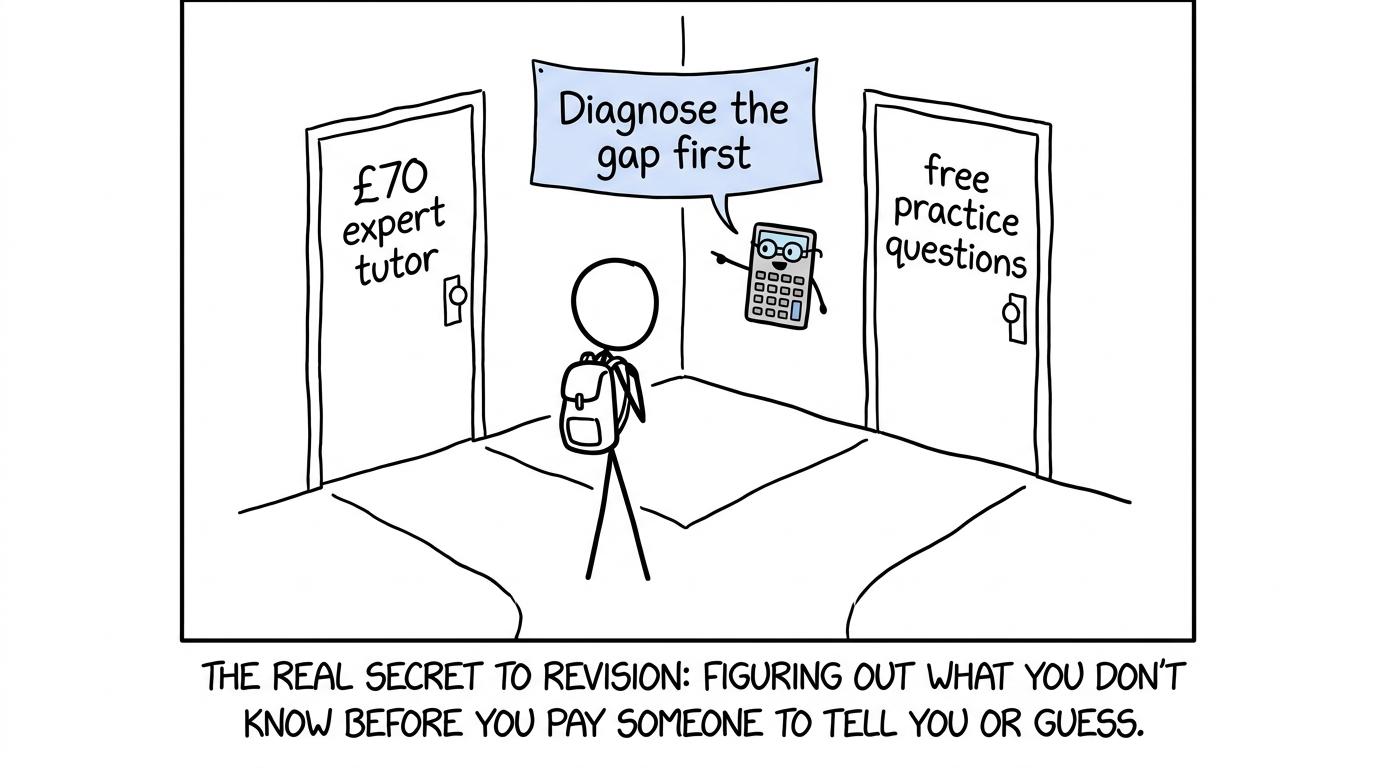 A student choosing between an expensive tutor and free practice while a calculator recommends diagnosing the gap first
What changes the price of a Statistics tutor?
Tutor experience and specialist knowledge
A university student who is confident with GCSE content will generally charge less than a qualified teacher. A current teacher, former teacher or examiner may charge more because they can bring classroom experience, specification knowledge and familiarity with mark schemes.
Yet titles alone do not guarantee a good match. GCSE Statistics involves more than calculating averages. Students may need to evaluate sampling methods, select suitable diagrams, interpret correlation, compare distributions and explain conclusions in context. A tutor should be able to teach the reasoning behind those answers, not merely complete calculations quickly.
Statistics is also a separate GCSE qualification for some students, so do not assume that every general GCSE Maths tutor knows its full specification. Ask directly which board and qualification the tutor has taught.
Online and face-to-face lessons
Online tuition often removes travel costs and gives families access to tutors beyond their local area. It can therefore be cheaper, although current market data does not show a universal rule: some online tutors charge as much as face-to-face tutors because of demand, platform fees or specialist experience.
Face-to-face tuition may cost more where travel time is included. Rates also tend to be higher in London and some parts of the South East, although local supply can matter as much as geography.
Neither format is automatically better. An online lesson needs a reliable connection, a shared workspace and a clear way to inspect graphs and written reasoning. Face-to-face tuition needs a suitable, observable study space and sensible travel arrangements.
Individual lessons or a block booking
Some tutors offer lower rates when several sessions are purchased together. Before paying, read the refund, expiry and cancellation terms. A discount has little value if the tutor is not suitable.
A trial lesson should establish whether the tutor can identify errors, explain ideas clearly and set useful independent practice. It should not become a sales presentation for a long package.
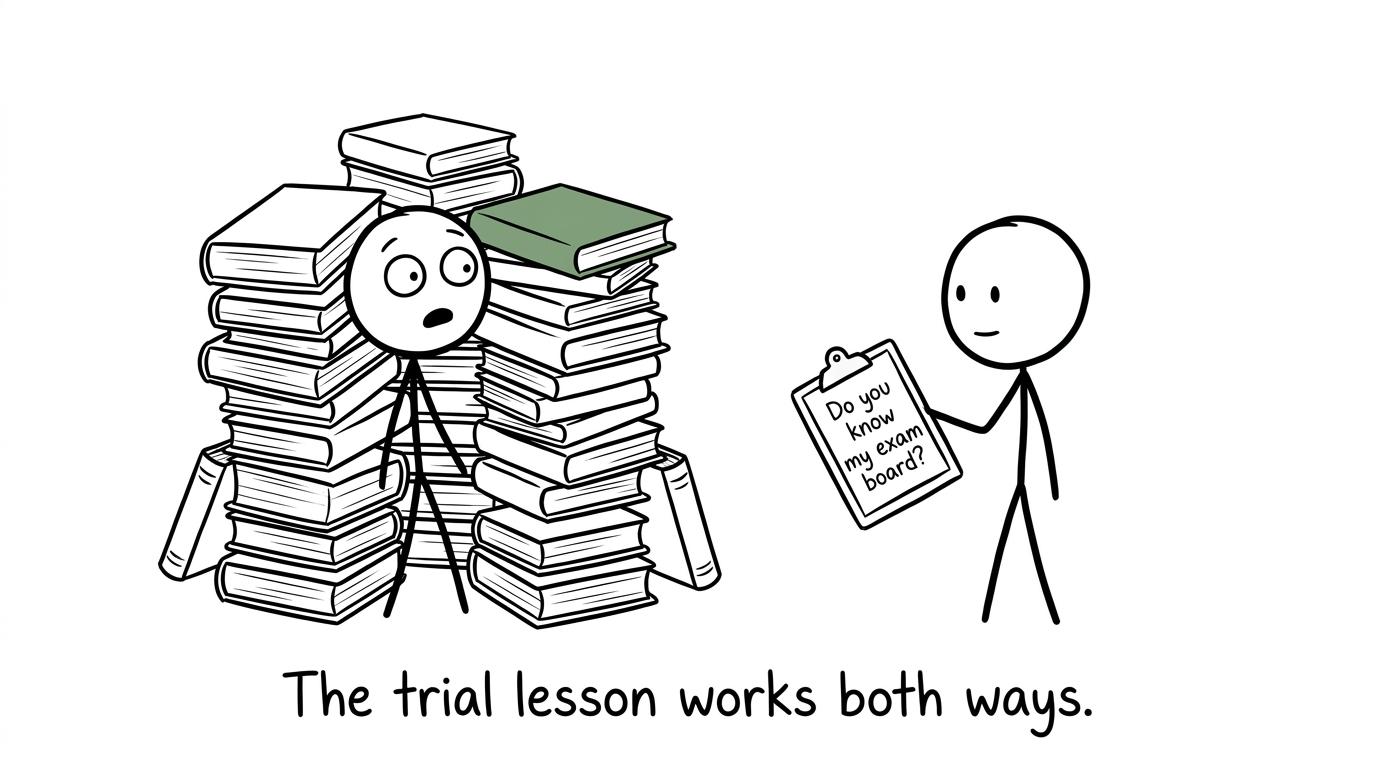 A GCSE student interviews a tutor about exam-board knowledge during a trial lesson
What will tutoring cost over time?
Hourly rates hide the total commitment. If a tutor charges £40\pounds40£40 per hour and you book one lesson each week, the cost is:
12×£40=£48012 \times \pounds40 = \pounds48012×£40=£480That covers approximately three months of weekly lessons. Twenty weekly sessions would cost:
20×£40=£80020 \times \pounds40 = \pounds80020×£40=£800A more focused arrangement can cost less. Six lessons at £45\pounds45£45 each would total:
6×£45=£2706 \times \pounds45 = \pounds2706×£45=£270These totals exclude possible registration fees, resources, travel charges or late-cancellation costs. Ask for the full price in writing before committing.
It is also worth considering session length. A 454545-minute lesson costing £30\pounds30£30 has an hourly equivalent of:
£30÷4560=£40\pounds30 \div \frac{45}{60} = \pounds40£30÷6045=£40Comparing equivalent hourly rates prevents a shorter session from appearing cheaper than it really is. However, a focused 454545-minute lesson may still be more effective than an unfocused hour.
How to decide whether tutoring is worth it
Private tuition is most valuable when it solves a defined problem. "I am bad at Statistics" is too broad. "I cannot choose an appropriate sampling method or justify my answer" gives a tutor something precise to address.
A sensible decision process is:
- complete a mixed set of questions or part of a past paper;
- mark it carefully using the mark scheme;
- sort lost marks into knowledge, method, interpretation and exam technique;
- use free revision lessons and practice questions on the weakest topics;
- seek tuition if the same obstacles remain.
MathsGenie's Edexcel GCSE Statistics resources include specification-focused lessons, worksheets, exam-style questions and papers for foundation and higher tier. Students on other boards can begin from the main Statistics hub and choose the appropriate route.
The GCSE Statistics resit revision plan also explains how to turn marked papers into a targeted programme. The method is useful before a first sitting too: diagnose, repair, practise and retest.
Signs tuition may offer good value
Tutoring may be worthwhile when:
- school absence has created specific gaps;
- repeated independent practice is not resolving misconceptions;
- the student needs immediate feedback on written interpretations;
- there is a limited period before the examination;
- revision lacks structure despite genuine effort;
- a particular grade is needed for a sixth-form or college pathway.
It may offer poor value when lessons simply duplicate school teaching, the student completes no practice between sessions, or nobody checks whether marks are improving.
Questions to ask before hiring a tutor
A good conversation before the first paid lesson can prevent weeks of expensive drift. Ask:
- Which GCSE Statistics exam boards have you taught?
- Are you familiar with my tier and current specification?
- How will you diagnose my weakest areas?
- Will you use past-paper questions and mark schemes?
- What independent work will you set?
- How often will progress be reviewed?
- Are resources, marking and messages between lessons included?
- What is your cancellation policy?
- Can a parent or carer see qualifications, references and relevant safeguarding information?
NSPCC guidance recommends that independent tutors undertake appropriate criminal-record checks and show parents or carers current documentation. A check is useful evidence, but it does not replace references, professional boundaries, parental oversight or careful monitoring of lessons.
The trial lesson works both ways. A tutor should also ask about the student's exam board, recent marks, target, school feedback and confidence. Someone who promises a particular grade before seeing any work is making a claim without enough evidence.
Make each paid lesson work harder
The best way to reduce the effective cost is to arrive prepared. Send the tutor a marked paper, school assessment or short list of difficult topics beforehand. This protects paid time from being spent discovering basic information.
After each lesson, the student should be able to state:
- what misconception was corrected;
- which method or interpretation improved;
- what questions need to be completed independently;
- how success will be checked next time.
Use free resources between sessions. For instance, AQA GCSE histogram questions can provide extra exam-style practice when that overlapping GCSE Maths skill needs attention. Students following CCEA can use specification-matched resources such as the moving averages questions.
When broader revision feels disorganised, the best order for learning GCSE Maths topics offers a practical sequence, including statistics and probability. This matters because some apparent Statistics difficulties are actually gaps in fractions, percentages, graphs or calculator use.
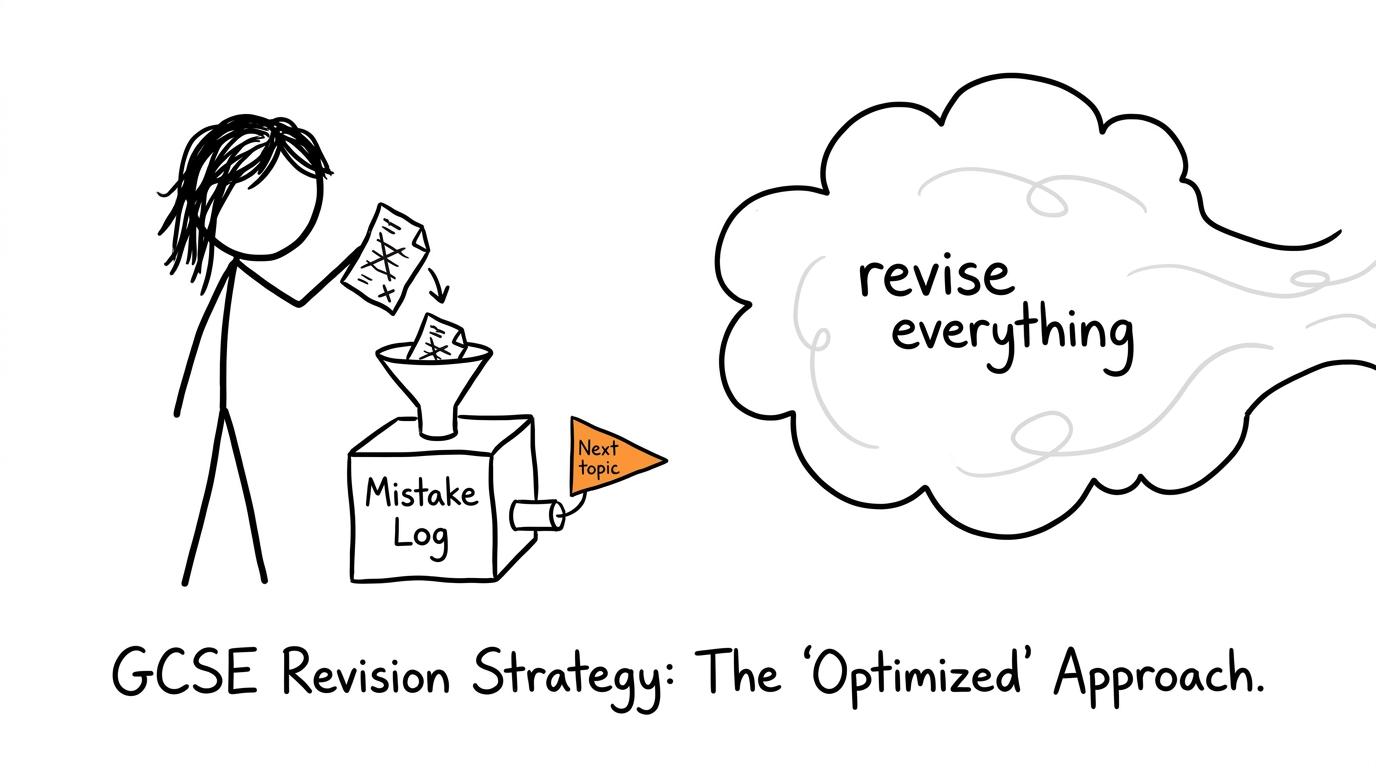 A mistake log turns marked papers into a clear next topic while vague revision drifts away
Common mistakes when comparing tutoring costs
Choosing only by hourly price
The cheapest tutor is not automatically poor, and the most expensive tutor is not automatically effective. Compare preparation, marking, subject knowledge and progress checks rather than one number.
Buying a large package immediately
A block discount can create pressure to continue with a weak match. Begin with a trial or short arrangement unless the terms provide suitable protection.
Hiring a general tutor without checking Statistics knowledge
GCSE Maths contains statistics, but a separate GCSE Statistics course can demand wider specification coverage. Confirm the exact qualification, board and tier.
Paying for explanations but skipping practice
Understanding a lesson is not the same as being able to answer independently under examination conditions. Most improvement happens through deliberate practice, marking and correction between sessions.
Treating predicted papers as forecasts
Predicted papers are practice tools, not promises about the examination. MathsGenie's guide to using predicted topics without guessing explains why they should sit alongside broad topic revision and official past papers.
A measured decision is usually the best one
A realistic GCSE statistics tutoring cost is often £25\pounds25£25 to £55\pounds55£55 per hour, with specialist or premium tutors charging more. Whether that is worthwhile depends less on the rate than on the diagnosis, teaching quality and work completed between lessons.
Start by finding the exact gap. Use MathsGenie's free revision lessons, practice questions, worksheets, mark schemes and video solutions to test what can be improved independently. Then use past papers, mini tests and predicted papers to measure progress. If personalised help is still needed, hire a tutor for a clear purpose and review the evidence after a small number of sessions.
Begin at the MathsGenie GCSE Statistics revision hub, choose your exam board and turn the next lost mark into a specific task. Free practice and private tuition need not compete, used carefully, each can make the other more effective.