GCSE Statistics Revision Book Reviews: Buying Guide
GCSE statistics revision book reviews need more than stars. Check exam-board fit, topic coverage, practice, answers and genuine value before buying.
Buying a revision guide can feel like a sensible first step. The cover promises clarity, the reviews sound reassuring, and placing the book on your desk creates the pleasant sense that revision has begun. But ownership and progress are not the same thing.
The useful answer is simple: yes, it is worth reading GCSE statistics revision book reviews before buying, but star ratings alone are not enough. Check that the book matches your qualification, exam board, tier and current specification. Then inspect its explanations, statistical enquiry coverage, practice questions, answers and exam-style material.
The best book is not necessarily the most popular. It is the one that helps you notice a gap, understand it, practise it and correct your mistakes.
 A student checks whether a highly rated revision guide matches the specification
Your pre-purchase checklist
Before spending money, check these essentials:
- Qualification: is it for the separate GCSE Statistics qualification or the statistics content within GCSE Maths?
- Exam board: does it match the board named by your school?
- Tier: is it suitable for Foundation, Higher or both?
- Specification: does the contents page cover your current course?
- Explanations: does it teach why a method works rather than merely list rules?
- Practice: are questions included after each topic?
- Feedback: are there complete answers, mark guidance or worked solutions?
- Exam language: does it practise interpretation, comparison, evaluation and conclusions in context?
- Usability: can you find a weak topic quickly?
- Value: does it add something that free online resources do not already provide?
Use MathsGenie's GCSE Statistics revision hub as a comparison point. It brings together free resources by exam board, making it easier to see whether a proposed purchase covers the material you actually need.
Check which GCSE you are taking
This is the most important check, yet it is easy to miss.
A book labelled “GCSE statistics” might be intended for the standalone GCSE Statistics qualification. That course goes considerably further than the statistics strand found within GCSE Maths. It can include the statistical enquiry cycle, sampling, questionnaire design, measures of spread, time series, index numbers, correlation, probability and evaluation of conclusions.
Alternatively, a book may be a topic guide for the data and probability content within GCSE Maths. That can still be valuable, but it is not automatically a complete guide to GCSE Statistics.
Look at your school timetable, course details or exam entry information. Ask your teacher for the precise qualification and specification code if you are uncertain. For example, Pearson Edexcel GCSE Statistics uses specification code 1ST01ST01ST0, while AQA GCSE Statistics uses 838283828382.
If you take Edexcel, compare the book with the topic coverage on the Edexcel GCSE Statistics revision page. Students taking GCSE Maths with Edexcel, AQA, OCR or Eduqas should instead check the statistics and probability requirements for their own GCSE Maths specification.
Match the book to your board, tier and specification
Exam boards share national subject requirements, but their specifications, terminology, assessment structures and question styles are not interchangeable in every detail. A broad statistics book may explain the mathematics correctly while omitting material your board assesses.
Open the contents page and compare it line by line with your specification. Do not rely on a cover that merely says “suitable for GCSE”. Check for the topics your course names, including:
- planning a statistical enquiry;
- populations, samples and sampling methods;
- data types and data collection;
- charts, tables and graphical representations;
- averages and measures of spread;
- correlation, regression and time series;
- probability and risk;
- interpretation, evaluation and conclusions.
Tier matters too. GCSE Statistics has Foundation and Higher assessments. A Higher student needs adequate depth, while a Foundation student should not have to search through pages of material that cannot appear on their paper.
Check the publication edition rather than assuming that a new-looking cover means current content. A used copy may be inexpensive but aligned with an older specification. The safest evidence is a clear statement of the exam board, specification code and applicable exam series inside the book.
Look beyond formula coverage
A revision guide should contain accurate formulae. But statistics is not simply a list of calculations.
For instance, a guide may correctly state:
xˉ=∑fx∑f\bar{x}=\frac{\sum fx}{\sum f}xˉ=∑f∑fxor
IQR=Q3−Q1.\operatorname{IQR}=Q_3-Q_1.IQR=Q3−Q1.That is necessary, but an effective guide should also explain when a measure is suitable, what it reveals about the data and how it supports a comparison. It should distinguish correlation from causation, address bias and sampling limitations, and require conclusions to remain connected to the context.
Official GCSE Statistics assessment objectives include knowledge and calculation, interpretation and statistical reasoning, and evaluation through the statistical enquiry cycle. A book that concentrates almost entirely on short calculations may therefore leave an important gap.
When preview pages are available, look for prompts such as “interpret”, “compare”, “assess”, “evaluate” and “give a reason”. These often reveal whether the guide prepares you to reason statistically rather than just press calculator buttons.
Inspect the explanations and page design
A useful revision book reduces friction. You should be able to open it at a weak topic, understand the key idea and move into practice without decoding a crowded page.
Check a sample section and ask:
- Are new terms defined precisely?
- Are diagrams readable and correctly labelled?
- Are calculator instructions appropriate for your course?
- Are common misconceptions addressed?
- Does difficulty build gradually?
- Can you tell which material is Higher-only?
- Is there enough space or structure for active practice?
Some students prefer concise notes. Others need fuller explanations and visual structure. Neither preference is inherently better. The question is whether you can learn from the page without constantly needing another source to translate it.
 A revision guide faces a student interview about examples, practice and answers
Judge the questions and answers together
The quality of the question set matters more than the number printed on the cover. Look for a mixture of short skill checks, interpretation questions, unfamiliar contexts and longer statistical reasoning tasks.
Then inspect the answers. A final-answer list can confirm whether a calculation is right, but it may not reveal why marks were lost. Better feedback shows essential reasoning, acceptable conclusions and the level of detail expected.
This is where a book should work alongside real exam material rather than replace it. MathsGenie's guide to starting GCSE past papers explains how to move from targeted questions towards timed papers. The GCSE predicted papers collection can provide fresh exam-style practice later in revision.
For statistics-specific practice, return to the GCSE Statistics resources for available past papers, worksheets and exam-board materials. A revision book explains and organises; past papers reveal how knowledge is assessed.
Read reviews for evidence, not enthusiasm
The most helpful GCSE statistics revision book reviews describe the product rather than the reviewer's mood.
Look for comments that answer concrete questions:
- Which exam board and tier did the reviewer use it for?
- Does the book cover the full specification?
- Are the answers detailed enough for independent revision?
- Are there printing errors or unclear diagrams?
- Is the difficulty realistic?
- Can topics be found quickly?
Treat vague praise cautiously. “Excellent book” tells you very little about specification coverage. Equally, a low rating caused by delayed delivery says nothing about the mathematical quality of the guide.
Reviews can also become outdated when publishers release a new edition while older and newer comments remain mixed together. Confirm that the review refers to the same edition, format and ISBN as the copy you are considering.
Decide whether the book adds genuine value
A physical guide can be worthwhile if you focus better away from a screen, want a portable course summary or prefer annotating paper. It can also provide a reassuring structure when the specification feels scattered.
But do not buy a book merely because revision feels more serious when money has been spent. First ask what gap it will fill.
MathsGenie already provides free revision lessons, practice questions, worksheets, past papers, mark schemes, video solutions, mini tests and predicted papers where available. The GCSE one-month revision plan shows how those resources can fit into a repeatable routine.
A book earns its place if it improves that routine, perhaps through concise offline notes, a strong topic index or extra questions. If it only duplicates resources you already use successfully, the purchase may not be necessary.
Give the book a five-minute test
Before buying, choose one topic you find difficult and inspect the relevant pages. Do not start with your strongest topic, because almost any book feels clear when you already understand the material.
Ask whether the section helps you do four things:
- identify the statistical idea;
- choose an appropriate method;
- interpret the result in context;
- check your understanding with a question and useful answer.
If the book fails this small test, a higher average rating is unlikely to rescue it.
Common mistakes when choosing a revision guide
Buying for the wrong qualification
A GCSE Maths statistics chapter is not a complete standalone GCSE Statistics course. Verify the title, board and specification code.
Choosing by star rating alone
Ratings combine opinions about delivery, price, condition and content. Read the detailed comments and inspect sample pages.
Ignoring the edition
Older books may contain accurate mathematics but incomplete or outdated specification coverage. Check the exact edition and ISBN.
Counting pages instead of useful practice
A thick guide is not automatically comprehensive. Look for specification coverage, varied questions and feedback that helps you correct mistakes.
Rereading without retrieval
Revision can feel comfortable when the book remains open. Progress becomes visible when you close it and answer questions independently.
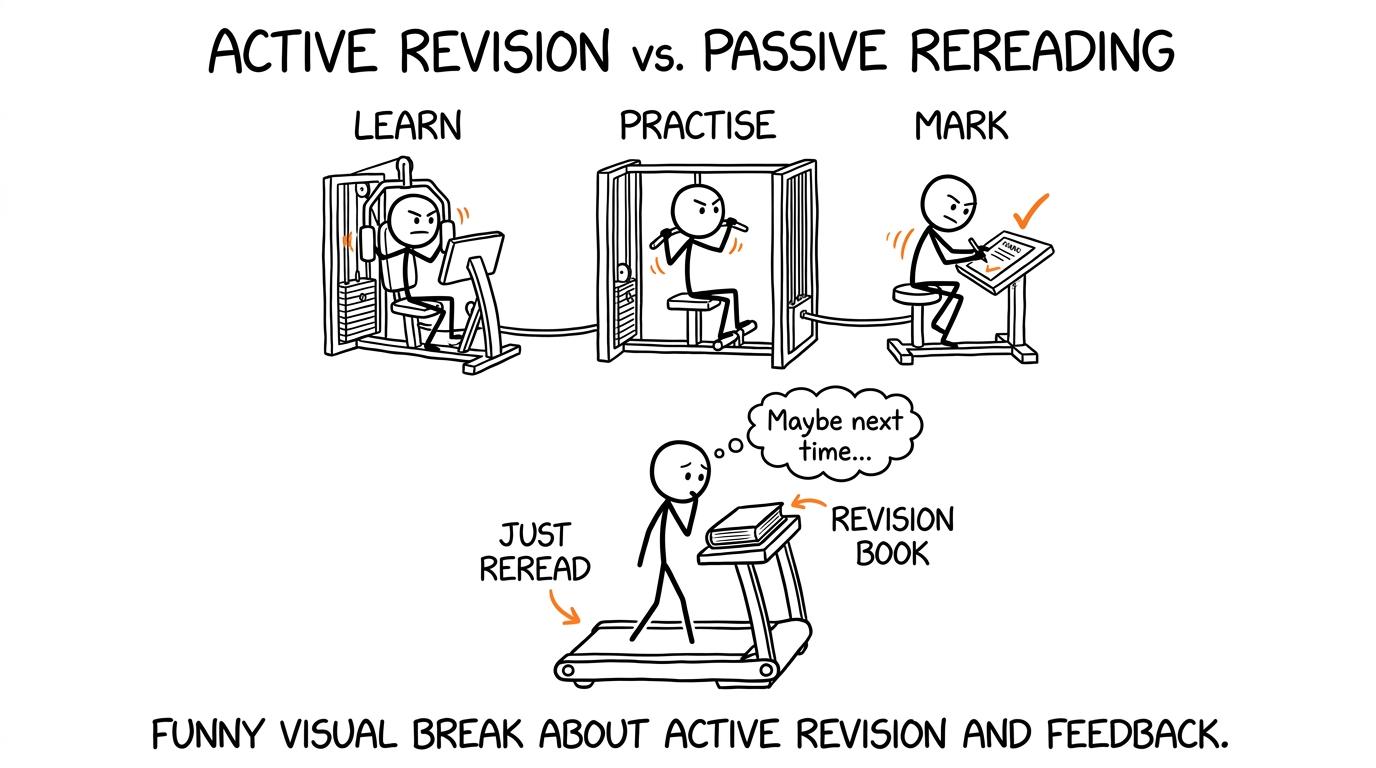 A student trains with learning, practice and marking while a book attempts passive rereading
Replacing past papers with the book
A guide supports learning; it does not reproduce the complete experience of an exam paper. Use official-style questions, mark your attempts and diagnose each lost mark. The GCSE Statistics grade boundaries guide also explains why raw marks and boundaries must be interpreted carefully rather than treated as fixed targets.
Choose a resource you will actively use
The best revision guide is not the one with the brightest cover or the longest review list. It is the one that matches your exact course and makes the next action obvious.
Check the qualification, board, tier, edition, specification coverage, explanations, questions and answers. Then decide whether the book fills a genuine gap in your revision system.
Start with MathsGenie's free GCSE Statistics revision resources. Use revision lessons to rebuild understanding, practice questions to test it, mark schemes and video solutions to correct it, and past papers, mini tests and predicted papers to develop exam readiness. If a book strengthens that cycle, it may be worth buying. If it does not, a shelf full of stars will not create marks.