GCSE Statistics Part-Time Job Balance: A Real Plan
GCSE statistics part-time job balance: build a realistic weekly plan, revise in short blocks, protect sleep and use shifts without losing exam progress.
A part-time job can make GCSE revision feel like a timetable problem with no solution. School fills the day, a shift takes the evening, and Statistics waits at home beside an unopened worksheet. Yet a realistic GCSE statistics part time job balance does not require perfect organisation or hours of revision every night. It requires a small weekly plan built around your actual shifts, short sessions with a clear purpose, and enough rest to think properly.
The aim is not to keep work and revision equal every day. It is to keep both stable across the week. Some days will contain a focused Statistics session; others may contain only a ten-minute review. That still counts when each session leads towards marks.
Your quick balance checklist
Before building a detailed timetable, check these foundations:
- Put school, travel, shifts and sleep into the week first.
- Choose two or three Statistics priorities, not the whole specification.
- Revise before demanding shifts when possible.
- Use short, low-pressure tasks after work.
- Mark every set of practice questions.
- Keep one catch-up space free each week.
- Tell your employer early when mocks and GCSE exams are approaching.
- Ask a parent, carer, teacher or manager for help if work is affecting school or wellbeing.
Start by opening the GCSE Statistics revision hub and confirming your exam board. Students taking the separate GCSE Statistics qualification will commonly be following AQA or Edexcel. Students revising the Statistics strand within GCSE Maths may be taking Edexcel, AQA, OCR or Eduqas, so the exact specification and tier still matter.
Build the week around reality, not ambition
A weak revision plan begins with an imaginary student who is always energetic. A useful plan begins with the student who comes home tired after standing, serving customers or travelling on a late bus.
Write down your fixed commitments first:
- school and required homework;
- journey times;
- confirmed work shifts;
- meals and family responsibilities;
- sleep;
- any regular clubs or appointments.
Your revision time is what remains after those commitments, not what you wish remained. You can represent the idea as:
Tr=Tw−Tf−Ts−TcT_r = T_w - T_f - T_s - T_cTr=Tw−Tf−Ts−TcHere, TrT_rTr is realistic revision time, TwT_wTw is the total time available in the week, TfT_fTf represents fixed commitments, TsT_sTs represents sleep, and TcT_cTc represents essential care and recovery.
This is not a calculation you need for an exam. It is a reminder that revision plans fail when they pretend sleep, travel and tiredness take no time.
NHS guidance suggests that teenagers aged thirteen to eighteen generally need around eight to ten hours of sleep. Treating sleep as spare revision time is therefore a poor trade: it creates more minutes at a desk while making concentration, accuracy and recall harder.
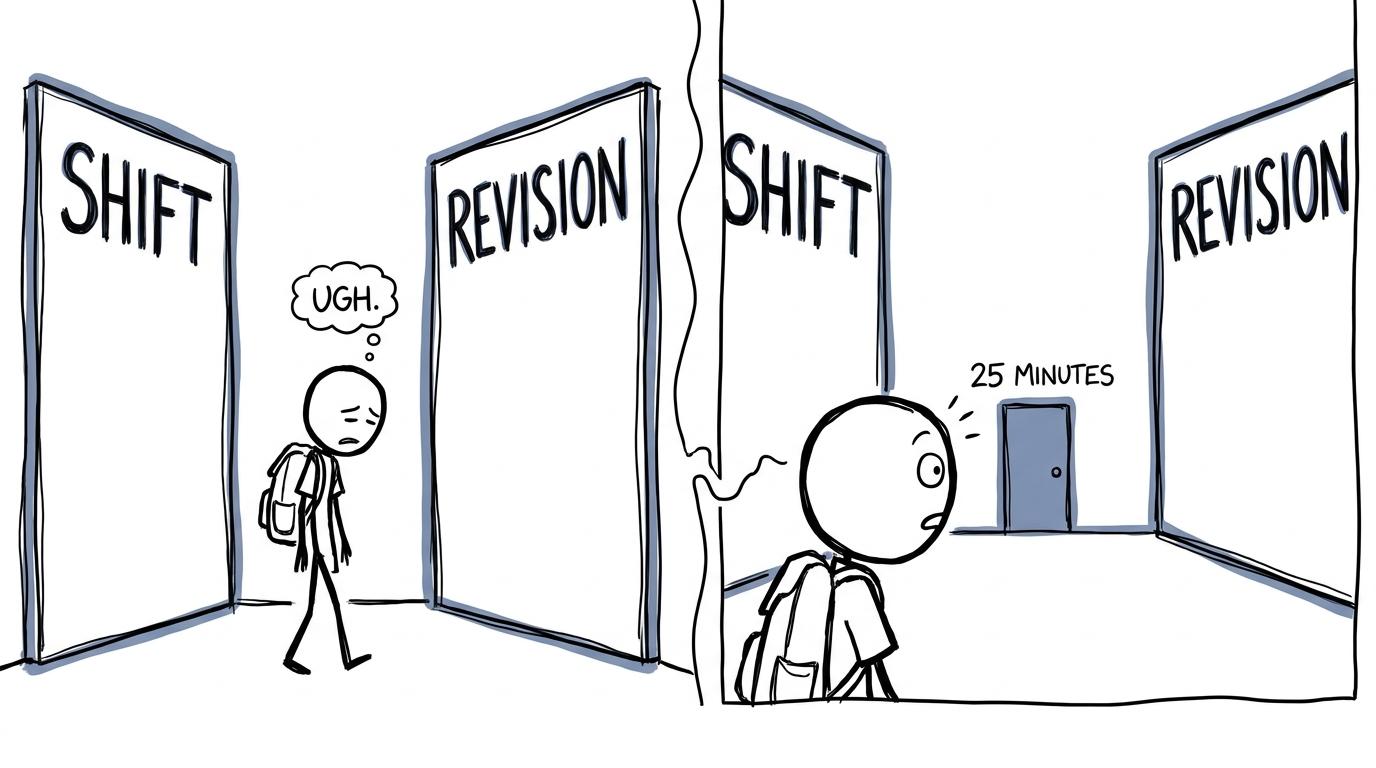 A student finding a manageable revision door between work and revision
Match the revision task to your energy
Not every Statistics task needs the same level of concentration. The practical solution is to keep different tasks for different kinds of day.
High-energy sessions
Use these when you are alert, perhaps on a free evening, before a weekend shift or during a protected school revision period. Good tasks include:
- learning an unfamiliar method;
- completing a timed paper section;
- interpreting unfamiliar data;
- comparing distributions;
- tackling Higher tier content;
- correcting a difficult assessment.
A focused session might last thirty to forty-five minutes. If you follow Edexcel, the Edexcel GCSE Statistics revision page brings lessons, worksheets, exam-style questions and papers together, reducing the time lost deciding what to do.
Medium-energy sessions
These are suitable for ordinary school nights without a shift. You could:
- complete a short set of topic questions;
- revisit a method learned earlier;
- mark yesterday’s work;
- explain a graph or conclusion in words;
- redo questions that previously lost marks.
Statistics is not only calculation. Official GCSE Statistics assessment objectives also cover interpreting results in context and evaluating methods through the statistical enquiry cycle. Your revision should therefore include written conclusions, sampling decisions and evaluation, rather than calculations alone.
Low-energy sessions after work
After a shift, promising yourself a full paper is usually unrealistic. Choose something with a low starting cost:
- review definitions or flashcards;
- watch one short video solution;
- mark three completed questions;
- read a mark scheme and identify the required wording;
- redo one familiar question without notes;
- update your mistake list.
Ten useful minutes are better than an exhausted hour spent rereading the same page. On particularly tiring days, stopping and sleeping may be the sensible academic decision.
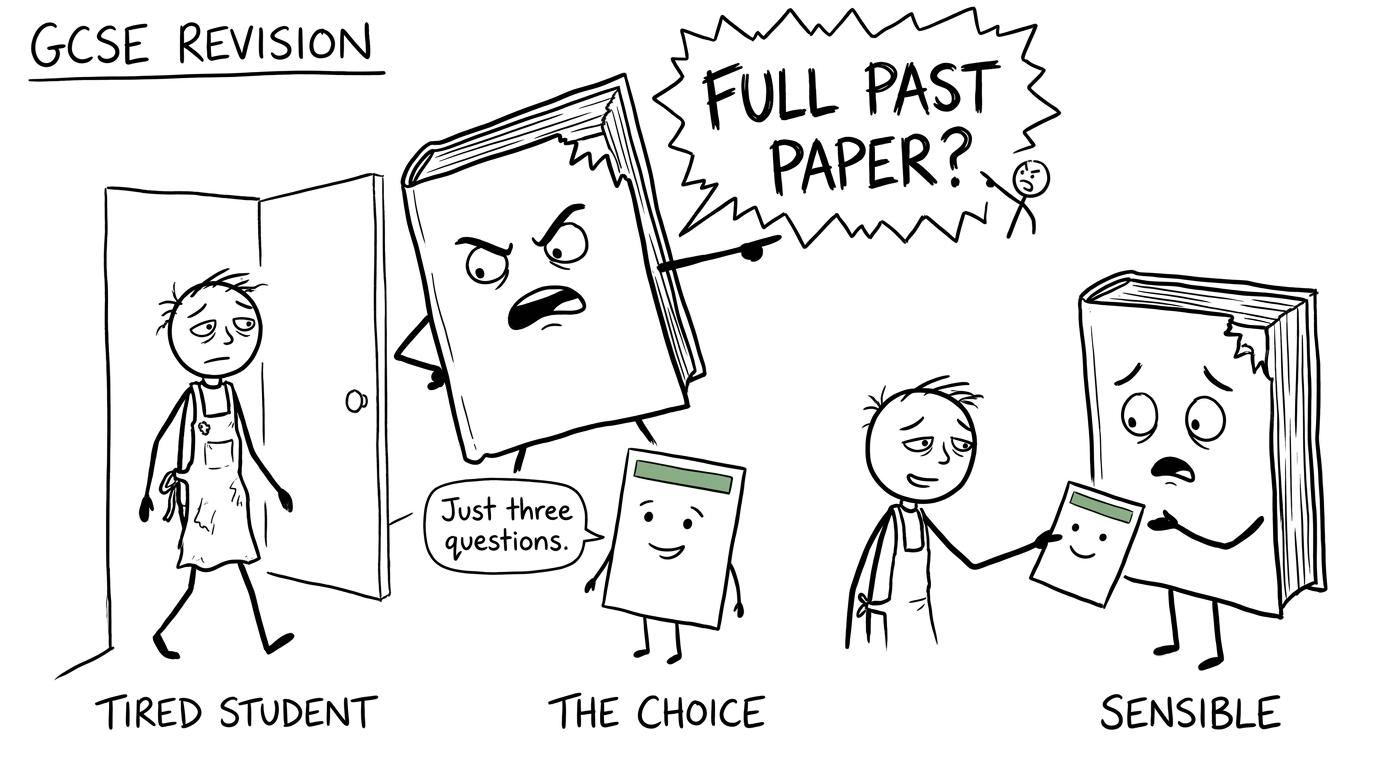 A tired student choosing three questions instead of a full paper
Prioritise the Statistics that costs you marks
Limited time makes diagnosis important. Do not revise topics simply because they feel comfortable.
Complete a short mixed set or part of a past paper, then classify each lost mark:
- Knowledge: you did not know the fact or method.
- Application: you knew the method but could not use it in context.
- Interpretation: the calculation was possible, but the conclusion was weak.
- Accuracy: arithmetic, plotting or rounding caused the error.
- Technique: you misread the command word or omitted working.
Turn this into a short priority list. “Revise Statistics” is too broad. “Compare box plots using median and interquartile range” is actionable.
Foundation and Higher tier students should follow their own specification. Core areas can include data collection, sampling, tables and charts, averages, spread, probability, correlation and the statistical enquiry cycle. Higher content can involve more demanding techniques and interpretation. If cumulative frequency is a weakness, for instance, use the focused cumulative frequency revision guide rather than wandering through an entire textbook.
For a broader check of where Statistics sits within GCSE Maths, consult the GCSE Maths topics by board and tier. This helps prevent spending scarce time on content that does not match your course.
Use a repeatable revision loop
When shifts change, a rigid timetable can collapse. A repeatable process is more resilient:
- Choose one precise weakness.
- Review the relevant lesson or method.
- Answer a small set of questions without support.
- Mark them immediately.
- Record why each mark was lost.
- Repeat the difficult questions several days later.
The marking stage matters. Completing questions can feel productive, but improvement comes from discovering the gap between your answer and the mark scheme. Keep a simple “marks leak” list with the topic, mistake and correction.
Once individual topics become secure, move towards mixed and timed practice. The GCSE Statistics resit planning guide contains a useful progression from diagnosis to topic work and full papers. Its planning principles are equally helpful for a first sitting.
Plan around changing shifts
Some students receive the same hours each week. Others do not. If your rota changes, plan in two layers.
Keep weekly anchors
Choose two sessions that are unlikely to move, such as one school-night block and one weekend morning. These are your protected Statistics sessions.
Add flexible sessions after the rota arrives
When your employer confirms the week, place one or two shorter sessions into genuine gaps. Keep one space empty as a buffer. If a shift changes or homework expands, the buffer absorbs it without destroying the plan.
A one-month GCSE revision plan can provide the wider structure, but reduce the daily workload to fit your circumstances. A plan is successful because it survives busy weeks, not because it looks impressive on Sunday evening.
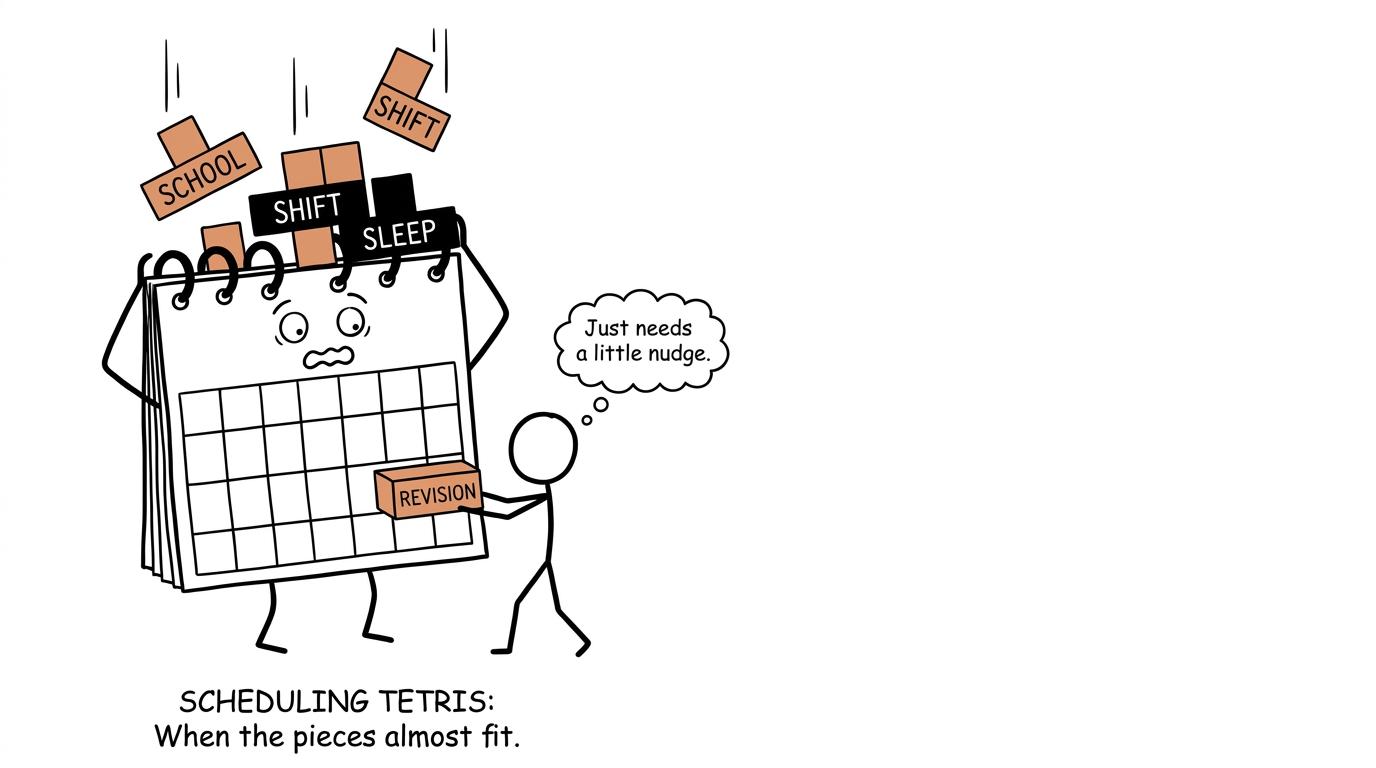 A calendar fitting school, work, sleep and revision together
Talk to your employer before pressure peaks
Do not wait until the night before a mock to mention that you need fewer hours. When you receive your exam timetable, explain which weeks will be demanding and ask whether shifts can be reduced, shortened or moved. Your employer may not be able to accept every request, but early notice makes adjustment more possible.
If you are below minimum school leaving age, official rules restrict child employment and local council requirements may also apply. GOV.UK guidance states that children working during term time are generally limited to twelve hours per week, with further daily restrictions, and work must not harm their education or wellbeing. Rules can depend on age, location and school-leaving status, so ask a parent or carer to check current local requirements if you are unsure.
If your hours, late finishes or tiredness are damaging attendance, homework or health, speak to a trusted adult. Balance is not a private test of toughness.
Common mistakes when balancing work and revision
Saving everything for days off
A day off can disappear into homework, errands and recovery. Use small sessions during the week, then reserve days off for deeper practice rather than the entire revision burden.
Revising only by watching videos
Videos can rebuild understanding, but the exam requires you to produce answers. Follow every lesson with questions completed without help.
Completing papers without learning from them
A raw mark is information, not the finished task. Use the mark scheme, correct each error and revisit the weakest topic. The GCSE Maths revision hub provides past papers, predicted papers, topic resources and mini tests for this process.
Making every session the same length
A twenty-minute session before work and a longer session on a free morning can both be valuable. Match the task to the time and energy available.
Sacrificing sleep to catch up
Late-night revision after a tiring shift often produces weak concentration and careless errors. Move the unfinished task into the weekly buffer instead.
Ignoring interpretation and evaluation
GCSE Statistics rewards more than correct arithmetic. Practise explaining results in context, discussing bias, assessing samples and judging whether conclusions are justified.
Keep both parts of your life standing
A good GCSE statistics part-time job balance is not a perfectly divided timetable. It is a system that bends without breaking: fixed commitments first, protected sleep, a few focused sessions, lighter tasks after shifts and honest marking.
Begin with one action. Open the MathsGenie GCSE Statistics resources, select your board and identify one topic currently leaking marks. Use a revision lesson, answer the practice questions, check the mark scheme and schedule a short retest.
As the exam approaches, build towards mini tests, past papers and predicted papers where available. MathsGenie keeps the lessons, practice questions, mark schemes, video solutions and paper practice together, so the limited time outside school and work can be spent revising rather than searching.