GCSE Statistics With No Background Knowledge?
GCSE statistics no background knowledge? See if a late start is realistic, what skills you need and how to catch up efficiently before your exams.
There is a particular kind of worry that appears when everyone else seems to know what a histogram is and you are still deciding which axis is which. If you searched for gcse statistics no background knowledge, the short answer is reassuring: starting late can be realistic, provided your school permits the entry and you quickly rebuild the essential Key Stage 3 maths beneath the course.
You do not need years of specialist statistics lessons. You do, however, need reasonable confidence with fractions, decimals, percentages, ratio, basic algebra and graphs. The official GCSE Statistics subject content builds on this prior knowledge rather than teaching every numerical skill from the beginning.
This guide explains what “no background” really means, how to judge whether the qualification is manageable and how to catch up without revising everything at once.
The quick readiness checklist
Before committing to GCSE Statistics, ask whether you can:
- calculate with fractions, decimals and percentages;
- interpret tables, scales and straightforward graphs;
- substitute values into a formula;
- calculate a mean and recognise a median or mode;
- use a scientific calculator confidently;
- explain a conclusion in a complete sentence;
- follow a regular revision plan alongside your other GCSE subjects.
A few gaps do not mean you cannot take the course. They show you where to begin. A larger problem would be having significant gaps across all these areas while also lacking the time or school support needed to repair them.
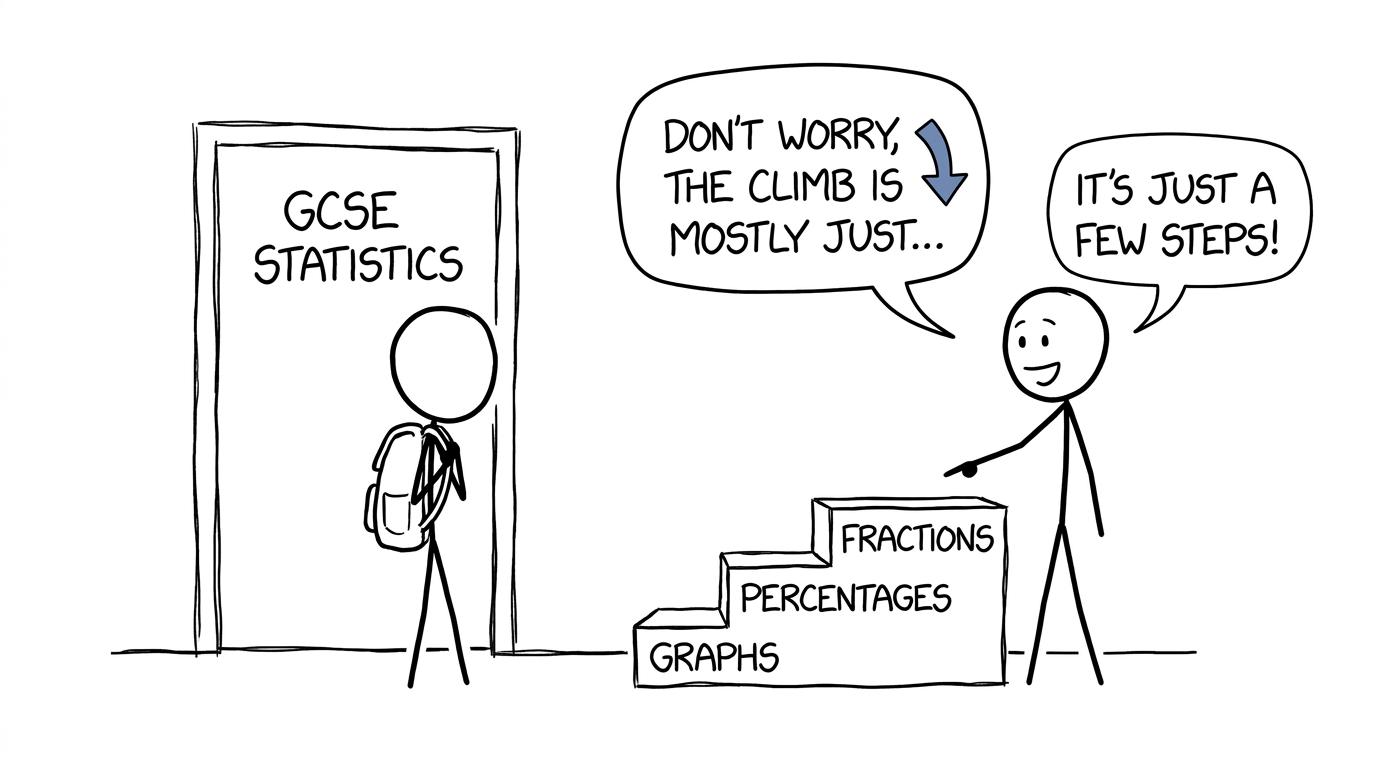 A student discovering that the staircase into GCSE Statistics is short and climbable
Can you take GCSE Statistics without the usual background?
Yes, potentially. GCSE Statistics is a standalone GCSE, and it should not be confused with the statistics topics contained inside GCSE Maths. Schools decide which qualifications they offer, which students they enter and whether a late change is practical. You therefore need to speak to your statistics teacher, maths department or examinations officer before treating self-revision as an exam entry plan.
The important qualification is that “no background knowledge” cannot literally mean no mathematical foundation. The Department for Education's GCSE Statistics subject content identifies prior knowledge including integers, fractions, decimals, percentages, calculation, accuracy, ratio, proportion and rates of change. AQA also states that students should be familiar with the Key Stage 3 programme of study and the prior knowledge listed in its specification.
That does not close the door. It defines the floor.
If you are already taking GCSE Maths, much of that floor will be familiar. Topics such as averages, probability, scatter graphs, cumulative frequency, box plots and histograms overlap with GCSE Maths, although the separate Statistics GCSE explores data collection, interpretation and statistical reasoning in greater depth.
Begin by opening the GCSE Statistics revision hub and selecting the correct exam board. Do not assume that a worksheet or past paper belongs to your specification merely because “statistics” appears in its title.
What GCSE Statistics actually asks you to learn
The course is not simply a collection of calculations. It asks you to understand how evidence is gathered, represented, analysed and evaluated.
Broadly, the content covers:
- planning statistical investigations;
- populations, samples and sampling methods;
- types and sources of data;
- questionnaires, experiments and possible bias;
- tables, charts and statistical diagrams;
- averages and measures of spread;
- probability;
- relationships between variables;
- interpreting results and judging the strength of conclusions.
The statistical enquiry cycle matters throughout. You need to think about the question being investigated, how suitable data can be collected, which methods should be used and whether the evidence actually supports the conclusion.
This is why students who are competent calculators can still lose marks. A numerical answer may be correct while the interpretation is too vague, the sample is biased or the chosen diagram is unsuitable.
Foundation and higher tier
Both AQA GCSE Statistics and Pearson Edexcel GCSE Statistics offer foundation and higher tiers. Foundation tier targets grades 1-5, while higher tier targets grades 4-9, subject to the exam board's grading rules. Students take papers at one tier rather than mixing tiers.
AQA GCSE Statistics is specification code 8382. Pearson Edexcel uses 1ST0. Both qualifications assess the course through two written papers, and calculators are permitted. Paper timings and question styles are not identical, so confirm your board rather than planning from another specification.
MathsGenie's Edexcel GCSE Statistics revision page brings the relevant lessons, worksheets, exam-style questions and papers together. If your school uses another board, choose it through the main Statistics hub.
The background knowledge worth rebuilding first
Catching up fast does not mean racing directly into the hardest higher-tier topic. Statistics rests on a small collection of reusable skills. Repairing these first makes later work much faster.
Fractions, decimals, percentages and ratio
These appear in probabilities, relative frequencies, sampling and comparisons. You should be able to move confidently between common forms and recognise that a probability lies from 000 to 111 inclusive.
For mutually exclusive outcomes covering every possibility, the probabilities satisfy
∑P(outcome)=1.\sum P(\text{outcome})=1.∑P(outcome)=1.If this foundation feels uncertain, use the GCSE probability revision guide before attempting full Statistics papers.
Averages and spread
You need more than a memory of “add and divide”. Each measure describes a distribution differently. The mean uses every value but may be affected by extreme values; the median identifies the middle; the mode identifies the most frequent value or category.
The core relationship is
mean=sum of the valuesnumber of values.\text{mean}=\frac{\text{sum of the values}}{\text{number of values}}.mean=number of valuessum of the values.Frequency tables and grouped data require additional care. The averages from frequency tables resources are a useful bridge between GCSE Maths knowledge and the demands of Statistics.
Spread matters because two data sets can share the same average while behaving very differently. You should recognise the range and interquartile range, where
IQR=Q3−Q1.\operatorname{IQR}=Q_3-Q_1.IQR=Q3−Q1.Graphs and data representation
A graph is not decoration. Its form should match the data and the purpose of the investigation. Bar charts suit categories or discrete values; histograms represent grouped continuous data; scatter graphs display paired variables.
Rebuild these topics in a sensible order. Start with scales, frequency tables and simple charts. Then move to cumulative frequency revision, box plots and histograms.
For a histogram, the central relationship is
frequency density=frequencyclass width.\text{frequency density}=\frac{\text{frequency}}{\text{class width}}.frequency density=class widthfrequency.This is a frequent source of confusion because frequency is represented by bar area, not simply its height.
Written interpretation
Statistics rewards careful language. You may need to compare centres and spreads, identify limitations, discuss bias or explain why an apparent relationship does not establish causation.
When revising scatter graphs, practise describing direction and strength in context. Remember that correlation suggests an association; by itself, it does not prove that changing one variable causes the other to change.
How to catch up quickly if your school allows it
Speed comes from sequence, not panic. Trying to read the entire textbook before answering a question creates the feeling of progress without revealing what you can actually do.
Diagnose the gap before planning the cure
Complete a short selection of questions from across the specification without notes. This is not a prediction of your eventual grade. It is a map.
Sort every lost mark into four groups:
- missing background knowledge;
- missing Statistics content;
- weak interpretation;
- avoidable examination error.
These categories need different responses. A percentage error needs prerequisite practice. A sampling error needs a Statistics lesson. A vague conclusion needs written-response practice.
Use a focused catch-up cycle
For each topic:
- learn the idea through a revision lesson or guide;
- answer a small set of questions without support;
- mark them carefully;
- write down the precise reason for each lost mark;
- revisit the skill after a short gap;
- move to mixed questions only when the method is reasonably secure.
Keep sessions narrow. “Revise statistics” is too large to be useful. “Distinguish random, systematic and stratified sampling” gives your attention somewhere to land.
Move from topics to papers gradually
Past papers are most valuable after you have built enough knowledge to understand your mistakes. Start with individual topics, then mixed sections, then timed papers.
Use mark schemes to learn how conclusions are expressed and which evidence earns credit. Later, use full past papers and predicted papers to practise decisions under time pressure. The GCSE Statistics resit revision plan contains a useful diagnostic approach even if this is your first entry rather than a resit.
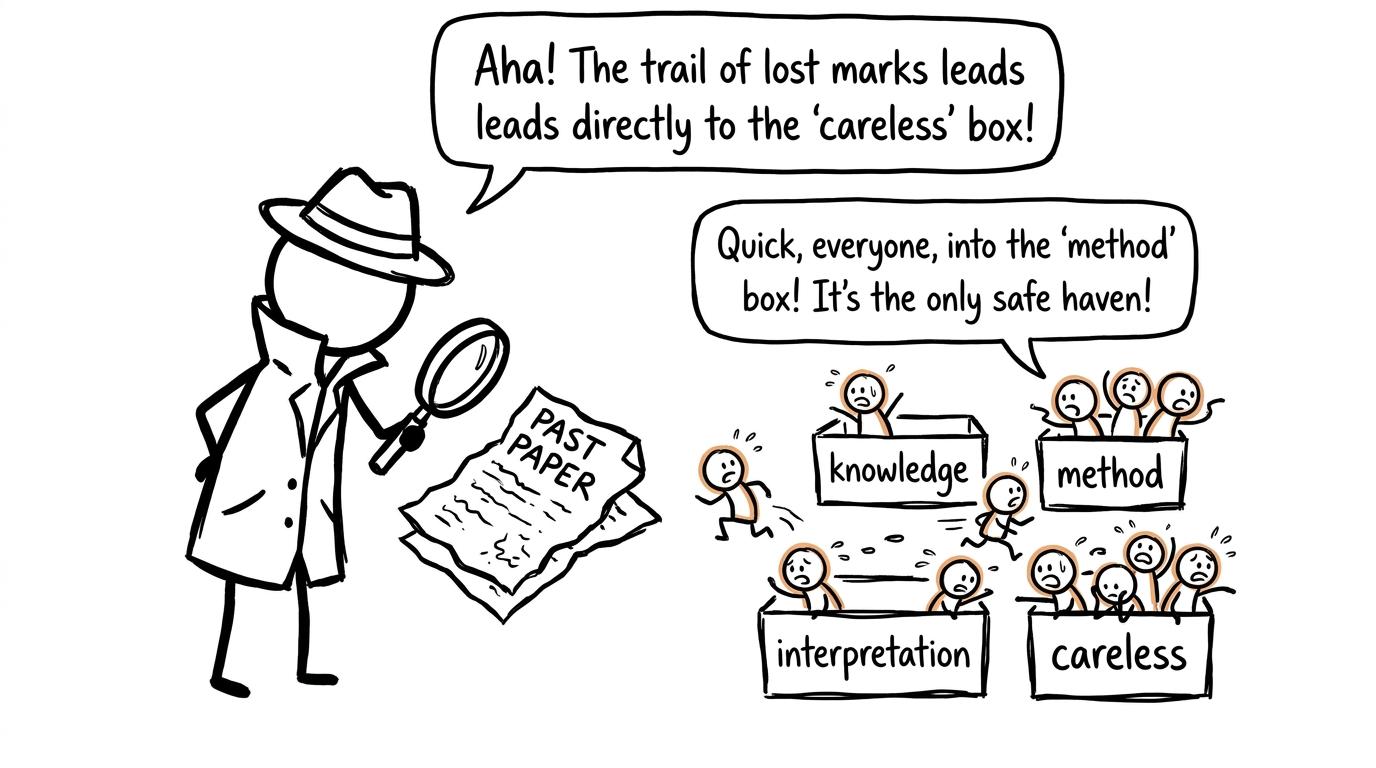 A student detective sorting escaped marks into useful revision categories
When starting late may not be realistic
Encouragement is useful only when it remains honest. A late start may be unwise if:
- your school cannot enter you for the qualification;
- you do not know which exam board or tier you would take;
- major gaps in basic number skills are affecting GCSE Maths as well;
- the extra course would damage revision for compulsory subjects;
- too little teaching or independent revision time remains;
- you cannot access feedback on extended statistical reasoning.
In that situation, strengthening the statistics component of GCSE Maths may be the better decision. You can still develop valuable data skills without adding a separate examination entry.
A useful question is not simply, “Could I learn this?” Most students could, given enough time. The better question is, “Can I learn it responsibly within my current timetable?”
Common mistakes when starting GCSE Statistics late
Skipping the specification
Students sometimes revise familiar GCSE Maths topics while missing Statistics-specific content such as sampling, data collection, bias and the enquiry cycle. Use your board's current specification as a checklist.
Beginning with full papers
A paper can diagnose weaknesses, but repeated full papers do not automatically teach missing content. Follow diagnosis with focused lessons and practice questions.
Memorising formulas without understanding the data
A calculator can produce a value without deciding whether the value is meaningful. Always identify what the variables represent, whether the data is discrete or continuous and what the result says in context.
Treating every graph as interchangeable
Bar charts and histograms are not the same. Nor are correlation and causation. Learn why a representation is appropriate rather than relying only on its appearance.
Ignoring written answers
Statistics includes explanation and evaluation. Practise using evidence from the question, naming the relevant statistical feature and linking it to the context.
Choosing a tier based only on ambition
Higher tier contains additional content and greater demand. Tier decisions should reflect current evidence, available preparation time and teacher guidance, not embarrassment or guesswork.
Start with the next manageable step
Taking GCSE Statistics with limited prior experience is possible when the foundations are repairable, the school supports the entry and your revision is organised. The course does not demand a mysterious statistical instinct. It asks for numerical fluency, careful interpretation and repeated practice.
Start at the MathsGenie GCSE Statistics hub, choose your exam board and identify your weakest prerequisite. Use revision lessons to learn it, practice questions to test it and mark schemes to understand where marks are earned. Then build towards mini tests, past papers and predicted papers.
Background knowledge is not something other students were simply born with. It is a collection of skills. Skills can be rebuilt: one focused session at a time.