Is a GCSE Biology Discord Server Worth Joining?
GCSE biology Discord server advice: discover the benefits, safety risks and practical ways to use online communities without weakening your revision.

Revision can become strangely lonely. You may spend an evening staring at a diagram of the heart, unsure whether your explanation of double circulation is precise enough, while everyone else appears to understand it already. At that moment, a GCSE biology Discord server can look like the perfect answer: instant explanations, shared resources and other students working towards the same exams.
It can be useful. But it should be treated as a discussion room, not as a textbook, teacher or mark scheme. The best servers help you ask better questions and stay accountable. The worst encourage distraction, circulate unreliable answers and create the feeling of revising without requiring much genuine practice.
For students balancing biology with GCSE maths, the sensible approach is simple: use the community for support, then return to structured, exam-board-specific revision.
The quick verdict
A subject Discord server may be worth joining if it has:
- active and visible moderation;
- channels organised by exam board or topic;
- clear rules about privacy, conduct and exam material;
- answers supported by specifications or mark schemes;
- quiet study rooms or accountability sessions;
- a culture that encourages independent work.
Leave, mute or avoid it if it is dominated by:
- unexplained screenshots and copied answers;
- supposed paper leaks or rumours;
- constant off-topic conversation;
- unsolicited direct messages;
- pressure to share personal information;
- confident claims that nobody can verify.
The deciding question is not whether the server feels busy. It is whether using it leads to better recall, clearer explanations and more completed exam questions.
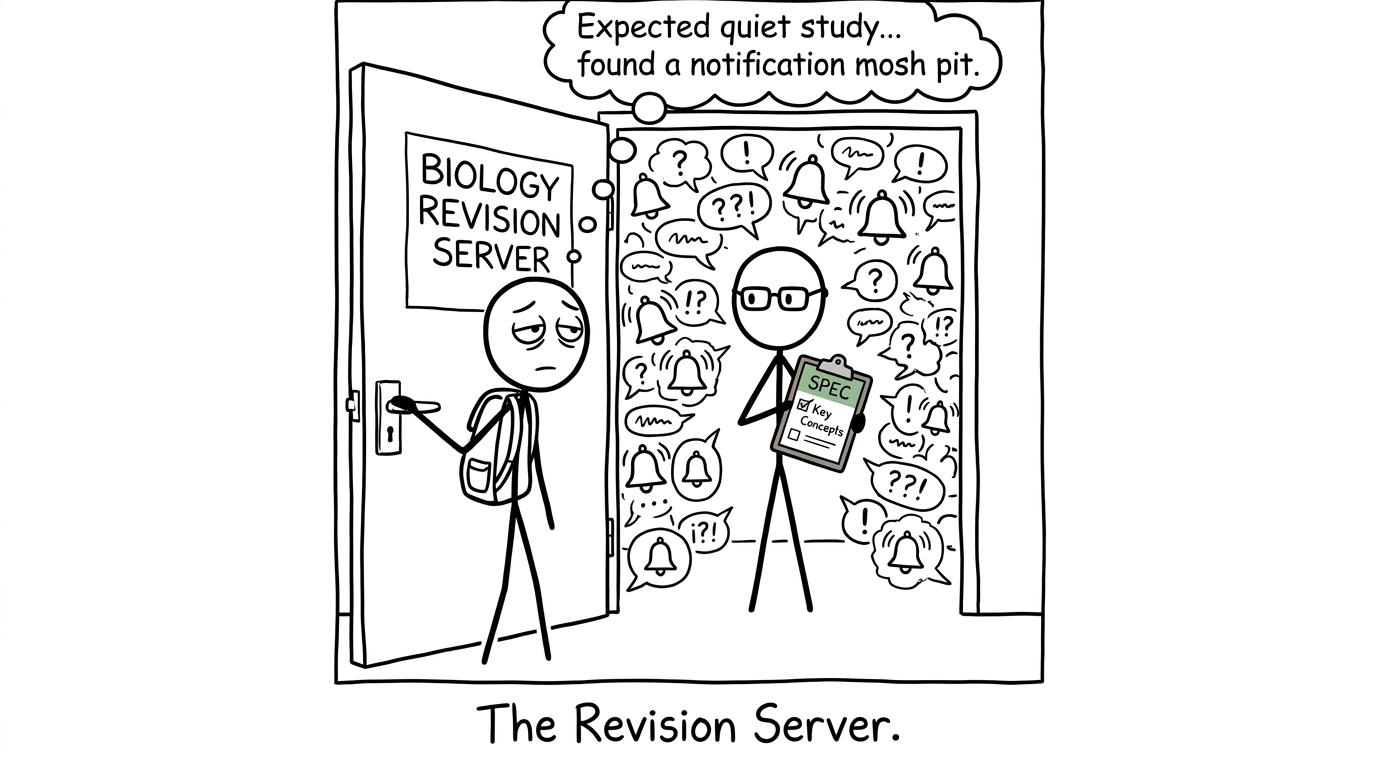 A student discovers that the biology revision server contains rather more chatter than revision
What a GCSE biology Discord server can realistically offer
Fast clarification when you are stuck
A good community can unblock a small misunderstanding. Perhaps you cannot distinguish diffusion from active transport, or you are unsure what an exam question means by “evaluate”. Another student may point you towards the relevant topic or explain which detail you have missed.
That immediacy has value. A five-minute clarification can prevent an entire revision session from stalling. However, the response should be a starting point for checking, not the final authority. Compare advice with your teacher’s guidance, your exam-board specification and an official mark scheme.
Exposure to other students’ questions
Sometimes the most useful question is one you had not thought to ask. Reading a careful discussion about control variables, genetic crosses or sampling methods can expose a gap in your own understanding.
This works particularly well when students explain why an answer is correct. A channel filled only with final answers offers much less value because recognition is not the same as recall. Reading somebody else’s response can feel fluent even when you could not produce it independently in an exam.
Accountability and a sense of company
Quiet study channels, revision check-ins and scheduled sessions can make independent revision feel less isolated. The community provides a starting signal: everyone arrives, states a goal and works for a defined period.
Yet accountability only helps when it ends in measurable work. “Revised biology” is vague. “Completed an ecology question set, marked it and corrected two errors” is useful. Maths revision benefits from the same discipline. The MathsGenie revision planner can turn good intentions into specific tasks rather than another evening spent discussing what you might revise.
Shared revision ideas
Students may exchange mnemonics, flashcard prompts, diagrams or ways to organise required practicals. These can make difficult material more memorable, provided they are accurate and appropriate for your specification.
AQA, Pearson Edexcel, OCR and Eduqas do not necessarily organise biology content and assessments in identical ways. Separate Biology and Combined Science also differ. Before saving any resource, check the exam board, qualification and tier for which it was created. A polished document can still be the wrong document.
What Discord cannot replace
Your specification and practical experience
A server may discuss microscopy or osmosis, but discussion cannot reproduce carrying out practical work, observing results and understanding why a method is designed in a particular way. Practical skills are assessed through written examinations across GCSE science qualifications. For example, AQA states that questions drawing on practical knowledge and understanding account for at least 15%15\%15% of the qualification marks.
That means revision must go beyond memorising a list of steps. You need to understand variables, hazards, measurements, uncertainty, data interpretation and possible improvements. Your teacher and the relevant specification should remain your main guides.
Exam practice under independent conditions
Discord is built for interaction. An examination is not. Eventually, you must close the chat, put away your notes and find out what you can produce alone.
This distinction matters in maths as much as biology. A useful routine is:
- learn or review one idea;
- answer questions without chat assistance;
- mark the work carefully;
- identify the exact error;
- revisit the skill later.
MathsGenie’s GCSE maths revision hub supports this cycle with revision lessons, exam questions, papers and solutions. Students can also use board-specific resources such as Edexcel GCSE maths revision or AQA GCSE maths revision, rather than relying on advice intended for a different specification.
Reliable assessment of your answer
A peer can say that an answer “looks right”, but that is not the same as applying a mark scheme. Biology marks often depend on precise scientific language, linked reasoning and the command word used. An incomplete explanation may contain correct facts but still fail to answer the question fully.
Whenever possible, compare your work with an official mark scheme and ask your teacher about responses you still do not understand. Online consensus is not evidence. Ten people can repeat the same misconception.
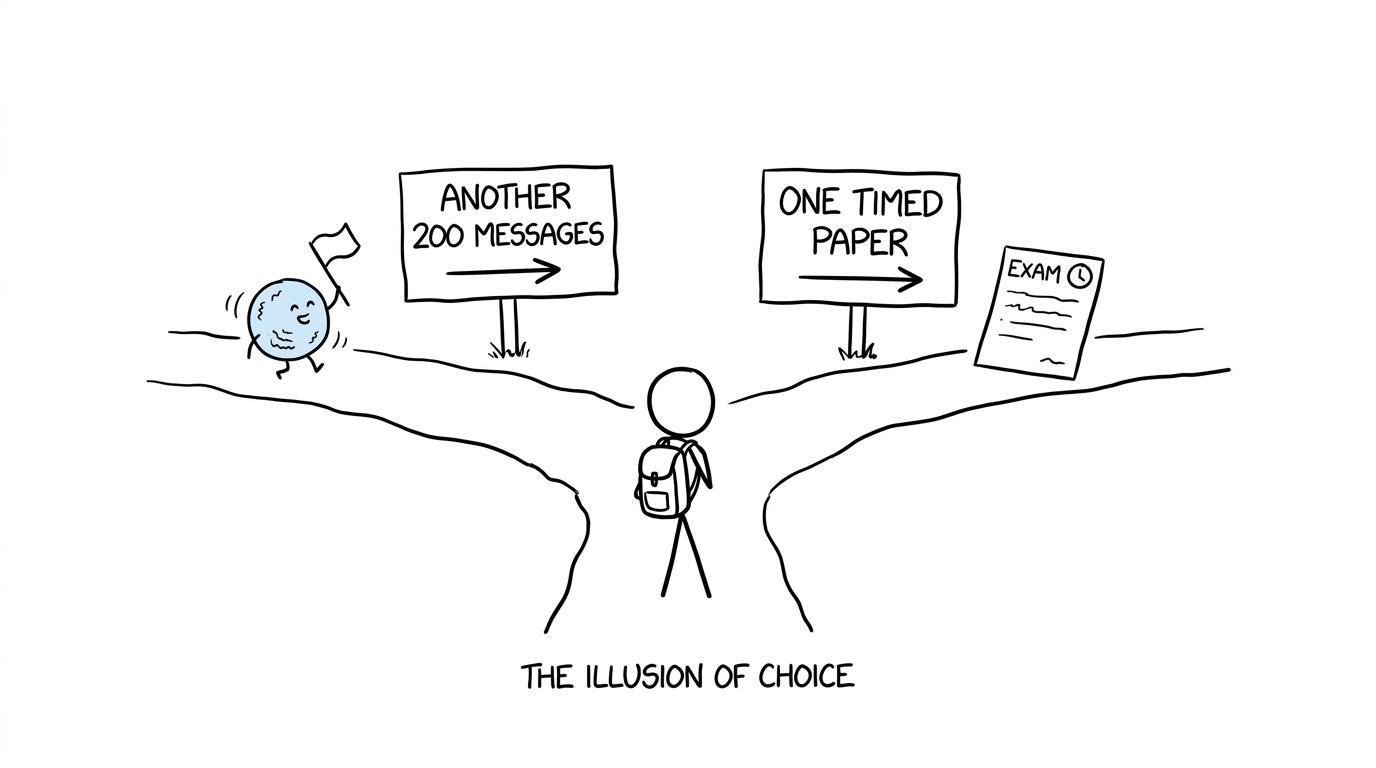 A student chooses between reading another two hundred messages and completing one timed paper
The risks of relying on an online revision community
Distraction disguised as productivity
Revision servers contain an awkward mixture of useful explanation and ordinary social conversation. Because both appear in the same app, it is easy to mistake time near revision for time spent revising.
Set a purpose before opening Discord: ask one question, join one scheduled session or check one resource. Then leave. If you routinely finish with more notifications but no completed work, the server is not supporting your revision.
For maths, shorter tasks can make this boundary easier to maintain. An Edexcel GCSE maths mini test gives you a defined piece of work to complete and mark before returning to any discussion.
Incorrect or oversimplified answers
Users may be helpful without being qualified. They can confuse separate Biology with Combined Science, mix exam boards or present a classroom shortcut as a complete scientific explanation. Confident wording can make weak advice appear trustworthy.
Use a simple verification ladder:
- check the qualification and exam board;
- locate the relevant specification statement;
- compare with an official mark scheme or trusted school resource;
- ask a teacher if uncertainty remains.
Be especially cautious with downloadable “complete notes” whose author, date and specification are unclear.
Privacy and unwanted contact
Discord does provide safety tools, including content filters, message requests, blocking and reporting. UK users also receive teen-appropriate default protections, with age assurance used for access to age-restricted features. These measures reduce risk, but they do not remove it.
Discord does not permit accounts for children under 131313, and students should also follow family and school rules. Do not reveal your full name, school, timetable, location, email address or examination centre. Keep direct messages restricted, be wary of unexpected files and links, and tell a trusted adult about threatening, sexual or manipulative contact.
A legitimate helper does not need private information to explain homeostasis.
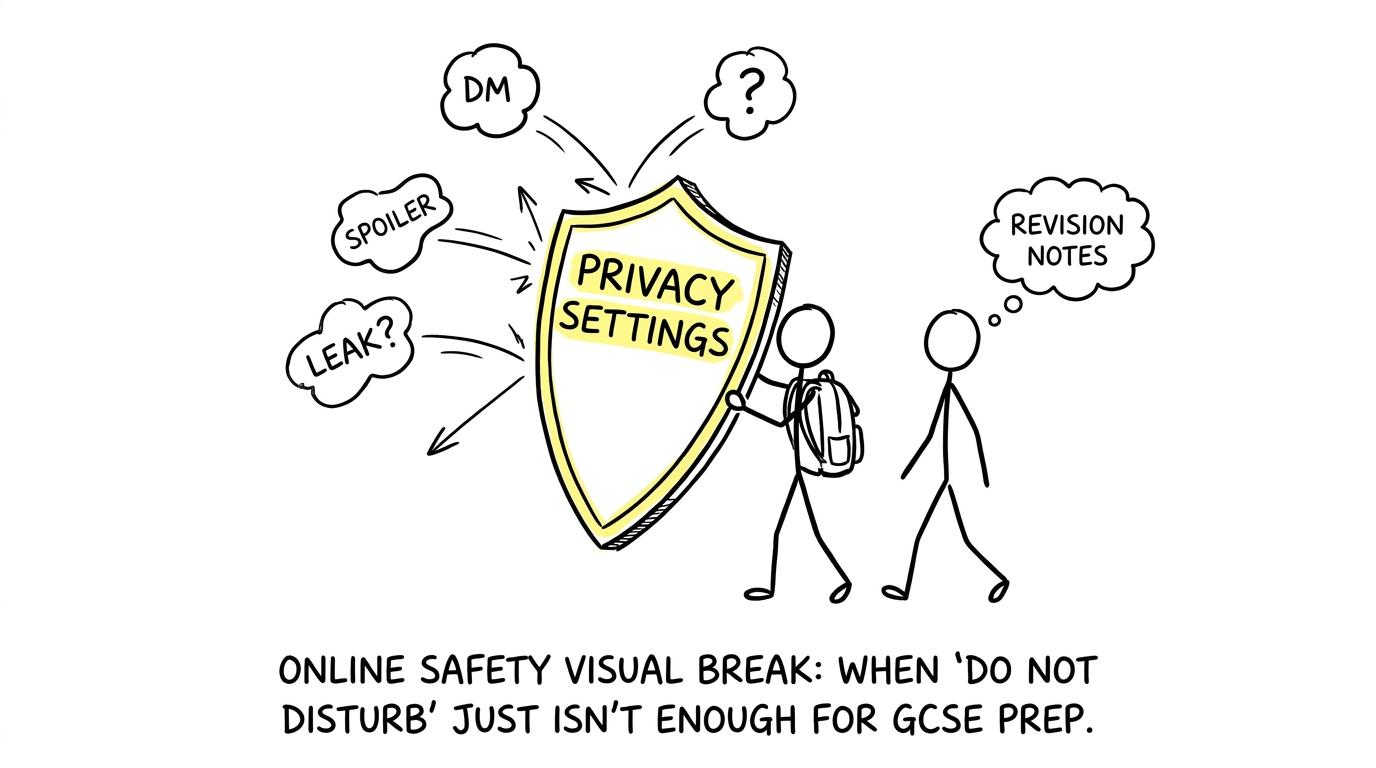 A student uses privacy settings to defend revision notes from suspicious messages and supposed leaks
Exam leaks, rumours and malpractice
Avoid channels claiming to sell, trade or reveal live examination content. The Joint Council for Qualifications tells candidates not to buy, request or share assessment content, pass on rumours about examinations, or circulate their work where independent assessment rules apply. Receiving supposedly confidential material should be reported to a teacher.
The material may be fake. That does not make engaging with it harmless. Current JCQ malpractice guidance covers the online exchange and circulation of real or fake assessment material, with possible sanctions depending on the circumstances. Leave the conversation, do not forward anything and speak to your school.
Predicted papers are different when they are openly created as revision resources rather than presented as leaked content. Even then, predictions should supplement broad preparation, not narrow it. MathsGenie explains this distinction in its guide to GCSE predicted topics and sensible revision.
How to use a subject server without letting it use you
Treat Discord as one small stage in a larger revision loop.
Arrive with a precise question
“Can someone help with cells?” is likely to produce scattered replies. State the concept, your exam board, what you currently think and the precise point of confusion. Do not post personal details or restricted assessment work.
Trying first matters. It reveals where your reasoning breaks and makes any explanation easier to evaluate.
Verify, then convert the answer into practice
After receiving help, close the conversation and answer a fresh question independently. If you cannot apply the idea without looking back, the gap is not yet fixed.
This is also why past-paper review matters in maths. The guide to when to start GCSE past papers explains how topic practice, timed work and mark-scheme review can fit together. Conversation may clarify a method, but independent questions make it reliable.
Limit notifications and measure output
Mute channels that are not directly useful. Avoid keeping Discord open beside your work, because every message creates another decision about whether to look.
Measure the session by outputs: questions answered, errors corrected, facts retrieved and topics retested. A structured plan such as the GCSE one-month maths revision plan can help protect time across subjects when biology discussions begin expanding into the evening.
Common mistakes when joining revision servers
Joining too many communities. More servers usually mean repeated resources and more notifications, not broader understanding. Choose one well-moderated community and review whether it genuinely helps.
Trusting roles or usernames automatically. A label such as “expert” or “top student” is not proof that an explanation matches your specification. Verify important claims.
Saving resources without using them. A folder full of notes creates potential, not progress. Select one resource, retrieve the content from memory and apply it to questions.
Asking for answers before attempting the task. This removes the productive struggle that shows what you understand. Attempt, identify the sticking point, then ask.
Ignoring privacy settings. Review message requests, friend requests and visible profile information before taking part. Block and report concerning behaviour rather than trying to manage it alone.
Replacing papers with chat. Community support feels easier than timed practice, which is precisely why it can take over. Keep your main revision time for active recall, exam questions, mark schemes and correction.
A community should support the work, not become the work
A GCSE biology Discord server can provide quick clarification, accountability and useful discussion. It is worth joining when moderation is strong, claims can be checked and your completed work improves. It is not worth relying on when chat replaces recall, strangers become your main source of scientific authority or rumours begin shaping what you revise.
Use the server briefly and deliberately. Then return to the quieter work that earns marks: learning the specification, completing questions independently, checking mark schemes and fixing errors.
For your maths preparation, make MathsGenie that structured home base. Start with free revision lessons and practice questions, test yourself with mini tests, and build towards past papers and predicted papers with mark schemes and video solutions. Plan the next task, complete it without the chat window open, and let the evidence on the page tell you what to do next.