GCSE Statistics Exam Dates 2026: Test Day Guide
GCSE statistics exam dates 2026 for AQA and Edexcel, plus paper times, equipment, contingency arrangements and a practical test-day checklist.
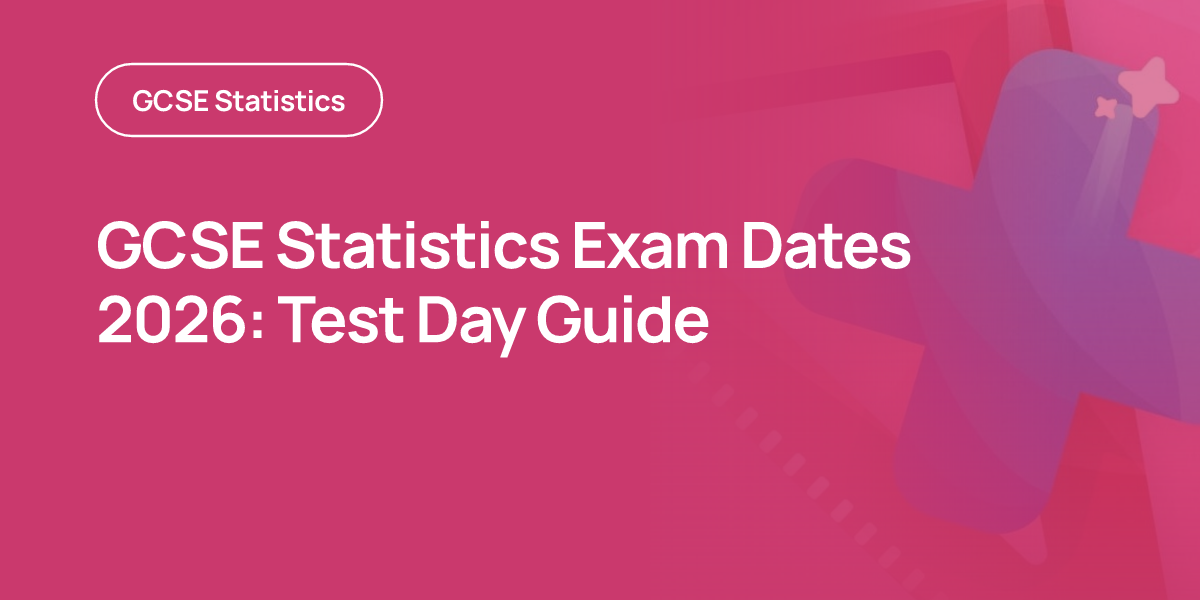
There is a particular kind of exam worry that has little to do with statistics. It comes from not knowing whether the date in your phone is correct, whether your paper is in the morning or afternoon, or whether your calculator is allowed.
Here is the essential answer. The published GCSE statistics exam dates 2026 for AQA and Pearson Edexcel are Tuesday 2 June for Paper 1 and Friday 12 June for Paper 2. Both are afternoon examinations. Your personal school timetable remains the final instruction because it contains your room, arrival time, tier and any access arrangements.
This guide covers what is on the timetable, what each paper involves, what to organise beforehand and how the day will usually unfold.
GCSE Statistics 2026 timetable at a glance
The following dates have been checked against the final summer 2026 timetables published by AQA and Pearson Edexcel.
| Exam board | Paper | Date | Session | Duration |
|---|---|---|---|---|
| AQA | Paper 1 Foundation or Higher | Tuesday 2 June 2026 | Afternoon | 111 hour 454545 minutes |
| AQA | Paper 2 Foundation or Higher | Friday 12 June 2026 | Afternoon | 111 hour 454545 minutes |
| Pearson Edexcel | Paper 1 Foundation or Higher | Tuesday 2 June 2026 | Afternoon | 111 hour 303030 minutes |
| Pearson Edexcel | Paper 2 Foundation or Higher | Friday 12 June 2026 | Afternoon | 111 hour 303030 minutes |
The relevant AQA codes are 8382/1F, 8382/1H, 8382/2F and 8382/2H. Edexcel uses 1ST0/1F, 1ST0/1H, 1ST0/2F and 1ST0/2H.
The F or H identifies your tier. Check it on your personal timetable now rather than discovering it when the question paper reaches your desk.
Published UK afternoon sessions normally begin at 1:30 pm1{:}30\text{ pm}1:30 pm, but your school may tell you to report earlier. Follow the arrival time supplied by your exams officer, not the time at which you think the paper begins.
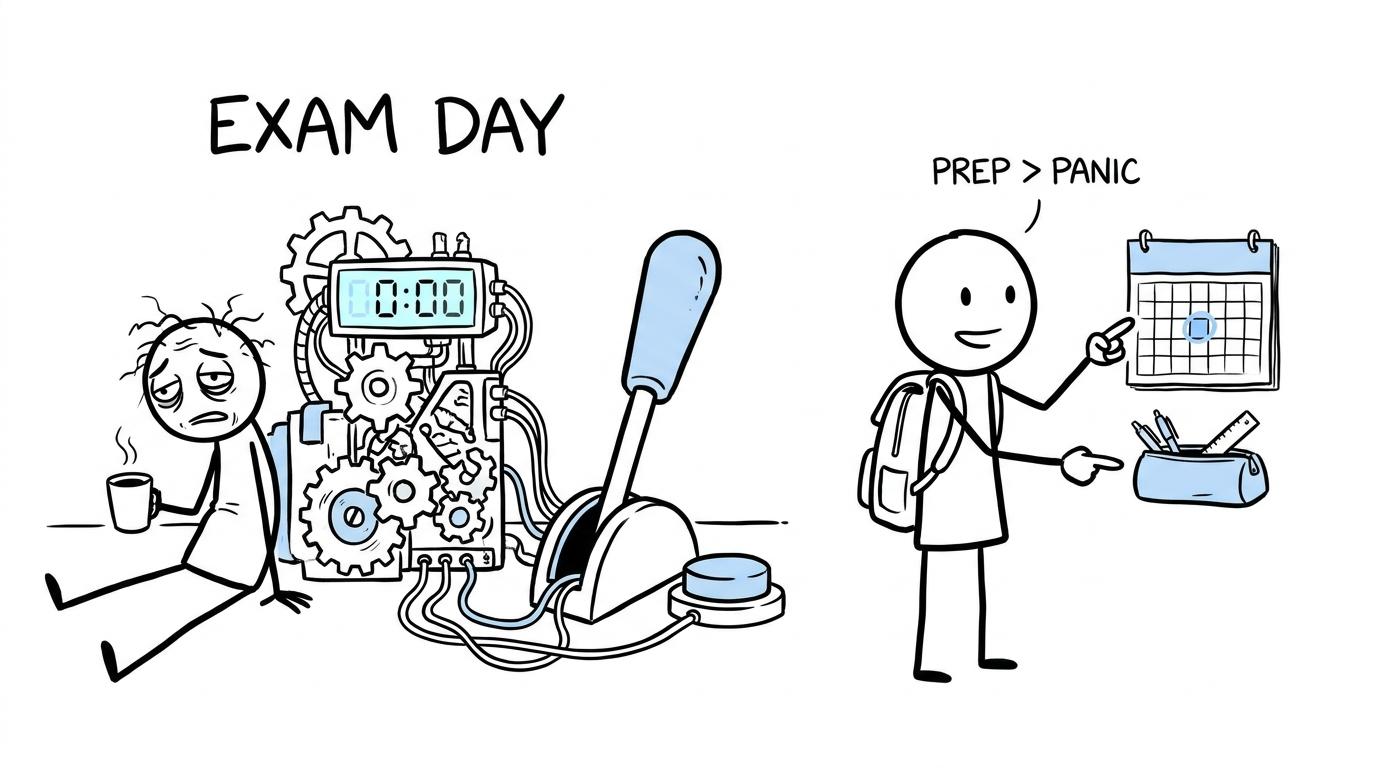 A student chooses a simple calendar and packed pencil case instead of an over-engineered exam countdown machine
Your pre-exam checklist
Before the first paper, make sure you can answer each of these questions:
- Which exam board am I taking?
- Am I entered for foundation or higher tier?
- Where is my exam room and when must I report?
- Have I kept both Tuesday 2 June and Friday 12 June free?
- Do I have an approved calculator that I know how to use?
- Are my pens, pencils and mathematical instruments in a clear pencil case?
- Have I read my school's candidate instructions?
- Are any agreed access arrangements shown correctly?
- Have I kept Wednesday 24 June 2026 available for the national contingency arrangements?
Add the dates to the MathsGenie revision planner, then plan backwards from each paper. A date becomes useful when it changes what you do this week.
What the GCSE Statistics papers involve
AQA GCSE Statistics
AQA GCSE Statistics consists of two written papers. Each lasts 111 hour 454545 minutes, carries 808080 marks and contributes 50%50\%50% of the qualification. Both papers can assess content from across the specification and include multiple-choice questions, short answers and questions connected with the statistical enquiry cycle.
Calculators are permitted. Foundation and higher candidates sit papers of the same duration, but the assessed demand and available grades differ by tier.
Pearson Edexcel GCSE Statistics
Edexcel also has two equally weighted written papers. Each lasts 111 hour 303030 minutes, carries 808080 marks and contributes 50%50\%50% of the qualification. Both papers assess content from across data collection, processing and representing data, analysis, probability and the statistical enquiry cycle.
Calculators may be used in both Edexcel papers. Do not confuse this qualification with GCSE Mathematics Paper 1, which is often described as a non-calculator paper. GCSE Statistics has its own specification and rules.
Students taking Edexcel can use the Edexcel GCSE Statistics revision centre to find specification-matched worksheets, questions and papers. If you are unsure which board you take, begin at the broader GCSE Statistics revision hub and confirm the board with your teacher.
What to revise between Paper 1 and Paper 2
The ten-day gap can look generous on a calendar. It becomes much smaller once other GCSE examinations are added. More importantly, both statistics papers can assess the full specification, so it is risky to assume that a topic appearing in Paper 1 cannot return in Paper 2.
Use the gap diagnostically:
- Write down topics that felt uncertain immediately after Paper 1, without trying to reconstruct or share secure exam content.
- Continue revising the whole specification rather than predicting Paper 2 from Paper 1.
- Complete mixed questions under time pressure.
- Mark your work and classify every lost mark as a knowledge, interpretation, calculation or communication error.
- Revisit the weakest areas before attempting another timed section.
MathsGenie's guide to finding your weakest GCSE topics explains how to turn lost marks into a focused revision list. Supporting GCSE maths resources such as the averages from frequency tables guide and cumulative frequency revision guide can strengthen overlapping skills, although your GCSE Statistics specification should remain your master checklist.
What to prepare the night before
The best exam morning is usually built the previous evening. It should feel almost boring: everything is known, packed and checked.
Put the following into a transparent pencil case:
- at least two black pens;
- pencils and an eraser for diagrams;
- a ruler and any mathematical instruments requested by your school;
- an approved calculator with a reliable power supply.
Clear anything stored in the calculator's memory and remove any lid or cover carrying printed instructions or formulae. Do not rely on a phone calculator. Phones, watches, earbuds, smart glasses, notes and other unauthorised materials must not enter the exam room.
Check your route and reporting time. Set an alarm with enough margin for an ordinary delay. Then stop revising at a sensible time. A final exhausted paper rarely adds as much as students hope; sleep protects the accuracy and attention you have already built.
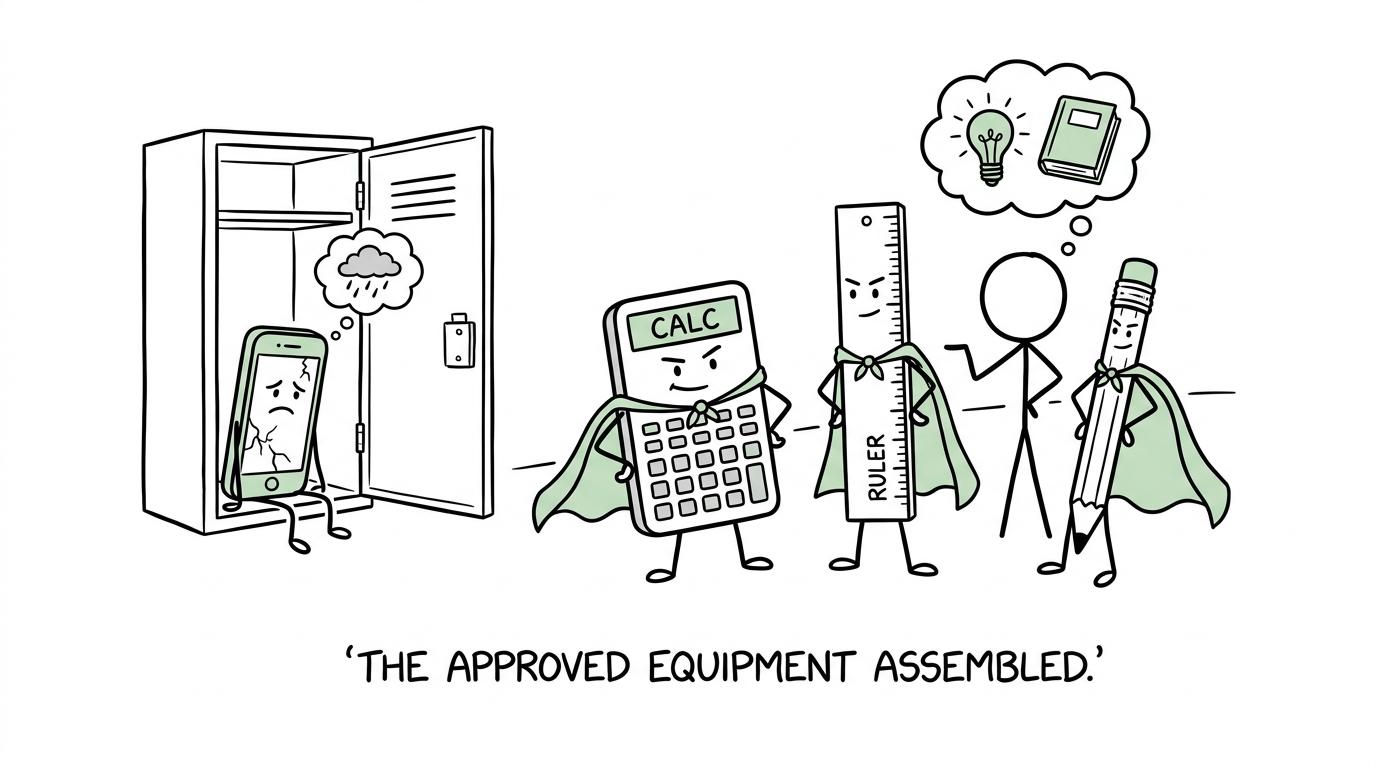 A calculator, ruler and pencil pose as an approved equipment superhero team while a mobile phone waits in a locker
How the exam day usually goes
Because both GCSE Statistics papers are scheduled for the afternoon, your morning may include lessons, supervised revision or arrangements specific to your school. Do not assume it is a normal school day. Read the instructions you receive from your exams officer.
A calm routine looks like this:
- Check the date, paper, tier and room against your personal timetable.
- Eat normally and drink enough water.
- Use the morning for brief retrieval, not an entire new topic.
- Report at the time set by your school.
- Hand in or store prohibited devices exactly as instructed.
- Enter quietly and sit in your assigned place.
- Check the board, paper code and tier on the question paper.
- Fill in your candidate details only when instructed.
- Raise your hand if the paper, equipment or printed details appear wrong.
Once the examination starts, read each question carefully and show enough working to communicate your statistical reasoning. Questions may ask you to interpret information, assess a method or justify a conclusion rather than merely calculate a value. Units, context and the limitations of data matter.
If you feel unwell, need additional paper or think something is wrong, raise your hand. Do not try to solve an administrative problem silently.
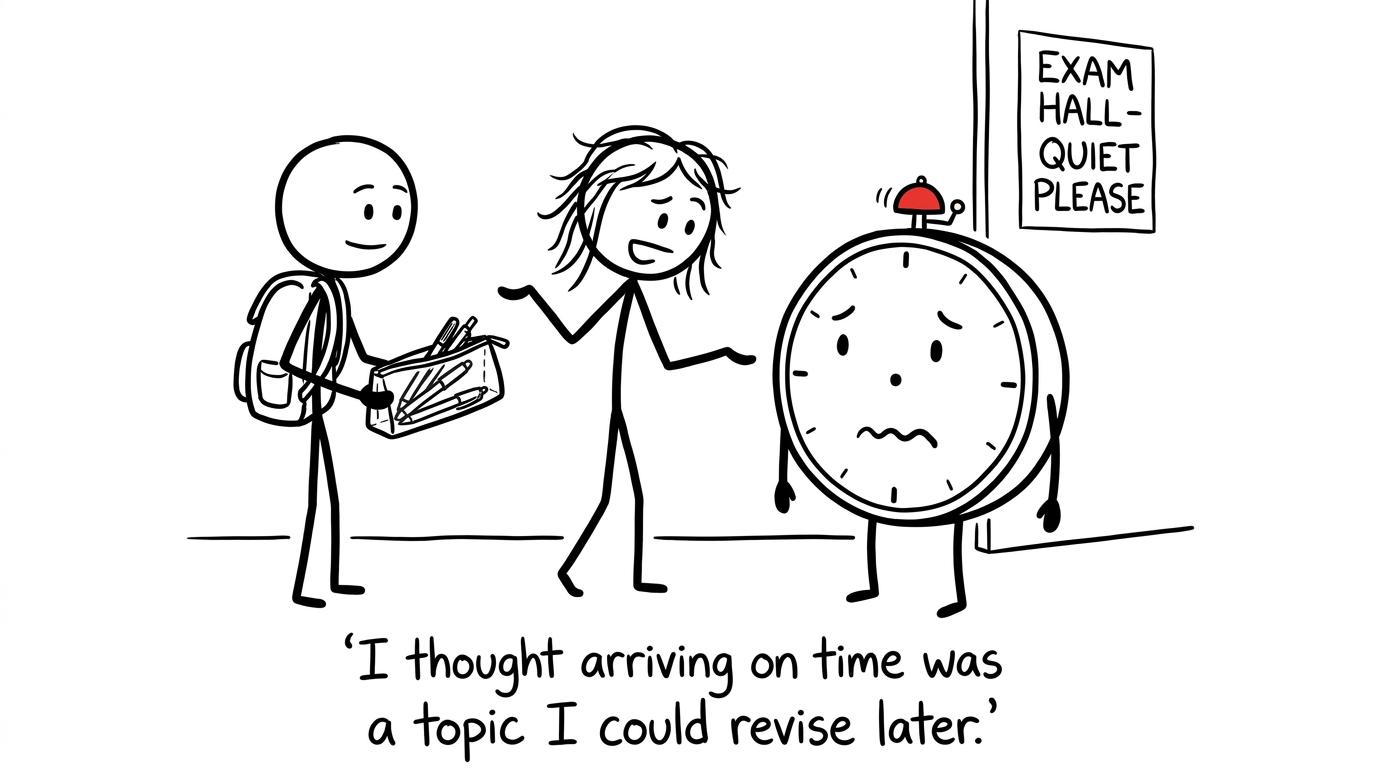 A student negotiates with a giant alarm clock outside an exam hall while another arrives calmly with a clear pencil case
The 2026 contingency day
Students must remain available for Wednesday 24 June 2026. This is the summer series contingency day, reserved for the unlikely event that an examination has to be moved because it cannot take place as planned nationally or because of significant disruption.
It is not a spare date for an individual examination you choose to miss. Keep it free until your school confirms that you no longer need to remain available. If an exam is affected, your school or college will explain what happens next.
Common mistakes before and during the exam
Confusing GCSE Mathematics with GCSE Statistics
The subjects have different paper codes, durations and calculator arrangements. Check that every practice paper and timetable entry says Statistics, not simply Mathematics.
Looking only at the national timetable
The national timetable gives the date and session. It does not tell you your seat, room, reporting time or access arrangements. Your personal timetable supplies those details.
Bringing a watch or phone into the room
Under the current candidate rules, watches and phones are unauthorised. Possession can cause serious penalties even when you did not intend to use the item. Follow your school's storage procedure.
Practising only calculations
GCSE Statistics tests interpretation, evaluation and communication as well as numerical methods. Use mark schemes to notice where conclusions need context, where a sampling method must be criticised and where a graph alone is insufficient.
Treating Paper 1 as a topic forecast
Both AQA and Edexcel can assess content across the specification in both papers. Paper 2 revision should not be based on guessing what will not reappear.
Chasing an old grade boundary
Grade boundaries can change between exam series and are set after the papers have been taken and marked. The GCSE Statistics grade boundaries guide is useful for historical context, but your revision should focus on improving raw marks rather than predicting the 2026 thresholds.
Turn the dates into a plan
An exam date can feel like a threat when it is only sitting on a calendar. Turn it into a sequence of actions and it becomes something else: a deadline with a route towards it.
Confirm your board and tier today. Use the free MathsGenie GCSE Statistics hub for revision lessons, practice questions and worksheets. Build towards mini tests and timed past papers, then study the mark schemes and video solutions carefully. Where available, use predicted papers as fresh timed practice rather than as a promise about what will appear.
Start with one paper, find the marks that are leaking away, and repair those topics one at a time. By Tuesday 2 June, the aim is not to feel certain about every possible question. It is to arrive with the right equipment, the correct information and a revision process you can trust.