GCSE Statistics Exam Conditions Practice at Home
GCSE statistics exam conditions practice: build a realistic timed session at home, choose the right paper, remove distractions and review every lost mark.
The hardest part of a practice paper is not always the statistics. It is discovering that the doorbell rings, your phone lights up and somebody asks whether you want a cup of tea just as you begin a long question.
Effective GCSE statistics exam conditions practice removes those interruptions before the timer starts. Choose an unseen paper for your exam board and tier, use its official time limit, allow only the permitted equipment, work without notes or pauses, and mark it afterwards. That is the short answer. The deeper benefit is that you learn how your statistical knowledge behaves under pressure.
A quiet home is not an exam hall. It does not need to be. It only needs to reproduce the decisions that matter: what to attempt first, when to move on, how carefully to interpret data and how to recover when a question feels unfamiliar.
Your realistic practice checklist
Before sitting down, confirm that you have:
- the correct GCSE Statistics exam board and foundation or higher tier paper
- an unseen question paper without annotations
- the time stated on that paper or in the current specification
- the equipment permitted for that particular assessment
- a quiet desk, firm finishing time and clock visible at a distance
- no notes, mark scheme, internet access or help
- a plan for marking and reviewing the paper afterwards
Start at the GCSE Statistics revision hub to select the correct board. Edexcel students can use the dedicated Edexcel GCSE Statistics resources, which bring together lessons, questions, worksheets and past papers.
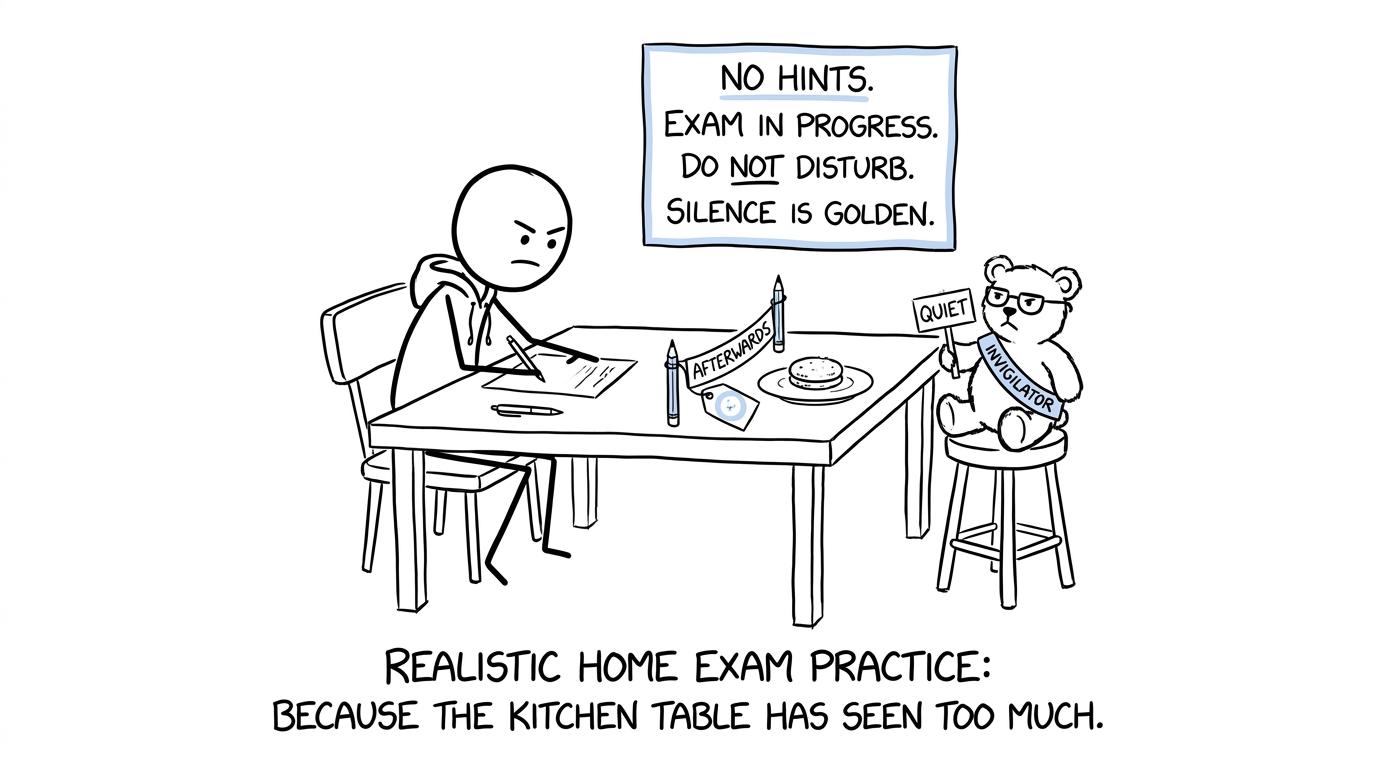 A student turns a kitchen table into a serious home exam hall
Choose a paper that matches your real assessment
A paper is only a realistic simulation if it resembles the qualification you will sit. Check the front cover carefully for the subject, exam board, paper number, tier, permitted equipment, total marks and time allowance.
Do not assume every GCSE Statistics paper has the same duration. Current formats differ between specifications. For example, AQA GCSE Statistics papers are listed as 111 hour 454545 minutes and 808080 marks each, while Pearson Edexcel GCSE Statistics materials use their own stated timings. The safest rule is simple: follow the instructions printed on your chosen paper and confirm the current arrangement with your teacher or official specification.
Use an unseen paper where possible. If you remember several answers, it can still support topic revision, but it will no longer measure genuine recall or decision-making. Save some recent papers for full simulations and use older questions for ordinary practice. MathsGenie's guide to when to start GCSE past papers explains how to progress from short sections to complete timed attempts.
Past papers, predicted papers and mini tests serve different purposes
A past paper gives the closest available picture of established exam style. A predicted paper offers fresh, exam-style practice but cannot guarantee what will appear. A mini test is useful for building speed or checking one area, although it does not reproduce the stamina required by a full paper.
Build towards realism:
- begin with short, timed sets when several topics remain insecure
- move to half-papers when you can sustain concentration
- complete full unseen papers in the final stage of revision
- use predicted papers for additional unfamiliar practice, not as a replacement for specification coverage
If a complete paper currently feels too large, GCSE maths mini tests can help develop the habit of working against a fixed clock before you attempt a full Statistics assessment.
Prepare the room before the clock starts
Clear the desk completely, then return only what the paper permits. This will usually mean black pens, pencils for diagrams, a ruler, an eraser and an appropriate calculator where allowed. Check the calculator battery, settings and display beforehand. Do not use a phone calculator.
Current JCQ exam guidance treats phones, watches, earbuds and other smart devices as unauthorised items in real examinations. At home, place them in another room rather than merely turning them face down. Use a wall clock or a simple timer positioned beyond easy reach. Your school will explain the exact rules that apply on the real day.
Also prepare the ordinary details:
- sit at a table rather than on a bed or sofa
- use a supportive chair
- tell other people when the session will finish
- put pets elsewhere if they are likely to interrupt
- use a clear, unlabelled water bottle if you want to copy exam-room habits
- visit the toilet before starting
The aim is not theatrical severity. It is fewer negotiations with yourself once the paper begins.
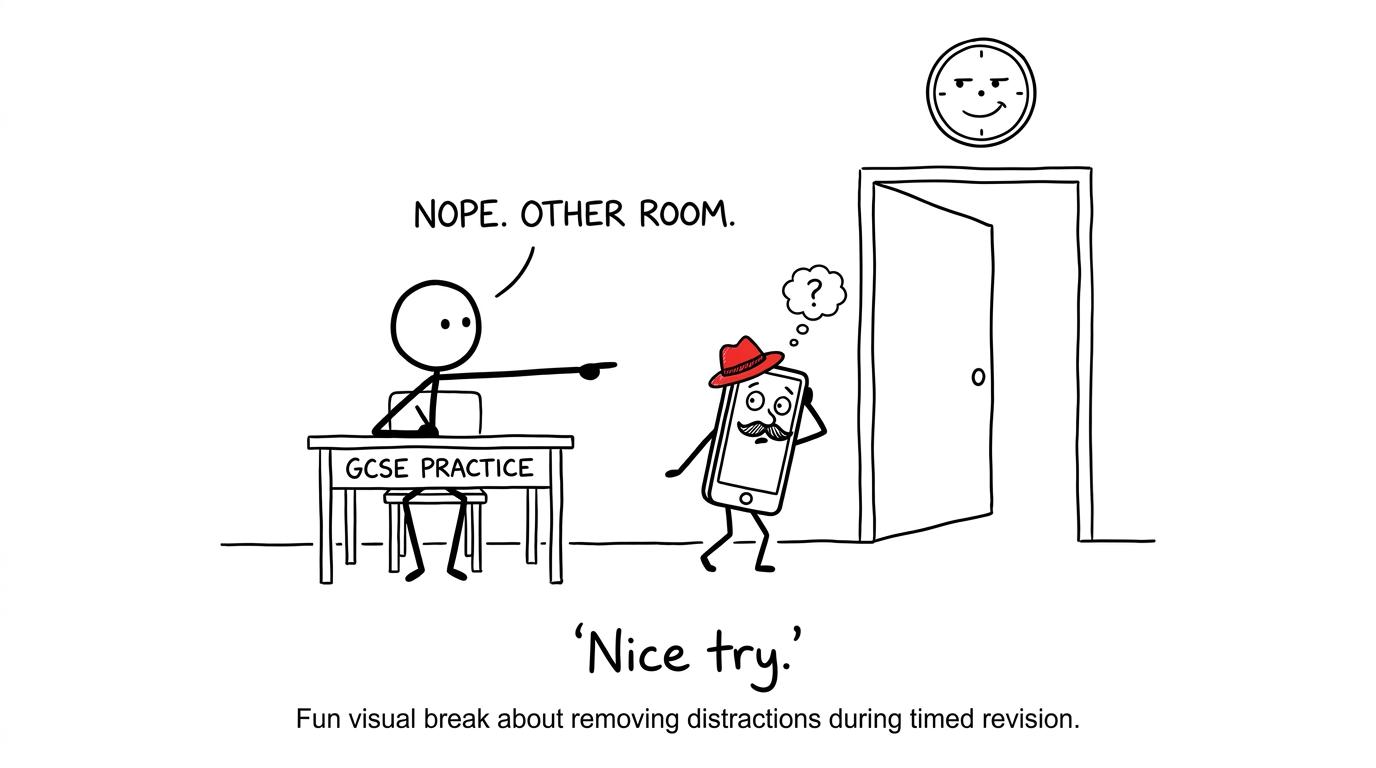 A disguised phone is sent away from the practice desk
Reproduce the rules, not just the timer
Set the full time and begin only when the paper, equipment and room are ready. From that point:
- do not pause the timer
- do not check notes, videos or answers
- do not ask somebody to explain a word or method
- do not search online
- do not listen to music or use headphones
- continue through difficult moments rather than ending early
If a question stops you, mark it visibly, move forward and return later. This is not avoiding the problem. It is managing a limited resource.
A simple measure of pace is
average time per mark=paper time in minutestotal available marks.\text{average time per mark}=\frac{\text{paper time in minutes}}{\text{total available marks}}.average time per mark=total available markspaper time in minutes.Treat this as a broad guide, not a rule for every question. Reading, drawing graphs and evaluating conclusions may take longer than short calculations. Reserve time at the end to inspect skipped questions, labels, scales, rounding and written conclusions.
Use the conditions you will actually receive
If your school has approved access arrangements, practise with them. That may include extra time, supervised rest breaks or another formal adjustment. Do not remove an approved arrangement to make a session feel tougher; realism means rehearsing the conditions that apply to you. Ask your school's examinations officer or teacher if you are uncertain.
For extra time of p%p\%p%, the adjusted duration can be represented by
adjusted time=standard time(1+p100).\text{adjusted time}=\text{standard time}\left(1+\frac{p}{100}\right).adjusted time=standard time(1+100p).Use only the percentage or arrangement formally confirmed for your examinations.
Practise the thinking GCSE Statistics demands
Timed practice should test more than calculator speed. GCSE Statistics includes selecting methods, interpreting representations, evaluating evidence and communicating conclusions within context. Questions may draw on the statistical enquiry cycle, sampling, averages, measures of spread, probability, correlation and data presentation.
During the paper, read command words precisely. Calculate requires a numerical process. Compare needs statements about both distributions or data sets. Interpret asks what a result means in context. Evaluate requires a reasoned judgement about evidence, method or conclusion.
Show the important stages of your method even when using a calculator. For graphical work, check axes, scales, labels and plotted values. In a histogram, frequency is represented by bar area rather than height alone. If this is a weak point, revisit the histograms revision guide. For running totals, quartiles and medians from grouped data, use the cumulative frequency revision guide.
Do not abandon written questions because they appear less mathematical. A correct calculation followed by an unsupported or out-of-context conclusion can still lose marks. Statistics is partly about deciding what the numbers permit you to say.
Mark the paper without protecting your score
Take a short break after the timer ends, then mark with the official mark scheme. Do not award a mark because your answer was “basically” correct. Look for the required method, accuracy, units, context and conclusion.
Record three figures:
raw score=marks awarded,\text{raw score}=\text{marks awarded},raw score=marks awarded, percentage score=marks awardedmarks available×100%,\text{percentage score}=\frac{\text{marks awarded}}{\text{marks available}}\times 100\%,percentage score=marks availablemarks awarded×100%,and the number of questions affected by time pressure.
Do not attach a grade using a boundary from an unrelated series. Grade boundaries can change after papers have been taken. The score is most useful as evidence of what to fix, not as a prediction carved in stone.
For every lost mark, assign one cause:
- knowledge: the fact, method or concept was missing
- interpretation: the data or command word was misunderstood
- execution: the method was known but applied inaccurately
- communication: working, units or contextual reasoning were incomplete
- timing: the question was rushed or not reached
MathsGenie's guide to finding your weakest GCSE topics provides a practical way to turn this evidence into a focused revision list.
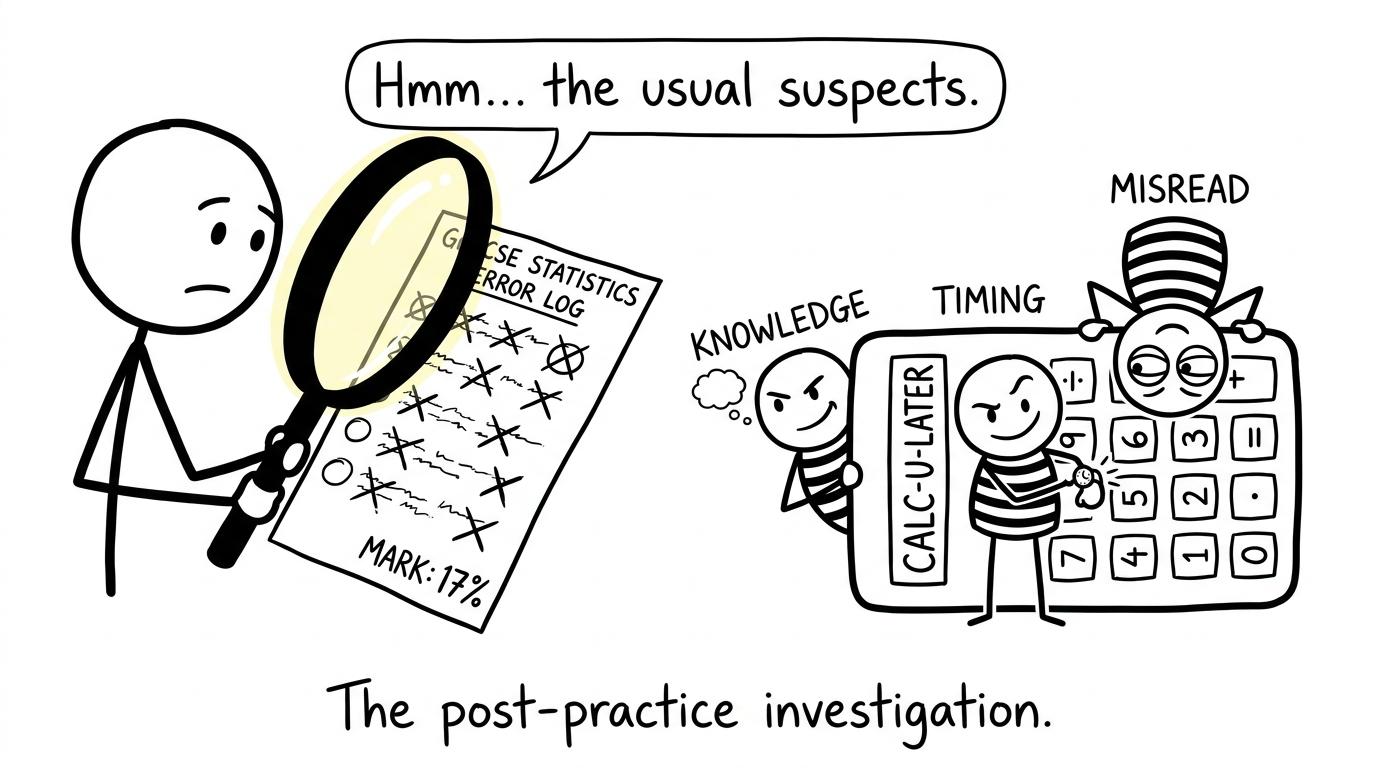 A student investigates lost marks like a detective
Turn one mock into the next revision cycle
The paper is not finished when it is marked. Choose the two or three weaknesses that cost the most marks. Use a revision lesson to rebuild the idea, complete practice questions without notes, check the mark scheme or video solution, then attempt a different question on the same skill.
Revisit the original question later without looking at your correction. If you can now solve it independently, the mistake has become useful. If not, the gap needs another cycle.
Schedule the next simulation using the free MathsGenie revision planner. Leave enough time between full papers to repair what the previous one exposed. Repeated testing without correction merely measures the same weaknesses again.
Common mistakes when practising exam conditions
Starting before checking the paper
Students sometimes discover halfway through that they chose the wrong tier, paper or time limit. Verify every detail first.
Keeping a phone beside the desk
A silent phone still divides attention and does not reproduce current exam conditions. Put it in another room.
Pausing whenever a question becomes uncomfortable
The uncomfortable minute is part of the practice. Mark the question, move on and return later while the clock continues.
Looking at the mark scheme too soon
One quick hint changes the session from assessment into supported practice. Both are valuable, but they answer different questions.
Recording only the final score
A score tells you how the paper went. An error log tells you what to do next. Record causes, not just question numbers.
Completing too many full papers
Full simulations require concentration and careful review. Quality matters more than collecting finished papers. Alternate them with focused lessons, practice questions and mini tests.
Make the real room feel familiar
A realistic home session will never reproduce the invigilator, rows of desks or sound of pages turning. It can reproduce something more important: your routine.
Choose the correct paper. Clear the desk. Start on time. Keep going when a question feels awkward. Then mark honestly and repair the largest leaks before repeating the process.
MathsGenie gives you the free structure to do this well. Begin at the GCSE Statistics revision hub, strengthen weak areas with revision lessons and practice questions, and test them through past papers, predicted papers and mini tests. Use the mark schemes and video solutions to understand every lost mark. Then put the answers away, reset the clock and try again under conditions that count.